Question 511 Mark
A random variable X has the following probability distribution:
| X: |
1 |
2 |
3 |
4 |
5 |
6 |
7 |
8 |
| P(X): |
0.15 |
0.23 |
0.12 |
0.10 |
0.20 |
0.08 |
0.07 |
0.05 |
Find the events E = {X : X is a prime number}, F{X : X < 4}, the probability $\text{P}(\text{E}\cup\text{F})$ is: Answer
- 0.77
Solution:
P(E) = P(2) + P(3) + P(5) + P(7)
P(E) = 0.23 + 0.12 + 0.20 + 0.07
P(E) = 0.62
And
P(F) = P(1) + P(2) + P(3)
P(F) = 0.15 + 0.23 + 0.12
P(F) = 0.5
Also,
$\text{P}(\text{E}\cap\text{F})=\text{P}(2)+\text{P}(3)$
$\text{P}(\text{E}\cap\text{F})=0.23+0.12$
$\text{P}(\text{E}\cap\text{F})=0.35$
$\text{P}(\text{E}\cup\text{F})=\text{P}(\text{E})+\text{P(F)}-\text{P}(\text{E}\cap\text{F})$
$\text{P}(\text{E}\cup\text{F})=0.62+0.5-0.35$
$\text{P}(\text{E}\cup\text{F})=0.77$ View full question & answer→Question 521 Mark
In each of the following, choose the correct answer:
The probability that a student is not a swimmer is $\frac{1}{5}.$ Then the probability that out of five students, four are swimmers is
AnswerThe repeated selection of students who are swimmers are Bernoulli trials. Let X denote the number of students, out of 5 students, who are swimmers.
Probability of students who are not swimmers, $\text{q}=\frac{1}{5}$
$\therefore\text{p}=1-\text{q}=1-\frac{1}{5}=\frac{4}{5}$
Clearly, X has a binomial distribution with n = 5 and $\text{p}=\frac{1}{5}$
$\text{P}(\text{X=x})=\ ^\text{n}\text{C}_\text{x}\text{q}^\text{n-x}\text{p}^\text{x}=\ ^5\text{C}_\text{x}\bigg(\frac{1}{5}\bigg)^{5-\text{x}}.\bigg(\frac{4}{5}\bigg)^\text{x}$
P(four students are swimmers) = P(X = 4) $=\ ^5\text{C}_4\bigg(\frac{1}{5}\bigg).\bigg(\frac{4}{5}\bigg)^4$
Therefore, the correct answer is A.
View full question & answer→Question 531 Mark
Out of 30 consecutive integers, 2 are chosen at random. The probability that their sum is odd, is
Answer
- $\frac{15}{29}$
Solution:
For sum of two integers to be odd, one integer should be even and the other should be odd. In 30 consecutive integers, 15 are even and 15 are odd.
P(Sum is odd) = P(first integer is odd and second is even) + P(first integer is even and second integer is odd)
$=\frac{15}{30}\times\frac{15}{29}+\frac{15}{30}\times\frac{15}{29}$
$=\frac{450}{30\times29}$
$=\frac{15}{29}$ View full question & answer→Question 541 Mark
A coin is tossed 10 times. The probability of getting exactly six heads is:
Answer
- $\frac{105}{512}$
Solution:
$\text{n}=10,\text{x}=6,\text{p = q}=\frac{1}{2}$
$\text{P(X}=6)=\text{ }^{10}\text{C}_6\big(\frac{1}{2}\big)^{10}=\frac{105}{512}$ View full question & answer→Question 551 Mark
Two events A and B will be independent, if
AnswerTwo events A and B are said to be independent, if $\text{P}(\text{AB})=\text{P}(\text{A})\times\text{P}(\text{B})$Distracter Rationale.
- Let P(A) = m, P(B) = n, 0 < m, n < 1
A and B are mutually exclusive.
$\therefore\text{A}\cap\text{B}=\phi$
$\Rightarrow\text{P}(\text{AB})=0$
$\text{However,}\ \text{P}(\text{A})\cdot\text{P}(\text{B})=mn\neq0$
$\therefore\text{P}(\text{A}).\text{P}(\text{B})\neq\text{P}(\text{AB})$
- Consider the result given in alternative.
$\text{P}(\text{A}'\text{B}')=\big[1-\text{P}(\text{A})\big]\big[1-\text{P}(\text{B})\big]$
$\Rightarrow\text{P}(\text{A}'\cap\text{B}')=1-\text{P}(\text{A})-\text{P}(\text{B})+\text{P}(\text{A}).\text{P}(\text{B})$
$\Rightarrow1-\text{P}(\text{A}\cup\text{B})=1-\text{P}(\text{A})-\text{P}(\text{B})+\text{P}(\text{A}).\text{P}(\text{B})$
$\Rightarrow\text{P}(\text{A}\cup\text{B})=\text{P}(\text{A})+\text{P}(\text{B})-\text{P}(\text{A})\cdot\text{P}(\text{B})$
$ \Rightarrow\text{P}(\text{A})+\text{P}(\text{B})-\text{P}(\text{AB})=\text{P}(\text{A})+\text{P}(\text{B})-\text{P}(\text{A}).\text{P}(\text{B})$
$\Rightarrow\text{P}(\text{AB})=\text{P}(\text{A}).\text{P}(\text{B})$
This implies that A and B are independent, if $\text{P}(\text{A}'\text{B}')=\big[1-\text{P}(\text{A})\big]\big[1-\text{P}(\text{B})\big]$
- Let A: Event of getting an odd number on throw of a die = {1, 3, 5}
$\Rightarrow\text{P}(\text{A})=\frac{3}{6}=\frac{1}{2}$
B: Event of getting an even number on throw of a die = {2, 4, 6}
$\text{P}(\text{B})=\frac{3}{6}=\frac{1}{2}$
Here, $\text{A}\cap\text{B}=\phi$
$\therefore\text{P}(\text{AB})=0 $
$\text{P}(\text{A}).\text{P}(\text{B})=\frac{1}{4}\neq0$
$ \Rightarrow\text{P}(\text{A}).\text{P}(\text{B})\neq\text{P}(\text{AB})$
- From the above example, it can be seen that,
$\text{P}(\text{A})+\text{P}(\text{B})=\frac{1}{2}+\frac{1}{2}=1$
However, it cannot be inferred that A and B are independent.
Thus, the correct answer is B. View full question & answer→Question 561 Mark
Choose the correct answer from the given four options.
The probability distribution of a discrete random variable X is given below:
| $\text{X}$ |
$2$ |
$3$ |
$4$ |
$5$ |
| $\text{P}(\text{X})$ |
$\frac{5}{\text{k}}$ |
$\frac{7}{\text{k}}$ |
$\frac{9}{\text{k}}$ |
$\frac{11}{\text{k}}$ |
The value of k is: Answer
- 32.
Solution:
We know that, $\sum\text{P}\text{X}=1$
$\Rightarrow\frac{5}{\text{k}}+\frac{7}{\text{k}}+\frac{9}{\text{k}}+\frac{11}{\text{k}}=1$
$\Rightarrow\frac{32}{\text{k}}=1$
$\therefore\text{k}=32$ View full question & answer→Question 571 Mark
Choose the correct answer from the given four options.
A flashlight has 8 batteries out of which 3 are dead. If two batteries are selected without replacement and tested, the probability that both are dead is:
Answer
- $\frac{3}{28}$
Solution:
Required probability $=\text{P}_{\text{D}}\cdot\text{P}_{\text{D}}$
$=\frac{3}{8}\cdot\frac{2}{7}=\frac{3}{28}$ View full question & answer→Question 581 Mark
10 persons are seated around a round table. What is the probability that 4 particular persons are always seated together?
Answer
- $\frac{1}{21}$
Solution:
10 persons can sit around a table in 9! ways.
Consider the particular four persons as one unit.
Now, the entities are 6 + 1 = 7
These 7 entities can be arranged in 6! ways.
In the entities itself they can be arranged in 4! ways.
The required number of arrangements = 6!4!
Probability $= \text{nm} = \frac{!6!4}{9!} = \frac1{21}$ View full question & answer→Question 591 Mark
If X is a binomial variate with parameters n and p, where 0 < p < 1 such that $\frac{\text{P(X = r)}}{\text{P(X = n - r})}$ is independent of n and r, then p equals:
Answer
- $\frac{1}{2}$
Solution:
Consider,
$\text{P(X = r})=\text{kP(X = n}-\text{r})$
Using $\text{ }^{\text{n}}\text{C}_{\text{r}}=\text{ }^{\text{n}}\text{C}_{\text{n}-\text{r}},\text{q}=1-\text{p}$
$\text{p}^{\text{r}}\text{q}^{\text{n}-\text{r}}=\text{kp}^{\text{n}-\text{r}}\text{q}^{\text{r}}$
$\text{p}^{\text{r}}(1-\text{p})^{\text{n}-\text{r}}=\text{kp}^{\text{n}-\text{r}}(1-\text{p})^{\text{r}}$
$\text{P}^{2\text{r}-\text{n}}=\text{k}(1-\text{p})^{2\text{r}-\text{n}}$
$\big(\frac{\text{p}}{\text{q}}\big)^{2\text{r}-\text{n}}=\text{k}$
when $\text{p = q}$ then $\text{k}=1$
$\Rightarrow\text{p = q}=\frac{1}{2}$ View full question & answer→Question 601 Mark
Let $X$ be a discrete random variable. Then the variance of $X$ is$:$
AnswerSince, the variance of a discrete random variable $X$ is given by$:$
Var$(X) = E(X^2) - (E(X))^2$
Hence, the correct alternative is option $(c).$
View full question & answer→Question 611 Mark
The least number of times a fair coin must be tossed so that the probability of getting at least one head is at least 0.8, is:
Answer
- 3
Solution:
A fair coin is tossed $\Rightarrow\text{p = q}=\frac{1}{2}$
$\text{P(X}\geq1)\geq0.8$
$\Rightarrow1-\text{P}(0)\geq0.8$
$\Rightarrow\text{P}(0)=0.2$
$\Rightarrow\big(\frac{1}{2}\big)^{\text{n}}=0.2$
$\Rightarrow2^{-\text{n}}=0.2$
$\Rightarrow2^{\text{n}}\geq5$
$\Rightarrow\text{n}\geq3$ View full question & answer→Question 621 Mark
$\int\limits^1_0\sqrt{\text{x}(1-\text{x})}\text{ dx}$ equals:
Answer
- $\frac{\pi}{8}$
Solution:
$\text{I}=\int\limits^1_0\sqrt{\text{x}(1-\text{x})}\text{ dx} $
$\text{I}= \int\limits^1_0\sqrt{\text{x}-\text{x}^2}\text{dx}$
$\text{I}=\int\limits^1_0\sqrt{\frac{1}{4}+\text{x}-\text{x}^2+\frac{1}{4}}\text{dx}$
$\text{I}=\int\limits^1_0\sqrt{\frac{1}{4}-\Big(\text{x}^2-\text{x}+\frac{1}{4}\Big)}\text{dx}$
$\text{I}=\int\limits^1_0\sqrt{\Big(\frac{1}{2}\Big)^2-\Big(\text{x}-\frac{1}{2}\Big)^2}\text{dx}$
$\text{I}=\Bigg[\frac{\text{x}-\frac{1}{2}}{2}\sqrt{\text{x}(1-\text{x})}+\frac{1}{2}\times\frac{1}{4}\sin^{-1}(2\text{x}-1)\Bigg]^1_0$
$\text{I}=0+\frac{1}{8}\big(\sin^{-1}(1)-\sin^{-1}(-1)\big)$
$\text{I}= \frac{1}{8}\Big(\frac{\pi}{2}-\Big(\frac{\pi}{2}\Big)\Big)$
$\text{I}= \frac{\pi}{8}$ View full question & answer→Question 631 Mark
A five-digit number is written down at raddom. The probability that the number is divisible by 5, and no two consecutive digits are identical, is:
Answer
- $\text{None of these}$
Solution:
If last digit is either O or 5 then the number is divisible by 5.
Case : 1
Last digit is 0.
First three places can be selected by 9 × 9 × 9 = 729 ways.
If c = 0 then three places can be selected by 9 × 8 × 1 = 72
If C ≠ 0 then 729 - 72 = 657
Fourth place has 8 choices = 657 × 8 = 5256
Total = 72 + 5256 = 5904
Case : 2
If C = 5
First place other than 5
then first three places can be filled in 8 × 8 × 1 = 64
If first place is 5 then first three places can be filled in 1× 9 × 1 = 9 ways.
If third place is other than 5 then 729 - 64 - 9 = 656 ways.
For fourth place has 8 choices.
As per required condition = (64 + 9) × 9 + 656 × 8 = 5905
required probability $=\frac{5904+5905}{9\times10\times10\times10\times10}=\frac{11809}{90000}$
NOTE: Answer not matching with back answer. View full question & answer→Question 641 Mark
Choose the correct answer in each of the following:
Suppose that two cards are drawn at random from a deck of cards. Let X be the number of aces obtained. Then the value of E(X) is
Answer$\text{n}(\text{S})=52,\ \text{n}(\text{A})=4$ $\text{P}(\text{X}=0)=\frac{^{48}\text{C}_2}{^{52}\text{C}_2}=\frac{48\times47}{52\times51}=\frac{188}{221}$ $\text{P}(\text{X}=1)=\frac{^{48}\text{C}_2\times^4\text{C}_1}{^{52}\text{C}_2}=\frac{2\times48\times4}{52\times51}=\frac{32}{221}$ $\text{P}(\text{X}=2)=\frac{^4\text{C}_2}{^{52}\text{C}_2}=\frac{4\times3}{52\times51}=\frac{1}{221}$
| $\text{x}_i$ |
$\text{p}_i$ |
$\text{p}_i\text{x}_i$ |
$0$
$1$
$2$ |
$\frac{188}{221}$
$\frac{32}{221}$
$\frac{1}{221}$ |
$0$
$\frac{32}{221}$
$\frac{2}{221}$ |
| |
|
$\sum\text{p}_i\text{x}_i=\frac{34}{221}=\frac{2}{13}$ |
$\text{Now}\ \text{E}(\text{X})=\frac{2}{13}$ Therefore, option (D) is correct. View full question & answer→Question 651 Mark
Choose the correct answer in each of the following:
If A and B are two events such that P(A) ≠ 0 and P(B | A) = 1, then
Answer$\text{A}\subset\text{B}$
$\text{P}(\text{B|A})=1$
$\Rightarrow\ \frac{\text{P}(\text{B}\cap\text{A})}{\text{P}(\text{A})}=1\ \ \text{P}(\text{B}\cap\text{A})=\text{P}(\text{A})$
$\therefore$ (A) is correct answer.
View full question & answer→Question 661 Mark
Probability that $A$ speaks truth is $\frac{4}{5}. A$ coin is tossed. $A$ reports that a head appears. The probability that actually there was head is
AnswerLet $A$ be the event that the man reports that head occurs in tossing a coin and let $E_{1 }$ be the event that head occurs and $E_{2 }$ be the event head does not occur.
$\text{P}(\text{E}_1)=\frac{1}{2},\ \text{P}(\text{E}_2)=\frac{1}{2}$
$\text{P}(\text{A}|\text{E}_1) = P(A$ reports that head occurs when head had actually occur red on the coin$) = \frac{4}{5}$
$\text{P}(\text{A}|\text{E}_2)= P(A$ reports that head occurs when head had not occur red on the coin$) =1-\frac{4}{5}=\frac{1}{5}$
By Bayes’ theorem,
$ \text{P}(\text{E}_1|\text{A})=\frac{\text{P}(\text{E}_1)\text{P}(\text{A}|\text{E}_1)}{\text{P}(\text{E}_1)\text{P}(\text{A}|\text{E}_1)+{\text{P}(\text{E}_2)\text{P}(\text{A}|\text{E}_2)}}=\frac{\frac{1}{2}\times\frac{4}{5}}{\frac{1}{2}\times\frac{4}{5}+\frac{1}{2}\times\frac{1}{5}}=\frac{4}{4+1}=\frac{4}{5}$
Hence, option $(A)$ is correct.
View full question & answer→Question 671 Mark
Mark the correct alternative in the following question:
Suppose a random variable X follows the binomial distribution with parameters n and p, where 0 < p < 1. If $\frac{\text{P(X = r})}{\text{P(X = n} -\text{r})}$ is independent of n and r, then p equals:
Answer
- $\frac{1}{2}$
Solution:
Consider,
$\text{P(X = r) = kP(X = n}-\text{r})$
Using $\text{ }^{\text{n}}\text{C}_{\text{r}}=\text{ }^{\text{n}}\text{C}_{\text{n}-\text{r}},\text{q}=1-\text{p}$
$\text{p}^{\text{r}}\text{q}^{\text{n}-\text{r}}=\text{kp}^{\text{n}-\text{r}}\text{q}^{\text{r}}$
$\text{p}^{\text{r}}(1-\text{p})^{\text{n}-\text{r}}=\text{kp}^{\text{n}-\text{r}}(1-\text{p})^{\text{r}}$
$\text{p}^{2\text{r}-\text{n}}=\text{k}(1-\text{p})^{\text{2r}-\text{n}}$
$\big(\frac{\text{p}}{\text{q}}\big)^{\text{2r}-\text{n}}=\text{k}$
when p = q then k = 1
$\Rightarrow\text{p = q}=\frac{1}{2}$ View full question & answer→Question 681 Mark
A letter is known to have come either from $\text{LONDON}$ or $\text{CLIFTON}$; on the postmark only the two consecutive letters $\text{ON}$ are ellegible. The probability that it came from $\text{LONDON}$ is:
AnswerWe define the following events:
$A_1:$ Selecting a pair of consecutive letters from the word $\text{LONDON}$
$A_2:$ Selecting a pair of consecutive letters from the word $\text{CLIFTON}$
$E:$ Selecting a pair of letters $ON$
Then ${\text{P(A}_1∩\text{E})=\frac52},$ as there are $5$ pairs of consecutive letters out of which $2$ are $ON.$
$\text{P(A}_2∩\text{E})=\frac61,$ as there are 6 pairs of consecutive letters of which $1$ is $ON.$
So, required probability $\text{P}=\Big(\frac{\text{A}_1}{\text{E}}\Big)$
$\Rightarrow\Big(\frac{\text{A}_1}{\text{E}}\Big)=\frac{\text{P}(\text{A}_1\cap\text{E})}{\text{P}(\text{A}_1\cap\text{E}) + \text{P}(\text{A}_1\cap\text{E})}=\frac{\frac25}{\frac25+\frac16}=\frac{12}{17}$
View full question & answer→Question 691 Mark
Choose the correct answer from the given four options.If $\text{P}(\text{A})=\frac{2}{5},\text{P}(\text{B})=\frac{3}{5}$ and $\text{P}(\text{A}\cap\text{B})=\frac{1}{5},$ then $\text{P}\Big(\frac{\text{A}'}{\text{B}'}\Big)\cdot\text{P}\Big(\frac{\text{B}'}{\text{A}'}\Big)$ is equas:
Answer
- $\frac{5}{6}$
Solution:
Here, $\text{P}(\text{A})=\frac{2}{5},\text{P}(\text{B})=\frac{3}{5}$ and $\text{P}(\text{A}\cap\text{B})=\frac{1}{5}$
$\text{P}\Big(\frac{\text{A}'}{\text{B}'}\Big)=\frac{\text{P}(\text{A}'\cap\text{B}')}{\text{P}(\text{B}')}+\frac{1-\text{P}(\text{A}\cap\text{B})}{1-\text{P}(\text{B})}$
$=\frac{1-\big[\text{P}(\text{A})+\text{P}(\text{B})-\text{A}(\text{A}\cap\text{B})\big]}{1-\text{P}(\text{B})}$
$=\frac{1-\Big(\frac{2}{5}+\frac{3}{10}-\frac{1}{5}\Big)}{1-\frac{3}{10}}$
$=\frac{1-\Big(\frac{4+3-2}{10}\Big)}{\frac{7}{10}}-\frac{1-\frac{1}{2}}{\frac{7}{10}}$
$=\frac{5}{7}$
And $\text{P}\Big(\frac{\text{B}'}{\text{A}'}\Big)=\frac{\text{P}(\text{B}'\cap\text{A}')}{\text{P}(\text{A}')}$
$=\frac{1-\text{P}(\text{A}\cup\text{B})}{1-\text{P}(\text{A})}$
$=\frac{1-\frac{1}{2}}{1-\frac{2}{5}}$ $\Big[\because\text{P}(\text{A}\cup\text{B})=\frac{1}{2}\Big]$
$=\frac{\frac{1}{2}}{\frac{3}{5}}=\frac{5}{6}$
$\therefore\text{P}\Big(\frac{\text{A}'}{\text{B}'}\Big)\cdot\text{P}\Big(\frac{\text{B}'}{\text{A}'}\Big)=\frac{5}{7}\cdot\frac{5}{6}=\frac{25}{42}$ View full question & answer→Question 701 Mark
A special lottery is to be held to select a student who will live in the only deluxe room in a hostel. There are 100 Year-III, 150 Year-II and 200 Year-I students who applied. Each Year-III's name is placed in the lottery 3 times; each Year-II's name, 2 times and Year-I's name, 1 time. What is the probability that a Year-III's name will be chosen?
Answer
- $\frac38$
Solution:
Total names in the lottery
= 3 × 100 + 2 × 150 + 200 = 800
Number of Year-III's names = 3 × 100 = 300
Required probability $=\frac{300}{800}=\frac38$ View full question & answer→Question 711 Mark
If A and B are two independent events with $\text{P(A)}=\frac{3}{5}$ and $\text{P(B)}=\frac{4}{9},$ then $\text{P}(\overline{\text{A}}\cap\overline{\text{B}})$ equals,
Answer
- $\frac{2}{9}$
Solution:
$\text{P(A)}=\frac{3}{5},\text{P(B)}=\frac{4}{9}$
$\text{P}(\overline{\text{A}}\cap\overline{\text{B}})=\text{P}(\overline{\text{A}\cup\text{B}})$
$\text{P}(\overline{\text{A}}\cap\overline{\text{B}})=1-\text{P}(\text{A}\cup\text{B})$
$\text{P}(\overline{\text{A}}\cap\overline{\text{B}})=1-\big[\text{P(A)}+\text{P(B)}-\text{P}(\text{A}\cap\text{B})\big]$
$\text{P}(\overline{\text{A}}\cap\overline{\text{B}})=1-\Big[\frac{3}{5}+\frac{4}{9}-\frac{3}{5}\times\frac{4}{9}\Big]$
($\because$ A and B are independent)
$\text{P}(\overline{\text{A}}\cap\overline{\text{B}})=1-\frac{7}{9}$
$\text{P}(\overline{\text{A}}\cap\overline{\text{B}})=\frac{2}{9}$ View full question & answer→Question 721 Mark
The probability that a leap year will have 53 fridays or 53 Saturdays is.
Answer
- $\frac{3}{7}$
Soluction:
Non-leap year has 365 days = 52 weeks + 1
366 days in leap year.
We want to find probability of 53 Fridays or 53 Saturday.
Favourable cases = {(Thursday, Friday), (Friday, Saturday), (Saturday, Sunday)}
Required probability $=\frac{3}{7}$ View full question & answer→Question 731 Mark
Choose the correct answer from the given four options:
If A and B are such events that $\text{P}(\text{A})>0$ and $\text{P}(\text{B})\neq1,$ then $\text{P}\Big(\frac{\text{A}'}{\text{B}'}\Big)$ equals to:
Answer
- $\frac{1-\text{P}(\text{A}\cup\text{B})}{\text{P}(\text{B}')}$
Solution:
We have, $\text{P}(\text{A})>0$ and $\text{P}(\text{B})\neq1$
$\text{P}\Big(\frac{\text{A}'}{\text{B}'}\Big)=\frac{\text{P}(\text{A}'\cap\text{B}')}{\text{P}(\text{B}')}$
$=\frac{1-\text{P}(\text{A}\cup\text{B})}{\text{P}(\text{B}')}$ View full question & answer→Question 741 Mark
Choose the correct answer from the given four options.
Let A and B be two events such that $\text{P}(\text{A})=\frac{3}{8},\text{P}({\text{B}})=\frac{5}{8}$ and $\text{P}(\text{A}\cup\text{B})=\frac{3}{4}.$Then $\text{P}\Big(\frac{\text{A}}{\text{B}}\Big)\cdot\text{P}\Big(\frac{\text{A'}}{\text{B}}\Big)$ is equal to:
Answer
- $\frac{6}{25}$
Solution:
We have, $\text{P}(\text{A})=\frac{3}{8},\text{P}({\text{B}})=\frac{5}{8}$ and $\text{P}(\text{A}\cup\text{B})=\frac{3}{4}$
Now $\text{P}(\text{A}\cup\text{B})=\text{P}(\text{A})+\text{P}(\text{B})-\text{P}(\text{A}\cap\text{B})$
$\Rightarrow\text{P}(\text{A}\cap\text{B})=\frac{3}{8}+\frac{5}{8}-\frac{3}{4}=\frac{1}{4}$
$\because\text{P}\Big(\frac{\text{A}}{\text{B}}\Big)=\frac{\text{P}(\text{A}\cap\text{B})}{\text{P}(\text{B})}$
$=\frac{\frac{1}{4}}{\frac{5}{8}}=\frac{2}{5}$
and $\text{P}\Big(\frac{\text{A}'}{\text{B}}\Big)=\frac{\text{P}(\text{A}'\cap\text{B})}{\text{P}(\text{B})}=\frac{\text{P}(\text{B})-\text{P}(\text{A}\cap\text{B})}{\text{P}(\text{B})}$
$=\frac{\frac{5}{8}-\frac{1}{4}}{\frac{5}{8}}=\frac{3}{5}$
$\therefore\text{P}\Big(\frac{\text{A}}{\text{B}}\Big)\cdot\text{P}\Big(\frac{\text{A}'}{\text{B}}\Big)$
$=\frac{2}{5}\cdot\frac{3}{5}=\frac{6}{25}$ View full question & answer→Question 751 Mark
Choose the correct answer from the given four options.
A bag contains 5 red and 3 blue balls. If 3 balls are drawn at random without replacement the probability of getting exactly one red ball is:
Answer
- $\frac{15}{56}$
Solution:
Probability of getting exactly one red (R) ball
$=\text{P}_{\text{R}}\cdot\text{P}_{\bar{\text{R}}}\cdot\text{P}_{\bar{\text{R}}}+\text{P}_{\bar{\text{R}}}\cdot\text{P}_{\text{R}}\cdot\text{P}_{\bar{\text{R}}}+\text{P}_{\bar{\text{R}}}\cdot\text{P}_{\bar{\text{R}}}\cdot\text{P}_{\text{R}}$
$=\frac{5}{8}\cdot\frac{3}{7}\cdot\frac{2}{6}+\frac{3}{8}\cdot\frac{5}{7}\cdot\frac{2}{7}+\frac{3}{8}\cdot\frac{2}{7}\cdot\frac{5}{6}$
$=\frac{15}{4\cdot7\cdot6}+\frac{15}{4\cdot7\cdot6}+\frac{15}{4\cdot7\cdot6}$
$=\frac{5}{56}+\frac{5}{56}+\frac{5}{56}=\frac{15}{56}$ View full question & answer→Question 761 Mark
Two cards are drawn from a well shuffled deck of $52$ playing cards with replacement. The probability that both cards are queen is
AnswerTwo cards are drawn from $52$ cards.
Let, $E_1$ be the event that getting queen in first draw and $E_2$ be the event that getting queen in second draw,
$\text{P}(\text{E}_1\cap\text{E}_2)$
$=\frac{4}{52}\times\frac{4}{52}$
$=\frac{1}{13}\times\frac{1}{13}$
View full question & answer→Question 771 Mark
Choose the correct answer from the given four options.
The probability that exactly two of the three balls were red, the first ball being red, is:
AnswerLet $E_1=$ Event that first ball being red
And $E_2 =$ Event that exactly two of three balls being red
$\therefore\text{P}(\text{E}_1)=\text{P}_{\text{R}}\cdot\text{P}_{\text{R}}\cdot\text{P}_{\text{R}}+\text{P}_{\text{R}}\cdot\text{P}_{\text{R}}\cdot\text{P}{_\bar{\text{R}}}+\text{P}_{\text{R}}\cdot\text{P}{_\bar{\text{R}}}\cdot\text{P}_{\text{R}}+\text{P}_{\text{R}}\cdot\text{P}{_\bar{\text{R}}}\cdot\text{P}{_\bar{\text{R}}}$
$=\frac{5}{8}\cdot\frac{4}{7}\cdot\frac{3}{6}+\frac{5}{8}\cdot\frac{4}{7}\cdot\frac{3}{6}+\frac{5}{8}\cdot\frac{3}{7}\cdot\frac{4}{6}+\frac{5}{8}\cdot\frac{3}{7}\cdot\frac{2}{6}$
$=\frac{60+60+60+30}{336}=\frac{210}{336}$
$\text{P}(\text{E}_1\cap\text{E}_2)=\text{P}{_\text{R}}\cdot\text{P}{_\bar{\text{R}}}\cdot\text{P}{_\text{R}}+\text{P}{_\text{R}}\cdot\text{P}{_\text{R}}\cdot\text{P}{_\bar{\text{R}}}$
$=\frac{5}{8}\cdot\frac{3}{7}\cdot\frac{4}{6}+\frac{5}{8}\cdot\frac{4}{7}\cdot\frac{3}{6}=\frac{120}{336}$
$\therefore\text{P}\Big(\frac{\text{E}_2}{\text{E}_1}\Big)=\frac{\text{P}(\text{E}_1\cap\text{E}_2)}{\text{P}(\text{E}_1)}$
$=\frac{\frac{120}{336}}{\frac{210}{336}}=\frac{4}{7}$
View full question & answer→Question 781 Mark
Choose the correct answer from the given four options.
$\text{P}\Big(\frac{\text{B}}{\text{A}}\Big)$ is equal to:
Answer
- $\frac{3}{5}$
Solution:
$\text{P}\Big(\frac{\text{B}}{\text{A}'}\Big)=\frac{\text{P}(\text{B}\cap\text{A}')}{\text{P}(\text{A}')}$
$=\frac{\text{P}(\text{B})-\text{P}(\text{B}\cap\text{A})}{1-\text{P}(\text{A})}$
$=\frac{\frac{3}{5}-\frac{3}{10}}{1-\frac{1}{2}}=\frac{\frac{6-3}{10}}{\frac{1}{2}}$
$=\frac{6}{10}=\frac{3}{5}$ View full question & answer→Question 791 Mark
If one ball is drawn ar random from each of three boxes containing 3 white and 1 black, 2 white and 2 black, 1 white and 3 black balls, then the probability that 2 white and 1 black balls will be drawn is.
Answer
- $\frac{13}{32}$
Solution:
Total balls in first box = 3 white + 1 black = 4
Total balls in second box = 2 white + 2black = 4
Total balls in third box = 1white + 3black = 4
Probability of 2 white and 1 black
= P(WWB) + P(WBW) + P(BWW)
$=\frac{3}{4}\times\frac{2}{4}\times\frac{3}{4}+\frac{3}{4}\times\frac{2}{4}\times\frac{1}{4}+\frac{1}{4}\times\frac{2}{4}\times\frac{1}{4}$
$=\frac{18+6+2}{64}=\frac{13}{32}$ View full question & answer→Question 801 Mark
From a set of 100 cards numbered 1 to 100, one card is drawn at randow. The probability number obtained on the card is divisible by 6 or 8 but not by 24 is
Answer
- $\frac{6}{25}$
Solution:
Number of cards divisible by 6 = 16
$\Rightarrow\ \text{P(A)}=\frac{16}{100}$
Number of cards divisible by 8 = 12
$\Rightarrow\ \text{P(B)}=\frac{12}{100}$
Number of cards divisible by 24 = 4
$\Rightarrow\ \text{P}(\text{A}\cap\text{B})=\frac{4}{100}$
$\text{P}(\text{A}\cup\text{B})=\frac{16}{100}+\frac{12}{100}-\frac{4}{100}$
$\text{P}(\text{A}\cup\text{B})=\frac{6}{25}$ View full question & answer→Question 811 Mark
Choose the correct answer from the given four options.
If $\text{P}(\text{A})=\frac{3}{10},\text{P}(\text{B})=\frac{2}{5}$ and $\text{P}(\text{A}\cup\text{B})=\frac{3}{5},$ then $\text{P}\Big(\frac{\text{B}}{\text{A}}\Big)+\text{P}\Big(\frac{\text{A}}{\text{B}}\Big)$ equas:
Answer
- $\frac{7}{12}$
Solution:
We have, $\text{P}(\text{A})=\frac{3}{10},\text{P}(\text{B})=\frac{2}{5}$ and $\text{P}(\text{A}\cup\text{B})=\frac{3}{5}$
$\text{P}(\text{A}\cup\text{B})=\text{P}(\text{A})+\text{P}(\text{B})-\text{P}(\text{A}\cap\text{B})$
$\therefore\frac{3}{5}=\frac{3}{10}+\frac{2}{5}-\text{P}(\text{A}\cap\text{B})$
$\therefore\text{P}(\text{A}\cap\text{B})=\frac{1}{10}$
$\text{P}\Big(\frac{\text{B}}{\text{A}}\Big)+\text{P}\Big(\frac{\text{A}}{\text{B}}\Big)=\frac{\text{P}(\text{B}\cap\text{A})}{\text{P}(\text{A})}+\frac{\text{P}(\text{A}\cap\text{B})}{\text{P}(\text{B})}$
$=\frac{\frac{1}{10}}{\frac{3}{10}}+\frac{\frac{1}{10}}{\frac{2}{5}}$
$=\frac{1}{3}+\frac{1}{4}=\frac{7}{12}$ View full question & answer→Question 821 Mark
If $\text{P(B)}=\frac{3}{5},\text{P}(\text{A}|\text{B})=\frac{1}{2}$ and $\text{P}(\text{A}\cup\text{B})=\frac{4}{5},$ then $\text{P}(\text{B}|\overline{\text{A}})=$
Answer
- $\frac{3}{5}$
Solution:
$\text{P(B)}=\frac{3}{5},\text{P}\Big(\frac{\text{A}}{\text{B}}\Big)=\frac{1}{2},\text{P}(\text{A}\cup\text{B})=\frac{4}{5}$
Consider,
$\text{P}\Big(\frac{\text{A}}{\text{B}}\Big)=\frac{1}{2}$
$\frac{\text{P}(\text{A}\cap\text{B})}{\text{P(B)}}=\frac{1}{2}$
$\frac{\text{P}(\text{A}\cap\text{B})}{\frac{3}{5}}=\frac{1}{2}$
$\text{P}(\text{A}\cap\text{B})=\frac{3}{10}$
$\text{P(A)}+\text{P(B)}-\text{P}(\text{A}\cup\text{B})=\frac{3}{10}$
$\text{P(A)}+\frac{3}{5}-\frac{4}{5}=\frac{3}{10}$
$\text{P(A)}=\frac{1}{2}$
$\text{P}\Big(\frac{\text{B}}{\overline{\text{A}}}\Big)=\frac{\text{P}(\text{B}\cap\overline{\text{A}})}{\text{P}(\overline{\text{A}})}$
$\text{P}\Big(\frac{\text{B}}{\overline{\text{A}}}\Big)=\frac{\frac{3}{5}-\frac{3}{10}}{1-\frac{1}{2}}$
$\text{P}\Big(\frac{\text{B}}{\overline{\text{A}}}\Big)=\frac{3}{5}$ View full question & answer→Question 831 Mark
If S is the samle space and $\text{P(A)}=\frac{1}{3}, \text{P(B)}$ and $\text{S}=\text{A}\cup\text{B,}$ where A and B are tow mutually exclusive events, then P(A) =
Answer
- $\frac{1}{4}$
Solution:
$\text{P(A)}=\frac{1}{3}\text{P(A)}$
$\Rightarrow\ \text{P(B)}=3\text{P(A)}\ .....(\text{i})$
A and B are mutually exclusive events.
$\Rightarrow\ \text{P}(\text{A}\cap\text{B}) = 0$
Now,
$\text{P}(\text{A}\cup\text{B})=\text{P(A)}+\text{P(B)}=\text{P(S)}$
$\Rightarrow\ \text{P(A)}+\text{P(B)}=1$
$\Rightarrow\ \text{P(A)}+3\text{P(A)}=1$ [From (i)]
$\Rightarrow\ 4\text{P(A)}=1$
$\Rightarrow\ \text{P(A)}=\frac{1}{4}$ View full question & answer→Question 841 Mark
Choose the correct answer from the given four options.
If $\text{P}(\text{B})=\frac{3}{5},\text{P}\Big(\frac{\text{A}}{\text{B}}\Big)=\frac{1}{2}$ and $\text{P}(\text{A}\cup\text{B})=\frac{4}{5},$ then $\text{P}(\text{A}\cup\text{B})'+\text{P}(\text{A}'\cup\text{B})=$
Answer
- $1.$
Solution:
We have, $\text{P}(\text{B})=\frac{3}{5},\text{P}\Big(\frac{\text{A}}{\text{B}}\Big)=\frac{1}{2}$
$\therefore\text{P}(\text{A}\cap\text{B})=\text{P}\Big(\frac{\text{A}}{\text{B}}\Big)\cdot\text{P}(\text{B})$
$=\frac{1}{2}\cdot\frac{3}{5}=\frac{3}{10}$
Now, $\text{P}(\text{A}\cup\text{B})=\text{P}(\text{A})+\text{P}(\text{B})-\text{P}(\text{A}\cap\text{B})$
$\Rightarrow\text{P}(\text{A})=\frac{4}{5}-\frac{3}{5}+\frac{3}{10}=\frac{1}{2}$
$\therefore\text{P}(\text{A}\cup\text{B})'=1-\text{P}(\text{A}\cup\text{B})$
$=1-\frac{4}{5}=\frac{1}{5}$
And $\text{P}(\text{A}'\cap\text{B})=1-\text{P}(\text{A}-\text{B})$
$=1-\big[\text{P}(\text{A})-\text{P}(\text{A}\cap\text{B})\big]$
$=1-\Big(\frac{1}{2}-\frac{3}{10}\Big)=\frac{4}{5}$
$\Rightarrow\text{P}(\text{A}\cup\text{B})'+\text{P}(\text{A}'\cup\text{B})$
$=\frac{1}{5}+\frac{4}{5}=1$ View full question & answer→Question 851 Mark
Let A and B be two events. If $\text{P(A)}=0.2,\text{P(B)}=0.4,\text{P}(\text{A}\cup\text{B})=0.6$ then P(A|B) is equal to
Answer
- 0
Solution:
$\text{P(A)}=0.2,\text{P(B)}=0.4,\text{P}(\text{A}\cup\text{B})=0.6$
$\text{P}\Big(\frac{\text{A}}{\text{B}}\Big)=\frac{\text{A}(\text{A}\cap\text{B})}{\text{P(B)}}$
$\Rightarrow \text{P}\Big(\frac{\text{A}}{\text{B}}\Big)=\frac{\text{P(A)}+\text{P(B)}-\text{P}(\text{A}\cup\text{B})}{\text{P(B)}}$
$\Rightarrow\text{P}\Big(\frac{\text{A}}{\text{B}}\Big)=\frac{0.2+0.4-0.6}{\text{P(B)}}$
$\Rightarrow\text{P}\Big(\frac{\text{A}}{\text{B}}\Big)=0$ View full question & answer→Question 861 Mark
A bag contains six red four green and eight white balls If a ball is picked at random the probability that it is not white is:
Answer
- $\frac59$
Solution:
Number of balls that are not white = 10
Total $=\frac 18$
$∴ $ P(not white) $= \frac{18}{10} = 95$ View full question & answer→Question 871 Mark
Two dice are thrown simultaneously. The probability of getting a pair of aces is
Answer
- $\frac{1}{36}$
Solution:
Required probability = Probability of ace in first throw + Probability of ace in second throw
$=\frac{1}{6}\times\frac{1}{6}=\frac{1}{36}$ View full question & answer→Question 881 Mark
A bag contains 5 red and 3 blue balls are drawn at random without replacement, then the probability of getting exactly one red ball is.
Answer
- $\frac{15}{56}$
Solution:
Total balls = 5 red + 3 blue = 8
Let R be the event of getting red ball
B be the event of getting a blue ball.
Required probability = P(BBR) + R(BRB) + P(RBB)
$=\frac{3}{8}\times\frac{2}{7}\times\frac{5}{6}+\frac{3}{8}\times\frac{5}{7}\times\frac{2}{6}+\frac{5}{8}\times\frac{3}{7}\times\frac{2}{6}$
$=\frac{15}{56}$ View full question & answer→Question 891 Mark
If a vowel is selected at random from the English alphabet then what is the probability that it is U?
Answer
- $\frac{1}{5}$
Solution:
Total number of vowels in English alphabet = 5 which are a, e, i, o, u
So, probability of u when a vowel is selected $=\frac{\text{Number of favourable outcomes}}{\text{Total number of outcomes}}=\frac15$ View full question & answer→Question 901 Mark
If two events are independent, then.
Answer
- None of the above is correctIf two. events are independent, then.
Solution:
Let A and B are two independent events, Then,
$\text{P}(\text{A}\cap\text{B})=\text{P(A)}\times\text{P(B)}$
As, $\text{P}(\text{A}\cap\text{B})\neq0\text{ or }\text{P(A)}+\text{P(B)}\neq1$
So, both are neither mutually exclisive nor their sum of probability is 1.
Hence, the correct alternative is option (d). View full question & answer→Question 911 Mark
A bag A contains $4$ green and $6$ red balls. Another bag $B$ contains $3$ green and $4$ red balls. If one ball is drawn from each bag, find the probability that both are green:
AnswerBag $A$ has $4$ green balls and $6$ red balls
$⇒$ probability of choosing green ball from $A$ is $p($green$A) = \frac4{10}$
Bag $A$ has $3$ green balls and $4$ red balls
$⇒$ probability of choosing green ball from $B$ is $p($green$B) =\frac37$
On choosing one ball from each bag probability that both are green $= p($green$_A) \times p($green$_B)$
$=\frac4{10}\times\frac37=\frac{6}{35}$
View full question & answer→Question 921 Mark
In a college 30% students fail in Physics, 25% fail in Mathenatics and 10% fail in both. One student is chosen at random. The probability that she fails in Physics if she failed in Mathematics is.
Answer
- $\frac{2}{5}$
Solution:
Let A be the event that students failed in Physics. B be the event that students failed in Mathematics.
Given that, $\text{P(A)}=30\%=\frac{30}{100}$
$\text{P(B)}=25\%=\frac{25}{100}$
$\text{P}(\text{A}\cap\text{B})=10\%=\frac{10}{100}$
Required probability is given by $\text{P}\Big(\frac{\text{A}}{\text{B}}\Big)$
$\Rightarrow\ \text{P}\Big(\frac{\text{A}}{\text{B}}\Big)=\frac{\text{P}(\text{A}\cap\text{B})}{\text{P(B)}}=\frac{\frac{10}{100}}{\frac{25}{100}}=\frac{2}{5}$ View full question & answer→Question 931 Mark
If $\text{P(B)}=\frac{3}{5},\text{P}(\text{A}|\text{B})=\frac{1}{2}$ and $\text{P}(\text{A}\cup\text{B})=\frac{4}{5},$ then $\text{P}(\overline{\text{A}\cap\text{B}})+\text{P}(\overline{\text{A}}\cap\text{B})=$
Answer
- 1
Solution:
$\text{P(B)}=\frac{3}{5},\text{P}\Big(\frac{\text{A}}{\text{B}}\Big)=\frac{1}{2},\text{P}\Big({\text{A}}\cup{\text{B}}\Big)=\frac{4}{5}$
Consider,
$\text{P}\Big(\frac{\text{A}}{\text{B}}\Big)=\frac{1}{2}$
$\Rightarrow\ \frac{\text{P}(\text{A}\cap\text{B})}{\text{P(B)}}=\frac{1}{2}$
$\Rightarrow\ \frac{\text{P}(\text{A}\cap\text{B})}{\frac{3}{5}}=\frac{1}{2}$
$\Rightarrow\ \text{P}(\text{A}\cap\text{B})=\frac{3}{10}$
$\text{P}(\overline{\text{A}\cup\text{B}})+\text{P}(\overline{\text{A}}\cap\text{B})$
$=1-\text{P}(\text{A}\cap\text{B})+\text{P(B)}-\text{P}(\text{A}\cap\text{B})$
$=1-\frac{3}{10}+\frac{3}{5}-\frac{3}{10}$
$=1$ View full question & answer→Question 941 Mark
One ticket is drawn from a bag containing 70 tickets numbered 1 to 70 Find the probability that it is a multiple of 5 or 7:
Answer
- $\frac{11}{35}$
Solution:
Out of the 70 numbers, numbers that are a multiple of 5 or 7 are 5, 7, 10, 14, 15, 20, 21, 25, 28, 30, 35, 40, 42, 45, 49, 50, 55, 56, 60, 63, 65, 70
So, probability that the number is even $=\frac{22}{70}=\frac{22}{70}=\frac{11}{35}$ View full question & answer→Question 951 Mark
Two persons $A$ and $B$ take turns in throwing a pair of dice.The first person to throw $9$ from both dice will be awarded the prize. If $A$ throws first, then the probability that $B$ wins the game is.
Answer9 can be obtained from throw of two dice in only $4$ cases as given below:
$\{(3, 6), (4, 5), (5, 4), (6, 3)\}$
$\Rightarrow\ \text{P(getting }9)=\frac{4}{36}=\frac{1}{9}$
$\text{P(not getting }9)=\frac{32}{36}=\frac{8}{9}$
Now,
$P(B$ is winning$) = P($getting $9$ in $2^{nd}$ throw$) + P($getting $p$ in $4^{th}$ throw$) + P($getting $9$ in $6^{th}$ throw$) + .....$
$=\frac{8}{9}\times\frac{1}{9}+\frac{8}{9}\times\frac{8}{9}\times\frac{8}{9}\times\frac{1}{9}+\ .....$
$=\frac{8}{81}\Big[1+\frac{64}{81}+\Big(\frac{64}{81}\Big)^2+\ ......\Big]$
$=\frac{8}{81}\times\frac{1}{1-\frac{64}{81}}$
$=\frac{8}{81}\times\frac{81}{17}$
$=\frac{8}{17}$
View full question & answer→Question 961 Mark
Choose the correct answer from the given four options.
$A$ and $B$ are two students. Their chances of solving a problem correctly are $\frac{1}{3}$ and $\frac{1}{4},$ respectively. If the probability of their making a common error is, $\frac{1}{20}$ and they obtain the same answer, then the probability of their answer to be correct is:
AnswerLet $E_{1 }=$ Event that both $A$ and $B$ solve the problem
$\therefore \text{P}(\text{E}_1)=\frac{1}{3}\times\frac{1}{4}=\frac{1}{12}$
Let $E_2 =$ Event that both $A$ and $B$ got incorrect solution of the problem
$\therefore\text{P}(\text{E}_2)=\frac{2}{3}\times\frac{3}{4}=\frac{1}{2}$
Here, $\text{P}\Big(\frac{\text{E}_1}{\text{E}}\Big)=1,\text{P}\Big(\frac{\text{E}}{\text{E}_2}\Big)=\frac{1}{20}$
$\therefore\text{P}\Big(\frac{\text{E}_1}{\text{E}}\Big)=\frac{\text{P}(\text{E}_1\cap\text{E})}{\text{P}(\text{E})}=\frac{\text{P}(\text{E}_1)\cdot\text{P}\Big(\frac{\text{E}_1}{\text{E}}\Big)}{\text{P}(\text{E}_1)\cdot\text{P}\Big(\frac{\text{E}_1}{\text{E}}\Big)+\text{P}(\text{E}_2)\cdot\text{P}\Big(\frac{\text{E}_1}{\text{E}}\Big)} $
$=\frac{\frac{1}{12}\times1}{\frac{1}{12}\times1+\frac{1}{2}\times\frac{1}{20}}=\frac{10}{30}$
View full question & answer→Question 971 Mark
If $\text{P}(\text{A}\cup\text{B})=0.8$ and $\text{P}(\text{A}\cap\text{B})=0.3$ then $\text{P}(\overline{\text{A}})=\text{P}(\overline{\text{B}})=$
Answer
- 0.9
Solution:
If $\text{P}(\text{A}\cup\text{B})=0.8\text{ P}(\text{A}\cap\text{B})=0.3,$
$\text{P}(\text{A}\cup\text{B})=\text{P(A)}+\text{P(B)}-\text{P}(\text{A}\cap\text{B})$
$\Rightarrow\ \text{P(A)}+\text{P(B)}=\text{P}(\text{A}\cup\text{B})-\text{P}(\text{A}\cap\text{B})$
$\Rightarrow\ \text{P(A)}+\text{P(B)}=1.1$
$\Rightarrow\ \text{P}(\overline{\text{A}})+\text{P}(\overline{\text{B}})=1-\text{P(A)}+1-\text{P(B)}$
$\Rightarrow\ \text{P}(\overline{\text{A}})+\text{P}(\overline{\text{B}})=\big[\text{P(A)}+\text{P(B)}\big]$
$\Rightarrow\ \text{P}(\overline{\text{A}})+\text{P}(\overline{\text{B}})=2-1.1$
$\Rightarrow\ \text{P}(\overline{\text{A}})+\text{P}(\overline{\text{B}})=0.9$ View full question & answer→Question 981 Mark
A bag $X$ contains $2$ white and $3$ black balls and another bag $Y$ contains $4$ white and $2$ black balls. One bag is selected at random and a ball is drawn from it. Then, the probability chosen to be white is,
AnswerA white ball can be drawn in two mutually exclusive ways:
- Selecting bag $X$ and then drawing a white ball from it.
- Selecting bag $Y$ ane then drawing a white ball from it.
Let $E_1, E_2$ and $A$ be the three evenes as defined below:
$E_1 =$ Selecting abg $X$
$E_2 =$ Selecting bag $Y$
$A =$ Drawing a white ball
We know that one bag is selected randomly. View full question & answer→Question 991 Mark
Let A and B be two events such that P(A) = 0.6, P(B) = 0.2, P(A|B) = 0.5. Then $\text{P}(\overline{\text{A}}|\overline{\text{B}})$ equals.
Answer
- $\frac{3}{8}$
Solution:
Given that,
$\text{P(A)}=0.6,\text{P(B)}=0.2,\text{P}\Big(\frac{\text{A}}{\text{B}}\Big)=0.5$
Consider,
$\text{P}\Big(\frac{\text{A}}{\text{B}}\Big)=0.5$
$\Rightarrow\frac{\text{P}(\text{A}\cap\text{B})}{\text{P(B)}}=0.5$
$\Rightarrow\frac{\text{P}(\text{A}\cap\text{B})}{0.2}=0.5$
$\Rightarrow \text{P}(\text{A}\cap\text{B})=0.1$
$\Rightarrow \text{P(A)}+\text{P(B)}-\text{P}(\text{A}\cup\text{B})=0.1$
$\Rightarrow \text{P}(\text{A}\cup\text{B})=\text{P(A)}+\text{P(B)}-0.1$
$\Rightarrow\text{P}(\text{A}\cup\text{B})=0.7$
Now, $\text{P}(\overline{\text{A}}\cap\overline{\text{B}})=\text{P}(\overline{\text{A}\cup\text{B}})$
$\text{P}(\overline{\text{A}}\cap\overline{\text{B}})=1-\text{P}(\text{A}\cup\text{B})$
$\Rightarrow \text{P}(\overline{\text{A}}\cap\overline{\text{B}})=0.3$
To find
$\text{P}\Big(\frac{\overline{\text{A}}}{\overline{\text{B}}}\Big)=\frac{\text{P}(\overline{\text{A}\cap\text{B}})}{\text{P}(\overline{\text{B}})}$
$\text{P}\Big(\frac{\overline{\text{A}}}{\overline{\text{B}}}\Big)=\frac{0.3}{0.8}$
$\text{P}\Big(\frac{\overline{\text{A}}}{\overline{\text{B}}}\Big)=\frac{3}{8}$ View full question & answer→Question 1001 Mark
If A and B are two events, then $\text{P}(\overline{\text{A}}\cap\text{B})=$
Answer
- $\text{P}(\text{B})-\text{P}(\text{A}\cap\text{B})$
Solution:
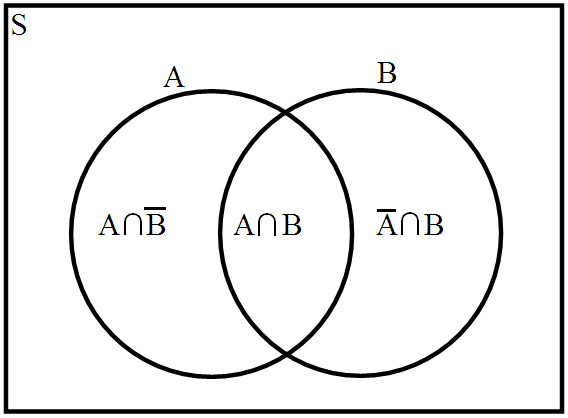
From the diagram, we get $\text{A}\cap\text{B}$ and $\overline{\text{A}}\cap\text{B}$ are mutually exclusive events such that $(\text{A}\cap\text{B})\cup(\overline{\text{A}}\cap\text{B})=\text{B}.$ therefore by
$\text{P}(\text{A}\cap\text{B})+\text{P}(\overline{\text{A}}\cap\text{B})=\text{P(B)}$
$\therefore\ \text{P}(\overline{\text{A}}\cap\text{B})=\text{P(B)}-\text{P}(\text{A}\cap\text{B})$ View full question & answer→