Questions · Page 2 of 2

5 Marks Questions

Question 515 Marks
By examining the chest $X-$ray, probability that $T.B.$ is detected when a person is actually suffering is $0.99.$ The probability that the doctor diagnoses incorrectly that a person has $T.B.$ on the basic of $X-$ray is $0.001.$ In a certain city $1$ in $1000$ persons suffers from $T.B.$ A person is selected at random is diagnosed to have $T.B.$ what is the chance that he actually has $T.B.$?
Answer
Consider events $E_1, E_2$ and $A$ as
$E_1 =$ The person selected is actually having $T.B.$
$E_2 =$ The person selected not having $T.B.$
$E_3 =$ The person diagnosed to have $T.B.$
Given,
$\text{P}(\text{E}_1)=\frac{1}{1000}$
$\text{P}(\text{E}_2)=\frac{999}{1000}$
$P(A|E_1) = P($Person diagnosed to have $T.B.$ and he is actually having $T.B.)$
$=0.99$
$\text{P}\Big(\frac{\text{A}}{\text{E}_2}\Big)= P($Person diagnossed to have a $T.B.$ and he is not a actually having $T.B.)$
$0.001$
To find, $P($Person diagnosed to have $T.B.$ is actually having $T.B.)=\text{P}\Big(\frac{\text{E}_1}{\text{A}}\Big)$
By baye's theorem,
$\text{P}\Big(\frac{\text{E}_1}{\text{A}}\Big)=\frac{\text{P}(\text{E}_1)\text{P}\Big(\frac{\text{A}}{\text{E}_1}\Big)}{\text{P}(\text{E}_1)\text{P}\Big(\frac{\text{A}}{\text{E}_1}\Big)+\text{P}(\text{E}_2)\text{P}\Big(\frac{\text{A}}{\text{E}_2}\Big)}$
$=\frac{\frac{1}{1000}\times0.99}{\frac{1}{1000}\times0.99+\frac{999}{1000}\times0.001}$
$=\frac{990}{990+999}$
$=\frac{990}{1989}$
$=\frac{110}{221}$
Required probability $=\frac{110}{221}$
View full question & answer
Question 525 Marks
A bag contains 20 tickets, numbered from 1 to 20. Two tickets are drawn without replacement. What is the probability that the first ticket has an even number and the second an odd number.
Answer
Total number of tickets are 20 numbered from 1, 2, 3, ..... 20.
Number of tickets with even numbers,
= 10 [Since, even numbers are 2, 4, 6, 8, 10, 12, 14, 16, 18, 20]
Number of tickets with odd numbers,
= 10 [Since, odd numbers are 1, 3, 5, 7, 9, 11, 13, 15, 17,19]
Two cards are drawn without replacement.
A = tickets with even numbers
B = tickets with odd numbers
P (first ticket has even number and second has odd number)
$=\text{P(A) }\text{P}\Big(\frac{\text{B}}{\text{A}}\Big)$
$=\frac{10}{20}\times\frac{10}{19}$
$=\frac{5}{19}$
Required probability $=\frac{5}{19}$
View full question & answer
Question 535 Marks
If A and B are two events such that,
$\text{P(A)}=\frac{1}{2},\text{P(B)}=\frac{1}{3}$ and $\text{P}(\text{A}\cap\text{B})=\frac{1}{4},$ then find $\text{P}(\text{A}|\text{B}), \text{ P}(\text{B}|\text{A}), \text{ P}(\overline{\text{A}}|\text{B})$ and $\text{P}(\overline{\text{A}}|\overline{\text{B}}).$
Answer
We have,
$\text{P(A)}=\frac{1}{2},\text{P(B)}=\frac{1}{3}$ and $\text{P}(\text{A}\cap\text{B})=\frac{1}{4},$
Also, $\text{P}(\overline{\text{B}})=1-\text{P(B)}=1-\frac{1}{3}=\frac{2}{3}$
As, $\text{P}(\text{A}\cup\text{B})=\text{P(A)}+\text{P(B)}-\text{P}(\text{A}\cap\text{B})$
$=\frac{1}{2}+\frac{1}{3}-\frac{1}{4}$
$=\frac{6+4-3}{12}$
$\Rightarrow\ \text{P}(\text{A}\cup\text{B})=\frac{7}{12}$
Also, $\text{P}(\overline{\text{A}}\cap\text{B})=\text{P(B)}-\text{P}(\text{A}\cap\text{B})$
$\Rightarrow\ \text{P}(\overline{\text{A}}\cap\text{B})=\frac{1}{3}-\frac{1}{4}$
$\Rightarrow\ \text{P}(\overline{\text{A}}\cap\text{B})=\frac{4-3}{12}$
$\Rightarrow\ \text{P}(\overline{\text{A}}\cap\text{B})=\frac{1}{12}$
And, $\Rightarrow\ \text{P}(\overline{\text{A}}\cap\overline{\text{B}})=\text{P}(\overline{\text{A}\cup\text{B}})$
$=1-\text{P}({\text{A}\cup\text{B}})$
$=1-\frac{7}{12}$
$=\frac{5}{12}$
Now,
$\text{P}(\text{A}|\text{B})=\frac{\text{P}(\text{A}\cap\text{B})}{\text{P}(\text{B})}=\frac{\Big(\frac{1}{4}\Big)}{\Big(\frac{1}{3}\Big)}=\frac{3}{4},$
$\text{P}(\text{B}|\text{A})=\frac{\text{P}(\text{A}\cap\text{B})}{\text{P}(\text{A})}=\frac{\Big(\frac{1}{4}\Big)}{\Big(\frac{1}{2}\Big)}=\frac{2}{4}=\frac{1}{2},$
$\text{P}(\overline{\text{A}}|\text{B})=\frac{\text{P}(\overline{\text{A}}\cap\text{B})}{\text{P(B)}}=\frac{\Big(\frac{1}{12}\Big)}{\Big(\frac{1}{3}\Big)}=\frac{3}{12}=\frac{1}{4}$ and
$\text{P}(\overline{\text{A}}|\overline{\text{B}})=\frac{\text{P}(\overline{\text{A}}\cap\overline{\text{B}})}{\text{P}(\overline{\text{B}})}=\frac{\Big(\frac{5}{12}\Big)}{\Big(\frac{2}{3}\Big)}=\frac{15}{24}=\frac{5}{8}$
View full question & answer
Question 545 Marks
A die is thrown three times, find the probability that 4 appears on the third toss if it is given that 6 and 5 appear respectively on first two tosses.
Answer
A = 4 appears on third toss, if a die is thrown three times
= {(1, 1, 4), (1, 2, 4), (1, 3, 4), (1, 4, 4), (1, 5, 4), (1, 6, 4)
(2, 1, 4), (2, 2, 4), (2, 3, 4), (2, 4, 4), (2, 5, 4), (2, 6, 4)
(3, 1, 4), (3, 2, 4), (3, 3, 4), (3, 4, 4), (3, 5, 4), (3, 6, 4)
(4, 1, 4), (4, 2, 4), (4, 3, 4), (4, 4, 4), (4, 5, 4), (4, 6, 4)
(5, 1, 4), (5, 2, 4), (5, 3, 4), (5, 4, 4), (5, 5, 4), (5, 6, 4)
(6, 1, 4), (6, 2, 4), (6, 3, 4), (6, 4, 4), (6, 5, 4), (6, 6, 4)}
B = 6 and 5 appears respectively on first two tosses, if die is tosses three times
B = {(6, 5, 1), (6, 5, 2), (6, 5, 3), (6, 5, 4), (6, 5, 5), (6, 5, 6)}
$\text{A}\cap\text{B}=\{(6,5,4)\}$
Required probability $=\text{P}\Big(\frac{\text{A}}{\text{B}}\Big)$
$=\frac{\text{n}(\text{A}\cap\text{B})}{\text{n}(\text{B})}$
$=\frac{1}{6}$
Required Probability $=\frac{1}{6}$
View full question & answer
Question 555 Marks
Coloured balls are distributed in four boxes as shown in the following table:
Box
Colour
Black
White
Red
Blue
$I$
$II$
$III$
$IV$
$3$
$2$
$1$
$4$
$4$
$2$
$2$
$3$
$5$
$2$
$3$
$1$
$6$
$2$
$1$
$5$
A box is selected at random and then a ball is randomly drawn from the selected box. The colour of the ball is black, what is the probability that ball drawn is from the box $III.$
Answer
Let $A, E_1, E_2, E_3$ and $E_4$ denote the events that the ball is black, box $I$ selected, box $II$ selected, box $III$ is selected and box $IV$ is selected respectively.
$\therefore\ \text{P}(\text{E}_1)=\frac{1}{4}$
$\text{P}(\text{E}_2)=\frac{1}{4}$
$\text{P}(\text{E}_3)=\frac{1}{4}$
Now,
$\text{P}\Big(\frac{\text{A}}{\text{E}_1}\Big)=\frac{3}{18}$
$\text{P}\Big(\frac{\text{A}}{\text{E}_2}\Big)=\frac{2}{8}$
$\text{P}\Big(\frac{\text{A}}{\text{E}_3}\Big)=\frac{1}{7}$
$\text{P}\Big(\frac{\text{A}}{\text{E}_4}\Big)=\frac{4}{13}$
Using Bayes' theorem, we get
Required probability $\text{P}\Big(\frac{\text{E}_3}{\text{A}}\Big)=\frac{\text{P}(\text{E}_1)\text{P}\Big(\frac{\text{A}}{\text{E}_1}\Big)}{\text{P}(\text{E}_1)\text{P}\Big(\frac{\text{A}}{\text{E}_1}\Big)+\text{P}(\text{E}_2)\text{P}\Big(\frac{\text{A}}{\text{E}_2}\Big)}$
$=\frac{\frac{1}{4}\times\frac{1}{7}}{\frac{1}{4}\times\frac{3}{18}+\frac{1}{4}\times\frac{2}{8}+\frac{1}{4}\times\frac{1}{7}+\frac{1}{4}\times\frac{4}{13}}$
$=\frac{\frac{1}{7}}{\frac{1}{6}+\frac{1}{4}+\frac{1}{7}+\frac{1}{13}}=\frac{156}{947}$
View full question & answer
Question 565 Marks
One bag contains $4$ yellow and $5$ red balls. Another bag contains $6$ yellow and $3$ red balls. $A$ ball is transferred from the first bag to the second bag and then a ball is drawn from the second bag. Find the probability that ball drawn is yellow.
Answer
Bag $I$ contains $4$ yellow and $5$ red balls
Bag $II$ contains $6$ yellow and $3$ red balls
Transfer can be done in two ways:
$I - A$ red ball is transferred from bag $I$ to bag $II$ and then one yellow ball is drawn from bag $II.$
$II - A$ red ball is transferred from bag $I$ to bag $II$ and then one yelllow ball is drawn from bag $II.$
Let $E_1, E_2$ and $A$ be events as:
$E_1 =$ One yellow ball drawn from bag $I$
$E_2 =$ One red ball drawn from bag $I$
$A =$ one yellow ball draw from bag $II.$
$\text{P}(\text{E}_1)=\frac{4}{9}$
$\text{P}(\text{E}_2)=\frac{4}{9}$
$\text{P}(\text{A}|\text{E}_1)=\frac{7}{10}$
$[$Since $E_1$ has increased one yellow ball in bag $II]$
$\text{P}\Big(\frac{\text{A}}{\text{E}_2}\Big)=\frac{6}{10}$
$[$Since $E_2$ has increased one red ball in bag $II]$
By law of total probability,
$\text{P(A)}=\text{P}(\text{E}_1)\text{ P}(\text{A}|\text{E}_1)+\text{P}(\text{E}_2)\text{P}\Big(\frac{\text{A}}{\text{E}_2}\Big)$
$=\frac{4}{9}\times\frac{7}{10}\times\frac{5}{9}\times\frac{6}{10}$
$=\frac{28+30}{90}$
$=\frac{58}{90}$
$=\frac{29}{45}$
Required probability $=\frac{29}{45}$
View full question & answer
Question 575 Marks
The probability that A hits a target is $\frac{1}{3}$ and the probability that B hits it, is $\frac{2}{5}$, What is the probability that the target will be hit, if each one of A and B shoots at the target?
Answer
Given,
Probability that A hits a target $=\frac{1}{3}$
$\Rightarrow\ \text{P(A)}=\frac{1}{3}$
Probability that B hits the targer $=\frac{2}{5}$
$\Rightarrow\ \text{P(B)}=\frac{2}{5}$
P (Target will be hit)
= 1 - P (target will not be hit)
= 1 - P (Niether A non B hits the target)
$=1-\text{P}(\overline{\text{A}}\cap\overline{\text{B}})$
$=1-\text{P}(\overline{\text{A}})\text{P}(\overline{\text{B}})$
$=1-[1-\text{P(A)}][1-\text{P}(\overline{\text{B}})]$
$=1-\Big[1-\frac{1}{3}\Big]\Big[1-\frac{2}{5}\Big]$
$=1-\frac{2}{3},\frac{3}{5}$
$=1-\frac{2}{5}$
$=\frac{2}{5}$
Required probability $=\frac{2}{5}$
View full question & answer
Question 585 Marks
A and B are two independent events. The probability that A and B occur is $\frac{1}{6}$ and the probability that neither of them occurs is $\frac{1}{3}$. Find the probability of occurrence of two events.
Answer
Given
$\text{P}(\text{A}\cap\text{B})=\frac{1}{6}$
$\text{P}(\overline{\text{A}}\cap\overline{\text{B}})=\frac{1}{3}$
We know that,
$\text{P}(\overline{\text{A}}\cap\overline{\text{B}})=\text{P(A) }\text{P(B)}$
$\frac{1}{3}=(1-\text{P(A)})(1-\text{P(A)})$
$\frac{1}{3}=1-\text{P(B)}-\text{P(A)}+\text{P(A) }\text{P(B)}$
$\frac{1}{3}=1-\text{P(B)}-\text{P(A)}+\text{P}(\text{A}\cap\text{B})$
$\frac{1}{3}=1-\text{P(B)}-\text{P(B)}+\frac{1}{6}$
$\text{P(A)}+\text{P(A)}=\frac{1}{1}+\frac{1}{6}-\frac{1}{3}$
$=\frac{6+1-2}{6}$
$\text{P(A)}+\text{P(B)}=\frac{5}{6}$
$\text{P(A)}=\frac{5}{6}-\text{P(B)}\ .....\text{(i)}$
Given, $\text{P}(\text{A}\cap\text{B})=\frac{1}{6}$
$\text{P(A) } \text{P(B)}=\frac{1}{6}$
$\Big[\frac{5}{6}-\text{P(B)}\Big]\text{P(B)}=\frac{1}{6}$
[Using equation (i)]
$\Rightarrow\ \frac{5}{6}\text{P(B)}-\big\{\text{P(B)}\big\}^2=\frac{1}{6}$
$\Rightarrow\ \{\text{P(B)}\}^2-\frac{5}{6}\text{P(B)}+\frac{1}{6}=0$
$\Rightarrow\ 6\{\text{P(B)}\}^2-5\text{P(B)}+1=0$
$\Rightarrow\ 6\{\text{P(B)}\}^2-3\text{P(B)}-2\text{P(B)}+1=0$
$\Rightarrow\ 3\text{P(B)}[2\text{P(B)}-1]-1[2\text{P(B)}-1]=0$
$\Rightarrow\ [2\text{P(B)}-1][3\text{P(B)-1}]=0$
$\Rightarrow\ 2\text{P(B)}-1 = 0\text{ or }3\text{P(B)}-1=0$
$\Rightarrow\ \text{P(B)}=\frac{1}{2} \text{ or P(B)}=\frac{1}{3}$
⇒ Using equation (i),
$\text{P(B)}=\frac{1}{2}\Rightarrow\ \text{P(A)}=\frac{5}{6}-\frac{1}{2}=\frac{1}{3}$
$\text{P(B)}=\frac{1}{2}\Rightarrow\ \text{P(A)}=\frac{5}{6}-\frac{1}{3}=\frac{1}{2}$
Hence, $\text{P(B)}=\frac{1}{2},\text{P(A)}=\frac{1}{3} \text{ or }\text{P(B)}=\frac{1}{3},\text{P(A)}=\frac{1}{2}$
View full question & answer
Question 595 Marks
Bag $A$ contains $3$ red and $5$ black balls, while bag $B$ contains $4$ red and $4$ black balls. Two balls are transferred at random from bag $A$ to bag $B$ and then a ball is drawn from bag $B$ at random. If the ball drawn from bag $B$ is found to be red find the probability that two red balls were transferred from $A$ to $B.$
Answer
It is given that bag $A$ contains $3$ red and $5$ black balls and bag $B$ contains $4$ red and $4$ black balls.
Let $E_1, E_2, E_3$ and $A$ be the events as defined below:
$E_1 :$ Two red balls are transferred from bag $A$ to Bag $B.$
$E_2 :$ One red ball and one black ball is transferred from bag $A$ to bag $B.$
$E_3 :$ Two black balls are transferred from bag $A$ to bag $B.$
$A =$ Ball drawn from bag $B$ is red.
So,
$\text{P}(\text{E}_1)=\frac{^{3}\text{C}_2}{^{8}\text{C}_2}=\frac{3}{28}$
$\text{P}(\text{E}_2)=\frac{^{3}\text{C}_1\times ^{5}\text{C}_1}{^{8}\text{C}_2}=\frac{15}{28}$
$\text{P}(\text{E}_3)=\frac{^{5}\text{C}_2}{^{8}\text{C}_2}=\frac{10}{28}$
Also,
$\text{P}\Big(\frac{\text{A}}{\text{E}_1}\Big)=\frac{6}{10}$
$\text{P}\Big(\frac{\text{A}}{\text{E}_2}\Big)=\frac{5}{10}$
$\text{P}\Big(\frac{\text{A}}{\text{E}_3}\Big)=\frac{4}{10}$
$\therefore$ Required probability $=$ Probability that two red balls were transferred from $A$ to $B$ given that the ball drawn from bag $B$ is red
$\text{P}\Big(\frac{\text{E}_1}{\text{A}}\Big)=\frac{\text{P}(\text{E}_1)\text{P}\Big(\frac{\text{A}}{\text{E}_1}\Big)}{\text{P}(\text{E}_1)\text{P}\Big(\frac{\text{A}}{\text{E}_1}\Big)+\text{P}(\text{E}_2)\text{P}\Big(\frac{\text{A}}{\text{E}_2}\Big)+\text{P}(\text{E}_3)\text{P}\Big(\frac{\text{A}}{\text{E}_3}\Big)}$
$[$Using Baye's Theorem$]$
$=\frac{\frac{3}{28}\times\frac{6}{10}}{\frac{3}{28}\times\frac{6}{10}+\frac{15}{28}\times\frac{5}{10}+\frac{10}{28}\times\frac{4}{10}}$
$=\frac{18}{18+75+40}$
$=\frac{18}{133}$
View full question & answer
Question 605 Marks
Given that the two numbers appearing on throwing two dice are different. Find the probability of the event 'the sum of numbers on the dice is 4'.
Answer
A = Two numbers on two dice are different
= {(1, 2), (1, 3), (1, 4), (1, 5), (1, 6)
(2, 1), (2, 3), (2, 4), (2, 5), (2, 6)
(3, 1), (3, 2), (3, 4), (3, 5), (3, 6)
(4, 1), (4, 2), (4, 3), (4, 5), (4, 6)
(5, 1), (5, 2), (5, 3), (5, 4), (5, 6)
(6, 1), (6, 2), (6, 3), (6, 4), (6, 5)}
B = Sum of numbers on the dice is 4
B = {(1, 3), (2, 2), (3, 1)}
$\text{A}\cap\text{B}=\{(1,3),(3,1)\}$
Required probability $=\text{P}\Big(\frac{\text{B}}{\text{A}}\Big)$
$=\frac{\text{n}(\text{A}\cap\text{B})}{\text{n}(\text{A})}$
$=\frac{2}{30}$
Required probability $=\frac{1}{15}$
View full question & answer
Question 615 Marks
A bag contains 3 red and 2 black balls. One ball is drawn from it at random. Its colour is noted and then it is put back in the bag. A second draw is made and the same procedure is repeated. Find the probability of drawing,
  1. Two red balls,
  2. Two black balls,
  3. First red and second black ball.
Answer
Given bag contains 3 red and 2 black balls. A = Getting one red ball $\Rightarrow\ \text{P(A)}=\frac{3}{5}$ B = Getting one black ball $\Rightarrow\ \text{P(B)}=\frac{2}{5}$
  1. P(Getting two red balls)
= P(A) P(A)
$=\frac{3}{5}\times\frac{3}{5}$
$=\frac{9}{25}$
P(Getting two red balls) $=\frac{9}{25}$
  1. P(Getting two black balls)
= P(B) P(B)
$=\frac{2}{5}\times\frac{2}{5}$
$=\frac{4}{25}$
P(Getting two black balls) $=\frac{4}{25}$
  1. P(Getting first red and second black ball)
= P(A) P(B)
$=\frac{3}{5}\times\frac{2}{5}$
$=\frac{6}{25}$
P(Getting first red and second black ball) $=\frac{6}{25}$
View full question & answer
Question 625 Marks
A die is thrown thrice. Find the probability of getting an odd number at least once.
Answer
P(getting an odd number in one throw) $=\frac{1}{2}$
Here, getting an odd number in three throws refers to 3 independent events.
$\text{P(A)}=\text{P{B}}=\text{P(C)}=\frac{1}{2}$
$\text{P}(\text{A}\cup\text{B}\cup\text{C})=\text{P(A)}+\text{P(B)}+\text{P(C)} \\ -[\text{P}(\text{A}\cap\text{B})+(\text{B}\cap\text{C})+(\text{C}\cap\text{A})]+\text{P}(\text{A}\cap\text{B}\cap\text{C})$
$=\frac{1}{2}+\frac{1}{2}+\frac{1}{2}-\Big[\frac{1}{2}\times\frac{1}{2}+\frac{1}{2}\times\frac{1}{2}+\frac{1}{2}\times\frac{1}{2}\Big] \\ +\frac{1}{2}\times\frac{1}{2}\times\frac{1}{2}$
$=\frac{3}{2}-\frac{3}{4}+\frac{1}{8}$
$=\frac{12-6+1}{8}$
$=\frac{7}{8}$
View full question & answer
Question 635 Marks
Suppose a girl throws a die. If she gets $1$ or $2,$ she tosses a coin three times and notes the number of tails. If she gets $3, 4, 5$ or $6,$ she tosses a coin once and notes whether a 'head' or 'tail' is obtained. If she obtained exactly one 'tail', then what is the probability that she threw $3, 4, 5$ or $6$ with the die?
Answer
Let $E_1$ be the event that the outcome on the die is $1$ or $2$ and $E_2$ be the event that the outcome on the die is $3, 4, 5$ or $6$. then,
$\text{P}(\text{E}_1)=\frac{2}{6}=\frac{1}{3}$ and $\text{P}(\text{E}_2)=\frac{4}{6}=\frac{2}{3}$
Let $A$ bethe event of getting exaxtly one 'tail'. $\text{P}\Big(\frac{\text{A}}{\text{E}_1}\Big)$ = Probability of getting exactly one tail by tossing the coin three times if she tesd $1$ or $2 = P(A|E_2) =$ Probability of getting exactly one tail in a single throw of a coin ifshe gets $3, 4, 5$ or $5 =$ As, the probability that the girlthrew $3, 4, 5$ or $6$ with the die, if she obtained exaxtly one tail, is given by $P(E_2|A).$
So, by using Baye's therorem, we get
$\text{P}(\text{E}_2|\text{A})=\frac{\text{P}(\text{E}_2)\times\text{P}(\text{A}|\text{E}_2)}{\text{P}(\text{E}_1)\times\text{P}(\text{A}|\text{E}_1)+\text{P}(\text{E}_2)\times\text{P}(\text{A}|\text{E}_2)}$
$=\frac{\Big(\frac{2}{3}\times\frac{1}{2}\Big)}{\Big(\frac{1}{3}\times\frac{3}{8}+\frac{2}{3}\times\frac{1}{2}\Big)}$
$=\frac{\Big(\frac{2}{6}\Big)}{\Big(\frac{1}{8}+\frac{1}{3}\Big)}$
$=\frac{\Big(\frac{2}{6}\Big)}{\Big(\frac{11}{24}\Big)}$
$=\frac{24\times2}{11\times6}$
$=\frac{8}{11}$
View full question & answer
Question 645 Marks
Two groups are competing for the positions of the Board of Directors of a Corporation. The probabilities that the first and the second groups will win are $0.6$ and $0.4$ respectively. Further, if the first group wins, the probability of introducing a new product is $0.7$ and the corresponding probability is $0.3$ if the second group wins. Find the probability that the new product introduced was by the second group.
Answer
Let $E_1$ and $E_2$ denote the events that the first group and the second group win the competition, respectively.
Let $A$ be the event of introducing a new product.
$P(E_1) =$ Probability that the first group wins the competition $= 0.6$
$P(E_2) =$ Probability that the second group wins the competition $= 0.4$
$\text{P}\Big(\frac{\text{A}}{\text{E}_1}\Big)=$ Probability of introducing a new product if the first group wins $= 0.7$
$\text{P}\Big(\frac{\text{A}}{\text{E}_2}\Big)=$ Probability of introducing a new product if the second group wins $= 0.3$
The probability that the new product is introduced by the second group is given by $\text{P}\Big(\frac{\text{E}_2}{\text{A}}\Big).$
Using Bayes' theorem, we get
Required probability $=\text{P}\Big(\frac{\text{E}_2}{\text{A}}\Big)=\frac{\text{P}(\text{E}_2)\text{P}\Big(\frac{\text{A}}{\text{E}_2}\Big)}{\text{P}(\text{E}_1)\text{P}\Big(\frac{\text{A}}{\text{E}_1}\Big)+\text{P}(\text{E}_2)\text{ P}\Big(\frac{\text{A}}{\text{E}_2}\Big)}$
$=\frac{0.4\times0.3}{0.6\times0.7+0.4\times0.3}$
$=\frac{0.12}{0.54}=\frac{2}{9}$
View full question & answer
Question 655 Marks
If A and B are two events such that,
$\text{P(A)}=\frac{7}{13},\text{P(B)}=\frac{9}{13}$ and $\text{P}(\text{A}\cap\text{B})=\frac{4}{13},$ then find $\text{P}(\overline{\text{A}}|\text{B}).$
Answer
We have,
$\text{P(A)}=\frac{7}{13},\text{P(B)}=\frac{9}{13}$ and $\text{P}(\text{A}\cap\text{B})=\frac{4}{13},$
As, $\text{P}(\overline{\text{A}}\cap\text{B})=\text{P(B)}-\text{P}(\text{A}\cap\text{B})$
$\Rightarrow\ \text{P}(\overline{\text{A}}\cap\text{B})=\frac{9}{13}-\frac{4}{13}$
$\Rightarrow\ \text{P}(\overline{\text{A}}\cap\text{B})=\frac{9-4}{13}$
$\Rightarrow\ \text{P}(\overline{\text{A}}\cap\text{B})=\frac{5}{13}$
Now,
$\text{P}(\overline{\text{A}}|\text{B})=\frac{\text{P}(\overline{\text{A}}\cap\text{B})}{\text{P(B)}}=\frac{\Big(\frac{5}{13}\Big)}{\Big(\frac{9}{13}\Big)}=\frac{5}{9}$
View full question & answer
Question 665 Marks
There are three urns $A, B$, and $C.$ Urn A contains $4$ red balls and $3$ black balls. urn $B$ contains $5$ red balls and $4$ black balls. Urn $C$ contains $4$ red and $4$ black balls. One ball is drawn from each of these urns. What is the probability that $3$ balls drawn consists of $2$ red balls and a black ball?
Answer
Urn $A$ contains $4$ red $(R_1)$ and $3$ black $(B_1)$ balls
Urn $B$ contains $5$ red $(R_2)$ and $4$ black $(B_2)$ balls
Urn $C$ contains $4$ red $(R_3)$ and $4$ balck $(B_3)$ balls.
$P (3$ balls drawn consists or $2$ red and a black ball$)$
$=\text{P}\big[(\text{R}_1\cap\text{R}_2\cap\text{R}_3)\cup(\text{R}_1\cap\text{B}_2\cap\text{R}_3)\cap(\text{B}_1\cap\text{R}_2\cap\text{R}_3)\big]$
$=\text{P}(\text{R}_1\cap\text{R}_2\cap\text{R}_3)+\text{P}(\text{R}_1\cap\text{B}_2\cap\text{R}_3)+\text{P}(\text{B}_1\cap\text{R}_2\cap\text{R}_3)$
$=\text{P}(\text{R}_1)\text{P}(\text{R}_2)\text{P}(\text{R}_3)+\text{P}(\text{R}_1)\text{P}(\text{B}_2)\text{P}(\text{R}_3)+\text{P}(\text{B}_1)\text{P}(\text{R}_2)\text{P}(\text{R}_3)$
$=\frac{4}{7}\times\frac{5}{9}\times\frac{4}{8}+\frac{4}{7}\times\frac{4}{9}\times\frac{4}{8}+\frac{3}{7}\times\frac{5}{9}\times\frac{4}{8}$
$=\frac{80+64+60}{504}$
$=\frac{204}{504}$
$=\frac{17}{42}$
Required probability $=\frac{17}{42}$
View full question & answer
Question 675 Marks
In a group of $400$ people, $160$ are smokers and non$-$vegetarian, $100$ are smokers and vegetarian and the remaining are non$-$smokers and vegetarian. The probabilities of getting a special chest disease are $35\%, 20\%$ and $10\%$ respectively. A person is chosen from the group at random and is found to be suffering from the disease. What is the probability that the selected person is a smoker and non$-$vegetarian?
Answer
Let $E_1, E_2, E_3$ be the events that the people are smokers and non$-$vegetarian, skokers and vegetarian, and non-smokers and vegetarian respectively.
$\text{P}(\text{E}_1)=\frac{2}{5},\text{P}(\text{E}_2)=\frac{1}{4},\text{P}(\text{E}_1)=\frac{7}{20}$
Let A denote the event that the person has the special chest disease. It is given that
$\text{P}\Big(\frac{\text{A}}{\text{E}_1}\Big)=0.35,\text{P}\Big(\frac{\text{A}}{\text{E}_2}\Big)=020,\text{P}\Big(\frac{\text{A}}{\text{E}_3}\Big)=0.10$
We have to find $\text{P}\Big(\frac{\text{E}_1}{\text{A}}\Big)$
By Baye's theorem,
$\text{P}\Big(\frac{\text{E}_1}{\text{A}}\Big)=\frac{\text{P}(\text{E}_1)\text{P}\Big(\frac{\text{A}}{\text{E}_1}\Big)}{\text{P}(\text{E}_1)\text{P}\Big(\frac{\text{A}}{\text{E}_1}\Big)+\text{P}(\text{E}_2)\text{P}\Big(\frac{\text{A}}{\text{E}_2}\Big)+\text{P}(\text{E}_3)\text{P}\Big(\frac{\text{A}}{\text{E}_3}\Big)}$
$=\frac{\frac{2}{5}(0.35)}{\frac{2}{5}(0.35)+\frac{1}{4}(0.20)+\frac{7}{20}(0.10)}=\frac{\frac{7}{50}}{\Big(\frac{7}{50}\Big)+\Big(\frac{1}{20}\Big)+\Big(\frac{7}{200}\Big)}$
$=\frac{\frac{7}{50}}{\frac{9}{40}}=\frac{28}{45}$
View full question & answer
Question 685 Marks
Suppose $5$ men out of $100$ and $25$ women out of $1000$ are good orators. An orator is chosen at random. Find the probability that a male person is selected. Assume that there are equal number of men and women.
Answer
Given,
$5$ man out of $100$ and $25$ women out of $1000$ are good orators.
Consider $E_1, E_2$ and $A$ events as:
$E_1 =$ Selected persom is male
$E_2 =$ Selected person is famale
$E_3 =$ Selected person is an orator
$\text{P}(\text{E}_1)=\frac{1}{2}$
$\text{P}(\text{E}_2)=\frac{1}{2}$
$[$Since number of ,ales and females are equal$]$
$P(A|E_1) = P($Selecting a male orator$)$
$=\frac{5}{100}$
$=\frac{1}{20}$
$\text{P}\Big(\frac{\text{A}}{\text{E}_2}\Big)=\text{P}$ (Selecting a female orator)
$=\frac{25}{1000}$
$=\frac{1}{40}$
To find,$ P($Prator selected is a male$) =\text{P}\Big(\frac{\text{E}_1}{\text{A}}\Big)$
By baye's theorem,
$\text{P}\Big(\frac{\text{E}_1}{\text{A}}\Big)=\frac{\text{P}(\text{E}_1)\text{ P}\Big(\frac{\text{A}}{\text{E}_1}\Big)}{\text{P}(\text{E}_1)\text{ P}\Big(\frac{\text{A}}{\text{E}_1}\Big)+\text{P}(\text{E}_2)\text{ P}\Big(\frac{\text{A}}{\text{E}_2}\Big)}$
$=\frac{\frac{1}{2}\times\frac{1}{20}}{\frac{1}{2}\times\frac{1}{20}+\frac{1}{2}\times\frac{1}{40}}$
$=\frac{\frac{1}{40}}{\frac{1}{40}+\frac{1}{80}}$
$=\frac{1}{40}\times\frac{80}{3}$
$=\frac{2}{3}$
Required probability $=\frac{2}{3}.$
View full question & answer
Question 695 Marks
Two balls are drawn at random with replacement from a box containing 10 black and 8 red balls. Find the probability that,
  1. Both balls are red,
  2. First ball is black and second is red,
  3. One of them is black and other is red.
Answer
The Box contains 10 black balls and 8 red balls. Then $\text{P(Black ball)}=\frac{10}{18}$ $\text{P(red ball)}=\frac{8}{18}$
  1. P(Both ballls are red) $=\frac{8}{18}\times\frac{8}{18}=\frac{16}{81}$
  2. P (First ball is black and second is red) $=\frac{10}{18}\times\frac{8}{18}=\frac{20}{81}$
  3. P (One of them is black and other is red)
$=\frac{10}{18}\times\frac{8}{18}+\frac{8}{18}\times\frac{10}{18}$
$=2\Big(\frac{20}{81}\Big)$
$=\frac{40}{81}$
View full question & answer
Question 705 Marks
Three persons $A, B$ and $C$ apply for a job of Manager in a Private Company. Chances of their selection $(A, B$ and $C)$ are in the ratio $1 : 2 : 4.$ The probabilities that $A, B$ and $C$ can introduce changes to improve profits of the company are $0.8, 0.5$ and $0.3,$ respectively. If the change does not take place, find the probability that it is due to the appointment of $C.$
Answer
Let $E_1, E_2$ and $E_3$ be the events denoting the selecting of $A, B$ and $C$ as managers, respectively.
$P(E_1) =$ Ptobability of selection of $A =\frac{1}{7}$
$P(E_2) =$ Probability of selection of $B =\frac{2}{7}$
$P(E_3) =$ Probability of selection of $C =\frac{4}{7}$
Let be the event denoting the change not taking place.
$\text{P}\Big(\frac{\text{A}}{\text{E}_1}\Big)=$ Probability that $A$ does not introduce change $= 0.2$
$\text{P}\Big(\frac{\text{A}}{\text{E}_2}\Big)=$ Probability that $B$ does not introduce change $= 0.5$
$\text{P}\Big(\frac{\text{A}}{\text{E}_3}\Big)=$ Probability that $C$ does not introduce change $= 0.7$
$\therefore$ Required probability $=\text{P}\Big(\frac{\text{E}_1}{\text{A}}\Big)$
By Baye's theorem, we have
$\text{P}\Big(\frac{\text{E}_3}{\text{A}}\Big)=\frac{\text{P}(\text{E}_3)\text{P}\Big(\frac{\text{A}}{\text{E}_3}\Big)}{\text{P}(\text{E}_1)\text{P}\Big(\frac{\text{A}}{\text{E}_1}\Big)+\text{P}(\text{E}_2)\text{P}\Big(\frac{\text{A}}{\text{E}_2}\Big)+\text{P}(\text{E}_3)\text{P}\Big(\frac{\text{A}}{\text{E}_3}\Big)}$
$=\frac{\frac{4}{7}\times0.7}{\frac{1}{7}\times0.2+\frac{2}{7}\times0.5+\frac{4}{7}\times0.7}$
$=\frac{2.8}{0.2+1+2.8}$
$=\frac{2.8}{4}=0.7$
View full question & answer
Question 715 Marks
In a factory, machine $A$ produces $30\%$ of the total output, machine $B$ produces $25\%$ and the machine $C$ produces the remaining output. If defective items produced by machines $A, B$ and $C$ are $1\%, 1.2\%,2\%$ respectively. Three machines working together produce $10000$ items in a day. An item is drawn at random from a day's output and found to be defective. Find the probability that it was produced by machine $B$?
Answer
Consider events $E_1, E_2, E_3$ and Aas:
$E_1 =$ Selecting product from machine $A$
$E_2 =$ Selecting product from machine $B$
$E_3 =$ Selecting product from machine $C$
$A =$ Selecting a standard quality product
$\text{P}(\text{E}_1)=\frac{30}{100}$
$\text{P}(\text{E}_2)=\frac{25}{100}$
$\text{P}(\text{E}_3)=\frac{45}{100}$
$P(A|E_1) = P($Selecting defective product from machine $A)$
$=\frac{1}{100}$
$\text{P}\Big(\frac{\text{A}}{\text{E}_2}\Big)=\text{P} ($Selecting defective prodcut from machine $B)$
$=\frac{1.2}{100}$
$\text{P}\Big(\frac{\text{A}}{\text{E}_3}\Big)=\text{P} ($Selecting defective product from machine $C)$
$=\frac{2}{100}$
To find, $P($Selecting defective product is produced by machine $B)$
By baye's theorem,
$\text{P}\Big(\frac{\text{E}_2}{\text{A}}\Big)=\frac{\text{P}(\text{E}_2)\text{ P}\Big(\frac{\text{A}}{\text{E}_2}\Big)}{\text{P}(\text{E}_1)\text{ P}\Big(\frac{\text{A}}{\text{E}_1}\Big)+\text{P}(\text{E}_2)\text{ P}\Big(\frac{\text{A}}{\text{E}_2}\Big)+\text{P}(\text{E}_3)\text{ P}\Big(\frac{\text{A}}{\text{E}_3}\Big)}$
$=\frac{\frac{25}{100}\times\frac{12}{1000}}{\frac{30}{100}\times\frac{1}{100}+\frac{25}{100}\times\frac{12}{1000}+\frac{45}{100}\times\frac{2}{100}}$
$=\frac{300}{300+300+900}$
$=\frac{300}{1500}$
$=\frac{1}{5}$
Required probability $=\frac{1}{5}$
View full question & answer
Question 725 Marks
The odds against a certain event are 5 to 2 and the odds in favour of another event, independent to the former are 6 to 5. Find the probability that,
  1. At least one of the events will occur,
  2. None of the events will occur.
Answer
Given, The adds against a certain event (say, A) are 5 to 2 $\Rightarrow\ \text{P}(\overline{\text{A}})=\frac{5}{5+2}$ $\text{P}(\overline{\text{A}})=\frac{5}{7}$ The odds in favour of another event (say, B) are 6 to 5 $\Rightarrow\ \text{P(B)}=\frac{6}{5+6}$ $\text{P(B)}=\frac{6}{11}$ $\text{P}(\overline{\text{B}})=1-\frac{6}{11}$ $\text{P}(\overline{\text{B}})=\frac{5}{11}$
  1. P (At least one of the events will occur)
= 1 - P (None of events occur)
$=1-\text{P}(\overline{\text{A}}\cap\overline{\text{B}})$
$=1-\text{P}(\overline{\text{A}})\text{ P}(\overline{\text{B}})$
[Since events are independent]
$=1-\frac{5}{7}\times\frac{5}{11}$
$=1-\frac{25}{77}$
$=\frac{52}{77}$
Required probability $=\frac{52}{77}$
  1. P (None of the events will occur)
$=\text{P}(\overline{\text{A}}\cap\overline{\text{B}})$
$=\text{P}(\overline{\text{A}})\text{ P}(\overline{\text{B}})$
$=\frac{5}{7}\times\frac{5}{11}$
$=\frac{25}{77}$
Required probability $=\frac{25}{77}$
View full question & answer
Question 735 Marks
A purse contains $2$ silver and $4$ copper coins. $A$ second purse contains $4$ silver and $3$ copper coins. If a coin is pulled at random from one of the two purses, what is the probability that it is a silver coin?
Answer
Purse $(I)$ contains $(2)$ silver and $4$ copper coins
Purse $(II)$ contains $4$ silver and $3$ copper coins
Let $E_1, E_2$ and $A$ are defined as
$E_1 =$ Selecting purse $I$
$E_2 =$ Selectin purse $II$
$A =$ Drawinf a silver coin
$\text{P}(\text{E}_1)=\frac{1}{2}$
$\text{P}(\text{E}_2)=\frac{1}{2}$
$[$Since, there are only $2$ purses$]$
$P(A|E_1) = P(A|$silver coin from purse $I)$
$=\frac{2}{6}$
$​​=\frac{1}{3}$
$\text{P}\Big(\frac{\text{A}}{\text{E}_2}\Big)=\text{P}(A|$ silver coin from purse $II)$
By the law of total probability,
$\text{P(A)}=\text{P}(\text{E}_1)\text{P}(\text{A}|\text{E}_1)+\text{P}(\text{E}_2)\text{P}\Big(\frac{\text{A}}{\text{E}_2}\Big)$
$=\frac{1}{2}\times\frac{1}{3}+\frac{1}{2}\times\frac{4}{7}$
$=\frac{1}{6}+\frac{4}{14}$
$=\frac{7+12}{42}$
$=\frac{19}{42}$
Required probability $=\frac{19}{42}$
View full question & answer
Question 745 Marks
The probability that a student selected at random from a class will pass in Mathematics is $\frac{4}{5}$, and the probability that he/ she passes in Mathematics and Computer Science is $\frac{1}{2}$. What is the probability that he/ she will pass in Computer Science if it is known that he/ she has passed in Mathematics?
Answer
Given,
Probability to pass mathen atics (M)
$\text{P(M)}=\frac{4}{5}$
Probability to pass in mathematics (M) and computer Science (C)
$\text{P}(\text{M}\cap\text{C})=\frac{1}{2}$
To find, $\text{P}\Big(\frac{\text{C}}{\text{M}}\Big)$
We know tht,
$\text{P}\Big(\frac{\text{C}}{\text{M}}\Big)=\frac{\text{P}(\text{M}\cap\text{C})}{\text{P(M)}}$
$=\frac{\frac{1}{2}}{\frac{4}{5}}$
$=\frac{1}{2}\times\frac{5}{4}$
$=\frac{8}{5}$
Required probability $=\frac{8}{5}$
View full question & answer
Question 755 Marks
If A and B are two events such that $2\text{P(A)}=\text{P(B)}=\frac{5}{13}$ and $\text{P}\Big(\frac{\text{A}}{\text{B}}\Big)=\frac{2}{5}$ find $\text{P}(\text{A}\cap\text{B}).$
Answer
Given,
$2\text{P(A)}=\text{P(B)}=\frac{5}{13}$
$2\text{P(A)}=\frac{5}{13}$
$\Rightarrow \text{P(A)}=\frac{5}{26}$
$\text{P}\Big(\frac{\text{A}}{\text{B}}\Big)=\frac{\text{P}(\text{A}\cap\text{B})}{\text{P(B)}}$
$\frac{2}{5}=\frac{\text{P}(\text{A}\cap\text{B})}{\frac{5}{13}}$
$\text{P}(\text{A}\cap\text{B})=\frac{2}{5}\times\frac{5}{13}$
$\text{P}(\text{A}\cap\text{B})=\frac{2}{13}$
We know that,
$\text{P}(\text{A}\cap\text{B})=\text{P}(\text{A})+\text{P(B)}-\text{P}(\text{A}\cap\text{B})$
$=\frac{5}{26}+\frac{5}{13}-\frac{2}{13}$
$=\frac{5+10-4}{26}$
$=\frac{11}{26}$
$\text{P}(\text{A}\cap\text{B})=\frac{11}{26}$
View full question & answer
Question 765 Marks
A pair of dice is thrown. Let E be the event that the sum is greater than or equal to 10 and F be the event "5 appears on the first-die". Find $\text{P}\Big(\frac{\text{E}}{\text{F}}\Big)$. If F is the event "5 appears on at least one die", find $\text{P}\Big(\frac{\text{E}}{\text{F}}\Big)$.
Answer
A pair of die is thrown E = Sum is greater than or equal to 10 = {(4, 6), (5, 5), (6, 4), (5, 6), (6, 6)}Case I:
F = 5 appears on first die = {(5, 1), (5, 2), (5, 3), (5, 4), (5, 5), (5, 6)} $\text{E}\cap\text{F}=\{(5, 5), (5, 6)\}$ $\text{P}\Big(\frac{\text{E}}{\text{F}}\Big)=\frac{\text{n}(\text{E}\cap\text{F})}{\text{n}(\text{F})}$ $\text{P}\Big(\frac{\text{E}}{\text{F}}\Big)=\frac{1}{3}$Case: II
F = 5 appears on at least one die = {(1, 5), (2, 5), (3, 5), (4, 5), (6, 5), (5, 1), (5, 2), (5, 3), (5, 4), (5, 5), (5, 6)} $\text{E}\cap\text{F}=\{(5,5), (5, 6), (6, 5)\}$ $\text{P}\Big(\frac{\text{E}}{\text{F}}\Big)=\frac{\text{n}(\text{E}\cap\text{F})}{\text{n}(\text{F})}$ $=\frac{3}{11}$ $\text{P}\Big(\frac{\text{E}}{\text{F}}\Big)=\frac{3}{11}$
View full question & answer
Question 775 Marks
There are three coins. One is two headed coin, another is a biased coin that comes up heads $75\%$ of the time and third is an unbiased coin. One of the three coins is chosen at random and tossed, it shows heads, what is the probability that it was the two headed coin?
Answer
Let $E_1, E_2$ and $E_3$ be the respective events of choosing a two headed coin, a biased coin, and an unbiased coin.
$\therefore\ \text{P}(\text{E}_1)=\text{P}(\text{E}_2)=\text{P}(\text{E}_3)=\frac{1}{3}$
Let $A$ be the event that the coin shows heads.
A two$-$headed coin will always show heads.
$\therefore P(A|E_1) = P ($coin showing heads, given that it is a two$-$headed coin$) = 1$
Probability of heads coming up, given that it is a biased coin $= 75\%$
$\therefore P(A|E_2) = P($coin showing heads, given that it is a biased coin$) =\frac{75}{100}=\frac{3}{4}$
Since the third coin is unbiased, the probability that it shows heads is always $\frac{1}{2}$.
$\therefore P(A|E_3) = P($coin showing heads, given that it is an unbiased coin$) =\frac{1}{2}$
The probability that the coin is two$-$headed, given that it shows heads, is given by $P(E_1|A).$
By using Bayes' theorem, we obtain
$=\text{P}(\text{E}_1|\text{A})=\frac{\text{P}(\text{E}_1)\times\text{P}(\text{A}|\text{E}_1)}{\text{P}(\text{E}_1)\times\text{P}(\text{A}|\text{E}_1)+\text{P}(\text{E}_2)\times\text{P}(\text{A}|\text{E}_2)+\text{P}(\text{E}_3)\times\text{P}(\text{A}|\text{E}_3)}$
$=\frac{\frac{1}{3}\times1}{\frac{1}{3}\times1+\frac{1}{3}\times\frac{3}{4}+\frac{1}{3}\times\frac{1}{2}}$
$=\frac{\frac{1}{3}}{\frac{1}{3}\Big(1+\frac{3}{4}+\frac{1}{2}\Big)}$
$=\frac{1}{\frac{9}{4}}$
$=\frac{4}{9}$
View full question & answer
Question 785 Marks
If A and B are two events such that,
$\text{P(A)}=\frac{1}{3},\text{P(B)}=\frac{1}{4}$ and $\text{P}(\text{A}\cap\text{B})=\frac{5}{12},$ then find P(A|B) and P(B|A).
Answer
We have,
$\text{P(A)}=\frac{1}{3},\text{P(B)}=\frac{1}{4}$ and $\text{P}(\text{A}\cup\text{B})=\frac{5}{12}$
As, $\text{P}(\text{A}\cup\text{B})=\text{P(A)}+\text{P(B)}=\text{P}(\text{A}\cap\text{B})$
$\Rightarrow\ \text{P}(\text{A}\cap\text{B})=\text{P(A)}+\text{P}(\text{B})-\text{P}(\text{A}\cap\text{B})$
$\Rightarrow\ \text{P}(\text{A}\cap\text{B})=\frac{1}{3}+\frac{1}{4}-\frac{5}{12}$
$\Rightarrow\ \text{P}(\text{A}\cap\text{B})=\frac{2}{12}$
$\Rightarrow\ \text{P}(\text{A}\cap\text{B})=\frac{1}{6}$
Now,
$\text{P}(\text{A}|\text{B})=\frac{\text{P}(\text{A}\cap\text{B})}{\text{P(B)}}=\frac{\Big(\frac{1}{6}\Big)}{\Big(\frac{1}{4}\Big)}=\frac{4}{6}=\frac{2}{3}$ and
$\text{P}(\text{B}|\text{A})=\frac{\text{P}(\text{A}\cap\text{B})}{\text{P(A)}}=\frac{\Big(\frac{1}{6}\Big)}{\Big(\frac{1}{3}\Big)}=\frac{3}{6}=\frac{1}{2}$
View full question & answer
Question 795 Marks
There are three categories of students in a class of 60 students:
A : Very hardworking
B : Regular but not so hardworking
C : Careless and irregular 10 students are in category A, 30 in category B and the rest in category C.
It is found that the probability of students of category A, unable to get good marks in the final year examination is 0.002, of category B it is 0.02 and of category C, this probability is 0.20. A student selected at random was found to be one who could not get good marks in the examination. Find the probability that this student is category C.
Answer
Let E denote the event that the student could not get good marks in the examination.
Also, A : The event that student is very hardworking
B : The event that student is regular but not so hardworking
C : The event that student is careless and irregular
$\therefore\ \text{P(A)}=\frac{10}{60},\text{P(B)}=\frac{30}{60} \text{ and P(C)}=\frac{20}{60}$
Also,
$\text{P}\Big(\frac{\text{E}}{\text{A}}\Big)=$ Probability that the student of category A could not get good marks in the examination = 0.002
$\text{P}\Big(\frac{\text{E}}{\text{B}}\Big)=$ Probability that the student of category B could not get good marks in the examination = 0.02
$\text{P}\Big(\frac{\text{E}}{\text{C}}\Big)=$ Probability that the student of category C could not get good marks in the examination = 0.2
$\therefore$ Required probability $=\text{P}\Big(\frac{\text{C}}{\text{E}}\Big)=\frac{\text{P}(\text{C})\text{P}\Big(\frac{\text{E}}{\text{C}}\Big)}{\text{P}(\text{A})\text{P}\Big(\frac{\text{E}}{\text{A}}\Big)+\text{P}(\text{B})\text{P}\Big(\frac{\text{E}}{\text{B}}\Big)+\text{P}(\text{C})\text{P}\Big(\frac{\text{E}}{\text{C}}\Big)}$
$=\frac{\frac{20}{60}\times0.2}{\frac{10}{60}\times0.002+\frac{30}{60}\times0.02+\frac{20}{60}\times0.2}$
$=\frac{4}{4.62}=\frac{400}{462}=\frac{200}{231}$
View full question & answer
Question 805 Marks
An urn contains 4 red and 7 black balls. Two balls are drawn at random with replacement. Find the probability of getting,
  1. 2 red balls,
  2. 2 blue balls,
  3. One red and one blue ball.
Answer
Given, Urn contains 4 red and 7 black balls. Two balls drawn at random with replacement. Consider, R = Getting one red ball from urn. $\text{P(R)}=\frac{4}{11}$ B = Getting one blue ball from urn. $\text{P(B)}=\frac{7}{11}$
  1. P(Getting 2 red balls)
= P(R) P(R)
$=\frac{4}{11}\times\frac{4}{11}$
$=\frac{16}{121}$
Required probability $=\frac{16}{121}$
  1. P(Getting two blue balls)
= P(B) P(B)
$=\frac{7}{11}\times\frac{7}{11}$
$=\frac{49}{121}$
Required probability $=\frac{49}{121}$
  1. P(Getting one red and one blue ball)
= P(R) P(B) + P(B) P(R)
$=\frac{4}{11}\times\frac{7}{11}+\frac{7}{11}\times\frac{4}{11}$
$=\frac{28}{121}+\frac{28}{121}$
$=\frac{56}{121}$
View full question & answer
Question 815 Marks
The probability that a certain person will buy a shirt is 0.2, the probability that he will buy a trouser is 0.3, and the probability that he will buy a shirt given that he buys a trouser is 0.4. Find the probability that he will buy both a shirt and a trouser. Find also the probability that he will buy a trouser given that he buys a shirt.
Answer
Given,
Probability that a person buys a shirt (S) = P(S) = 0.2
Probability that he buys a trouser (T) = P(T) = 0.3
$\text{P}\Big(\frac{\text{S}}{\text{T}}\Big)=0.4$
We know that,
$\text{P}\Big(\frac{\text{S}}{\text{T}}\Big)=\frac{\text{P}(\text{S}\cap\text{T})}{\text{P}(\text{T})}$
$0.4=\frac{\text{P}(\text{S}\cap\text{T})}{0.3}$
$\text{P}(\text{S}\cap\text{T})=0.4\times0.3$
$\text{P}(\text{S}\cap\text{T})=0.12$
Probability that he buys a shirt and a trouser both = 0.12
$\text{P}\Big(\frac{\text{T}}{\text{S}}\Big)=\frac{\text{P}(\text{S}\cap\text{T})}{\text{P}(\text{S})}$
$=\frac{0.12}{0.2}$
$\text{P}\Big(\frac{\text{T}}{\text{S}}\Big)=\frac{12}{20}$
$=\frac{3}{5}$
$=0.6$
Probability that he buys a trouser given that he buys a shirt = 0.6
View full question & answer
Question 825 Marks
If A and B are two events such that,
$\text{P(A)}=\frac{6}{11},\text{P(B)}=\frac{5}{11}$ and $\text{P}(\text{A}\cap\text{B})=\frac{7}{11},$ then find $\text{P}(\text{A}\cap\text{B}),$ P(A|B) and P(B|A).
Answer
We have,
$\text{P(A)}=\frac{6}{11},\text{P(B)}=\frac{5}{11}$ and $\text{P}(\text{A}\cup\text{B})=\frac{7}{11}$
As, $\text{P}(\text{A}\cap\text{B})=\text{P(A)}+\text{P(B)}-\text{P}(\text{A}\cap\text{B})$
$\Rightarrow\ \text{P}(\text{A}\cap\text{B})=\text{P(A)}+\text{P(B)}-\text{P}(\text{A}\cap\text{B})$
$\Rightarrow\ \text{P}(\text{A}\cap\text{B})=\frac{6}{11}+\frac{5}{11}-\frac{7}{11}$
$\Rightarrow\ \text{P}(\text{A}\cap\text{B})=\frac{6+5-7}{11}$
$\Rightarrow\ \text{P}(\text{A}\cap\text{B})=\frac{4}{11}$
Now,
$\text{P}(\text{A}|\text{B})=\frac{\text{P}(\text{A}\cap\text{B})}{\text{P}(\text{b})}=\frac{\Big(\frac{4}{11}\Big)}{\Big(\frac{5}{11}\Big)}=\frac{4}{5}$ and
$\text{P}(\text{B}|\text{A})=\frac{\text{P}(\text{A}\cap\text{B})}{\text{P}(\text{A})}=\frac{\Big(\frac{4}{11}\Big)}{\Big(\frac{6}{11}\Big)}=\frac{4}{6}=\frac{2}{3}$
View full question & answer
Question 835 Marks
A bag contains $3$ white and $2$ black balls and another bag contains $2$ white and $4$ black balls. One bag is chosen at random. From the selected bag, one ball is drawn. Find the probability that the ball drawn is white.
Answer
Bag $I$ contains $3$ white and $2$ black balls
Bag $II$ contains $2$ white and $4$ black balls
One bag is chosen at random, then one ball is drawn and its is while.
Let $E_1, E_2$ and $A$ be events as:
$E_1 =$ Selecting bag $I$
$E_2 =$ Selecting bag $II$
$A =$ Drawing one white ball
$\text{P}(\text{E}_1)=\frac{1}{2}$
$\text{P}(\text{E}_2)=\frac{1}{2}$
$[$Since there are only $2$ bags$]$
$P(A|E_1) = P($Drawing a white ball from bag $I)$
$=\frac{3}{5}$
$\text{P}\Big(\frac{\text{A}}{\text{E}_2}\Big)=\text{P} [$Drawing a white ball from bag $II]$
By law of total probability,
$\text{P(A)}=\text{P}(\text{E}_1)\text{ P}(\text{A}|\text{E}_1)+\text{P}(\text{E}_2)\text{ P}\Big(\frac{\text{A}}{\text{E}_2}\Big)$
$=\frac{1}{2}\times\frac{3}{5}+\frac{1}{2}\times\frac{2}{6}$
$=\frac{3}{10}+\frac{2}{12}$
$=\frac{18+10}{60}$
$=\frac{28}{60}$
$=\frac{7}{15}$
Required probability $=\frac{7}{15}$
View full question & answer
Question 845 Marks
Find the probability that the sum of the numbers showing on two dice is 8, given that at least one die does not show five.
Answer
Two dice are thrown
A = Sum of the numbers on dice is 8
A = {(2, 6), (3, 5), (4, 4), (5, 3), (6, 2)}
B = At least one die does not show five
B = {(1, 1), (1, 2), (1, 3), (1, 4), (1, 6)
(2, 1), (2, 2), (2, 3), (2, 4), (2, 6)
(3, 1), (3, 2), (3, 3), (3, 4), (3, 6)
(4, 1), (4, 2), (4, 3), (4, 4), (4, 6)
(6, 1), (6, 2), (6, 3), (6, 4), (6, 6)}
$(\text{A}\cap\text{B})=\{(2, 6), (4, 6), (6, 2)\}$
$\text{P}\Big(\frac{\text{A}}{\text{B}}\Big)=\frac{\text{n}(\text{A}\cap\text{B})}{\text{n}(\text{B})}$
$=\frac{3}{25}$
Require probability $=\frac{3}{25}$
View full question & answer
Question 855 Marks
A coin is tossed thrice and all the eight outcomes are assumed equally likely. In which of the following cases are the following events A and B are independent?
A = the number of heads is two,
B = the last throw results in head.
Answer
Sample space for throwing a coin thrice
= {HHT, HTT, THT, TTT, HHH, HTH, THH, TTH}
A = The number of heads is two
A = {HHT, THH, HTH}
B = The Last throw results in head
B = {HHH, HTH, THH, TTH}
$\text{A}\cap\text{B}=\{\text{THH, HTH}\}$
$\text{P(A)}=\frac{3}{8}$
$\text{P(B)}=\frac{4}{8}=\frac{1}{2}$
$\text{P}(\text{A}\cap\text{B})=\frac{2}{8}=\frac{1}{4}$
$\text{P(A)}.\text{P}(\text{B})=\frac{3}{8}\times\frac{1}{2}$
$=\frac{3}{16}$
$\text{P(A)}.\text{P(B)}\neq\text{P}(\text{A}\cap\text{B})$
So, A and B are not independent events.
View full question & answer
Question 865 Marks
A company has two plants to manufacture bicycles. The first plant manufactures $60\%$ of the bicycles and the second plant $40\%.$ Out of the $80\%$ of the bicycles are rated of standard quality at the first plant and $90\%$ of standard quality at the second plant. $A$ bicycle is picked up at random and found to be standard quality. Find the probability that it comes from the second plant.
Answer
Consider events $E_1, E_2, E_3$ and Aas:
$E_1 =$ Selecting bicycle from first plant
$E_2 =$ Selecting bicycle from second plant
$A =$ Selecting a standard quality bicycle
$\text{P}(\text{E}_1)=\frac{60}{100}$
$\text{P}(\text{E}_1)=\frac{40}{100}$
$P(A|E_1) = P($Selecting standard quality bicycle from firs plant$)$
$=\frac{80}{100}$
$\text{P}\Big(\frac{\text{A}}{\text{E}_2}\Big)=\text{P} ($Selecting standard quality bicycle from second plant$)$
$=\frac{90}{100}$
To find, $P($Selected standard quality buicycle is from second plant$) =\text{P}\Big(\frac{\text{E}_2}{\text{A}}\Big)$
By baye's theorem,
$\text{P}\Big(\frac{\text{E}_2}{\text{A}}\Big)=\frac{\text{P}(\text{E}_2)\text{ P}\Big(\frac{\text{A}}{\text{E}_2}\Big)}{\text{P}(\text{E}_1)\text{ P}\Big(\frac{\text{A}}{\text{E}_1}\Big)+\text{P}(\text{E}_2)\text{ P}\Big(\frac{\text{A}}{\text{E}_2}\Big)}$
$=\frac{\frac{40}{100}\times\frac{90}{100}}{\frac{60}{100}\times\frac{80}{100}+\frac{40}{100}\times\frac{90}{100}}$
$=\frac{3600}{4800+3600}$
$=\frac{3600}{8400}$
$=\frac{3}{7}$
Required probability $=\frac{3}{7}$
View full question & answer
Question 875 Marks
Mother, father and son line up at random for a family picture. If A and B are two events given by A = Son on one end, B = Father in the middle, find P (A/B) and P (B/A).
Answer
Consider the given events.
A = Getting 4 on third throw
B = Getting 6 on first throw and and 5 on second throw
Clearly,
A = {(1, 1, 4), (1, 2, 4), (1, 3, 4), (1, 4, 4), (1, 5, 4), (1, 6, 4), (2, 1, 4), (2, 2, 4), (2, 3, 4), (2, 4, 4), (2, 5, 4), (2, 6, 4), ...... (6, 1, 4), (6, 2 4), (6, 3, 4), (6, 4, 4), (6, 5, 4), (6, 6, 4)}
B = {(6, 5, 1), (6, 5, 2), (6, 5, 3), (6, 5, 4), (6, 5, 5), (6, 5, 6)}
Now,
$(\text{A}\cap\text{B})=\{(6, 5, 4)\}$
$\therefore\ \text{Required probability} = \text{P}\Big(\frac{\text{A}}{\text{B}}\Big)=\frac{\text{n}(\text{A}\cap\text{B})}{\text{n}(\text{B})}=\frac{1}{6}$
$\therefore\ \text{Required probability} = \text{P}\Big(\frac{\text{B}}{\text{A}}\Big)=\frac{\text{n}(\text{A}\cap\text{B})}{\text{n}(\text{A})}=\frac{1}{36}$
View full question & answer
Question 885 Marks
Two dice are thrown together and the total score is noted. The event E, F and G are "a total of 4", "a total of 9 or more", and "a total divisible by 5", respectively. Calculate P(E), P(F) and P(G) and decide which pairs of events, if any, are independent.
Answer
$\text{S}=\begin{Bmatrix} (1,1),(1,2), (1, 3), (1, 4), (1, 5), (1, 6), \\ (2, 1), (2, 2), (2, 3), (2, 4), (2, 5), (2, 6), \\ (3, 1), (3, 2), (3, 3), (3, 4), (3, 5), (3, 6),\$4,1), (4,2), (4,3), (4,4), (4,5), (4, 6), \$5, 1),(5,2), (5,3), (5,4), (5,5), (5,6),\$6,1), (6,2), (6,3), (6,4), (6,5), (6,6)\end{Bmatrix}$n(S)=36
E be the event of geting a total of 4.
E = {(1, 3), (3, 1), (2, 2)}
n(E) = 3
$\text{P(E)}=\frac{\text{n(E)}}{\text{n(S)}}=\frac{3}{36}=\frac{1}{12}$
F be event of geting a total of 9 or more.
F = {(3, 6), (6, 3), (4, 5), (5, 4), (4, 6), (6, 4), (5, 5), (5, 6), (6, 5), (6, 6)}
n(F) = 10
$\text{P(F)}=\frac{\text{n(F)}}{\text{n(S)}}=\frac{10}{36}=\frac{5}{18}$
G be the event of getting a total divisible by 5.
G = {(1, 4), (4, 1), (2, 3), (3, 2), (4, 6), (6, 4), (5, 5)}
n(G) = 7
$\text{P(G)}=\frac{\text{n(G)}}{\text{n(S)}}=\frac{7}{36}$
No pair is independent.
View full question & answer
Question 895 Marks
A letter is known to have come either from $\text{LONDON}$ or $\text{CLIFTON}$. On the envelope just two consecutive letters $ON$ are visible. What is the probability that the letter has come from,$\text{CLIFTON}$?
Answer
Consider events $E_1, E_2$ and $A$ events
As: $E_1 =$ Letters come from $\text{LONDON} E_2 =$ Letters come from $\text{CLIFTON} E_3 =$ Two consecutive letters visible on the envelope are on $\text{P}(\text{E}_1)=\frac{1}{2}$
$\text{P}(\text{E}_2)=\frac{1}{2} [$Since letters came either from $\text{LONDON}$ or $\text{CLIFTON}] P(A | E_1) = P($Two consecutive letters $ON$ from $\text{LONDON})$
$=\frac{2}{5} [$Since $\text{LONDON}$ has $2 - ON$ and $5$ letters we consider one $'ON'$ as one letter$]$
$\text{P}\Big(\frac{\text{A}}{\text{E}_2}\Big)=\text{P} ($Two consecutive letters On from $\text{CLIFTON})$
$=\frac{1}{6} [$Since $\text{CLIFTON}$ has one $'ON'$ nad $6$ letters considering $ON$ as one letter$]$ $\text{P}\Big(\frac{\text{E}_2}{\text{A}}\Big)=\frac{\text{P}(\text{E}_2)\text{ P}\Big(\frac{\text{A}}{\text{E}_2}\Big)}{\text{P}(\text{E}_1)\text{ P}\Big(\frac{\text{A}}{\text{E}_1}\Big)+\text{P}(\text{E}_2)\text{ P}\Big(\frac{\text{A}}{\text{E}_2}\Big)}$
$=\frac{\frac{1}{2}\times\frac{1}{6}}{\frac{1}{2}\times\frac{2}{5}+\frac{1}{2}\times\frac{1}{6}}$
$=\frac{\frac{1}{12}}{\frac{2}{10}+\frac{1}{12}}$
$=\frac{1}{12}\times\frac{60}{17}$
$=\frac{5}{17}$ Required probability $=\frac{5}{17}$
View full question & answer
Question 905 Marks
A card is drawn from a pack of 52 cards so that each card is equally likely to be selected. In which of the following cases are the events A and B independent?
A = the card drawn is a spade,
B = the card drawn in an ace.
Answer
A card is drawn from a pack of 52 cards
There are 13 speades and 4 Ace in which one card is ace of spade
A = The card drawn is spade
$\text{P(A)}=\frac{13}{52}$
$\text{P(A)}=\frac{1}{4}$
B = The card drawn is an ace
$\text{P(B)}=\frac{4}{52}$
$\text{P(B)}=\frac{1}{13}$
$\text{A}\cap\text{B}=$ The card drawn is an ace of spade
$\text{P}(\text{A}\cap\text{B})=\frac{1}{52}$
$\text{P(A) }\text{P(B)}=\frac{1}{4}\times\frac{1}{13}$
$=\frac{1}{52}$
$\text{P(A) }\text{P(B)}=\text{P}(\text{A}\cap\text{B})$
Hence, A and B are independent events.
View full question & answer
Question 915 Marks
If P(A) = 0.4, P(B) = 0.8, $\text{P}\Big(\frac{\text{B}}{\text{A}}\Big)=0.6$. Find $\text{P}\Big(\frac{\text{A}}{\text{B}}\Big)$ and $\text{P}(\text{A}\cap\text{B}).$
Answer
Given:
P(A) = 0.4, P(B) = 0.8, $\text{P}\Big(\frac{\text{B}}{\text{A}}\Big)=0.6$
We know that,
$\text{P}\Big(\frac{\text{B}}{\text{A}}\Big)=\frac{\text{P}(\text{A}\cap\text{B})}{\text{P(A)}}$
$0.6=\frac{\text{P}(\text{A}\cap\text{P})}{0.4}$
$\text{P}(\text{A}\cap\text{B})=0.6\times0.4$
$\text{P}(\text{A}\cap\text{B})=0.24$
Now,
$\text{P}\Big(\frac{\text{A}}{\text{B}}\Big)=\frac{\text{P}(\text{A}\cap\text{B})}{\text{P(B)}}$
$=\frac{0.24}{0.8}$
$\text{P}\Big(\frac{\text{A}}{\text{B}}\Big)=0.3$
$\text{P}(\text{A}\cap\text{B})=\text{P(A)}+\text{P(B)}-\text{P}(\text{A}\cap\text{B})$
$=0.4+0.8-0.24$
$\text{P}(\text{A}\cap\text{B})=0.96$
$\text{P}\Big(\frac{\text{A}}{\text{B}}\Big)=0.3, \text{P}(\text{A}\cap\text{B})=0.96$
View full question & answer
Question 925 Marks
A test for detection of a particular disease is not fool proof. The test will correctly detect the disease $90\%$ of the time, but will incorrectly detect the disease $1\%$ of the time. For a large population of which an estimated $0.2\%$ have the disease, a person is selected at random, given the test, and told that he has the disease. What are the chances that the person actually have the disease?
Answer
Consider events $E_1, E_2$ and $A$ as:
$E_1 =$ The selected person actually has disease
$E_2 =$ The selected person actually has no disease
$A =$ Selected person has disease
$=\text{P}(\text{E}_1)=\frac{0.2}{100}$
$=\frac{2}{1000}$
$\text{P}(\text{E}_1)=\frac{998}{1000}$
$\text{P}(\text{A}|\text{E}_1)=\frac{90}{100}$
$\text{P}\Big(\frac{\text{A}}{\text{E}_2}\Big)=\frac{1}{100}$
To find, $P($Person has disease is actually diseased$) =\text{P}\Big(\frac{\text{E}_1}{\text{A}}\Big)$
By baye, theorem,
$\text{P}\Big(\frac{\text{E}_1}{\text{A}}\Big)=\frac{\text{P}(\text{E}_1)\text{P}\Big(\frac{\text{A}}{\text{E}_1}\Big)}{\text{P}(\text{E}_1)\text{P}\Big(\frac{\text{A}}{\text{E}_1}\Big)+\text{P}(\text{E}_2)\text{P}\Big(\frac{\text{A}}{\text{E}_2}\Big)}$
$=\frac{\frac{2}{1000}\times\frac{90}{100}}{\frac{2}{1000}\times\frac{90}{100}+\frac{998}{1000}\times\frac{1}{100}}$
$=\frac{180}{180+998}$
$=\frac{180}{1178}$
$=\frac{90}{589}$
Required probability $=\frac{90}{589}$
View full question & answer
Question 935 Marks
Prove that in throwing a pair of dice, the occurrence of the number 4 on the first die is independent of the occurrence of 5 on the second die.
Answer
A pair of dice are thrown. It has 36 elem ents in its samplw space.
A = Occurence of number 4 on firs die
A = {(4, 1), (4, 2), (4, 3), (4, 4), (4, 5), (4, 6)}
B = Occurence of 5 on second die
B = {(1, 5), (2, 5), (3, 5), (4, 5), (5, 5), (6, 5)}
$\text{A}\cap\text{B}=\Big\{(4,5)\Big\}$
$\text{P(A)}=\frac{6}{36}=\frac{1}{6}$
$\text{P(B)}=\frac{6}{36}=\frac{1}{6}$
$\text{P}(\text{A}\cap\text{B})=\frac{1}{36}$
$\text{P(A)}.\text{P(B)}\frac{1}{6}\times\frac{1}{6}$
$=\frac{1}{36}$
$\text{P(A)}.\text{P(B)}=\text{P}(\text{A}\cap\text{B})$
So, A and B are indepepndent events.
View full question & answer
Question 945 Marks
$A$ and $B$ take turns in throwing two dice, the first to throw $10$ being awarded the prize, show that if $A$ has the first throw, their chance of winning are in the ratio $12 : 11.$
Answer
Let $E$ be the events of throwing $10$ on a pair of dice,
$E = {(4, 6), (5, 5), (6, 4)}$
$\text{P(E)}=\frac{3}{37}$
$\text{P(E)}=\frac{1}{12}$
$\text{P}(\overline{\text{E}})=\frac{11}{12}$
A wins the game in first or $3^{rd}$ or $5^{th}$ throw, $.....$
Probability that $A$ wins in first throw $\text{P(E)}=\frac{1}{12}$
Probability that $A$ wins in $3^{rd}$ throw
$=\text{P}(\overline{\text{E}})\text{P}(\overline{\text{E}})\text{P(E)}$
$=\Big(\frac{11}{12}\Big)^2\Big(\frac{1}{12}\Big)$
Probability that $A$ wins in $5^{th}$ throw
$=\text{P}(\overline{\text{E}})\text{P}(\overline{\text{E}})\text{P}(\overline{\text{E}})\text{P}(\overline{\text{E}})\text{P(E)}$
$=\Big(\frac{11}{12}\Big)^4\Big(\frac{1}{12}\Big)$
Hence,
Probability of winning $A$
$=\frac{1}{12}+\Big(\frac{11}{12}\Big)^2\Big(\frac{1}{12}\Big)+\Big(\frac{11}{12}\Big)^4\Big(\frac{1}{12}\Big)$
$=\frac{1}{12}\Big[1+\Big(\frac{11}{12}\Big)^2+\Big(\frac{11}{12}\Big)^4+\ .....\Big]$
$=\frac{1}{12}\bigg[\frac{1}{1-\big(\frac{11}{12}\big)^2}\bigg]\Big[\text{Since S}_{\infty}=\frac{\text{a}}{1-\text{r}}\ \text{for G. P.}\Big]$
$=\frac{1}{12}\bigg[\frac{1}{1-\frac{121}{144}}\bigg]$
$=\frac{1}{12}\times\frac{144}{23}$
$=\frac{12}{23}$
Probability of winning $B$
$= 1 - P($ Winning $A)$
$=1-\frac{12}{23}$
$=\frac{11}{23}$
Chances of winning $A$ and $B$ are $\frac{12}{23}$ and $\frac{11}{23}$ respectively or in $12 : 11.$
View full question & answer
Question 955 Marks
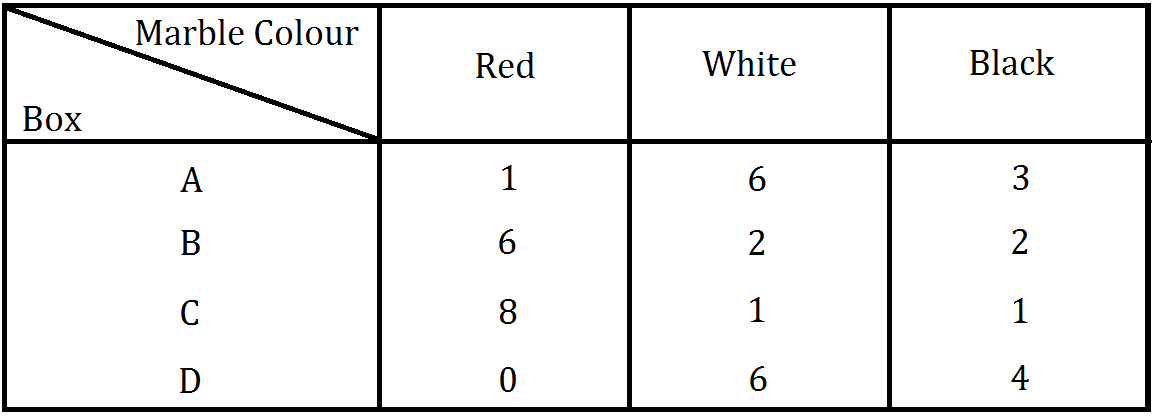
Suppose we have four boxes A, B, C, D containing coloured marbles as given below:
One of the boxes has been selected at random and a single marble is drawn from it. If the marble is red, what is the probability that it was drawn from,
  1. Box A?
  2. Box B?
  3. Box C?
Answer
$\text{P}\Big(\frac{\text{A}}{\text{Red}}\Big),\text{P}\Big(\frac{\text{B}}{\text{Red}}\Big),\text{P}\Big(\frac{\text{C}}{\text{Red}}\Big)$
Now,
$\text{P}\Big(\frac{\text{A}}{\text{Red}}\Big)=\frac{\text{P}\Big(\frac{\text{A}}{\text{Red}}\Big)\text{P(A)}}{\text{P}\Big(\frac{\text{A}}{\text{Red}}\Big)\text{P(A)}+\text{P}\Big(\frac{\text{B}}{\text{Red}}\Big)\text{P(B)}+\text{P}\Big(\frac{\text{C}}{\text{Red}}\Big)\text{P(C)}+\text{P}\Big(\frac{\text{D}}{\text{Red}}\Big)\text{P(D)}}$
$=\frac{\frac{1}{10}\times\frac{1}{4}}{\frac{1}{10}\times\frac{1}{4}+\frac{6}{10}\times\frac{1}{4}+\frac{8}{10}\times\frac{1}{4}+0}$
$=\frac{1}{1+6+8}=\frac{1}{15}$
Similarly,
$\text{P}\Big(\frac{\text{B}}{\text{Red}}\Big)=\frac{6}{15}$
$\text{P}\Big(\frac{\text{C}}{\text{Red}}\Big)=\frac{8}{15}$
View full question & answer
Question 965 Marks
A bag contains $4$ white and $5$ black balls and another bag contains $3$ white and $4$ black balls. A ball is taken out from the first bag and without seeing its colour is put in the second bag. A ball is taken out from the latter. Find the probability that the ball drawn is white.
Answer
There are two bags.
Bag $(1)$ contain $4$ white and $5$ black balls.
Bag $(2)$ contain $4$ white and $4$ black balls.
A ball is taken from bag $(i)$ and without seeing its colout is put in second bag.
Then a ball is drawn from bag $2$ and is white in colour.
$A ($White ball from bag $1) =\frac{4}{9}$
$\text{P}(\text{W}_1)=\frac{4}{9}$
$P($Black ball from bag $1) =\frac{5}{9}$
$\text{P}(\text{B}_1)=\frac{5}{9}$
$P($white ball from bag $2$ given $B_1$ transfer$)$
$\text{P}\Big(\frac{\text{W}_2}{\text{B}_1}\Big)=\frac{3}{8}$
$P($White from bag $2$ given $W_1$ transfer$)$
$\text{P}\Big(\frac{\text{W}_2}{\text{W}_2}\Big)=\frac{4}{8}$
$=\frac{1}{2}$
$P($white from bag $2)$
$=\text{P}(\text{B}_1)\text{P}\Big(\frac{\text{W}_2}{\text{B}_1}\Big)+\text{P}(\text{W}_1)\text{P}\Big(\frac{\text{W}_2}{\text{W}_1}\Big)$
$=\frac{5}{8}\times\frac{3}{8}+\frac{4}{9}\times\frac{1}{2}$
$=\frac{15}{72}+\frac{4}{18}$
$=\frac{31}{72}$
Required probability $=\frac{31}{72}$
View full question & answer
Question 975 Marks
If A and B are independent events such that P(A) = p, P(B) = 2p and P(Exactly one of A and B occurs) $=\frac{5}{9},$ then find the value or p.
Answer
As, A and B are independent events.
So, $\text{P}(\text{A}\cup\text{B})=\text{P(A)}\times\text{P(B)}\ .....(\text{i})$
Now,
P(Exactly one of A and B occurs) $=\frac{5}{9}$
$\Rightarrow\ \text{P(Only A)}+\text{P(Only B)}=\frac{5}{9}$
$\Rightarrow\ \big[\text{P(A)}-\text{P}(\text{A}\cup\text{B})\big]+\big[\text{P(B)}-\text{P}(\text{A}\cup\text{B})\big]=\frac{5}{9}$
$\Rightarrow\ \big[\text{P(A)}-\text{P}(\text{A})+\text{P}(\text{B})\big]\times\big[\text{P(B)}-\text{P}(\text{A})\times\text{P}(\text{B})\big]=\frac{5}{9}$
$\Rightarrow\ \text{P(A)}\times\big[1-\text{P}(\text{B})\big]+\text{P(B)}\big[1-\times\text{P}(\text{A})\big]=\frac{5}{9}$
$\Rightarrow\ \text{p}\big[1-2\text{p}\big]+2\text{p}\big[1-\text{p}\big]=\frac{5}{9}$
$=\text{p}-2\text{p}^2+2\text{p}-2\text{p}^2=\frac{5}{9}$
$\Rightarrow\ 3\text{p}-4\text{p}^2=\frac{5}{9}$
$\Rightarrow\ 27\text{p}-36\text{p}^2=5$
$\Rightarrow\ 36\text{p}^2-27\text{p}+5=0$
View full question & answer
Question 985 Marks
In a certain college, $4\%$ of boys and $1\%$ of girls are taller than $1.75$ metres. Further more, $60\%$ of the students in the colleges are girls. A student selected at random from the college is found to be taller than $1.75$ metres. Find the probability that the selected students is girl.
Answer
Consider the following events
$E_1 =$ The selected student is a girl
$E_2 =$ The selected student is not a girl
$A =$ The student is taller than $1.75$ meters
We have,
$\text{P}(\text{E}_1)=60\%=\frac{60}{100}=0.6$
$\text{P}(\text{E}_2)=1-\text{P}(\text{E}_1)=1-0.6=0.4$
$\text{P}\Big(\frac{\text{A}}{\text{E}_1}\Big)=$ Probability that the student is taller than $1.75$ meters given that the student is a girl
$\text{P}\Big(\frac{\text{A}}{\text{E}_1}\Big)=\frac{1}{100}=0.01$
And
$\text{P}\Big(\frac{\text{A}}{\text{E}_2}\Big)=$ Probability that the student is taller than $1.75$ meters given that the student is not a girl
$\text{P}\Big(\frac{\text{A}}{\text{E}_2}\Big)=\frac{4}{100}=0.04$
Now,
Required probability $\text{P}\Big(\frac{\text{E}_1}{\text{A}}\Big)=\frac{\text{P}(\text{E}_1)\text{P}\Big(\frac{\text{A}}{\text{E}_1}\Big)}{\text{P}(\text{E}_1)\text{P}\Big(\frac{\text{A}}{\text{E}_1}\Big)+\text{P}(\text{E}_2)\text{P}\Big(\frac{\text{A}}{\text{E}_2}\Big)}$
$=\frac{0.6\times0.01}{0.6\times0.01+0.4\times0.04}$
$=\frac{\frac{6}{1000}}{\frac{22}{1000}}$
$=\frac{3}{11}$
View full question & answer
5 Marks Questions - Page 2 - MATHS STD 12 Science Questions - Vidyadip