Question 15 Marks
Prove using vector: the quadrilateral obtained by joining mid-points of adjacent sides of a rectangle is a rhombus.
Answer
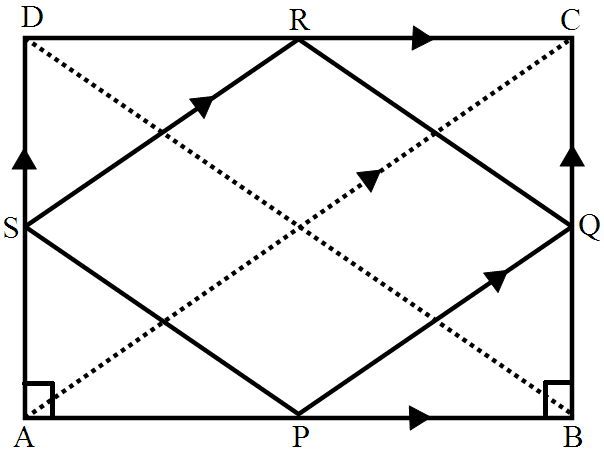 ABCD is a rectangle. Let P, Q, R and S be the mid-points of the sides AB, BC, CD and DA, respectively.Now,
$\vec{\text{PQ}} = \vec{\text{PB}} + \vec{\text{BQ}} = \frac{1}{2}\vec{\text{AB}} + \frac{1}{2}\vec{\text{BC}}$
$=\frac{1}{2}\big(\vec{\text{AB}}+\vec{\text{BC}}\big)=\frac{1}{2}\vec{\text{AC}}\dots(1)$
$\vec{\text{SR}} = \vec{\text{SD}} + \vec{\text{DR}} = \frac{1}{2}\vec{\text{AD}} + \frac{1}{2}\vec{\text{DC}}$
$=\frac{1}{2}\big(\vec{\text{AD}}+\vec{\text{DC}}\big)=\frac{1}{2}\vec{\text{AC}}\dots(2)$
From (1) and (2), we have
$\vec{\text{PQ}} = \vec{\text{SR}}$
So, the sides PQ and SR are equal and parallel. Thus, PQRS is a parallelogram.
Now,
$\big|\vec{\text{PQ}}\big|^{2}=\vec{\text{PQ}}.\vec{\text{PQ}}$
$\Rightarrow \big|\text{PQ}\big|^{2}=\big(\vec{\text{PB}} + \vec{\text{BQ}}\big).\big(\vec{\text{PB}} + \vec{\text{BQ}}\big)$
$\Rightarrow \big|\vec{\text{PQ}}\big|^2= \big|\vec{\text{PB}}\big|^{2} + 2\vec{\text{PB}}.\vec{\text{BQ}} + \big|\vec{\text{BQ}}\big|^{2}$
$\Rightarrow \big|\vec{\text{PQ}}\big|^2 = \big|\vec{\text{PB}}\big|^{2} + 0 + \big|\vec{\text{BQ}}\big|^2 $ $\big(\vec{\text{PB}} \perp \vec{\text{BQ}}\big)$
$\Rightarrow \big|\vec{\text{PQ}}\big|^{2} = \big|\vec{\text{PB}}\big|^{2} + \big|\vec{\text{BQ}}\big|^{2}\dots(3)$
Also,
$\big|\vec{\text{PS}}\big|^{2} = \vec{\text{PS}}.\vec{\text{PS}}$
$\Rightarrow\big|\vec{\text{PS}}\big|^{2} = \big(\vec{\text{PA}} + \vec{\text{AS}}\big).\big(\vec{\text{PA}} + \vec{\text{AS}}\big)$
$\Rightarrow \big|\vec{\text{PS}}\big|^{2} = \big|\vec{\text{PA}}\big|^{2}+ 2\vec{\text{PA}}.\vec{\text{AS}} + \big|\vec{\text{AS}}\big|^{2}$
$\Rightarrow \big|\vec{\text{PS}}\big|^{2} = \big|\vec{\text{PB}}\big|^{2} + 0 + \big|\vec{\text{BQ}}\big|^{2}$ $\big(\vec{\text{PA}} \perp \vec{\text{AS}}\big)$
$\Rightarrow \big|\vec{\text{PS}}\big|^{2} = \big|\vec{\text{PB}}\big|^{2} + \big|\vec{\text{BQ}}\big|^{2}\dots(4)$
From (3) and (4), we have
$\big|\vec{\text{PQ}}\big|^{2} = \big|\vec{\text{PS}}\big|^{2}$
$\Rightarrow \big|\vec{\text{PQ}}\big| = \big|\vec{\text{PS}}\big|$
So, the adjacent sides of the parallelogram are equal. Hence, PQRS is a rhombus. View full question & answer→Question 25 Marks
Express the vector $\vec{\text{a}}=5\hat{\text{i}}-2\hat{\text{j}}+5\hat{\text{k}}$ as the sum of two vectors such that one is parallel to the vector $\vec{\text{b}}=3\hat{\text{i}}+\hat{\text{k}}$ and other is perpendicular to $\vec{\text{b}}.$
AnswerGiven that $\vec{\text{a}}=5\hat{\text{i}}-2\hat{\text{j}}+5\hat{\text{k}}$ and $\vec{\text{b}}=3\hat{\text{i}}+\hat{\text{k}}$
Let $\vec{\text{x}}$ and $\vec{\text{y}} $ be such that
$\vec{\text{a}} =\vec{\text{x}} +\vec{\text{y}} $
$\Rightarrow\vec{\text{y}} =\vec{\text{a}} -\vec{\text{x}} \dots(1)$
Since $\vec{\text{x}}$ is parallei to $\vec{\text{b}},$
$\Rightarrow\vec{\text{x}}=\text{t}\vec{\text{b}}$ (t is constant)
$\Rightarrow\vec{\text{x}}=\text{t}\big(3\hat{\text{i}}+\vec{\text{k}}\big)=3\text{t}\hat{\text{i}}+\text{t}\hat{\text{k}}$
Substituting the values of $\vec{\text{x}}$ and $\vec{\text{a}}$ in (1), we get
$\vec{\text{y}}=5\hat{\text{i}}-2\hat{\text{j}}+5\hat{\text{k}}-\big(3\text{t}\hat{\text{i}}+\text{t}\hat{\text{k}}\big)=(5-3\text{t})\hat{\text{i}}-2\hat{\text{j}}+(5-\text{t})\hat{\text{k}}\dots(2)$
Since $\vec{\text{y}} $ is perpendicular to $\vec{\text{b}},$
$\vec{\text{y}}.\vec{\text{b}}=0$
$\Rightarrow\big[(5-3\text{t})\hat{\text{i}}-2\hat{\text{j}}+(5-\text{t})\hat{\text{k}}\big].\big(3\hat{\text{i}}+\hat{\text{k}}\big)=0$
$\Rightarrow3(5-3\text{t})+0+(5-\text{t})=0$
$\Rightarrow15-9\text{t}+5-\text{t}=0$
$\Rightarrow20-10\text{t}=0$
$\Rightarrow\text{t}=2$
From (1) and (2),we get
$\vec{\text{x}}=6\hat{\text{i}}+2\hat{\text{k}}$
$\vec{\text{y}}=-\hat{\text{i}}-2\hat{\text{j}}+3\hat{\text{k}}$
View full question & answer→Question 35 Marks
Express $2\hat{\text{i}}-\hat{\text{j}}+3\hat{\text{k}}$ as the sum of a vector parallel and a vector perpendicular to $2\hat{\text{i}}+4\hat{\text{j}}-2\hat{\text{k}}.$
AnswerLet $\big(2\hat{\text{i}}-\hat{\text{j}}+3\hat{\text{k}}\big)=\vec{\text{a}}+\vec{\text{b}}\dots(1)$
such that $\vec{\text{a}}$ is a vector parallel to vector $\big(2\hat{\text{i}}+4\hat{\text{j}}-2\hat{\text{k}}\big)$ and $\vec{\text{b}}$ is a vector perpendicular to the vector $\big(2\hat{\text{i}}+4\hat{\text{j}}-2\hat{\text{k}}\big).$
since, $\vec{\text{a}}$ is parallel to $\big(2\hat{\text{i}}+4\hat{\text{j}}-2\hat{\text{k}}\big)$
$\vec{\text{a}}=\lambda\big(2\hat{\text{i}}+4\hat{\text{j}}-2\hat{\text{k}}\big)$
$\vec{\text{a}}=2\lambda\hat{\text{i}}+4\lambda\hat{\text{j}}-2\lambda\hat{\text{k}}\dots(2)$
Put value of $\vec{\text{a}}$ in equation (1),
$\big(2\hat{\text{i}}-\hat{\text{j}}+3\hat{\text{k}}\big)=\big(2\lambda\hat{\text{i}}+4\lambda\hat{\text{j}}-2\lambda\hat{\text{k}}\big)+\vec{\text{b}}$
$\vec{\text{b}}=2\hat{\text{i}}-\hat{\text{j}}+3\hat{\text{k}}-2\lambda\hat{\text{j}}-4\lambda\hat{\text{j}}+2\lambda\hat{\text{k}}$
$\vec{\text{b}}=(2-2\lambda)\hat{\text{i}}+(-1-4\lambda)\hat{\text{j}}+(3+2\lambda)\hat{\text{k}}$
$\vec{\text{b}}$ is a vector perpendicuar to the vector $\big(2\hat{\text{i}}+4\hat{\text{j}}-2\hat{\text{k}}\big),$ then
$\vec{\text{b}}.\big(2\hat{\text{i}}+4\hat{\text{j}}-2\hat{\text{k}}\big)=0$
$\big[(2-2\lambda)\hat{\text{i}}+(-1-4\lambda)\hat{\text{j}}+(3+2\lambda)\hat{\text{k}}\big]\big(2\hat{\text{i}}+4\hat{\text{j}}-2\hat{\text{k}}\big)=0$
$(2-2\lambda)(2)+(-1-4\lambda)(4)+(3+2\lambda)(-2)=0$
$4-4\lambda-4-16\lambda-6-4\lambda=0$
$-6-24\lambda=0$
$-24\lambda=6$
$\lambda=-\frac{1}{4}$
Put $\lambda$ in equation (2),
$\vec{\text{a}}=2\lambda\hat{\text{i}}+4\lambda\hat{\text{j}}-2\lambda\hat{\text{k}}$
$=2\Big(-\frac{1}{4}\Big)\hat{\text{i}}+4\Big(-\frac{1}{4}\Big)\hat{\text{j}}-2\Big(-\frac{1}{4}\Big)\hat{\text{k}}$
$\vec{\text{a}}=-\frac{1}2{}\hat{\text{i}}-\hat{\text{j}}+\frac{1}2{}\hat{\text{k}}$
Put the value of $\vec{\text{a}}$ in equation (1),
$\big(2\hat{\text{i}}-\hat{\text{j}}+3\hat{\text{k}}\big)=\Big(-\frac{1}{2}\hat{\text{i}}-\hat{\text{j}}+\frac{1}{2}\hat{\text{k}}\Big)+\vec{\text{b}}$
$\vec{\text{b}}=2\hat{\text{i}}-\hat{\text{j}}+3\hat{\text{k}}+\frac{1}{2}\hat{\text{i}}+\hat{\text{j}}-\frac{1}{2}\hat{\text{k}}$
$=\frac{4\hat{\text{i}}-2\hat{\text{j}}+6\hat{\text{k}}+\hat{\text{i}}+2\hat{\text{j}}-\hat{\text{k}}}{2}$
$=\frac{5\hat{\text{i}}+5\hat{\text{k}}}{2}$
$\vec{\text{b}}=\frac{5}{2}\big(\hat{\text{i}}+\hat{\text{k}}\big)$
$\big(2\hat{\text{i}}-\hat{\text{j}}+3\hat{\text{k}}\big)=\Big(-\frac{1}{2}\hat{\text{i}}-\hat{\text{j}}+\frac{1}{2}\hat{\text{k}}\Big)+\frac{5}{2}\big(\hat{\text{i}}+\hat{\text{k}}\big)$
View full question & answer→Question 45 Marks
Show that the points whose position vectors are$\vec{\text{a}}=4\hat{\text{i}}-3\hat{\text{j}}+\hat{\text{k}}, \vec{\text{b}}=2\hat{\text{i}}-4\hat{\text{j}}+5\hat{\text{k}},\vec{\text{c}}=\hat{\text{i}}-\hat{\text{j}}$ from a right triangle.
AnswerGiven
$\vec{\text{a}}=4\hat{\text{i}}-3\hat{\text{j}}+\hat{\text{k}}$
$\vec{\text{b}}=2\hat{\text{i}}-4\hat{\text{j}}+5\hat{\text{k}}$
$\vec{\text{c}}=\hat{\text{i}}-\hat{\text{j}}$
$\overrightarrow{\text{AB}}$ = position vector of B - position vector of A
$=\big(2\hat{\text{i}}-4\hat{\text{j}}+5\hat{\text{k}}\big)-\big(4\hat{\text{i}}-3\hat{\text{j}}+\hat{\text{k}}\big)$
$=2\hat{\text{i}}-4\hat{\text{j}}+5\hat{\text{k}}-4\hat{\text{i}}+3\hat{\text{j}}-\hat{\text{k}}$
$\overrightarrow{\text{AB}}=-2\hat{\text{i}}-\hat{\text{j}}+4\hat{\text{k}}$
$\overrightarrow{\text{BC}}$ = position vector of C - position vector of B
$=\big(\hat{\text{i}}-\hat{\text{j}}\big)-\big(2\hat{\text{i}}-4\hat{\text{j}}+5\hat{\text{k}}\big)$
$=\hat{\text{i}}-\hat{\text{j}}-2\hat{\text{i}}+4\hat{\text{j}}-5\hat{\text{k}}$
$=-\hat{\text{i}}+3\hat{\text{j}}-5\hat{\text{k}}$
$\overrightarrow{\text{CA}}$ = position vector of A - position vector of C
$=\big(4\hat{\text{i}}-3\hat{\text{j}}+\hat{\text{k}}\big)-\big(\hat{\text{i}}-\hat{\text{j}}\big)$
$=4\hat{\text{i}}-3\hat{\text{j}}+\hat{\text{k}}-\hat{\text{i}}+\hat{\text{j}}$
$=3\hat{\text{i}}-2\hat{\text{j}}+\hat{\text{k}}$
View full question & answer→Question 55 Marks
Find the angles which the vector $\vec{\text{a}}=\hat{\text{i}}-\hat{\text{j}}+\sqrt{2}\hat{\text{k}}$ makes with the coordinate axes.
AnswerLet $\theta_{1}$ be the angle between $\vec{\text{a}}$ and x-axis.
$\big|\vec{\text{a}}\big|=\sqrt{(1)^2+(-1)^2+(\sqrt{2})^2}=\sqrt{4}=2$
$\vec{\text{b}}=\hat{\text{i}}$ (Because $\hat{\text{i}}$ is the unit vector along x-axis)
$\big|\vec{\text{b}}\big|=\sqrt{(1)^2}=\sqrt{1}=1$
$\vec{\text{a}}.\vec{\text{b}}=1+0+0=1$
$\cos\theta_{1}=\frac{\vec{\text{a}} .\vec{\text{b}}}{\big|\vec{a}\big|\big|\vec{b}\big|}=\frac{1}{(2)(1)}=\frac{1}{2}$
$\Rightarrow\theta_{1}=\cos^{-1}\big(\frac{1}{2}\big)=\frac{\pi}{3}$
Let $\theta_{2}$ be the angle between $\vec{\text{a}}$ and y-axis.
$\big|\vec{\text{a}}\big|=\sqrt{(1)^2+(-1)^2+(\sqrt{2})^2}=\sqrt{4}=2$
$\vec{\text{b}}=\hat{\text{j}}$(Because $\hat{\text{j}}$ is the unit vector along y-axis)
$\big|\vec{\text{b}}\big|=\sqrt{(1)^2}=\sqrt{1}=1$
$\vec{\text{a}}.\vec{\text{b}}=0-1+0=-1$
$\cos\theta_{2}=\frac{\vec{\text{a}} .\vec{\text{b}}}{\big|\vec{a}\big|\big|\vec{b}\big|}=\frac{-1}{(2)(1)}=\frac{-1}{2}$
$\Rightarrow\theta_{2}=\cos^{-1}\big(\frac{-1}{2}\big)=\frac{2\pi}{3}$
Let $\theta_{3}$ be the angle between $\vec{\text{a}}$ and z-axis.
$\big|\vec{\text{a}}\big|=\sqrt{(1)^2+(-1)^2+(\sqrt{2})^2}=\sqrt{4}=2$
$\vec{\text{b}}=\hat{\text{k}}$ (Because $\hat{\text{k}}$ is the unit vector along z-axis)
$\big|\vec{\text{b}}\big|=\sqrt{(1)^2}=\sqrt{1}=1$
$\vec{\text{a}}.\vec{\text{b}}=0+0+\sqrt{2}=\sqrt{2}$
$\cos\theta=\frac{\vec{\text{a}} .\vec{\text{b}}}{\big|\vec{a}\big|\big|\vec{b}\big|}=\frac{\sqrt{2}}{(2)(1)}=\frac{1}{\sqrt2}$
$\Rightarrow\theta=\cos^{-1}\big(\frac{1}{\sqrt2}\big)=\frac{\pi}{4}$
View full question & answer→Question 65 Marks
Prove that the diagonals of a rhombus are perpendicular bisectors of each other.
Answer
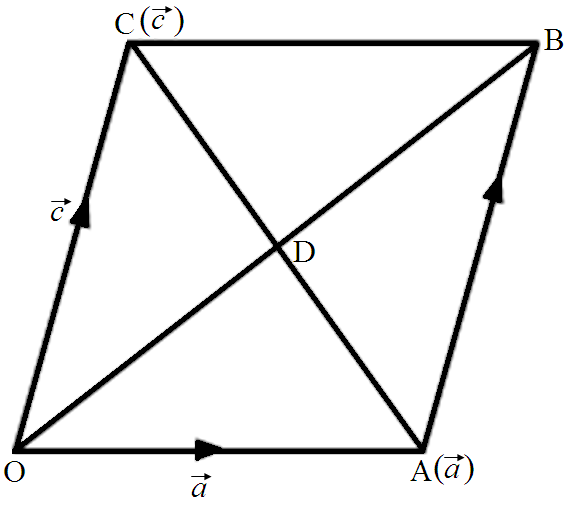 Let OABC be a rhombus, whose diagonals OB and AC intersect at D. suppose O is origin.Let the position vector of A and C be $\vec{\text{a}}$ and $\vec{\text{c}},$ respectively. Then,
$\vec{\text{OA}} = \vec{\text{a}}$ and $\vec{\text{OC}} =\vec { \text{c}}$
In $\triangle \text{OAB,}$
$\vec{\text{OB}} = \vec{\text{OA}} + \vec{\text{AB}} = \vec{\text{OA}} + \vec{\text{OC}} = \vec{\text{a}} + \vec{\text{c}}$ $\big(\vec{\text{AB}} = \vec{\text{OC}}\big)$
Position vector of mid-point of $\vec{\text{OB}} = \frac{1}{2}\big(\vec{\text{a}} + \vec{\text{c}}\big)$
position vector of mid-point of $\vec{\text{AC}} = \frac{1}{2}\big(\vec{\text{a}} + \vec{\text{c}}\big)$ (mid-point formula)
So, the mid-points of OB and AC coincide. Thus, the diagonals OB and AC bisect each other.
Now,
$\vec{\text{OB}}.\vec{\text{AC}} = \big(\vec{\text{a}} + \vec{\text{c}}\big).\big(\vec{\text{c}}-\vec{\text{a}}\big)$
$= \big(\vec{\text{c}} + \vec{\text{a}}\big).\big(\vec{\text{c}} - \vec{\text{a}}\big)$
$= \big|\vec{\text{c}}\big|^{2} - \big|\vec{\text{a}}\big|^{2}$
$= \big|\vec{\text{OC}}\big|^{2} - \big|\vec{\text{OA}}\big|^{2}$
$= 0 $ $\big(\big|\vec{\text{OC}}\big| = \big|\vec{\text{OA}}\big|\big)$
$\Rightarrow \vec{\text{OB}} \perp \vec{\text{AC}}$
Hence, the diagonals OB and AC are perpendicular to each other.
Thus, the diagonals of a rhombus are perpendicular bisectors of each other. View full question & answer→Question 75 Marks
Prove by vector method that the sum of the squares of the diagonals of a parallelogram is equal to the sum squares of its sides.
Answer
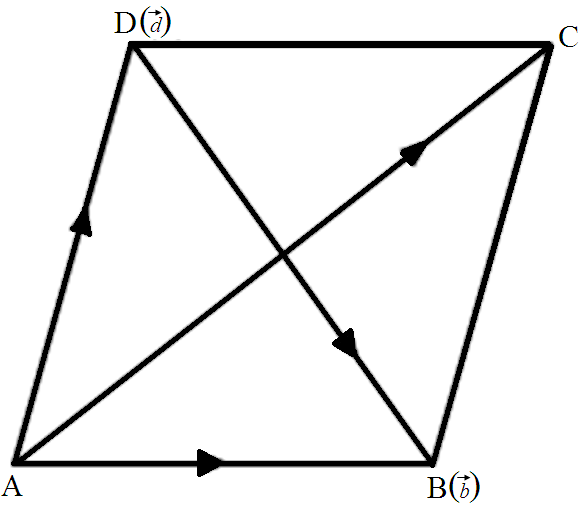 Let ABCD be a parallelogram such that AC and BD are its two diagonals.Taking A as the origin, let the position vectors of B and D be $\vec{\text{b}}$ and $\vec{\text{d}},$ respectively.Then,$\vec{\text{AB}} = \vec{\text{b}}$ and $\vec{\text{AD}} = \vec{\text{d}}$
Using triangle law of vector addition, we have
$\vec{\text{AD}} + \vec{\text{DB}} = \vec{\text{AB}}$
$\Rightarrow \vec{\text{DB}} = \vec{\text{b}} - \vec{\text{d}}$
In $\triangle\text{ ABC,}$
$\vec{\text{AC}} = \vec{\text{AB}} + \vec{\text{BC}} = \vec{\text{AB}} + \vec{\text{AD}} = \vec{\text{b}} + \vec{\text{d}}$
Now,
$\big|\vec{\text{AB}}\big|^{2} + \big|\vec{\text{BC}}\big|^{2}+\big|\vec{\text{CD}}\big|^2+ \big|\vec{\text{DA}}\big|^{2}$
$=\big|\vec{\text{AB}}\big|^{2} + \big|\vec{\text{AD}}\big|^{2} + \big|-\vec{\text{AB}}\big|^{2} + \big|-\vec{\text{AD}}\big|^{2}$
$=2\big|\vec{\text{AB}}\big|^{2} + 2\big|\vec{\text{AD}}\big|^{2}$
$=2\big|\vec{\text{b}}\big|^{2} + 2\big|\vec{\text{d}}\big|^{2}\dots(1)$
Also,
$\big|\vec{\text{DB}}\big|^{2} + \big|\vec{\text{AC}}\big|^{2}$
$=\big|\vec{\text{b}}-\vec{\text{d}}\big|^{2} + \big|\vec{\text{b}} + \vec{\text{d}}\big|^{2}$
$=\big(\vec{\text{b}} - \vec{\text{d}}\big).\big(\vec{\text{b}} - \vec{\text{d}}\big) + \big(\vec{\text{b}} + \vec{\text{d}}\big).\big(\vec{\text{b}} + \vec{\text{d}}\big)$
$=\big|\vec{\text{b}}\big| ^ 2 - 2\vec{\text{b}}.\vec{\text{d}} + \big|\vec{\text{d}}\big|^{2} + \big|\vec{\text{b}}\big|^{2}+2\vec{\text{b}}.\vec{\text{d}} + \big|\vec{\text{d}}\big|^{2}$
$=2\big|\vec{\text{b}}\big|^{2} + 2\big|\vec{\text{d}}\big|^{2}\dots(2)$
From (1) and (2), we have
$\big|\vec{\text{AB}}\big|^{2} + \big|\vec{\text{BC}}\big|^{2} + \big|\vec{\text{CD}}\big|^{2} + \big|\vec{\text{DA}}\big|^{2}=\big|\vec{\text{DB}}\big|^{2} = \big|\vec{\text{AC}}\big|^{2}$ View full question & answer→Question 85 Marks
Find the values of x and y if the vectors $\vec{\text{a}}=3\hat{\text{i}}+\text{x}\hat{\text{j}}-\hat{\text{k}}$ and $\vec{\text{b}}=2\hat{\text{i}}+\hat{\text{j}}+\text{y}\hat{\text{k}}$ are mutually perpendicular vectors of equal magnitude.
AnswerWe have
$\vec{\text{a}}=3\hat{\text{i}}+\text{x}\hat{\text{j}}-\hat{\text{k}}$ and $\vec{\text{b}}=2\hat{\text{i}}+\hat{\text{j}}+\text{y}\hat{\text{k}}$
It is given that the vectors are perpendicular.
$\Rightarrow\vec{\text{a}}.\vec{\text{b}}=0$
$\Rightarrow6+\text{x}-\text{y}=0$
$\Rightarrow\text{x}-\text{y}=-6\dots(1)$
Also, it is given that
$|\vec{\text{a}}|=\big|\vec{\text{b}}\big|$
$\Rightarrow\sqrt{9+\text{x}^2+1}=\sqrt{4+1+\text{y}^2}$
$\Rightarrow\sqrt{10+\text{x}^2}=\sqrt{5+\text{y}^2}$
$\Rightarrow10+\text{x}^2=5+\text{y}^2$
$\Rightarrow\text{x}^2-\text{y}^2=-5$
View full question & answer→Question 95 Marks
If the median to the base of a triangle is perpendicular to the base, then triangle is isosceles.
Answer
 Let $\triangle \text{ABC}$ be a triangle such that AD is the median. Taking A as the origin, let the position vectors of B and C be $\vec{\text{b}}$ and $\vec{\text{c}},$ respectively. Then,position vector of $\text{D} = \frac{\vec{\text{b}} + \vec{\text{c}}}{2}$ (mid-point formula)
Now,
$\vec{\text{AD}} = $ position vector of D-podition vector of $\text{A}= \frac{\vec{\text{b}} + \vec{\text{c}}}{2}$
$\vec{\text{BC}} = $ position vector of C-position vector of $\text{B} = \vec{\text{C}} - \vec{\text{b}}$
Since $\vec{\text{AD}} \perp \vec{\text{BC}},$
$\therefore\vec{\text{AD}}.\vec{\text{BC}} = 0$
$\Rightarrow\frac{1}{2}\big(\vec{\text{b}}+ \vec{\text{c}}\big).\big(\vec{\text{c}} - \vec{\text{b}}\big)=0$
$\Rightarrow \big(\vec{\text{c}} + \vec{\text{b}}\big).\big(\vec{\text{c}}- \vec{\text{b}}\big) = 0$
$\Rightarrow|\vec{\text{c}}|^{2} - \big|\vec{\text{b}}\big|^{2} = 0$
$\Rightarrow|\vec{\text{c}}| =\big| \vec{\text{b}}\big|$
$\Rightarrow \text{AC} = \text{AB}$
Hence, the $\triangle \text{ABC }$ is an isosceles triangle. View full question & answer→Question 105 Marks
If either $\vec{\text{a}}=\vec{0}$ or $\vec{\text{b}}=\vec{0},$ then $\vec{\text{a}}.\vec{\text{b}}=0.$ But the converse need not be true. Justify your answer with an example.
AnswerLet us assume that either $|\vec{\text{a}}|=0$ or $\big|\vec{\text{b}}\big|=0$Then, $\vec{\text{a}}.\vec{\text{b}}=|\vec{\text{a}}|\big|\vec{\text{b}}\big|\cos\theta=0$ ($\theta$ is the angle between $\vec{\text{a}}$ and $\vec{\text{b}}$)
Now, let us assume that $\vec{\text{a}}.\vec{\text{b}}=0$
$\Rightarrow|\vec{\text{a}}|\big|\vec{\text{b}}\big|\cos\theta=0$
But here we cannot say that either $|\vec{\text{a}}|=0$ or $\big|\vec{\text{b}}\big|=0$. (Because even $\cos\theta$ can be zero)
For example, let
$\vec{\text{a}}=2\hat{\text{i}}+\hat{\text{j}}+3\hat{\text{k}}$ and $\vec{\text{b}}=-3\hat{\text{i}}+2\hat{\text{k}}$
Here, $|\vec{\text{a}}|=\sqrt{4+1+9}=\sqrt{14}\neq0$
$\big|\vec{\text{b}}\big|=\sqrt{9+4}=\sqrt{13}\neq0$
But $\vec{\text{a}}.\vec{\text{b}}=\big(2\hat{\text{i}}+\hat{\text{j}}+3\hat{\text{k}}\big).\big(-3\hat{\text{i}}+2\hat{\text{k}}\big)=-6+0+6=0$
View full question & answer→Question 115 Marks
If $\hat{\text{a}}$ and $\hat{\text{b}}$ are unit vectors inclined at an angle $\theta$, prove that$\tan\frac{\theta}{2}=\frac{\big|\hat{\text{a}}-\hat{\text{b}}\big|}{\big|\hat{\text{a}}+\hat{\text{b}}\big|}$
AnswerHere, $\hat{\text{a}}$ and $\hat{\text{b}}$ are unit vectors
$\big|\hat{\text{a}}\big|=\big|\hat{\text{b}}\big|=1$
$\frac{\big|\hat{\text{a}}-\hat{\text{b}}\big|^2}{\big|\hat{\text{a}}+\hat{\text{b}}\big|^2}=\frac{(\hat{\text{a}}-\hat{\text{b}})^2}{(\hat{\text{a}}+\hat{\text{b}})^2}$
$=\frac{(\hat{\text{a}})^2+(\hat{\text{b}})^2-2\hat{\text{a}}.\hat{\text{b}}}{(\hat{\text{a}})^2+(\hat{\text{b}})^2+2\hat{\text{a}}.\hat{\text{b}}}$
$=\frac{\big|\hat{\text{a}}\big|^2+\big|\hat{\text{b}}\big|^2-2\hat{\text{a}}.\hat{\text{b}}}{\big|\hat{\text{a}}\big|^2+\big|\hat{\text{b}}\big|^2+2\hat{\text{a}}.\hat{\text{b}}}$
$\frac{\big|\hat{\text{a}}-\hat{\text{b}}\big|^2}{\big|\hat{\text{a}}+\hat{\text{b}}\big|^2}=\frac{(1)^2+(1)^2-2\big|\vec{\text{a}}\big|\big|\vec{\text{b}}\big|\cos\theta}{(1)^2+(1)^2+2\big|\vec{\text{a}}\big|\big|\vec{\text{b}}\big|\cos\theta}$ $\big[\text{since }\vec{\text{a}}.\vec{\text{b}}=\big|\vec{\text{a}}\big|\big|\vec{\text{b}}\big|\cos\theta\big]$
$\frac{\big|\hat{\text{a}}-\hat{\text{b}}\big|^2}{\big|\hat{\text{a}}+\hat{\text{b}}\big|^2}=\frac{1+1-2(1)(1)\cos\theta}{1+1+2(1)(1)\cos\theta}$
$=\frac{2-2\cos\theta}{2+2\cos\theta}$
$=\frac{2(1-\cos\theta)}{2(1+\cos\theta)}$
$=\frac{2\times\sin^2\frac{\theta}{2}}{2\times\cos^2\frac{\theta}{2}}$ $\Big[\text{Since}1-\cos\theta=2\sin^2\frac{\theta}{2},1+\cos\theta=2\cos^2\frac{\theta}{2}\Big]$
$\frac{\big|\hat{\text{a}}-\hat{\text{b}}\big|^2}{\big|\hat{\text{a}}+\hat{\text{b}}\big|^2}=\tan^2\frac{\theta}{2}$
$\tan\frac{\theta}{2}=\frac{\big|\hat{\text{a}}-\hat{\text{b}}\big|^2}{\big|\hat{\text{a}}+\hat{\text{b}}\big|^2}$
View full question & answer→Question 125 Marks
A unit vector $\vec{\text{a}}$ makes angles $\frac{\pi}{4}$ and $\frac{\pi}{3}$ with $\hat{\text{i}}$ and $\hat{\text{j}}$ respectively and an acute angle $\theta$ with $\hat{\text{k}}$. find the angle $\theta$ and components of $\vec{\text{a}}$ .
AnswerLet $\vec{\text{a}}=\text{a}_{1}\hat{\text{i}}+\text{a}_2\hat{\text{j}}+\text{a}_3\hat{\text{k}},$ where $\text{a}_1,\text{a}_2$ and $\text{a}_3$ are components of $\vec{\text{a}.}$
$\Rightarrow{\text{a}_1}^2+{\text{a}_2}^2+{\text{a}_3}^2=1$ (Because $\vec{\text{a}}$ is a unit vector) ...(1)
Now,
$\vec{\text{a}}.\hat{\text{i}}=\text{a}_1$
$\Rightarrow|\vec{\text{a}}||\hat{\text{i}}|\cos\frac{\pi}{4}=\text{a}_1$ (Because the angle between $\vec{\text{a}}$ and $\hat{\text{i}}$ is $\frac{\pi}{4}$)
$\Rightarrow(1)(1)\frac{1}{\sqrt{2}}=\text{a}_1$ (Because $\vec{\text{a}}$ and $\hat{\text{i}}$ are unit vectors)
$\Rightarrow \text{a}_1=\frac{1}{\sqrt{2}}$
Again,
$\vec{\text{a}}.\hat{\text{j}}=\text{a}_2$
$\Rightarrow|\vec{\text{a}}||\hat{\text{i}}|\cos\frac{\pi}{3}=\text{a}_2$ (Becasue the angle between $\vec{\text{a}}$ and $\hat{\text{i}}$ is $\frac{\pi}{3}$)
$\Rightarrow(1)(1)\frac{1}{2}=\text{a}_2$ (Because $\vec{\text{a}}$ and $\hat{\text{i}}$ are unite vectors)
$\Rightarrow{\text{a}}_2=\frac{1}{2}$
Now from (1),
$\Big(\frac{1}{\sqrt{2}}\Big)^2+\big(\frac{1}{2}\big)^2+{\text{a}_3}^2=1$
View full question & answer→Question 135 Marks
If $\vec{\alpha}=3\hat{\text{i}}+4\hat{\text{j}}+5\hat{\text{k}}$ and $\vec{\beta}=2\hat{\text{i}}+\hat{\text{j}}-4\hat{\text{k}},$ then express $\vec{\beta}$ in the form of $\vec{\beta}=\vec{\beta}_1+\vec{\beta}_2,$ where $\vec{\beta}_1$ is parallel to $\vec{\alpha}$ and $\vec{\beta}_2$ is perpendicular to $\vec{\alpha}$.
AnswerGiven that $\vec{\alpha}=3\hat{\text{i}}+4\hat{\text{j}}+5\hat{\text{k}}$ and $\vec{\beta}=2\hat{\text{i}}+\hat{\text{j}}-4\hat{\text{k}}$
Also,
$\vec{\beta}=\vec{\beta}_1+\vec{\beta}_2,$
$\Rightarrow\vec{\beta}_2=\vec{\beta}+\vec{\beta}_1\dots(1)$
Since $\vec{\beta}_1$ is parallel to $\vec{\alpha},$
$\vec{\beta}_1=\text{t}\vec{\alpha}$
$\Rightarrow\vec{\beta}_1=\text{t}\big(3\hat{\text{i}}+4\hat{\text{j}}+5\hat{\text{k}}\big)=3\text{t}\hat{\text{i}}+4\text{t}\hat{\text{j}}+5\text{t}\hat{\text{k}}\dots(2)$
Substituting the values of $\vec{\beta}_1$ and $\vec{\alpha}$ in (1),we get
$\vec{\beta}_2=2\hat{\text{i}}+\hat{\text{j}}-4\hat{\text{k}}-\big(3\text{t}\hat{\text{i}}+4\text{t}\hat{\text{j}}+5\text{t}\hat{\text{k}}\big)\\=(2-3\text{t})\hat{\text{i}}+(1-4\text{t})\hat{\text{j}}+(-4-5\text{t})\hat{\text{k}}\dots(3)$Since $\vec{\beta}_2$ is perpendicular to $\vec{\alpha},$
$\vec{\beta}_2.\vec{\alpha}=0$
$\Rightarrow\Big[(2-3\text{t})\hat{\text{i}}+(1-4\text{t})\hat{\text{j}}+(-4-5\text{t})\hat{\text{k}}\Big].\big(3\hat{\text{i}}+4\hat{\text{j}}+5\hat{\text{k}}\big)=0$
$\Rightarrow3(2-3\text{t})+4(1-4\text{t})+5(-4-5\text{t})=0$
$\Rightarrow6-9\text{t}+4-16\text{t}-20-25\text{t}=0$
$\Rightarrow-50\text{t}=10$
$\Rightarrow\text{t}=\frac{-1}{5}$
From (2) and (3), we get
$\vec{\beta}_1=\frac{-1}{5}\big(3\hat{\text{i}}+4\hat{\text{j}}+5\hat{\text{k}}\big)$
$\vec{\beta}_2=\frac{13}{5}\hat{\text{i}}+\frac{9}{5}\hat{\text{j}}-3\hat{\text{k}}=\frac{1}{5}\big(13\hat{\text{i}}+9\hat{\text{j}}-15\hat{\text{k}}\big)$
View full question & answer→Question 145 Marks
Show that the vector $\hat{\text{i}}+\hat{\text{j}}+\hat{\text{k}}$ is equally inclined to the coordinate axes.
AnswerLet $\theta_1$ be the angle between $\vec{\text{a}}$ and x-axis.
$|\vec{\text{a}}|=\sqrt{(1)^2+(1)^2+(1)^2}=\sqrt{3}$
$\vec{\text{b}}=\hat{\text{i}}$ (Because $\hat{\text{i}}$ is the unit vector along x-axis)
$\big|\vec{\text{b}}\big|=\sqrt{(1)^2}=\sqrt{1}=1$
$\vec{\text{a}}.\vec{\text{b}}=1+0+0=1$
$\cos\theta_{1}=\frac{\vec{\text{a}}.\vec{\text{b}}}{|\vec{a}|\big|\vec{\text{b}}\big|}=\frac{1}{(\sqrt{3})(1)}=\frac{1}{\sqrt{3}}$
$\Rightarrow\theta_{1}=\cos^{-1}\Big(\frac{1}{\sqrt{3}}\Big)\dots(1)$
Let $\theta_{2}$ be the angle between $\vec{\text{a}}$ and y-axis.
$|\vec{\text{a}}|=\sqrt{(1)^2+(1)^2+(1)^2}=\sqrt{3}$
$\vec{\text{b}}=\hat{\text{j}}$ (Because $\hat{\text{j}}$ is the unit vector along y-axis)
$\big|\vec{\text{b}}\big|=\sqrt{(1)^2}=\sqrt{1}=1$
$\vec{\text{a}}.\vec{\text{b}}=0+1+0=1$
$\cos\theta_{2}=\frac{\vec{\text{a}}.\vec{\text{b}}}{|\vec{a}|\big|\vec{\text{b}}\big|}=\frac{1}{(\sqrt{3})(1)}=\frac{1}{\sqrt{3}}$
$\Rightarrow\theta_{2}=\cos^{-1}\Big(\frac{1}{\sqrt{3}}\Big)\dots(2)$
Let $\theta_{3}$ be the angle between $\vec{\text{a}}$ and z-axis.
$|\vec{\text{a}}|=\sqrt{(1)^2+(1)^2+(1)^2}=\sqrt{3}$
$\vec{\text{b}}=\hat{\text{k}}$ (Because $\hat{\text{k}}$ is the unit vector along z-axis)
$\big|\vec{\text{b}}\big|=\sqrt{(1)^2}=\sqrt{1}=1$
$\vec{\text{a}}.\vec{\text{b}}=0+0+1=1$
$\cos\theta=\frac{\vec{\text{a}}.\vec{\text{b}}}{|\vec{a}|\big|\vec{\text{b}}\big|}=\frac{1}{(\sqrt{3})(1)}=\frac{1}{\sqrt{3}}$
$\Rightarrow\theta=\cos^{-1}\Big(\frac{1}{\sqrt{3}}\Big)\dots(3)$
From (1), (2) and (3), the given vector is equally inclined to the coordinate axes.
View full question & answer→Question 155 Marks
In a triangle OAB, $\angle\text{AOB}=90^\circ.$ If P and Q are points of trisection of AB, prove that $\text{OP}^2+\text{OQ}^2=\frac{5}{9}\text{AB}^2.$
AnswerLet $\vec{\text{o}},\vec{\text{a}}$ and $\vec{\text{b}}$ be the position vector of the O,A and B.
P and Q are points of trisection of AB.
Position vector of point $\text{P}= \frac{2\vec{\text{a}}+\vec{\text{b}}}{3}$
Position vector of point $\text{Q}= \frac{\vec{\text{a}}+2\vec{\text{b}}}{3}$
$\text{OP}=\frac{2\vec{\text{a}}+\vec{\text{b}}}{3}-\vec{\text{O}}=\frac{2\vec{\text{a}}+\vec{\text{b}}-3\vec{\text{o}}}{3}=\frac{20\text{A+OB}}{3}$
$\text{OQ}=\frac{\vec{\text{a}}+2\vec{\text{b}}}{3}-\vec{\text{O}}=\frac{\vec{\text{a}}+2\vec{\text{b}}-3\vec{\text{o}}}{3}=\frac{\text{OA+2OB}}{3}$
$\text{OP}^2+\text{OQ}^2=\Big(\frac{2\text{OA}+\text{OB}}3\Big)^{2}+\Big(\frac{\text{OA}+2\text{OB}}{3}\Big)^{2}$
$\frac{5(\text{OA}^{2}+\text{OB}^{2})+8(\text{OA})(\text{OB})\cos90^{\circ}}{9}$
$=\frac{5}{9}\text{AB}^{2}\dots \big[\because \text{OA}^{2}+\text{OB}^{2}=\text{AB}^{2} \text{and}\cos90^{\circ}=0\big]$
View full question & answer→Question 165 Marks
Let $\vec{\text{u}},\vec{\text{v}}$ and $\vec{\text{w}}$ be vectors such $\vec{\text{u}}+\vec{\text{v}}+\vec{\text{w}}=\vec{0}.$ If $|\vec{\text{u}}|=3,|\vec{\text{v}}|=4$ and $|\vec{\text{w}}|=5,$ then find $\vec{\text{u}}.\vec{\text{v}}+\vec{\text{v}}.\vec{\text{w}}+\vec{\text{w}}.\vec{\text{u}}.$
AnswerHere, $\vec{\text{u}}+\vec{\text{v}}+\vec{\text{w}}=0$
Squaring both the sides,
$\big(\vec{\text{u}}+\vec{\text{v}}+\vec{\text{w}}\big)^2=(0)^2$
$|\vec{\text{u}}|^2+|\vec{\text{v}}|^2+|\vec{\text{w}}|^2+2\vec{\text{u}}\vec{\text{v}}+2\vec{\text{v}}\vec{\text{w}}+2\vec{\text{w}}\vec{\text{u}}=0$
$(3)^2+(4)^2+(5)^2+2\big(\vec{\text{u}}.\vec{\text{v}}+\vec{\text{v}}.\vec{\text{w}}+\vec{\text{w}}.\vec{\text{u}}\big)=0$
$9+16+25+2\big(\vec{\text{u}}\vec{\text{v}}+\vec{\text{v}}\vec{\text{w}}+\vec{\text{w}}\vec{\text{u}}\big)=0$
$2\big(\vec{\text{u}}\vec{\text{v}}+\vec{\text{v}}\vec{\text{w}}+\vec{\text{w}}\vec{\text{u}}\big)=-50$
$\vec{\text{u}}\vec{\text{v}}+\vec{\text{v}}\vec{\text{w}}+\vec{\text{w}}\vec{\text{u}}=\frac{-50}{2}$
$\vec{\text{u}}\vec{\text{v}}+\vec{\text{v}}\vec{\text{w}}+\vec{\text{w}}\vec{\text{u}}=-25$
View full question & answer→Question 175 Marks
If $\vec{\text{a}}$ and $\vec{\text{b}}$ are two non-collinear unit vectors such that $\big|\vec{\text{a}}+\vec{\text{b}}\big|=\sqrt{3},$ find $\big(2\vec{\text{a}}-5\vec{\text{b}}\big).\big(3\vec{\text{a}}+\vec{\text{b}}\big).$
AnswerGiven
$\vec{\text{a}}$ and $\vec{\text{b}}$ are unit vectors
then, $|\vec{\text{a}}|=\big|\vec{\text{b}}\big|=1$
$\big|\vec{\text{a}}+\vec{\text{b}}\big|=\sqrt{3}$
Squaring both the sides,
$\big|\vec{\text{a}}+\vec{\text{b}}\big|^2=(\sqrt{3})^2$
$|\vec{\text{a}}|^2+\big|\vec{\text{b}}\big|^2+2\vec{\text{a}}.\vec{\text{b}}=3$
$1+1+2\vec{\text{a}}.\vec{\text{b}}=3$
$2+2\vec{\text{a}}.\vec{\text{b}}=3$
$2\vec{\text{a}}.\vec{\text{b}}=3-2$
$2\vec{\text{a}}.\vec{\text{b}}=1$
$2\vec{\text{a}}.\vec{\text{b}}=\frac{1}{2}$
View full question & answer→Question 185 Marks
Decompose the vector $6\hat{\text{i}}-3\hat{\text{j}}-6\hat{\text{k}}$ into vectors which are parallal and perpendicular to the vector $\hat{\text{i}}+\hat{\text{j}}+\hat{\text{k}}.$
AnswerLet $\vec{\text{a}}=6\hat{\text{i}}-3\hat{\text{j}}-6\hat{\text{k}}$ and $\vec{\text{b}}=\hat{\text{i}}+\hat{\text{j}}+\hat{\text{k}}$
and $\vec{\text{x}}$ and $\vec{\text{y}}$ be such that
$\vec{\text{a}}=\vec{\text{x}}+\vec{\text{y}}$
$\Rightarrow\vec{\text{y}}=\vec{\text{a}}-\vec{\text{x}}\dots(1)$
Since $\vec{\text{x}}$ is parallel to $\vec{\text{b}},$
$\vec{\text{x}}=\text{t}\vec{\text{b}}$
$\Rightarrow\vec{\text{x}}=\text{t}\big(\hat{\text{i}}+\hat{\text{j}}+\hat{\text{k}}\big)=\text{t}\hat{\text{i}}+\text{t}\hat{\text{j}}+\text{t}\hat{\text{k}}\dots(2)$
Substituting the values of $\vec{\text{x}}$ and $\vec{\text{a}}$ in (1), we get
$\vec{\text{y}}=6\hat{\text{i}}-3\hat{\text{j}}-6\hat{\text{k}}-\big(\text{t}\hat{\text{i}}+\text{t}\hat{\text{j}}+\text{t}\hat{\text{k}}\big)=(6-\text{t})\hat{\text{i}}+(-3-\text{t})\hat{\text{j}}+(-6-\text{t})\hat{\text{k}}\dots(3)$
Since $\vec{\text{y}}$ is perpendicular to $\vec{\text{b}},$
$\vec{\text{y}}.\vec{\text{b}}=0$
$\Rightarrow\big[(6-\text{t})\hat{\text{i}}+(-3-\text{t})\hat{\text{j}}+(-6-\text{t})\hat{\text{k}}\big].\big(\hat{\text{i}}+\hat{\text{j}}+\hat{\text{k}}\big)=0$
$\Rightarrow1(6-\text{t})+1(-3-\text{t})+1(-6-\text{t})=0$
$\Rightarrow-3-3\text{t}=0$
$\Rightarrow\text{t}=-1$
From (2) and (3), we get
$\vec{\text{x}}=-\hat{\text{i}}-\hat{\text{j}}-\hat{\text{k}}$
$\vec{\text{y}}=7\hat{\text{i}}-2\hat{\text{j}}-5\hat{\text{k}}$
So,
$\vec{\text{a}}=\vec{\text{x}}+\vec{\text{y}}=\big(-\hat{\text{i}}-\hat{\text{j}}-\hat{\text{k}}\big)+\big(7\hat{\text{i}}-2\hat{\text{j}}-5\hat{\text{k}}\big)$
View full question & answer→Question 195 Marks
If $\big|\vec{\text{a}}+\vec{\text{b}}\big|=60,\big|\vec{\text{a}}-\vec{\text{b}}\big|=40$ and $\big|\vec{\text{b}}\big|=46,$ find $|\vec{\text{a}}|$
AnswerHere, $\big|\vec{\text{a}}+\vec{\text{b}}\big|=60$
Squaring both the sides,
$\big|\vec{\text{a}}+\vec{\text{b}}\big|^2=(60)^2$
$(\vec{\text{a}}+\vec{\text{b}})=(60)^2$
$(\vec{\text{a}})^2+(\vec{\text{b}})^2+2\vec{\text{a}}\vec{\text{b}}=3600$
$|\vec{\text{a}}|^2+\big|\vec{\text{b}}\big|^2+2\vec{\text{a}}\vec{\text{b}}=3600\dots(1)$
Now, $\big|\vec{\text{a}}-\vec{\text{b}}\big|=40$
Squaring both the sides,
$\big|\vec{\text{a}}-\vec{\text{b}}\big|^2=(40)^2$
$|\vec{\text{a}}|^2+\big|\vec{\text{b}}\big|^2-2\vec{\text{a}}\vec{\text{b}}=1600\dots(2)$
Adding (1) and (2),
$2|\vec{\text{a}}|^2+2\big|\vec{\text{b}}\big|^2+2\vec{\text{a}}\vec{\text{b}}-2\vec{\text{a}}\vec{\text{b}}=3600-1600$
$2|\vec{\text{a}}|^2+2(46)^2=5200$
$2|\vec{\text{a}}|^2=5200-4232$
$2|\vec{\text{a}}|^2=968$
$|\vec{\text{a}}|^2=\frac{968}{2}$
$|\vec{\text{a}}|^2=484$
$|\vec{\text{a}}|=\sqrt{484}$
$|\vec{\text{a}}|=22$
View full question & answer→Question 205 Marks
Show that the vectors
$\vec{\text{a}}=\frac{1}{7}(2\hat{\text{i}}+3\hat{\text{j}}+6\hat{\text{k}}),\vec{\text{b}}=\frac{1}{7}(3\hat{\text{i}}-6\hat{\text{j}}+2\hat{\text{k}}),\vec{\text{c}}=\frac{1}{7}(6\hat{\text{i}}+2\hat{\text{j}}-3\hat{\text{k}})$ are mutually perpendicular unit vectors.
AnswerWe have
$|\vec{\text{a}}|=\frac{1}{7}\sqrt{2^2+3^2+6^2}=\frac{1}{7}\sqrt{49}=\frac{7}{7}=1$
$\big|\vec{\text{b}}\big|=\frac{1}{7}\sqrt{3^2+(-6)^2+2^2}=\frac{1}{7}\sqrt{49}=\frac{7}{7}=1$
$|\vec{\text{c}}|=\frac{1}{7}\sqrt{6^2+2^2+(-3)^2}=\frac{1}{7}\sqrt{49}=\frac{7}{7}=1$
And
$\vec{\text{a}}.\vec{\text{b}}$
$=\frac{1}{7}(2\hat{\text{i}}+3\hat{\text{j}}+6\hat{\text{k}}).\frac{1}{7}(3\hat{\text{i}}-6\hat{\text{j}}+2\hat{\text{k}})$
$=\frac{1}{49}(6-18+12)$
$=0$
$\vec{\text{b}}.\vec{\text{c}}$
$=\frac{1}{7}(3\hat{\text{i}}-6\hat{\text{j}}+2\hat{\text{k}}).\frac{1}7{}(6\hat{\text{i}}+2\hat{\text{j}}-3\hat{\text{k}})$
$=\frac{1}{49}(18-12-6)$
$=0$
$\vec{\text{c}}.\vec{\text{a}}$
$=\frac{1}{7}(6\hat{\text{i}}+2\hat{\text{j}}-3\hat{\text{k}}).\frac{1}7{}(2\hat{\text{i}}+3\hat{\text{j}}+6\hat{\text{k}})$
$=\frac{1}{49}(12+6-18)$
$=0$
So, $|\vec{\text{a}}|=\big|\vec{\text{b}}\big|=|\vec{\text{c}}|=1$ and $\vec{\text{a}}.\vec{\text{b}}=\vec{\text{b}}.\vec{\text{c}}=\vec{\text{c}}.\vec{\text{a}}=0$
So, the given vectors are mutuaiiy perpendicular unit vectors.
View full question & answer→Question 215 Marks
Prove that the diagonals of a rectangle are perpendicular if and only if the rectangle is a square.
Answer
 Let ABCD be a rectangle.Take A as origion.
Let position vectors of point B, D be $\vec{\text{a}}$ and $\vec{\text{b}}$ respectively.
By parallelogram law,
$\vec{\text{AC}} = \vec{\text{a}} + \vec{\text{b}}$ and $\vec{\text{BD}} = \vec{\text{a}} - \vec{\text{b}}$
As ABCD is a rectangle, $\text {AB}\perp{\text{AD}}$
$\Rightarrow \vec{\text{a}}. \vec{\text{b}} = 0\dots(\text{i})$
Now, diagonals AC and BD are perpendicular iff $\vec{\text{AC}} . \vec{\text{BD}} = 0$
$\Rightarrow \big(\vec{\text{a}} + \vec{\text{b}}\big)\big(\vec{\text{a}} - \vec{\text{b}}\big) = 0$
$\Rightarrow (\vec{\text{a}})^{2} - (\vec{\text{b}})^{2} = 0$
$\Rightarrow\big|\vec{\text{AB}}\big|^{2} = \big|\vec{\text{AD}}\big|^{2}$
$\Rightarrow \big|\vec{\text{AB}}\big|^{2} = \big|\vec{\text{AD}}\big|$
Hence ABCD is a square. View full question & answer→Question 225 Marks
(Pythagoras's theorem) Prove by vector method that in a right angleg triang, the square of the hypotenuse is equal to the sum of the squares of the other two sides.
Answer
 Let ABC be a right triangle with $\angle\text{BAC}=90^\circ.$ Taking A as the origin, let the position vectors of B and C be $\vec{\text{b}}$ and $\vec{\text{c}},$ respectively. Then,$\vec{\text{AB}}=\vec{\text{b}}$ and $\vec{\text{AC}}=\vec{\text{c}}$
Since $\vec{\text{AB}}\perp\vec{\text{AC}}\Rightarrow\vec{\text{b}}.\vec{\text{c}}=0\dots(1)$
Now,
$\big|\vec{\text{AB}}\big|^{2}+\big|\vec{\text{AC}}\big|^{2}=\big|\vec{\text{b}}\big|^{2}+|\vec{\text{c}}|^{2}\dots(2)$
Also,
$\big|\vec{\text{BC}}\big|^{2}=\big|\vec{\text{c}}-\vec{\text{b}}\big|^{2}$
$=\big(\vec{\text{c}}-\vec{\text{b}}\big).\big(\vec{\text{c}}-\vec{\text{b}}\big)$
$=|\vec{\text{c}}|^{2}-2\vec{\text{b}}.\vec{\text{c}}+\big|\vec{\text{b}}\big|^{2}$
$ = |\vec{\text{c}}|^{2} + \big|\vec{\text{b}}\big|^{2}\dots(3) $ [Using (1)]
From (2) and (3), we have
$\big|\vec{\text{AB}}\big|^{2}+\big|\vec{\text{AC}}\big|^{2}=\big|\vec{\text{BC}}\big|^{2}$ View full question & answer→Question 235 Marks
In a quadrilateral $ABCD,$ prove that $AB^2+ BC^2+ CD^2+ DA^2= AC^2+ BD^2+ 4PQ^2,$ where $P$ and $Q$ are middle points of diagonals $AC$ and $BD.$
Answer
Take $O$ as origin, let the position vectors of $A, B C$ and $D$ are $\vec{\text{a}},\vec{\text{b}},\vec{\text{c}}$ and $\vec{\text{d}}$ respectively.position vector of $\text{p} = \frac{\vec{\text{a}}+ \vec{\text{c}}}{2}$position vector of $\text{Q} = \frac{\vec{\text{a}}+\vec{\text{d}}}{2}$
$LHS = AB^2 + BC^2 + CD^2 + DA^2$
$ = (\vec{\text{b}} - \vec{\text{a}})^{2} + (\vec{\text{c}}-\vec{\text{b}})^{2}+(\vec{\text{d}}-\vec{\text{c}})^{2}+(\vec{\text{d}}-\vec{\text{a}})^{2}$
$= 2\big[(\vec{\text{a}})^{2}+(\vec{\text{b}})^{2}+(\vec{\text{c}})^{2}+(\vec{\text{d}})^{2}-\vec{\text{a}}\vec{\text{b}}\cos\theta_1-\vec{\text{b}}\vec{\text{c}}\cos\theta_2-\vec{\text{d}}\vec{\text{c}}\cos\theta_1-\vec{\text{c}}\vec{{\text{a}}}\cos\theta_4\big]$
$RHS = AC^2 + BD^2 + 4PQ^2$
$ = (\vec{\text{c}}-\vec{\text{a}})^{2} + (\vec{\text{d}}-\vec{\text{b}})^{2} + 4\Big(\frac{\vec{\text{a}} + \vec{\text{b}}}{2}-\frac{\vec{\text{a}}+\vec{\text{c}}}{2}\Big)^{2}$
$= 2 \big[(\vec{\text{a}})^{2} +(\vec{\text{b}})^{2} + (\vec{\text{c}})^{2}+ (\vec{\text{d}})^{2}-\vec{\text{a}}\vec{\text{b}}\cos\theta_1-\vec{\text{b}}\vec{\text{c}}\cos\theta_2-\vec{\text{d}}\vec{\text{c}}\cos\theta_1-\vec{\text{c}}\vec{\text{a}}\cos\theta_4\big]$
= LHS
Hence proved.
View full question & answer→Question 245 Marks
If AD is the median of $\triangle\text{ABC},$ using vectors, prove that $\text{AB}^2+\text{AC}^2=2\big(\text{AD}^2+\text{CD}^2\big).$
Answer
Take A as origin, let the position vectors of B and C are $\vec{\text{b}}$ and $\vec{\text{c}}$ respectively. position vector of $\text{D} = \frac{\vec{\text{b}} + \vec{\text{c}}}{2},\vec{\text{AB}} = \vec{\text{b}}$ and $\vec{\text{AC}} = \vec{\text{c}.}$$\vec{\text{AD}} = \frac{\vec{\text{b}} + \vec{\text{c}}}{2} - 0 = \frac{\vec{\text{b}} +\vec{\text{c}}}{2}$
consider, $2 (AD^2+ CD^2)$
$= 2\Big[\Big(\frac{\vec{\text{b}}+ \vec{\text{c}}}{2}\Big)^{2} + \Big(\frac{\vec{\text{b}} + \vec{\text{c}}}{2}-\vec{\text{c}}\Big)^{2}\Big]$
$=2\Big[\Big(\frac{\vec{\text{b}} + \vec{\text{c}}}{2}\Big)^{2}\Big(\frac{\vec{\text{b}} - \vec{\text{c}}}{2}\Big)^{2}\Big]$
$=\frac{1}{2}\big[\big(\vec{\text{b}} + \vec{\text{c}}\big)^{2} + \big(\vec{\text{b}} - \vec{\text{c}}\big)^{2}\big]$
$= (\vec{\text{b}})^{2} + (\vec{\text{c}})^{2}$
$= \big(\vec{\text{AB}}\big)^{2} + \big(\vec{\text{AC}}\big)^{2}$
$= \text{AB}^2 + \text{AC}^2$
Hence proved.
View full question & answer→Question 255 Marks
Prove that: If the diagonals of a quadrilateral bisect each other at right angles, then it is a rhombus.
Answer

 Let OACB be a quadrilateral such that diagonals OC and AB bisect each other at 90°.
Taking O as the origin, let the position vectors of A and B be $\vec{\text{a}}$ and $\vec{\text{b}},$respectively. Then,
$\vec{\text{OA}}=\vec{\text{a}}$ and $\vec{\text{OB}}=\vec{\text{b}}$
position vector of mid-point of AB, $\vec{\text{OE}}=\frac{\vec{\text{a}}+\vec{\text{b}}}{2}$
$\therefore$ position vector of c, $\vec{\text{OC}}=\vec{\text{a}}+\vec{\text{b}}$
By the triangle law of vector addition, we have
$\vec{\text{OA}}+\vec{\text{AB}}=\vec{\text{OB}}$
$\Rightarrow\vec{\text{AB}}=\vec{\text{OB}}-\vec{\text{OA}}=\vec{\text{b}}-\vec{\text{a}}$
Since $\vec{\text{AB}}\perp\vec{\text{OC}},$
$\Rightarrow \vec{\text{AB}}.\vec{\text{OC}}=0$
$\Rightarrow\big(\vec{\text{b}}-\vec{\text{a}}\big).\big(\vec{\text{a}}+\vec{\text{b}}\big)=0$
$\Rightarrow\big|\vec{\text{b}}\big|^{2}-|\vec{\text{a}}|^{2}=0$
$\Rightarrow|\vec{\text{a}}|^{2}=\big|\vec{\text{b}}\big|^{2}$
$\Rightarrow|\vec{\text{a}}|=\big|\vec{\text{b}}\big|$
$\Rightarrow \text{OA = OB}$
In a quadrilateral if diagonals bisects each other at right angle and adjacent sides are equal, then it is a rhombus. View full question & answer→Question 265 Marks
Find the angles of a triangle whose vertices are A (0, -1 ,-2), B(3, 1 ,4) and C(5 ,7 ,1).
Answer$\vec{\text{A}}=0.\hat{\text{i}}-\hat{\text{j}}-2\hat{\text{k}}$
$\vec{\text{B}}=3\hat{\text{i}}+\hat{\text{j}}+4\hat{\text{k}}$
$\vec{\text{C}}=5\hat{\text{i}}+7\hat{\text{j}}+\hat{\text{k}}$
$\overrightarrow{\text{AB}}=\vec{\text{B}}-\vec{\text{A}}$
$=\big(3\hat{\text{i}}+\hat{\text{j}}+4\hat{\text{k}}\big)-\big(0.\hat{\text{i}}-\hat{\text{j}}-2\hat{\text{k}}\big)$
$=3\hat{\text{i}}+\hat{\text{j}}+4\hat{\text{k}}-0.\hat{\text{i}}+\hat{\text{j}}+2\hat{\text{k}}$
$\overrightarrow{\text{AB}}=3\hat{\text{i}}+2\hat{\text{j}}+6\hat{\text{k}}$
$\overrightarrow{\text{BC}}=\vec{\text{C}}-\vec{\text{B}}$
$=\big(5\hat{\text{i}}+7\hat{\text{j}}+\hat{\text{k}}\big)-\big(3\hat{\text{i}}+\hat{\text{j}}+4\hat{\text{k}}\big)$
$=5\hat{\text{i}}+7\hat{\text{j}}+\hat{\text{k}}-3\hat{\text{i}}-\hat{\text{j}}-4\hat{\text{k}}$
$\overrightarrow{\text{BC}}=2\hat{\text{i}}+6\hat{\text{j}}-3\hat{\text{k}}$
$\overrightarrow{\text{AC}}=\vec{\text{C}}-\vec{\text{A}}$
$=\big(5\hat{\text{i}}+7\hat{\text{j}}+\hat{\text{k}}\big)-\big(-\hat{\text{j}}-2\hat{\text{k}}\big)$
$=5\hat{\text{i}}+7\hat{\text{j}}+\hat{\text{k}}+\hat{\text{j}}+2\hat{\text{k}}$
$\overrightarrow{\text{AC}}=5\hat{\text{i}}+8\hat{\text{j}}+3\hat{\text{k}}$
Angle between $\overrightarrow{\text{AB}}$ and $\overrightarrow{\text{AC}},$
$\cos\text{A}=\frac{\overrightarrow{\text{AB}}.\overrightarrow{\text{AC}}}{\big|\overrightarrow{\text{AB}}\big|\big|\overrightarrow{\text{AC}}\big|}$
$=\frac{\big(3\hat{\text{i}}+2\hat{\text{j}}+6\hat{\text{k}}\big)\big(5\hat{\text{i}}+8\hat{\text{j}}+3\hat{\text{k}}\big)}{\sqrt{(3)^2+(2)^2+(6)^2}\sqrt{(5)^2+(8)^2+(3)^2}}$
$=\frac{(3)(5)+(2)(8)+(6)(3)}{\sqrt{9+4+36}\sqrt{25+64+9}}$
$=\frac{15+16+18}{\sqrt{49}\sqrt{98}}$
$=\frac{49}{\sqrt{49}\sqrt{49\times2}}$
$\cos\text{A}=\frac{49}{49\sqrt{2}}$
$\cos\text{A}=\frac{1}{\sqrt{2}}$
$\text{A}=\cos^{-1}\Big(\frac{1}{\sqrt{2}}\Big)$
$=\frac{\pi}{4}$
$\angle\text{A}=\frac{\pi}{4}$
Angle between $\overrightarrow{\text{BC}}$ and $\overrightarrow{\text{BA}}$
$\cos\text{B}=\frac{\overrightarrow{\text{BC}}.\overrightarrow{\text{BA}}}{\big|\overrightarrow{\text{BC}\big|}\big|\overrightarrow{\text{BA}\big|}}$
$=\frac{\big(2\hat{\text{i}}+6\hat{\text{j}}-3\hat{\text{k}}\big)\big(-3\hat{\text{i}}-2\hat{\text{j}}-6\hat{\text{k}}\big)}{\sqrt{(2)^2+(6)^2+(-3)^2\sqrt{(-3)^2+(-2)^2+(-6)^2}}}$
$=\frac{(2)(-3)+(6)(-2)+(-3)(-6)}{\sqrt{4+36+9}\sqrt{9+4+36}}$
$=\frac{-6-12+18}{\sqrt{49}\sqrt{98}}$
$\cos\text{B}=\frac{-18+18}{49}$
$=\frac{0}{49}$
$\cos\text{B}=0$
$\text{B}=\cos^{-1}(0)$
$\angle\text{B}=\frac{\pi}{2}$
We know that,
$\angle\text{A}+\angle\text{B}+\angle\text{C}=\pi$
$\frac{\pi}{4}+\frac{\pi}{2}+\angle\text{C}=\pi$
$\frac{3\pi}{4}+\angle\text{C}=\pi$
$\angle\text{C}=\frac{\pi}{1}-\frac{3\pi}{4}$
$\angle\text{C}=\frac{4\pi-3\pi}{4}$
$\angle\text{C}=\frac{\pi}{4}$
$\angle\text{A}=\frac{\pi}{4}$
$\angle\text{B}=\frac{\pi}{2}$
View full question & answer→Question 275 Marks
If $\vec{\text{p}}=5\hat{\text{i}}+\lambda\hat{\text{j}}-3\hat{\text{k}}$ and $\vec{\text{q}}=\hat{\text{i}}+3\hat{\text{j}}-5\hat{\text{k}},$ then find the value of $\lambda,$ so that $\vec{\text{p}}+\vec{\text{q}}$ and $\vec{\text{p}}-\vec{\text{q}}$ are perpendicular vectora.
AnswerGiven that
$\vec{\text{p}}=5\hat{\text{i}}+\lambda\hat{\text{j}}-3\hat{\text{k}}$
and $\vec{\text{q}}=\hat{\text{i}}+3\hat{\text{j}}-5\hat{\text{k}},$
$\vec{\text{p}}+\vec{\text{q}}=\big(5\hat{\text{i}}+\lambda\hat{\text{j}}-3\hat{\text{k}}\big)+(\hat{\text{i}}+3\hat{\text{j}}-5\hat{\text{k}})\\=6\hat{\text{i}}+(\lambda+3)\hat{\text{j}}-8\hat{\text{k}}$
$\vec{\text{p}}-\vec{\text{q}}=\big(5\hat{\text{i}}+\lambda\hat{\text{j}}-3\hat{\text{k}}\big)-(\hat{\text{i}}+3\vec{\text{j}}-5\hat{\text{k}})\\=4\hat{\text{i}}+(\lambda-3)\hat{\text{j}}+2\hat{\text{k}}$
Given that $\vec{\text{p}}+\vec{\text{q}}$ is orthogonal to $\vec{\text{p}}-\vec{\text{q}}.$
$\Rightarrow\big(\vec{\text{p}}+\vec{\text{q}}\big).\big(\vec{\text{p}}-\vec{\text{q}}\big)=0$
$\Rightarrow\Big[6\hat{\text{i}}+(\lambda+3)\hat{\text{j}}-8\hat{\text{k}}\Big].\Big[4\hat{\text{i}}+(\lambda-3)\hat{\text{j}}+2\hat{\text{k}}\Big]=0$
$\Rightarrow24+\lambda^2-9-16=0$
$\Rightarrow\lambda^2=1$
$\therefore\lambda=\pm1$
View full question & answer→Question 285 Marks
If $\hat{\text{a}}$ and $\hat{\text{b}}$ are unit vectors inclined at an angle $\theta$, prove that$\cos\frac{\theta}{2}=\frac{1}{2}\big|\hat{\text{a}}+\hat{\text{b}}\big|$
AnswerHere, $\hat{\text{a}}$ and $\hat{\text{b}}$ are unit vectors, then
$\big|\hat{\text{a}}\big|=\big|\hat{\text{b}}\big|=1$
$\big|\hat{\text{a}}+\hat{\text{b}}\big|^2=\big(\hat{\text{a}}+\hat{\text{b}}\big)^2$
$=(\hat{\text{a}})^2+(\hat{\text{b}})^2+2\hat{\text{a}}.\hat{\text{b}}$
$=\big|\hat{\text{a}}\big|^2+\big|\hat{\text{b}}\big|^2+2\hat{\text{a}}.\hat{\text{b}}$
$=(1)^2+(1)^2+2\hat{\text{a}}.\hat{\text{b}}$
$\big|\hat{\text{a}}+\hat{\text{b}}\big|^2=2+2\hat{\text{a}}\times\hat{\text{b}}$
$\big|\hat{\text{a}}+\hat{\text{b}}\big|^2=2+2\times\big|\hat{\text{a}}\big|\big|\hat{\text{b}}\big|\cos\theta$ $\big[\text{since }\vec{\text{a}} .\vec{\text{b}}=\big|\hat{\text{a}}\big|\big|\hat{\text{b}}\big|\cos\theta\big]$
$\big|\hat{\text{a}}+\hat{\text{b}}\big|^2=2+2\times1\times1\times\cos\theta$
$=2+2\cos\theta$
$\big|\hat{\text{a}}+\hat{\text{b}}\big|^2=2(1+\cos\theta)$
$\big|\hat{\text{a}}+\hat{\text{b}}\big|^2=2\big(2\cos^2\frac{\theta}{2}\big)$ $\Big[\text{since}1+\cos\theta=2\cos^2\frac{\theta}{2}\Big]$
$\big|\hat{\text{a}}+\hat{\text{b}}\big|^2=4\cos^2\frac{\theta}{2}$
$\big|\hat{\text{a}}+\hat{\text{b}}\big|=\sqrt{4\cos^2\frac{\theta}{2}}$
$\big|\hat{\text{a}}+\hat{\text{b}}\big|=2\cos\frac{\theta}{2}$
$\cos\frac{\theta}{2}=\frac{1}{2}\big|\hat{\text{a}}+\hat{\text{b}}\big|$
View full question & answer→Question 295 Marks
Let $\vec{\text{a}}=\text{x}^2\hat{\text{i}}+2\hat{\text{j}}-2\hat{\text{k}},\vec{\text{b}}=\hat{\text{i}}-\hat{\text{j}}+\hat{\text{k}}$ and $\vec{\text{c}}=\text{x}^2\hat{\text{i}}+5\hat{\text{j}}-4\hat{\text{k}}$ be three vectors. Find the valuse of x for which the angle between $\vec{\text{a}}$ and $\vec{\text{b}}$ is acute and the angle between $\vec{\text{b}}$ and $\vec{\text{c}}$ is obtuse.
AnswerWe have
$\vec{\text{a}}=\text{x}^2\hat{\text{i}}+2\hat{\text{j}}-2\hat{\text{k}},\vec{\text{b}}=\hat{\text{i}}-\hat{\text{j}}+\hat{\text{k}}$ and $\vec{\text{c}}=\text{x}^2\hat{\text{i}}+5\hat{\text{j}}-4\hat{\text{k}}$
Let $\theta_1$ be the angle between $\vec{\text{a}}$ and $\vec{\text{b}}$ and $\theta_2$ be the angle between $\vec{\text{b}}$ and $\vec{\text{c}}.$
Given that $\theta_1$ is acute and $\theta_2$ is obtuse.
$\Rightarrow\cos\theta_1>0$ and $\cos\theta_2<0$
$\Rightarrow\frac{\vec{\text{a}}.\vec{\text{b}}}{|\vec{\text{a}}|.\big|\vec{\text{b}}\big|}>0$ and $\frac{\vec{\text{b}}.\vec{\text{c}}}{\big|\vec{\text{b}}\big|.|\vec{\text{c}}|}<0$
$\Rightarrow\frac{\text{x}^2-4}{\sqrt{\text{x}^2+4+4}\sqrt{\text{1+1+1}}}>0$ and $\frac{\text{x}^2-9}{\sqrt{\text{1+1+1}}\sqrt{\text{x}^4}+25+16}<0$
$\Rightarrow\text{x}^2-4>0$ and $\text{x}^2-9<0$
$\Rightarrow\text{x}\in(-\infty,-2)\cup(2,\infty)$ and $\text{x}\in(-3,3)$
$\Rightarrow\text{x}\in(-3,-2)\cup(2,3)$
View full question & answer→