Questions · Page 3 of 4

M.C.Q (1 Marks)

Question 1011 Mark
ox, oy are positive x-axis, positive y-axis respectively where O = (0, 0,0)  The d.c.s of the llne which bisects $\angle\text{xoy}$ are:
  1. $1,1,0$
  2. $\frac{1}{\sqrt{2}},\frac{1}{\sqrt{2}},0$
  3. $\frac{1}{\sqrt{2}},0,\frac{1}{\sqrt{2}}$
  4. $0,0,1$
Answer
  1. $\frac{1}{\sqrt{2}},\frac{1}{\sqrt{2}},0$
Solution:
Equation of line bisecting XOY is x = y
$\therefore$ d.r.s are (1, 1, 0)
And thus d.c.s are $\Big(\frac{1}{\sqrt{2}},\frac{1}{\sqrt{2}},0\Big)$
View full question & answer
Question 1021 Mark
What is the sum of the squares ofdirection cosines of the line joining thepoints (1, 2, -3) and (-2, 3, 1):
  1. 0
  2. 1
  3. 3
  4. $\frac{2}{\sqrt{26}}$
Answer
  1. 1
Solution:
The sum of the squares of direction cosines of the line is always 1
View full question & answer
Question 1031 Mark
If $\alpha,\beta$ and $\gamma$ are the angles which a half ray makes with the positive direction of the axes, then $\sin^2\alpha+\sin^2\beta+\sin^2\gamma$ is equal to:
  1. 1
  2. 2
  3. 0
  4. -1
Answer
  1. 2
Solution:
Given expression, $\sin^2\alpha+\sin^2\beta+\sin^2\gamma$
$=(1-\cos^2\alpha)+(1-\cos^2\beta)+(1-\cos^2\gamma)$
$=3-\cos^2\alpha+\cos^2\beta+\cos^2\gamma=3-1=2$
$(\because\cos^2\alpha+\cos^2\beta+\cos^2\gamma=1)$
View full question & answer
Question 1041 Mark
The direction ratios of the line x - y + z - 5 = 0 = x - 3y - 6 are proportional to:
  1. $3,1,-2$
  2. $2,-4,1$
  3. $\frac{3}{\sqrt{14}},\frac{1}{\sqrt{14}},\frac{-2}{\sqrt{14}}$
  4. $\frac{2}{\sqrt{41}},\frac{-4}{\sqrt{41}},\frac{1}{\sqrt{41}}$
Answer
  1. $3,1,-2$
Solution:
We have
x - y + z - 5 = 0 = x - 3y - 6
⇒ x - 3y - 6=0
x - y + z - 5 = 0
⇒ x = 3y + 6 .....(1)
x - y + z - 5 = 0.....(2)
From (1) and (2), we get
3y + 6 - y + z - 5 = 0
⇒ 2y + z + 1 = 0
$\Rightarrow\text{y}=\frac{-\text{z}-1}{2}$
$\text{y}=\frac{\text{x}-6}{3}$ [From (1)]
$\therefore\frac{\text{x}-6}{3}=\text{y}=\frac{-\text{z}-1}{2}$
So, the given equation can be re-witten as
$\frac{\text{x}-6}{3}=\frac{\text{y}}{1}=\frac{\text{z}+1}{-2}$
Hence, the direction ratios the given line are proportional to 3, 1, -2.
View full question & answer
Question 1051 Mark
If $\alpha,\beta,\gamma$ are the angles which a directed line makes with the positive directions of the coordinate axes, then $\sin^2\alpha+\sin^2\beta+\sin^2\gamma$ is equal to:
  1. 1
  2. 4
  3. 3
  4. 2
Answer
  1. 2
Solution
The direction cosines of the line are
$\text{l}^2+\text{m}^2+\text{n}^2=1$
Now, $\Rightarrow\cos^2\alpha+\cos^2\beta+\cos^2\gamma=1$
$\Rightarrow1-\sin^2\alpha+1-\sin^2\beta+1-\sin^2\gamma=1$
$\Rightarrow\sin^2\alpha+\sin^2\beta+\sin^2\gamma=2$
View full question & answer
Question 1061 Mark
If a line makes angle $\frac{\pi}{3}$ and $\frac{\pi}{4}$ with x-axis and y-axis respectively, then the angle made by the line with z-axis is:
  1. $\frac{\pi}{2}$
  2. $\frac{\pi}{3}$
  3. $\frac{\pi}{4}$
  4. $\frac{5\pi}{12}$
Answer
  1. $\frac{\pi}{3}$
Solution:
If a line makes angles $\alpha,\beta$ and $\gamma$ with the axcs, then $\cos2\alpha+\cos2\beta+\cos2\gamma=1.$
Here,
$\alpha=\frac{\pi}{3}$
$\beta=\frac{\pi}{4}$
Now,
$\cos^2\alpha+\cos^2\beta+\cos^2\gamma=1$
$\Rightarrow\cos^2\frac{\pi}{3}+\cos^2\frac{\pi}{4}+\cos^2\gamma=1$
$\Rightarrow\frac{1}{4}+\frac{1}{2}+\cos^2\gamma=1 $
$\Rightarrow\cos^2\gamma=1-\frac{3}{4}$
$\Rightarrow\cos^2\gamma=\frac{1}{4}$
$\Rightarrow\cos\gamma=\frac{1}{2}$
$\Rightarrow\gamma=\frac{\pi}{3}$
View full question & answer
Question 1071 Mark
The shortest distance between the lines $\frac{\text{x}-3}{3}=\frac{\text{y}-8}{-1}=\frac{\text{z}-3}{1}$ and, $\frac{\text{x}+3}{-3}=\frac{\text{y}+7}{2}=\frac{\text{z}-6}{4}$ is:
  1. $\sqrt{30}$
  2. $2\sqrt{30}$
  3. $5\sqrt{30}$
  4. $3\sqrt{30}$
Answer
  1. $3\sqrt{30}$
Solution:
We have
$\frac{\text{x}-3}{3}=\frac{\text{y}-8}{-1}=\frac{\text{z}-3}{1}\dots(1)$
$\frac{\text{x}+3}{-3}=\frac{\text{y}+7}{2}=\frac{\text{z}-6}{4}\dots(2)$
We know that line (1) passes through the point (3, 8, 3) and has direction ratios proportional to 3, -1, 1.
Its vector equation is $\vec{\text{r}}=\vec{\text{a}}_1+\lambda\vec{\text{b}}_1,$ where $\vec{\text{a}}_1=3\hat{\text{i}}+8\hat{\text{j}}+3\hat{\text{k}}$ and $\vec{\text{b}}_1=3\hat{\text{i}}-\hat{\text{j}}+\hat{\text{k}}.$
Also, line (2) passes through the point (3, -7, 6) and has direction ratios proprtional to -3, 2, 4.
Its vector equation is $\vec{\text{r}}=\vec{\text{a}}_2+\mu\vec{\text{b}}_2,$ where $\vec{\text{a}}_2=-3\hat{\text{i}}-7\hat{\text{j}}+6\hat{\text{k}}$ and $\vec{\text{b}}_2=-3\hat{\text{i}}+2\hat{\text{j}}+4\hat{\text{k}}.$
Now,
$\vec{\text{a}}_2-\vec{\text{a}}_1=-6\hat{\text{i}}-15\hat{\text{j}}+3\hat{\text{k}}$
$\vec{\text{b}}_1\times\vec{\text{b}}_2=\begin{vmatrix}\hat{\text{i}}&\hat{\text{j}}&\hat{\text{k}}\\3&-1&1\\-3&2&4\end{vmatrix}$
$=-6\hat{\text{i}}-15\hat{\text{j}}+3\hat{\text{k}}$
$\Rightarrow\big|\vec{\text{b}}_1\times\vec{\text{b}}_2\big|=\sqrt{(-6)^2+(-15)^2+3^2}$
$=\sqrt{36+225+9}$
$=\sqrt{270}$
$\big(\vec{\text{a}}_2-\vec{\text{a}}_1\big).\big(\vec{\text{b}}_1\times\vec{\text{b}}_2\big)=\big(-6\hat{\text{i}}-15\hat{\text{j}}+3\hat{\text{k}}\big).\big(-6\hat{\text{i}}-15\hat{\text{j}}+3\hat{\text{k}}\big)$
$=36+225+9$
$=270$
The shortest distance between the lines $\vec{\text{r}}=\vec{\text{a}}_1+\lambda_1$ and $\vec{\text{r}}=\vec{\text{a}}_2+\mu\vec{\text{b}}_2$ is given by
$\text{d}=\Bigg|\frac{\big(\vec{\text{a}}_2-\vec{\text{a}}_1\big).\big(\vec{\text{b}}_1\times\vec{\text{b}}_2\big)}{\big|\vec{\text{b}}_1\times\vec{\text{b}}_2\big|}\Bigg|$
$=\Big|\frac{270}{\sqrt{270}}\Big|$
$=\sqrt{270}$
$=3\sqrt{30}$
View full question & answer
Question 1081 Mark
The projection of a directed line segment on the co-ordinate axes are 12, 4, 3, then the direction cosines of the line are:
  1. $\frac{-12}{13},\frac{-4}{13},\frac{-3}{13}$
  2. $\frac{12}{13},\frac{4}{13},\frac{3}{13}$
  3. $\frac{12}{13},\frac{-4}{13},\frac{3}{13}$
  4. $\frac{12}{13},\frac{4}{13},\frac{-3}{13}$
Answer
  1. $\frac{12}{13},\frac{4}{13},\frac{3}{13}$
Solution:
x = 12, y = 4, z = 3
Direction cosines = 
$\frac{\text{x}}{\text{x}^2 + \text{y}^2+\text{z}^2},\frac{\text{y}}{\text{x}^2 + \text{y}^2+\text{z}^2},\frac{\text{x}}{\text{x}^2 + \text{y}^2+\text{z}^2}$
$=\frac{12}{13},\frac{4}{13},\frac{3}{13}$
View full question & answer
MCQ 1101 Mark
If the projections of the line segment $AB$ on the coordinate axes are $12, 3, k$ and $AB = 13$ then $k^2 - 2k + 3$ is equal to$:$
  • A
    $0$
  • B
    $1$
  • C
    $11$
  • $27$
Answer
Correct option: D.
$27$
Let $a, b, c$ be the projection of a line on the coordinate axes.
Then the length of the line given by $\sqrt{\text{a}^2+\text{b}^2+\text{c}^2}$
Here we have $12^2 + 3^2 + k^2 = 169$
$\Rightarrow\text{k}=\underline{+}4$
Thus $k^2 - 2k + 3 = 11$ or $27.$
View full question & answer
MCQ 1111 Mark
The distance between the planes $2x + 2y - z +2 = 0$ and $4x + 4y - 2z + 5 = 0$ is:
  • A
    $\frac{1}{2}$
  • B
    $\frac{1}{4}$
  • $\frac{1}{6}$
  • D
    $\text{None of these}$
Answer
Correct option: C.
$\frac{1}{6}$
Multiplying the first equation of the plane by
$4x + 4y - 2z + 4 = 0$
$4x + 4y - 2z = -4 .....(1)$
The second eqution of the plane is
$4x + 4y - 2z + 5 = 0$
$4x + 4y - 2z = -5 .....(2)$
We know that the distance between two planes $ax + by + cz = d_1$ and $ax + by + cz = d_2$ is,
$=\frac{|\text{d}_2-\text{d}_1|}{\sqrt{\text{a}^2+\text{b}^2+\text{c}^2}}$
So, the required distance
$=\frac{|-5+4|}{\sqrt{4^2+4^2+(-2)^2}}$
$=\frac{|-1|}{\sqrt{16+16+4}}$
$=\frac{1}{\sqrt{36}}$
$=\frac{1}{6}\text{units}$
View full question & answer
Question 1131 Mark
lf a line makes angles $\frac{\pi}{12},\frac{5\pi}{12}$ with oy, oz respectively where 0 = (0, 0, 0), then the angle made by that line with ox is:
  1. 45°
  2. 90°
  3. 60°
  4. 30°
Answer
  1. 90°
Solution:
$\Big(\cos\frac{\pi}{12}\Big)^2+\Big(\cos\frac{5\pi}{12}\Big)^2+\big(\cos(\gamma)\big)^2=1$
$\Big(\cos\frac{\pi}{12}\Big)^2+\Big(\cos\frac{\pi}{12}\Big)^2+\big(\cos(\gamma)\big)^2=1..$
$\Big(\cos\theta=\sin\Big(\frac{\pi}{2}- \theta\Big)\Big)$
$\Big(\cos(\gamma)\Big)^2=0$
$\cos(\gamma)=0$
$\gamma=90^\circ$
View full question & answer
MCQ 1141 Mark
The direction ratios of the line joining the points $(x, y, z)$ and $(x_2, y_2, z_1)$ are$:$
  • A
    $\text{x}_{1} + \text{x}_{2}, \text{y}_{1} +\text{ y}_{2}, \text{z}_{1} + \text{z}_{2}$
  • B
    $ (\text{x}_{1}-\text{x}_{2})^2+(\text{y}_{1}-\text{y}_{2})^2+(\text{z}_{1}+\text{z}_{2})^2$
  • C
    $\frac{\text{x}_{1}+\text{x}_{2}}{2}, \frac{\text{y}_{1}+\text{y}_{2}}{2}, \frac{\text{z}_{1}+\text{z}_{2}}{2}$
  • $\text{x}_{2} - \text{x}_{1}, \text{y}_{2} - \text{y}_{1}, \text{z}_{2} -\text{ z}_{1}$
Answer
Correct option: D.
$\text{x}_{2} - \text{x}_{1}, \text{y}_{2} - \text{y}_{1}, \text{z}_{2} -\text{ z}_{1}$
View full question & answer
Question 1151 Mark
If a line makes the angle $\alpha,\beta,\gamma$ with three dimensional coordinate axes respectively, then $\cos2\alpha+\cos2\beta+\cos2\gamma$ is equal to:
  1. -2
  2. -1
  3. 1
  4. 2
Answer
  1. -1
Solution:
We need to find value of $\cos2\alpha+\cos2\beta+\cos2\gamma$
It is further equal to $\cos^2\alpha-1+\cos^2\beta-1+\cos^2\gamma-1$
$=2\big(\cos^2\alpha+\cos^2\beta+\cos^2\gamma\big)-3$
$= 2(1) - 3 = 2 = -1$
$\therefore(\text{l}^2 + \text{m}^2 + \text{n}^2 = 1)$
View full question & answer
Question 1161 Mark
The projection of the join of the two points (1, 4, 5), (6, 7, 2) on the line whose d.ss are (4, 5, 6) is:
  1. $\frac{17}{\sqrt{77}}$
  2. $\frac{7}{6}$
  3. $21$
  4. $\frac{7}{9}$
Answer
  1. $\frac{17}{\sqrt{77}}$
View full question & answer
Question 1171 Mark
lf $\text{AB}\perp\text{BC}$ then the value of $\lambda$ equal, where A(2k, 2, 3), B(k, 1, 5), C(3 + k, 2, 1):
  1. $3$
  2. $\frac{1}{3}$
  3. $-3$
  4. $-\frac{1}{3}$
Answer
  1. $-3$
Solution:
The drs of AB are (k, 1, -2)
The drs of BC are (3, 1, -4)
Since, they are perpendicular, AB.BC = 0
3k + 1 + 8 = 0
k = -3
View full question & answer
Question 1181 Mark
The direction ratios of the line perprndicular to the lines $\frac{\text{x}-7}{2}=\frac{\text{y}+17}{-3}=\frac{\text{z}-6}{1}$ and, $\frac{\text{x}+5}{1}=\frac{\text{y}+3}{2}=\frac{\text{z}-4}{-2}$ are proportional to:
  1. 4, 5, 7
  2. 4, -5, 7
  3. 4, -5, -7
  4. -4, 5, 7
Answer
  1. 4, 5, 7
Solution:
We have
$\frac{\text{x}-7}{2}=\frac{\text{y}+17}{-3}=\frac{\text{z}-6}{1}$
$\frac{\text{x}+5}{1}=\frac{\text{y}+3}{2}=\frac{\text{z}-4}{-2}$
The direction ratios of the given lines are proportional to 2, -3, 1 and 1, 2, -2.
The vectors parallel to the given vectors are $\vec{\text{b}}_1=2\hat{\text{i}}-3\hat{\text{j}}+\hat{\text{k}}$ and $\vec{\text{b}}_2=\hat{\text{i}}+2\hat{\text{j}}-2\hat{\text{k}}.$
Vector perpendicular to the given two lines is
$\vec{\text{b}}=\vec{\text{b}}_1\times\vec{\text{b}}_2$
$=\begin{vmatrix}\hat{\text{i}}&\hat{\text{j}}&\hat{\text{k}}\\2&-3&1\\1&2&-2\end{vmatrix}$
$=4\hat{\text{i}}+5\hat{\text{j}}+7\hat{\text{k}}$
Hence, the direction ration of the line perpendicular to the given two lines are proportional to 4, 5, 7.
View full question & answer
Question 1191 Mark
Choose the correct answer
Distance between the two planes: 2x + 3y + 4z = 4 and 4x + 6y + 8z = 12 is:
  1. $2\ \text{units}$
  2. $4\ \text{units}$
  3. $8\ \text{units}$
  4. $\frac{2}{\sqrt{29}}\ \text{units}.$
Answer
Equation of one plane is 2x + 3y + 4z = 4
⇒ 2x + 3y + 4z - 4 = 0
Equation of second plane is 4x + 6y + 8z = 12
⇒ 4x + 6y + 8z - 12 = 0
⇒ 2x + 3y + 4z - 6 = 0
Here $\frac{\text{a}_1}{\text{a}_2}=\frac{2}{4}=\frac{1}{2},\ \frac{\text{b}_1}{\text{b}_2}=\frac{3}{6}=\frac{1}{2},\ \frac{\text{c}_1}{\text{c}_2}=\frac{4}{8}=\frac{1}{2}$
Since, $\frac{\text{a}_1}{\text{a}_2}=\frac{\text{b}_1}{\text{b}_2}=\frac{\text{c}_1}{\text{c}_2}$ therefore, the given two lines are parallel.
We know that the distance of parallel lines $=\frac{|\text{d}_1-\text{d}_2|}{\sqrt{\text{a}^2+\text{b}^2+\text{c}^2}}$
$\Rightarrow\ \frac{|-4-(-6)|}{\sqrt{(2)^2+(3)^2+(4)^2}}$
$=\frac{|-4+6|}{\sqrt{4+9+16}}$
$=\frac{2}{\sqrt{29}}$
Therefore, option (D) is correct.
  1. $\frac{2}{\sqrt{29}}.$
View full question & answer
MCQ 1201 Mark
Choose the correct answer The planes: $2x – y + 4z = 5$ and $5x – 2.5y + 10z = 6$ are:
  • A
    Perpendicular
  • Parallel
  • C
    Intersect $y-$axis
  • D
    Passes through $\Big(0,\ 0,\ \frac{5}{4}\Big).$
Answer
Correct option: B.
Parallel
Equation of the given planes are $2x - y + 4z = 5(a_1x + b_1y + c_1z + d = 0)$
and $5x - 2.5y + 10z = 6(a_2x + b_2y + c_2z + d = 0)$
For perpendicular $a_1a_2 + b_1b_2 + c_1c_2 $
$= 2(5) + (-1)(-2.5) + 4(10) $
$= 10 + 2.5 + 40 $
$= 52.5$
$\because\ \text{a}_1\text{a}_2+\text{b}_1\text{b}_2+\text{c}_1\text{c}_2\neq0$
$\therefore$ Planes are not perpendicular.
For parallel $\frac{\text{a}_1}{\text{a}_2}=\frac{2}{5},\ \frac{\text{b}_1}{\text{b}_2}=\frac{-1}{-2.5}=\frac{10}{25}=\frac{2}{5},\ \frac{\text{c}_1}{\text{c}_2}=\frac{4}{10}=\frac{2}{5}$
$\because\ \frac{\text{a}_1}{\text{a}_2}=\frac{\text{b}_1}{\text{b}_2}=\frac{\text{c}_1}{\text{c}_2}$
$\therefore$ given planes are parallel.
Therefore, option $(B)$ is correct.
View full question & answer
Question 1211 Mark
The direction cosines of the ray P(1, -2, 4) and Q(-1, 1, -2) are:
  1. $\big(-2, -3, -6\big)$
  2. $\big(2, -3, -6\big)$
  3. $\Big(\frac{2}{7},\frac{3}{7},\frac{6}{7}\Big)$
  4. $\Big(-\frac{2}{7},\frac{3}{7},-\frac{6}{7}\Big)$
Answer
  1. $\Big(-\frac{2}{7},\frac{3}{7},-\frac{6}{7}\Big)$
Solution:
P(1, -2, 4), Q(-1, 1, -2)
$\text{PQ}=\sqrt{(1-(1))^2 +(2-1)^2+(4-(-2))^{2}}$
$=\sqrt{4+9+36}$
$=\sqrt{49}=7\text{DC}$
$=\Big(\frac{-1-1}{7},\frac{1-(2)}{7},\frac{-2-4}{7}\Big)$
$=\Big(-\frac{2}{7},\frac{3}{7},-\frac{6}{7}\Big)$
View full question & answer
Question 1221 Mark
The length of the perpendicular drawn from the point (4, -7, 3) on the y-axis is:
  1. 3 units
  2. 4 units
  3. 5 units
  4. 7 units
Answer
  1. 5 units
Solution:
The length of the perpendicular drawn from the point (4, -7, 3) on the y-axis is
⇒ Point on the y-axis would be = (0, -7, 0)
The length of the perpendicular drawn $=\sqrt{(4-0)^2}+(-7-(-7))^2+(3-0)^2$
$=\sqrt{4^2}+0^2+3^2$
$\Rightarrow\sqrt{16}+0+9$
$=\sqrt{25}$
$=5$
View full question & answer
Question 1231 Mark
The points with position vectors 60i + 3j, 40i − 8j and ai − 52j are collinear if:
  1. a = −40
  2. a = 40
  3. a = 20
  4. None of these
Answer
  1. a = −40
Solution:
Denoting a,b,c by the given vectors respectively
These vectors will be collinear if there is some constant k such that c − a = K(b − a)
⇒ a − 60 = −20K and −55 = −11K
⇒ a = −100 + 60 = −40
View full question & answer
Question 1241 Mark
Cosine of the angle between two diagonals of acube is equal to:
  1. $\frac{2}{\sqrt{6}}$
  2. $\frac{1}{3}$
  3. $\frac{1}{2}$
  4. None of these
Answer
  1. $\frac{1}{3}$
View full question & answer
Question 1251 Mark
If a line makes angles $\alpha,\beta,\gamma,\delta$ with four diagonals of a cube, then $\cos^2\alpha+\cos^2\beta+\cos^2\gamma+\cos^2\delta$ is equal to:
  1. $\frac{1}{3}$
  2. $\frac{2}{3}$
  3. $\frac{4}{3}$
  4. $\frac{8}{3}$
Answer
  1. $\frac{4}{3}$
Solution:

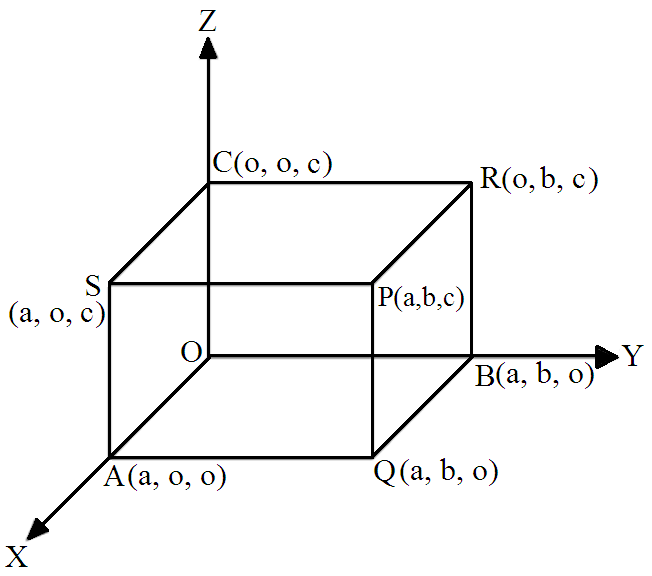
Let a be the length of an edge of the cube and let one corner be at the origin as shown in the figure. Clearly, OP, AR
The direction ratiosm of OP, AR, BS and CQ are
a - 0, a - 0, a - 0, i.e. a, a, a
0 - a, a - 0, a - 0, i.e. -a, a, a
a - 0, 0 - a, a - 0, i.e. a, -a, a
a - 0, a - 0, 0 -  a, i.e. a, a, -a
Let the direction ratios of a line be proportional to l, m and n. Suppose this line makes angles $\alpha,\beta,\gamma$ and $\delta$ with OP, AR.
Now, $\alpha$ is the angle between OP and the line whose direction ratios are proportional to l, m and n.
$\cos\alpha=\frac{\text{a}.\text{l}+\text{a}.\text{m}+\text{a}.\text{n}}{\sqrt{\text{a}^2+\text{a}^2+\text{a}^2}\sqrt{\text{l}^2+\text{m}^2+\text{n}^2}}\Rightarrow\cos\alpha=\frac{\text{l}+\text{m}+\text{n}}{\sqrt{3}\sqrt{\text{l}^2+\text{m}^2+\text{n}^2}}$
Since $\beta$ is the angle between AR and the line with direction ratios proportional to l, m and n, we get
$\cos\beta=\frac{-\text{a}.\text{l}+\text{a}.\text{m}+\text{a}.\text{n}}{\sqrt{\text{a}^2+\text{a}^2+\text{a}^2}\sqrt{\text{l}^2+\text{m}^2+\text{n}^2}}\Rightarrow\cos\beta=\frac{-\text{l}+\text{m}+\text{n}}{\sqrt{3}\sqrt{\text{l}^2+\text{m}^2+\text{n}^2}}$
Similarly,
$\cos\gamma=\frac{\text{a}.\text{l}-\text{a}.\text{m}+\text{a}.\text{n}}{\sqrt{\text{a}^2+\text{a}^2+\text{a}^2}\sqrt{\text{l}^2+\text{m}^2+\text{n}^2}}\Rightarrow\cos\gamma=\frac{\text{l}-\text{m}+\text{n}}{\sqrt{3}\sqrt{\text{l}^2+\text{m}^2+\text{n}^2}}$
$\cos\delta=\frac{\text{a}.\text{l}+\text{a}.\text{m}-\text{a}.\text{n}}{\sqrt{\text{a}^2+\text{a}^2+\text{a}^2}\sqrt{\text{l}^2+\text{m}^2+\text{n}^2}}\Rightarrow\cos\delta=\frac{\text{l}+\text{m}-\text{n}}{\sqrt{3}\sqrt{\text{l}^2+\text{m}^2+\text{n}^2}}$
$\cos^2\alpha+\cos^2\beta+\cos^2\gamma+\cos^2\delta$
$=\frac{(\text{l}+\text{m}+\text{n})^2}{3(\text{l}^2+\text{m}^2+\text{n}^2)}+\frac{(-\text{l}+\text{m}+\text{n})^2}{3(\text{l}^2+\text{m}^2+\text{n}^2)}+\frac{(\text{l}-\text{m}+\text{n})^2}{3(\text{l}^2+\text{m}^2+\text{n}^2)}+\frac{(\text{l}+\text{m}-\text{n})^2}{\sqrt{3}\sqrt{\text{l}^2+\text{m}^2+\text{n}^2}}$
$=\frac{1}{3(\text{l}^2+\text{m}^2+\text{n}^2)}\Big\{(\text{l}+\text{m}+\text{n})^2+(-\text{l}+\text{m}+\text{n})^2+(\text{l}-\text{m}+\text{n})^2+(\text{l}+\text{m}-\text{n})^2\Big\}$
$=\frac{1}{3(\text{l}^2+\text{m}^2+\text{n}^2)}4\big(\text{l}^2+\text{m}^2+\text{n}^2\big)=\frac{4}{3}$.
View full question & answer
Question 1261 Mark
The coordinates of the midpoints of the line segment joining the points (2, 3, 4) and (8, -3, 8) are:
  1. (10, 0, 12)
  2. (5, 6, 0)
  3. (6, 5, 0)
  4. (5, 0, 6)
Answer
  1. (5, 0, 6)
View full question & answer
Question 1271 Mark
The distance of the plane through the intersection of the planes ax + by + cz +d = 0 and lx + my + nz + P = 0 and parallel to the line y = 0, z = 0
  1. (bl - am)y + (cl - an)z + dl - ap = 0
  2. (am - bl)x + (mc - bn)z + md - bp = 0
  3. (na - cl)x + (bn - cm)y + nd - cp = 0
  4. None of these
Answer
  1. (bl - am)y + (cl - an)z + dl - ap = 0
Solution:
The equation of the plane passing through the intersection of the planes
ax + by + cz + d = 0
and lx + my + nz + p =0
Will be $(\text{ax} + \text{by} +\text{cz} +\text{d})+\lambda(\text{lm}+\text{my}+\text{nz}+\text{p})=0$
$\text{x}(\text{a}+\lambda1)+\text{y}(\text{b}+\lambda\text{m})+\text{z}(\text{c}+\lambda\text{n})+(\text{d}+\lambda\text{p})=0\ (1)$
Since the plane is parallel to the line y = 0 and z = 0
$\text{a}+\lambda1=0$
$\lambda=\frac{-\text{a}}{\text{l}}$
Putting the value of A in eqution (1), we get
$\text{x}\Big(\text{a}+\Big(\frac{\text{-a}}{\text{l}}\Big)\text{l}\Big)+\text{y}\Big(\text{b}+\Big(\frac{-\text{a}}{\text{l}}\Big)\text{m}+\text{y}\Big(\text{c}+\Big(\frac{-\text{a}}{\text{l}}\Big)\text{n}+\text{d}+\Big(\frac{-\text{a}}{\text{l}}\Big)\text{p}=0$
$\text{y}(\text{bl}-\text{am})+\text{z}(\text{cl}-\text{an})+\text{dl}-\text{ap}=0$
Heance, option (a)
View full question & answer
Question 1281 Mark
The eqution of the plane contaning the two lines $\frac{\text{x}-1}{2}=\frac{\text{y}+1}{-1}=\frac{\text{z}-0}{3}$ and $\frac{\text{x}}{-2}=\frac{\text{y}-2}{-3}=\frac{\text{z}+1}{-1}$ is:
  1. 8x + y - 5z - 7 = 0
  2. 8x + y + 5z - 7 = 0
  3. 8x - y - 5z - 7 = 0
  4. None of these
Answer
  1. None of these
Solution:
 $\frac{\text{x}-1}{2}=\frac{\text{y}+1}{-1}=\frac{\text{z}-0}{3}$ and $\frac{\text{x}}{-2}=\frac{\text{y}-2}{-3}=\frac{\text{z}+1}{-1}$
Now, if these two lines lie on a plane, so the direction ratio of lines will be perpendicular to the plane's normal vector.
View full question & answer
Question 1291 Mark
The perpendicular distance of the point P(1, 2, 3) from the line $\frac{\text{x}-6}{3}=\frac{\text{y}-7}{2}=\frac{\text{z}-7}{-2}$ is:
  1. 7
  2. 5
  3. 0
  4. None of these 
Answer
  1. 7
Solution:
$\frac{\text{x}-6}{3}=\frac{\text{y}-7}{2}=\frac{\text{z}-7}{-2}$
Let point (1, 2, 3) be P and the point through which the line passes be Q(6, 7,  7). Also, the line is parallel to the vector $\vec{\text{b}}=3\hat{\text{i}}+2\hat{\text{j}}-2\hat{\text{k}}.$
Now,
$\overrightarrow{\text{PQ}}=5\hat{\text{i}}+5\hat{\text{j}}+4\hat{\text{k}}$
$\therefore\vec{\text{b}}\times\overrightarrow{\text{PQ}} =\begin{vmatrix}\hat{\text{i}}&\hat{\text{j}}&\hat{\text{k}}\\3&2&-2\\5&5&4\end{vmatrix}$
$=18\hat{\text{i}}-22\hat{\text{j}}+5\hat{\text{k}}$
$\Rightarrow\big|\vec{\text{b}}\times\overrightarrow{\text{PQ}}\big|=\sqrt{18^2+(-22)^2+5^2}$
$=\sqrt{324+484+25}$
$=\sqrt{833}$
$\because\text{d}=\frac{\big|\vec{\text{b}}\times\overrightarrow{\text{PQ}}\big|}{\big|\vec{\text{b}}\big|}$
$=\frac{\sqrt{833}}{\sqrt{17}}$
$=\sqrt{49}$
$=7$
View full question & answer
Question 1301 Mark
The area of the quadrilateral ABCD, where A(0, 4, 1), B(2, 3, -1), C(4, 5, 0) and D(2, 6, 2) is equal to:
  1. 9sq. units
  2. 1sq. units
  3. 27sq. units
  4. 81sq. units
Answer
  1. 9sq. units
View full question & answer
MCQ 1321 Mark
The equation $x^2- x - 2 = 0$ in three dimensional space is represented by$:$
  • A pair of parallel planes
  • B
    A pair of straight lines
  • C
    A pair of perpendicular plane
  • D
    None of these
Answer
Correct option: A.
A pair of parallel planes
View full question & answer
Question 1331 Mark
A straight line L on the xy-plane bisects the angle between OX and OY. What are the direction cosines of L:
  1. $\Big(\frac{1}{\sqrt{2}},\frac{1}{\sqrt{2}},0\Big)$
  2. $\Big(\frac{1}{2},\frac{\sqrt{3}}{2},0\Big)$
  3. $\big(0,0,1\big)$
  4. $\Big(\frac{2}{3},\frac{2}{3},\frac{1}{3}\Big)$
Answer
  1. $\Big(\frac{1}{\sqrt{2}},\frac{1}{\sqrt{2}},0\Big)$
Solution
L makes an angle $\frac{\pi}{4}$ with X and Y axis and $\frac{\pi}{2}$
$\therefore$ d.cs are $\Big(\cos\frac{\pi}{34},\cos\frac{\pi}{4},\cos\frac{\pi}{2}\Big)=\Big(\frac{1}{\sqrt{2}},\frac{1}{\sqrt{2}},0\Big)$
View full question & answer
Question 1341 Mark
A line passes through the points (6, −7, −1) and (2, −3, 1). The direction cosines of the line so directed that the angle made by it with the positive direction of x-axis is acute, is?
  1. $\frac{2}{3},\frac{2}{3},-\frac{1}{3}$
  2. $-\frac{2}{3},\frac{2}{3},\frac{1}{3}$
  3. $\frac{2}{3}-\frac{2}{3},\frac{1}{3}$
  4. $\frac{2}{3},\frac{2}{3},\frac{1}{3}$
Answer
  1. $\frac{2}{3},\frac{2}{3},-\frac{1}{3}$
Solution:
Consider the problem 
Let l, m, n are direction cosines of the given line.
then as it made an acute angle with x−axis,
Therefore, l > 0
The line passes through (6, −7, −1) and (2, −3, 1)
Therefore, its direction ratios are 
6 − 2, −7 + 3, −1−1 or 2, −2, −1
Hence direction cosines of the line are given by $\frac{2}{3},\frac{2}{3},-\frac{1}{3}.$
View full question & answer
Question 1351 Mark
If the directions cosines of a line are A, k, k, then:
  1. k > 0
  2. 0 < k < 1
  3. k = 1
  4. $\text{k}=\frac{\sqrt{1}}{3}$ or $\frac{\sqrt{1}}{3}$
Answer
  1. $\text{k}=\frac{\sqrt{1}}{3}$ or $\frac{\sqrt{1}}{3}$
View full question & answer
Question 1371 Mark
The sine of the angle between the straight line $\frac{\text{x}-2}{3}=\frac{\text{y}-3}{4}=\frac{\text{z}-4}{5}$ and the plane 2x - 2y + z = 5 is:
  1. $\frac{10}{6\sqrt{5}}$
  2. $\frac{4}{5\sqrt{2}}$
  3. $\frac{2\sqrt{3}}{5}$
  4. $\sqrt{\frac{\sqrt{2}}{10}}$
Answer
  1. $\frac{2\sqrt{3}}{5}$
View full question & answer
Question 1381 Mark
A line with positive direction cosines passes through the point P(2, -1, 2) and makes equal angles with the coordinate axes. The line meets the plane 2x + y + z = 9 at point Q. The length of the line segment PQ equals:
  1. $1$
  2. $\sqrt{2}$
  3. $\sqrt{3}$
  4. $2$
Answer
  1. $\sqrt{3}$
Solution:
D.C of the line are $\frac{1}{\sqrt{3}},\frac{1}{\sqrt{3}},\frac{1}{\sqrt{3}}$
Any point on the line at a distance tt from P(2, -1, 2) is
$\Big(2+\frac{\text{t}}{\sqrt{3}},-1+\frac{\text{t}}{\sqrt{3}},2+\frac{\text{t}}{\sqrt{3}}\Big)$
which lies on $2\text{x} + \text{y + z} = 9$
$\Rightarrow\text{t}=\sqrt{3}$
View full question & answer
Question 1391 Mark
The direction cosines of the line joining (1, -1, 1) and (-1, 1, 1) are:
  1. 2, -2, 0
  2. 1, -1, 0
  3. $\frac{1}{\sqrt{2}},- \frac{1}{\sqrt{2}}$
  4. None of these
Answer
  1. $\frac{1}{\sqrt{2}},- \frac{1}{\sqrt{2}}$
View full question & answer
Question 1401 Mark
If the projections of the line segment AB on the coordinate axes are 2, 3, 6, then the square of the sine of the angle made by AB with x = 0, is:
  1. $\frac{3}{7}$
  2. $\frac{3}{49}$
  3. $\frac{4}{7}$
  4. $\frac{40}{49}$
Answer
  1. $\frac{40}{49}$
View full question & answer
Question 1411 Mark
What are the direction cosines of a line which is equally inclined to the positive directions of the axes:
  1. $\Big(\frac{1}{\sqrt{3}},\frac{1}{\sqrt{3}},\frac{1}{\sqrt{3}}\Big)$
  2. $\Big(-\frac{1}{\sqrt{3}},\frac{1}{\sqrt{3}},\frac{1}{\sqrt{3}}\Big)$
  3. $\Big(-\frac{1}{\sqrt{3}},-\frac{1}{\sqrt{3}},-\frac{1}{\sqrt{3}}\Big)$
  4. $\Big(\frac{1}{3},\frac{1}{3},\frac{1}{3}\Big)$
Answer
  1. $\Big(\frac{1}{\sqrt{3}},\frac{1}{\sqrt{3}},\frac{1}{\sqrt{3}}\Big)$
Solution:
We know sum of the squares of the direction cosines is one.
i.e. $\cos^2\alpha+\cos^2\gamma=1$ 
but its given that $\alpha=\beta=\gamma\therefore\cos^2\alpha=1$
$3\cos^2\alpha=1$
$\therefore\cos^2\alpha=\frac{1}{3}$
$\therefore$ Positive directions of the axes are $\Big(\frac{1}{\sqrt{3}},\frac{1}{\sqrt{3}},\frac{1}{\sqrt{3}}\Big)$
View full question & answer
Question 1421 Mark
Direction cosines of ray from P(1, -2, 4) to Q(-1, 1, -2) are:
  1. -2, 3, -6
  2. 2, -3, 6
  3. 2, 3, 6
  4. $\frac{-2}{7},\frac{3}{7},\frac{-6}{7}$
Answer
  1. $\frac{-2}{7},\frac{3}{7},\frac{-6}{7}$
Solution:
Given the points are P(1, -2, 4) and Q(-1, 1, -2) Now the direction
ratios of the ray PQ are (-1 - 1, 1 + 2, -2 - 4) = (-2, 3, -6)
The direction cosines of the line PQ will be
$\Big(\frac{2}{\sqrt{2^2+3^2+6^2}},\frac{3}{\sqrt{2^2+3^2+6^2}},\frac{-6}{\sqrt{2^2+3^2+6^2}}\Big)=\Big(\frac{-2}{7},\frac{3}{7},\frac{-6}{7}\Big)$
View full question & answer
Question 1431 Mark
The plane $2\text{x}-(1-\lambda)\text{y}+3\lambda\text{z}=0$ passes through the intersection of the planes:
  1. 2x - y = 0 and y- 3z = 0
  2. 2x + 3z = 0 and y = 0
  3. 2x - y + 3z = 0 and y - 3z = 0
  4. None of these
Answer
  1. 2x - y = 0 and y- 3z = 0
Solution:
The given plane is
$2\text{x}-(1-\lambda)\text{y}+3\lambda\text{z}=0$
$\Rightarrow(2\text{x}-\text{y})+\lambda(-\text{y}+3\text{z})=0$
So, this plane passes through the intersection of the planes
2x - y = 0 and -y + 3z = 0
⇒ 2x - y = 0 and y - 3z = 0.
View full question & answer
Question 1441 Mark
What are the direction ratios of the line if it passes through the intersection of the planes x = 3z + 4 and y = 2z - 3:
  1. (1, 2, 3)
  2. (2, 1, 3)
  3. (3, 2, 1)
  4. (1, 3, 2)
Answer
  1. (3, 2, 1)
Solution:
Equations of the planes are x = 3z + 4 and y = 2z - 3
$\therefore$ The equation of the plane passing through the line of intersection of these planes is x = 3z + 4 and y = 2z - 3
Thus The direction Ratios of the equation passes through intersection of the planes is (3, 2, 1).
View full question & answer
Question 1451 Mark
The product of the d.cs of the line which makesequal angles with ox, oy, oz is:
  1. $1$
  2. $\sqrt{3}$
  3. $\frac{1}{3\sqrt{3}}$
  4. $\frac{1}{\sqrt{3}}$
Answer
  1. $\frac{1}{3\sqrt{3}}$
Solution:
$\cos^2(\alpha)+\cos^2(\beta)+\cos^2(\gamma)=1$
$\Rightarrow3\cos^2(\alpha)=1$
$\Rightarrow\cos\alpha=\underline{+}\frac{1}{\sqrt{3}}$
View full question & answer
Question 1461 Mark
The direction cosines of the straight linegiven by the planes x = 0 and z = 0 are:
  1. 1, 0, 0
  2. 0, 0, 1
  3. 1, 1, 0
  4. 0, 1, 0
Answer
  1. 0, 1, 0
Solution:
Given, x = z = 0
It represents Z-axis
$\therefore$ Direction cosines = (0, 1, 0)
View full question & answer
Question 1471 Mark
Choose the correct answer from the given four options.
The sine of the angle between the straight line $\frac{\text{x}-2}{3}=\frac{\text{y}-2}{3}=\frac{\text{z}-2}{3}$ and the plane $2\text{x}-2\text{y}+\text{z}=5$ is:
  1. $\frac{10}{6\sqrt{5}}$
  2. $\frac{4}{5\sqrt{2}}$
  3. $\frac{2\sqrt{3}}{5}$
  4. $\frac{\sqrt{2}}{10}$
Answer
  1. $\frac{\sqrt{2}}{10}$
Solution:
We have, the equation of line as
$\frac{\text{x}-2}{3}=\frac{\text{y}-2}{3}=\frac{\text{z}-2}{3}$
This line is parallel to the vector $\vec{\text{b}}=3\hat{\text{i}}+4\hat{\text{j}}+5\hat{\text{k}}$
Equation of plane is $2\text{x}-2\text{y}+\text{z}=5$
Normal to the plane $\vec{\text{n}}=2\hat{\text{i}}-2\hat{\text{j}}+\hat{\text{k}}$
Its angle between line and plane is $'\theta'.$
Then $\sin\theta=\frac{|\vec{\text{b}}\cdot{\vec{\text{b}}}|}{|{\vec{\text{b}}}||{\vec{\text{b}}}|}$
$=\frac{\big|(3\hat{\text{i}}+4\hat{\text{j}}+5\hat{\text{k}})\cdot(2\hat{\text{i}}-2\hat{\text{j}}+\hat{\text{k}})\big|}{\sqrt{3^2+4^2+5^2}\sqrt{4+4+1}}$
$=\frac{|6-8+5|}{\sqrt{50}\sqrt{9}}$
$=\frac{3}{15\sqrt{2}}=\frac{1}{5\sqrt{2}}$
$\sin\theta=\frac{\sqrt{2}}{10}$
View full question & answer
Question 1481 Mark
The length of perpendicular from the origin to the plane which makes intercepts $\frac{1}{3},\frac{1}{4},\frac{1}{5}$​ respectively on the coordinate axes is:
  1. $\frac{1}{\sqrt[5]{2}}$
  2. $\frac{1}{10}$
  3. $\sqrt[5]{2}$
  4. $5$
 
Answer
  1. $\frac{1}{\sqrt[5]{2}}$
 
Solution:
Equation of plane $\frac{\text{x}}{\text{a}}+\frac{\text{y}}{\text{b}}+\frac{\text{z}}{\text{c}}=1$
3x + 4y + 5z − 1 = 0
diatance from origin $\frac{1}{\sqrt{150}}=\frac{1}{\sqrt[5]{2}}$
View full question & answer
Question 1491 Mark
The straigth line $\frac{\text{x}-3}{3}=\frac{\text{y}-2}{1}=\frac{\text{z}-1}{0}$ is:
  1. parallel to x-axis
  2. parallel to y-axis
  3. parallel to z-axis
  4. perpendicular to z-axis
Answer
  1. perpendicular to z-axis
Solution:
We have
$\frac{\text{x}-3}{3}=\frac{\text{y}-2}{1}=\frac{\text{z}-1}{0}$
Also, the given line is parallel to the vector $\vec{\text{b}}=3\hat{\text{i}}+\hat{\text{j}}+0\hat{\text{k}}$
Let $\text{x}\hat{\text{i}}+\text{y}\hat{\text{j}}+\text{z}\hat{\text{k}}$ be parpendicular to the given line.
Now,
$3\text{x}+4\text{y}+0\text{z}=0$
It is satisfied by the coordinates of z-axis, i.e. (0, 0, 1).
Hence, the given line is perpendicular to z-axis.
View full question & answer
Question 1501 Mark
For every point P(x, y, z) on the xy-plane,
  1. x = 0
  2. y = 0
  3. z = 0
  4. x = y = z = 0
Answer
  1. z = 0
Solution:
The Z-coordinate of every point on the XY-plane is zero.
View full question & answer