Question 15 Marks
Show that the points A (1, -2, -8), B (5, 0, -2) and C (11, 3, 7) are collinear, and find the ratio in which B divides AC.
AnswerA (1, -2, -8), B (5, 0, -2), C (11, 3, 7) $\overrightarrow {OA} = 1\hat i - 2\hat j - 8\hat k$
$\overrightarrow {OB} = 5\hat i - 0\hat j - 2\hat k$
$\overrightarrow {OC} = 11\hat i + 3\hat j + 7\hat k$
$\overrightarrow {AB} = \overrightarrow {OB} - \overrightarrow {OA} $
$= 4\hat i + 2\hat j + 6\hat k$
$\overrightarrow {BC} = \overrightarrow {OC} - \overrightarrow {OB} $
$ = \left( {6\hat i + 3\hat j + 9\hat k} \right)$
$ = 3\left( {2\hat i + \hat j + 3\hat k} \right)$
$ = \frac{3}{2}\left( {4\hat i + 2\hat j + 6\hat k} \right)$
$\overrightarrow {BC} = \frac{3}{2}\overrightarrow {AB} $
Thus $\overrightarrow {BC} ||\overrightarrow {AB} $ and one point B is common therefore A, B, C are collinear and B divides AC in 2:3.
View full question & answer→Question 25 Marks
If $\vec{a}, \vec{b}, \vec{\mathrm{c}}$ are mutually perpendicular vectors of equal magnitudes, show that the vector $\vec{c} \cdot \vec{d}=15$ is equally inclined to $\vec{a}, \vec{b}$ and $\vec c$.
AnswerGiven: vectors $\vec a, \vec b$ and $\vec c$ are mutually perpendicular to each other and are of equal magnitude.
$\Rightarrow \vec{\mathrm{a}} \cdot \vec{\mathrm{b}}=\vec{\mathrm{b}} \cdot \vec{\mathrm{c}}=\vec{\mathrm{c}} \cdot \vec{\mathrm{a}}=0$
And $|\vec{\mathrm{a}}|=|\vec{\mathrm{b}}|=|\vec{\mathrm{c}}|$
Let the vector $\vec{a}+\vec{b}+\vec{c}$ be inclined to $\vec{a}, \vec{b}$ and $\vec c$ at angles $\alpha, \beta$ and $\gamma$ respectively.
Then, we have
$\cos \alpha=\frac{(\vec{a}+\vec{b}+\vec{c}) \cdot \vec{a}}{|\vec{a}+\vec{b}+\vec{c}| \cdot|\vec{a}|}$
= $\frac{(\vec{a} \cdot \vec{a}+\vec{b .} \vec{a}+\vec{c . \vec{a}})}{|\vec{a}+\vec{b}+\vec{c}| \cdot|\vec{a}|}$
= $\frac{\left(|\vec{a}|^{2}+0+0\right)}{|\vec{a}+\vec{b}+\vec{c}| \cdot|\vec{a}|}=\frac{|\vec{a}|}{|\vec{a}+\vec{b}+\vec{c}|}$ ......(i)
$\cos \beta=\frac{(\vec{a}+\vec{b}+\vec{c}) \cdot \vec{b}}{|\vec{a}+\vec{b}+\vec{c}| \cdot|\vec{b}|}$
= $\frac{(\vec{a} \cdot \vec{b}+\vec{b} \cdot \vec{b}+\vec{c} \cdot \vec{b})}{|\vec{a}+\vec{b}+\vec{c}| \cdot|\vec{b}|}$
= $ \frac{\left(0+|\vec{\mathrm{b}}|^{2}+0\right)}{|\vec{\mathrm{a}+\vec{\mathrm{b}}+\vec{\mathrm{c}}}| \cdot|\vec{\mathrm{b}}|}=\frac{|\vec{\mathrm{b}}|}{|\vec{\mathrm{a}+\vec{\mathrm{b}}+\vec{\mathrm{c}}}|}$ ......(ii)
$\cos \gamma=\frac{(\vec{\mathrm{a}}+\vec{\mathrm{b}}+\vec{\mathrm{c}}) \cdot \vec{\mathrm{a}}}{|\vec{\mathrm{a}+\vec{\mathrm{b}}+\vec{\mathrm{c}}}| \cdot|\vec{\mathrm{a}}|} $
= $\frac{(\vec{a} \cdot \vec{c}+\vec{b} \cdot \vec{c}+\vec{c} \cdot \vec{c})}{\vec{|\vec{a}+\vec{b}+\vec{c}| \cdot|\vec{a}|}}$
= $\frac{\left(0+0+|\vec{\mathrm{c}}|^{2}\right)}{|\vec{\mathrm{a}+\vec{\mathrm{b}}+\vec{\mathrm{c}}}| \cdot|\vec{\mathrm{a}}|}=\frac{|\vec{\mathrm{c}}|}{|\vec{\mathrm{a}+\vec{\mathrm{b}}+\vec{\mathrm{c}}}|}$ .....(iii)
From (i), (ii) and (iii)
As $|\vec{\mathrm{a}}|=|\vec{\mathrm{b}}|=|\vec{\mathrm{c}}|$
Hence, $\cos \alpha=\cos \beta=\cos \gamma$
$\Rightarrow \alpha=\beta=\gamma$
Hence, the vector $\vec{a}+\vec{b}+\vec{c}$ are equally inclined to $\vec{a}, \vec{b}$ and $\vec c$
View full question & answer→Question 35 Marks
The scalar product of the vector $\hat i + \hat j + \hat k$ with a unit vector along the sum of vectors $2\hat i + 4\hat j - 5\hat k\;$ and $\lambda \hat i + 2\hat j + 3\hat k$ is equal to one. Find the value of$\;\lambda $.
AnswerLet $\overrightarrow{a}=\widehat{i}+\widehat{j}+\widehat{k},\overrightarrow{b}=2\widehat{i}+4\widehat{j}-5\widehat{k}$ and $\overrightarrow{c}=\lambda \widehat{i}+2\widehat{j}+3\widehat{k},$
$\vec b +\vec c =(\lambda+2)\hat i +6\hat j-2\hat k$
$\Rightarrow |\vec b+\vec c|=\sqrt{(\lambda+2)^2+40}$
Therefore, a unit vector along
$\overrightarrow{b}+\overrightarrow{c}$ is given by:
$\frac{\vec b +\vec c}{|\vec b+\vec c|}=\frac{(\lambda+2)\hat i +6 \hat j-2\hat k}{\sqrt{(\lambda+2)^2+40}}=1$
Also, scalar product of $\hat{i}+\hat{j}+\hat{k}$ with above unit vector is 1.
$\therefore(\hat i+ \hat j+\hat k).\frac{(\lambda+2)\hat i +6 \hat j-2\hat k}{\sqrt{(\lambda+2)^2+40}}=1$
$\Rightarrow (\lambda+6)^2=(\lambda+2)^2+40\Rightarrow \lambda=1$
View full question & answer→Question 45 Marks
Let $\vec a = \hat i + 4\hat j + 2\hat k$, $\vec b = 3\hat i - 2\hat j + 7\hat k$ and $\vec c = 2\hat i - \hat j + 4\hat k$. Find a vector $\vec d$ which is perpendicular to both $\vec a$ and $\vec b$, and $\vec c.\vec d = 15$.
AnswerGiven: Vectors $\vec a = \hat i + 4\hat j + 2\hat k$ and $\vec b = 3\hat i - 2\hat j + 7\hat k$
We know that the cross-product of two vectors, $\vec a \times \vec b$ is a vector perpendicular to both $\vec a$ and $\vec b$
Hence, vector $\vec d$ which is also perpendicular to both $\vec a$ and $\vec b$ is $\vec d = \lambda \left( {\vec a \times \vec b} \right)$ where $\lambda = 1$ or some other scalar.
Therefore, $\vec d = \lambda \left| {\begin{array}{*{20}{c}} \vec i&\vec j&\vec k \\ 1&4&2 \\ 3&{ - 2}&7 \end{array}} \right|$
$= \lambda \left[ {\hat i\left( {28 + 4} \right) - \hat j\left( {7 - 6} \right) + \hat k\left( { - 2 - 12} \right)} \right]$
$ \Rightarrow \vec d = 32\lambda \hat i - \lambda \hat j - 14\lambda \hat k$...(i)
Now given $\vec c = 2\hat i - \hat j + 4\hat k$ and $\vec c.\vec d = 15$
$\vec c.\vec d = 15$
$= 2\left( {32\lambda } \right) + \left( { - 1} \right)\left( { - \lambda } \right) + 4\left( { - 14\lambda } \right) = 15$
$ \Rightarrow 64\lambda + \lambda - 56\lambda = 15$
$ \Rightarrow 9\lambda = 15$
$ \Rightarrow \lambda = \frac{{15}}{9}$
$ \Rightarrow \lambda = \frac{5}{3}$
Putting $\lambda = \frac{5}{3}$ in eq. (i), we get
$\vec d = \frac{5}{3}\left[ {32\hat i - \hat j - 14\hat k} \right]$
$\Rightarrow \vec d = \frac{1}{3}\left[ {160\hat i - 5\hat j - 70\hat k} \right]$
View full question & answer→Question 55 Marks
The two adjacent sides of a parallelogram are $2\hat i - 4\hat j + 5\hat k\;$ and $\hat i - 2\hat j - 3\hat k$. Find the unit vector parallel to its diagonal. Also, find its area.
AnswerWe have, Diagonal AC as,
$\vec{AC}=(\hat i - 2\hat j -3\hat k )+(2\hat i-4\hat j +5\hat k)=3\hat i-6\hat j+2\hat k$
$\Rightarrow |\vec{AC}|=\sqrt{(3)^2+(-6)^2+(2)^2}=\sqrt{49}=7$
A unit vector parallel to $\vec AC$ is given by:
$\frac{\vec{AC}}{|\vec {AC}|}=\frac{3\hat i -6\hat j+2\hat k}{7}= \frac{3}{7}\hat i-\frac{6}{7}\hat j+\frac{2}{7}\hat k$
Also, area of parallelogram
$\Rightarrow |\vec{AB}\times\vec{AD}|$$ = \left| {\begin{array}{*{20}{c}} {\hat i}&{\hat j}&{\hat k} \\ 2&{ - 4}&5 \\ 1&{ - 2}&{ - 3} \end{array}} \right|$= $|22\hat i +11 \hat j|$
$=\sqrt{22^2+11^2}=\sqrt{605}=11\sqrt5$
View full question & answer→Question 65 Marks
Let the vectors $\vec{a}, \vec{b}, \vec{c}$ be given as $a_{1} \hat{i}+a_{2} \hat{j}+a_{3} \hat{k},~ b_{1} \hat{i}+b_{2} \hat{j}+b_{3} \hat{k}$, and $c_{1} \hat{i}+c_{2} \hat{j}+c_{3} \hat{k}$ . Then show that $\vec{a} \times(\vec{b}+\vec{c})=\vec{a} \times \vec{b}+\vec{a} \times \vec{c}$
AnswerGiven that
$\vec{\mathrm{a}}=\mathrm{a}_{1} \hat{\mathrm{i}}+\mathrm{a}_{2} \hat{\mathrm{j}}+\mathrm{a}_{3} \hat{\mathrm{k}}$ , $\vec{\mathrm{b}}=\mathrm{b}_{1} \hat{\mathrm{i}}+\mathrm{b}_{2} \hat{\mathrm{j}}+\mathrm{b}_{3} \hat{\mathrm{k}}$ and $\vec{\mathrm{c}}=\mathrm{c}_{1} \hat{\mathrm{i}}+\mathrm{c}_{2} \hat{\mathrm{j}}+\mathrm{c}_{3} \hat{\mathrm{k}}$
$We ~have~to~show,~\vec{a} \times(\vec{b}+\vec{c})=\vec{a} \times \vec{b}+\vec{a} \times \vec{c}$
Solving for left hand side,
$\vec{\mathrm{b}}+\vec{\mathrm{c}}=\left(\mathrm{b}_{1}+\mathrm{c}_{1}\right) \hat{\mathrm{i}}+\left(\mathrm{b}_{2}+\mathrm{c}_{2}\right) \hat{\mathrm{j}}+\left(\mathrm{b}_{3}+\mathrm{c}_{3}\right) \hat{\mathrm{k}}$
$\vec{\mathrm{a}} \times(\vec{\mathrm{b}}+\vec{\mathrm{c}})=\left|\begin{array}{ccc} {\hat{\mathrm{i}}} & {\hat{\mathrm{j}}} & {\hat{\mathrm{k}}} \\ {\mathrm{a}_{1}} & {\mathrm{a}_{2}} & {\mathrm{a}_{3}} \\ {\mathrm{b}_{1}+\mathrm{c}_{1}} & {\mathrm{b}_{2}+\mathrm{c}_{2}} & {\mathrm{b}_{3}+\mathrm{c}_{3}} \end{array}\right|$
$\Rightarrow \vec{\mathrm{a}} \times(\vec{\mathrm{b}}+\vec{\mathrm{c}})=\left|\begin{array}{lll} {\hat{\mathrm{i}}} & {\hat{\mathrm{j}}} & {\hat{\mathrm{k}}} \\ {\mathrm{a}_{1}} & {\mathrm{a}_{2}} & {\mathrm{a}_{3}} \\ {\mathrm{b}_{1}} & {\mathrm{b}_{2}} & {\mathrm{b}_{3}} \end{array}\right|+\left|\begin{array}{ccc} {\hat{\mathrm{i}}} & {\hat{\mathrm{j}}} & {\hat{\mathrm{k}}} \\ {\mathrm{a}_{1}} & {\mathrm{a}_{2}} & {\mathrm{a}_{3}} \\ {\mathrm{c}_{1}} & {\mathrm{c}_{2}} & {\mathrm{c}_{3}} \end{array}\right|$ (property of determinant)
$=(\vec{\mathrm{a}} \times \vec{\mathrm{b}})+(\vec{\mathrm{a}} \times \vec{\mathrm{c}})$ = R.H.S.
$\Rightarrow \overrightarrow{\mathrm{a}} \times(\vec{\mathrm{b}}+\vec{\mathrm{c}})=(\vec{\mathrm{a}} \times \vec{\mathrm{b}})+(\vec{\mathrm{a}} \times \vec{\mathrm{c}})$
Hence proved.
View full question & answer→Question 75 Marks
If a unit vector $\vec a$ makes angles $\frac{\pi}{3}$ with $\hat i$, $\frac{\pi}{4}$ with $\hat j$ and an acute angle $\theta$ with $\hat k$, then find $\theta$ and hence, the components of $\vec a $.
AnswerLet $\vec{\mathrm{a}}=\mathrm{x} \hat{\mathrm{i}}+\mathrm{y} \hat{\mathrm{j}}+\mathrm{z} \hat{\mathrm{k}}$
Given that it is a unit vector,
So, $|\vec{\mathrm{a}}|=\sqrt{\mathrm{x}^{2}+\mathrm{y}^{2}+\mathrm{z}^{2}}=1$ ......(i)
Let $\alpha, \beta, \theta$ be the angles $\vec a$ makes with $\hat{i}, \hat{\jmath}, \hat{\mathrm{k}}$ respectively.
Then,
$\cos \alpha=\frac{\vec{a} \cdot \hat{\imath}}{|\vec{a}||\hat{\imath}|}=\frac{x}{1}$
$\Rightarrow \alpha=\frac{\pi}{3}$ (Given)
$\Rightarrow x=\cos \alpha=\cos \frac{\pi}{3}=\frac{1}{2}$
$\cos \beta=\frac{\vec{\mathrm{a}} \cdot \hat{\mathrm{j}}}{|\vec{\mathrm{a}}||\hat{\mathrm{j}}|}=\frac{\mathrm{y}}{1}$
$\Rightarrow \beta=\frac{\pi}{4}$ (Given)
$\Rightarrow \mathrm{y}=\cos \beta=\cos \frac{\pi}{4}=\frac{1}{\sqrt{2}}$
$\cos \theta=\frac{\vec{\mathrm{a}} \cdot \hat{\mathrm{k}}}{|\vec{\mathrm{a}}||\hat{\mathrm{k}}|}=\frac{\mathrm{z}}{1}$
$\Rightarrow {z}=\cos \theta$
Putting value of x,y, z in equation (i)
$\sqrt{x^{2}+y^{2}+z^{2}}=1$
$\Rightarrow x^{2}+y^{2}+z^{2}=1$ (Squaring both sides)
$\Rightarrow\left(\frac{1}{2}\right)^{2}+\left(\frac{1}{\sqrt{2}}\right)^{2}+(\cos \theta)^{2}=1$
$\Rightarrow \frac{1}{4}+\frac{1}{2}+\cos ^{2} \theta=1$
$\Rightarrow \cos ^{2} \theta=1-\frac{3}{4}=\frac{1}{4}$
$\Rightarrow \cos \theta=\pm \frac{1}{2}$
As $\theta$ should be acute, $\theta=\cos ^{-1} \frac{1}{2}=\frac{\pi}{3}$
$\therefore \mathrm{z}=\cos \theta=\cos \frac{\pi}{3}=\frac{1}{2}$
Components of $\vec{\mathrm{a}}$ are the coefficients of $\hat{\imath}, \hat{\jmath}, \hat{\mathrm{k}}$ which are
$x=\frac{1}{2} ; y=\frac{1}{\sqrt{2}} ; z=\frac{1}{2}$ with $\theta=\frac{\pi}{3}$
View full question & answer→Question 85 Marks
Find a unit vector perpendicular to each of the vector $\vec a + \vec b\;$ and $\vec a - \vec b$, where $\vec a = 3\hat i + 2\hat j + 2\hat k\;$ and $\;\vec b = \hat i + 2\hat j - 2\hat k$.
AnswerIt is given that:
$\vec a = 3\hat i+2 \hat j+2 \hat k$ and $\vec b=\hat i +2 \hat j-2\hat k$
$\therefore \vec a +\vec b=4\hat i+4\hat j$ and $\vec a -\vec b=2\hat i +4 \hat k$
$\therefore (\vec a + \vec b) \times (\vec a - \vec b) = \left| {\begin{array}{*{20}{c}} {\hat i}&{\hat j}&{\hat k} \\ 4&4&0 \\ 2&0&4 \end{array}} \right| = 16\hat i - 16\hat j - 8\hat k$
$\therefore| (\vec a + \vec b) \times (\vec a - \vec b) |= \sqrt{576}=24$
Therefore, the unit vector perpendicular to both the vectors $(\overrightarrow{a}+\overrightarrow{b})$
and
$(\overrightarrow{a}-\overrightarrow{b})$ is given by:
$=\pm \frac{(16\widehat{i}-16\widehat{j}-8\widehat{k})}{24}=\pm \frac{1}{3}(2\widehat{i}-2\widehat{j}-\widehat{k}) .$
View full question & answer→Question 95 Marks
Show that each of the given three vectors is a unit vector:
$ \frac{1}{7}\left( {2\hat i + 3\hat j + 6\hat k} \right), \frac{1}{7}\left( {6\hat i + 2\hat j - 3\hat k} \right), \ \frac{1}{7}\left( {3\hat i - 6\hat j + 2\hat k} \right)$
Also, show that they are mutually perpendicular to each other.
Answer$\left| {\vec a} \right| =\frac{1}{7}\sqrt{36+4+9}=\frac{1}{7}\sqrt{49}= 1$ $\left| {\vec b} \right|=\frac{1}{7}\sqrt{36+4+9}=\frac{1}{7}\sqrt{49} = 1$
$\left| {\vec c} \right|=\frac{1}{7}\sqrt{9+36+4}=\frac{1}{7}\sqrt{49} = 1$
Hence they are unit vectors
$\vec a.\vec b = \frac{1}{49}(2\hat i+3\hat j+6\hat k)(6\hat i+2\hat j-3\hat k)$
$=\frac{1}{49}(12+6-18)=0$
$\vec b.\vec c=\frac{1}{49}(6\hat i+2\hat j-3\hat k)(3\hat i-6\hat j+2\hat k)$
$= \frac{1}{49}(18-12-6)=0$
$\vec c.\vec a = \frac{1}{49}(3\vec i-6\vec j+2\vec k)(2\vec i+3\vec j+6\vec k)$
$=\frac{1}{49}(6-18+12)=0$
$\vec a \bot \vec b, \ \vec b \bot \vec c$ and $\vec c \bot \vec a$
So they are $ \bot $ to each other.
View full question & answer→Question 105 Marks
Show that the vectors $2 \hat{i}-\hat{j}+\hat{k}$, $\hat{i}-3 \hat{j}-5 \hat{k}$ and $3 \hat{i}-4 \hat{j}-4 \hat{k}$ from the vertices of a right angled triangle.
Answer$\overrightarrow {AB} = - \hat i - 2\hat j - 6\hat k$
$\overrightarrow {BC} = 2\hat i - \hat j + \hat k$
$\overrightarrow {CA} = - \hat i + 3\hat j + 5\hat k$
${\left| {\overrightarrow {AB} } \right|^2} = 1^2+2^2+6^2=41$
$\left| {\overrightarrow {BC} } \right|^2 = 2^2+(-1)^2+1^2=6$
$\left| {\overrightarrow {CA} } \right|^2 = (-1)^2+3^2+5^2=35$
Here, ${\left| {\overrightarrow {AB} } \right|^2} = {\left| {\overrightarrow {BC} } \right|^2} + {\left| {\overrightarrow {CA} } \right|^2}$
Hence, the $\Delta $ is a right angled triangle.
View full question & answer→Question 115 Marks
If $\vec a,\vec b,\vec c$ are unit vectors such that $\vec a + \vec b + \vec c = 0$ find the value of $\vec a.\vec b + \vec b.\vec c + \vec c.\vec a$.
AnswerIt is given that: If $\vec{a},\vec{b},\vec{c}$ are unit vectors such that $\vec{a}+\vec{b}+\vec{c}=0,$
then:
$(\vec a +\vec b+\vec c).(\vec a +\vec b+\vec c)=\vec 0 .\vec 0$
$\Rightarrow |\vec a|^2+|\vec b|^2+|\vec c|^2+2(\vec a.\vec b+\vec b.\vec c+\vec c.\vec a)=0$
$\Rightarrow 1+1+1+2(\vec a.\vec b+\vec b.\vec c+\vec c.\vec a)=0$
$\Rightarrow (\vec a.\vec b+\vec b.\vec c+\vec c.\vec a)=-\frac{3}{2}$
View full question & answer→Question 125 Marks
Show that the points A, B and C with position vectors, $\vec{a}=3 \hat{i}-4 \hat{j}-4 \hat{k}$, $\vec{b}=2 \hat{i}-\hat{j}+\hat{k}$ and $\vec{c}=\hat{i}-3 \hat{j}-5 \hat{k}$ respectively form the vertices of a right angled triangle.
AnswerLet O be the origin
$\vec{\mathrm{a}}=\vec{\mathrm{OA}}=3 \hat{1}-4 \hat{\jmath}-4 \hat{\mathrm{k}}$
$\vec{\mathrm{b}}=\vec{{OB}}=2 \hat{\mathrm{i}}-\hat{\mathrm{j}}+\hat{\mathrm{k}}$
and
$\vec{\mathrm{c}}=\vec{\mathrm{OC}}=\hat{1}-3 \hat{\mathrm{j}}-5 \hat{\mathrm{k}}$
Now the find the vectors $\vec{\mathrm{AB}}, \vec{\mathrm{BC}}, \vec{\mathrm{CA}}$
$\vec{\mathrm{AB}}=\vec{\mathrm{B}}-\vec{\mathrm{A}}$
$\Rightarrow \vec{\mathrm{AB}}=(2 \hat{\mathrm{i}}-\hat{\mathrm{j}}+\hat{\mathrm{k}})-(3 \hat{\mathrm{i}}-4 \hat{\mathrm{j}}-4 \hat{\mathrm{k}})$
$\Rightarrow \vec{\mathrm{AB}}=(-\hat{\mathrm{i}}+3 \hat{\mathrm{j}}+5 \hat{\mathrm{k}})$ ......(i)
$\vec{\mathrm{BC}}=\vec{\mathrm{C}}-\vec{\mathrm{B}}$
$\Rightarrow \vec{{BC}}=(\hat{1}-3 \hat{j}-5 \hat{\mathrm{k}})-(2 \hat{\mathrm{i}}-\hat{\mathrm{j}}+\hat{\mathrm{k}})$
$\Rightarrow \vec{\mathrm{BC}}=(-\hat{\mathrm{i}}-2 \hat{\mathrm{j}}-6 \hat{\mathrm{k}})$ ......(ii)
$\vec{\mathrm{CA}}=\vec{\mathrm{A}}-\vec{\mathrm{C}}$
$\Rightarrow \vec{\mathrm{CA}}=(3 \hat{1}-4 \hat{\mathrm{j}}-4 \hat{\mathrm{k}})-(\hat{\mathrm{i}}-3 \hat{\mathrm{j}}-5 \hat{\mathrm{k}})$
$\Rightarrow \vec{\mathrm{CA}}=(2 \hat{\mathrm{i}}-\hat{\mathrm{j}}+\hat{\mathrm{k}})$ ......(iii)
Adding equation (i), (ii) and (iii)
$\vec{\mathrm{AB}}+\vec{\mathrm{BC}}+\vec{\mathrm{CA}}$ = $(-\hat{1}+3 \hat{\jmath}+5 \hat{k})+(-\hat{i}-2 \hat{j}-6 \hat{k})+(2 \hat{\imath}-\hat{\jmath}+\hat{k})$
$\Rightarrow \overrightarrow{\mathrm{AB}}+\overrightarrow{\mathrm{BC}}+\overrightarrow{\mathrm{CA}}=0 \hat{\mathrm{i}}+0 \hat{\mathrm{j}}+0 \hat{\mathrm{k}}$
Therefore, ABC form a triangle
Now, we want to prove that is a right triangle.
$|\vec{\mathrm{AB}}|=\sqrt{\mathrm{x}^{2}+\mathrm{y}^{2}+\mathrm{z}^{2}}=\sqrt{(-1)^{2}+(3)^{2}+5^{2}}=\sqrt{35}$
$|\vec{\mathrm{BC}}|=\sqrt{\mathrm{x}^{2}+\mathrm{y}^{2}+\mathrm{z}^{2}}=\sqrt{(-1)^{2}+(2)^{2}+(-6)^{2}}=\sqrt{41}$
$|\vec{\mathrm{CA}}|=\sqrt{\mathrm{x}^{2}+\mathrm{y}^{2}+\mathrm{z}^{2}}=\sqrt{(2)^{2}+(-1)^{2}+1^{2}}=\sqrt{6}$
$\Rightarrow|\vec{\mathrm{AB}}|^{2}+|\vec{\mathrm{CA}}|^{2}=(\sqrt{35})^{2}+(\sqrt{6})^{2}=35+6=41$
$\Rightarrow|\vec{\mathrm{AB}}|^{2}+|\vec{\mathrm{CA}}|^{2}=41=(\sqrt{41})^{2}=|\vec{\mathrm{BC}}|^{2}$
Therefore, the triangle satisfies the Pythagoras theorem. Hence, proved the given vectors form a right angled triangle.
View full question & answer→Question 135 Marks
Three vectors $\vec{a}, \vec{b}$ and $\vec c$ satisfy the condition $\vec{a}+\vec{b}+\vec{c}=\vec{0}$. Evaluate the quantity $\mu=\vec{a} \cdot \vec{b}+\vec{b} \cdot \vec{c}+\vec{c} \cdot \vec{a}$, if $|\vec{a}|=3,|\vec{b}|=4$ and $|\vec{c}|=2$.
AnswerSince $\vec{a}+\vec{b}+\vec{c}=\vec{0}$, we have
$\vec{a}+\vec{b}+\vec{c}=\overrightarrow{0}=0$
or $\vec{a} \cdot \vec{a}+\vec{a} \cdot \vec{b}+\vec{a} \cdot \vec{c}=0$
Therefore $\vec{a} \cdot \vec{b}+\vec{a} \cdot \vec{c}=-|\vec{a}|^{2}=-9$ .....(i)
Again $\vec{b} \cdot(\vec{a}+\vec{b}+\vec{c})=0$
or $\vec{a} \cdot \vec{b}+\vec{b} \cdot \vec{c}=-|\vec{b}|^{2}=-16$ .....(ii)
Similarly $\vec{a} \cdot \vec{c}+\vec{b} \cdot \vec{c}=-4$ ......(iii)
Adding (i), (ii) and (iii), we have
$2(\vec{a} \cdot \vec{b}+\vec{b} \cdot \vec{c}+\vec{a} \cdot \vec{c})=-29$
or $2 \mu=-29$ i.e. $\mu=\frac{-29}{2}$
View full question & answer→Question 145 Marks
Let $\vec a,\vec b$ and $\vec c$ be three vectors such that $\left| {\vec a} \right| = 3,\left| {\vec b} \right| = 4,\left| {\vec c} \right| = 5$ and each one of them being perpendicular to the sum of the other two, find $\left| {\vec a + \vec b + \vec c} \right|$.
Answer$\vec a.\left( {\vec b + \vec c} \right) = 0,\vec b.\left( {\vec c + \vec a} \right) = 0,\vec c.\left( {\vec a + \vec b} \right) = 0$ (given)
${\left| {\vec a + \vec b + \vec c} \right|^2} = \left( {\vec a + \vec b + \vec c} \right).\left( {\vec a + \vec b + \vec c} \right)$
$= \vec a.\vec a + \vec a\left( {\vec b + \vec c} \right) + \vec b.\vec b + \vec b\left( {\vec a + \vec c} \right) + \vec c.\vec c + \left( {\vec a + \vec b} \right)$
$= {\left| {\vec a} \right|^2} + {\left| {\vec b} \right|^2} + {\left| {\vec c} \right|^2}$
$ = 9 + 16 + 25$
= 50
$\left| {\vec a + \vec b + \vec c} \right| = \sqrt {50} $
$ = 5\sqrt 2 $
View full question & answer→Question 155 Marks
If $\hat{\mathbf{i}}+\hat{\mathbf{j}}+\hat{\mathbf{k}}, 2 \hat{\mathbf{i}}+5 \hat{\mathbf{j}}, 3 \hat{\mathbf{i}}+2 \hat{\mathbf{j}}-3 \hat{\mathbf{k}}$ and $\hat{\mathrm{i}}-6 \hat{\mathrm{j}}-\hat{\mathrm{k}}$ are the position vectors of points A, B, C and D respectively, then find the angle between $\vec {AB}$ and $\vec {CD}$. Deduce that $\overrightarrow{A B}$ and $\overrightarrow{C D}$ are collinear.
Answer$A(\hat{i}+\hat{j}+\hat{k}), \mathrm{B}(2 \hat{i}+5 \hat{j}), \mathrm{C}(3 \hat{i}+2 \hat{j}-3 \hat{k})$ and $D(\hat{i}-6 \hat{j}-\hat{k})$
$\begin{aligned} \overrightarrow{A B} &=(2-1) \hat{\imath}+(5-1) \hat{\jmath}+(0-1) \hat{k} \\ &=1 \hat{\imath}+4 \hat{\jmath}-\hat{k} \end{aligned}$
$\begin{aligned} \overrightarrow{C D} &=(1-3) \hat{\imath}+(-6-2) \hat{\jmath}+(-1-(-3)) \hat{k} \\ &=-2 \hat{\imath}-8 \hat{\jmath}+2 \hat{k} \end{aligned}$
Let $\theta$ be the angle between $\vec{\mathrm{AB}} $ and $\vec{\mathrm{CD}}$
So, $\cos \theta=\frac{\overrightarrow{A B} \cdot \overrightarrow{C D}}{|\overrightarrow{A B}||\overrightarrow{C D}|}$
$\cos \theta=\frac{(\hat{i}+4 \hat{j}-\hat{k}) \cdot(-2 \hat{i}-8 \hat{j}+2 \hat{k})}{\sqrt{1+16+1} \sqrt{4+64+4}}$
$\cos \theta=\frac{-2-32-2}{\sqrt{18} \sqrt{72}}$
$\cos \theta=\frac{-36}{\sqrt{2} \cdot 6 \sqrt{2}}$
cos $\theta$ = -1
cos $\theta$ = cos $\pi$
$\theta$ = $\pi$
Since $0 \leq \theta \leq \pi$ it follows that $\theta=\pi$. This shows that $\vec {AB}$ and $\vec {CD}$ are collinear.
View full question & answer→Question 165 Marks
Write all the unit vectors in $XY-$plane.
AnswerLet $\vec{r}=x \hat{i}+y \hat{j}$ be a unit vector in $XY-$plane.
Then, from the figure below, we have $x = \cos \theta$ and $y = \sin \theta ($since $|\vec r| = 1).$
So, we may write the vector $\vec r$ as
$\vec{r}(=\vec{\mathrm{OP}})=\cos \theta ~ \hat{i}+\sin \theta ~\hat{j} .........(i)$
Clearly, $|\vec{r}|=\sqrt{\cos ^{2} \theta+\sin ^{2} \theta}=1$
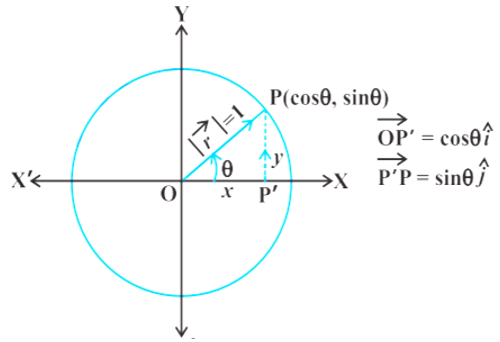
Also, as $\theta$ varies from $0 ~to ~2\pi$,
the point $P$ traces the circle $x^2 + y^2 = 1$ counterclockwise, and this covers all possible directions.
i,e $\vec{r}=\cos \theta \hat{i}+\sin \theta \hat{j} ; \theta \in(0,2 \pi)$, represents all the unit vectors in a plane. View full question & answer→Question 175 Marks
Show that for any two vectors $\vec a $ and $\vec b$ , we always have $|\vec{a}+\vec{b}| \leq|\vec{a}|+|\vec{b}|$ (triangle inequality).
AnswerThe inequality holds trivially in case either $\vec{a}=\vec{0}$ or $\vec{b}=\vec{0}$.
So, let $|\vec{a}| \neq \vec{0} \neq|\vec{b}|$. Then
$|\vec{a}+\vec{b}|^{2}=(\vec{a}+\vec{b})^{2}=(\vec{a}+\vec{b}) \cdot(\vec{a}+\vec{b})$
= $\vec{a} \cdot \vec{a}+\vec{a} \cdot \vec{b}+\vec{b} \cdot \vec{a}+\vec{b} \cdot \vec{b}$
= $|\vec{a}|^{2}+2 \vec{a} \cdot \vec{b}+|\vec{b}|^{2}$ (scalar product is commuatative)
=$\leq|\vec{a}|^{2}+2|\vec{a} \cdot \vec{b}|+|\vec{b}|^{2}$ (since $x \leq|x|~ \forall x \in {R}$)
=$\leq|\vec{a}|^{2}+2|\vec{a}||\vec{b}|+|\vec{b}|^{2}$ (from Cauchy Schwartz Inequality)
= $(|\vec{a}|+|\vec{b}|)^{2}$
$\Rightarrow |\vec{a}+\vec{b}| \leq|\vec{a}|+|\vec{b}|$
View full question & answer→