Question 11 Mark
If $\vec{a}$ and $\vec{b}$ are two vectors such that $|\vec{a}|=1,|\vec{b}|=2$ and $\vec{a} \cdot \vec{b}=\sqrt{3}$, then the angle between $2 \vec{a}$ and $-\vec{b}$ is:
AnswerWe have, $|\vec{a}|=1,|\vec{b}|=2$ and $\vec{a} \cdot \vec{b}=\sqrt{3}$
As, $\vec{a} \cdot \vec{b}=|a||b| \cos \theta$
$(2 \vec{a}) \cdot(-\vec{b})=|2 \vec{a}||-\vec{b}| \cos \theta$
$\Rightarrow-2(\vec{a} \cdot \vec{b})=2|\vec{a}||\vec{b}| \cos \theta \Rightarrow \cos \theta=\frac{-(\vec{a} \cdot \vec{b})}{|\vec{a}||\vec{b}|}=\frac{-\sqrt{3}}{2}$
$\therefore \quad$ Angle between $2 \vec{a}$ and $-\vec{b}=\pi-\frac{\pi}{6}$ or $\pi+\frac{\pi}{6}=\frac{5 \pi}{6}$ or $\frac{7 \pi}{6}$
View full question & answer→Question 21 Mark
The position vectors of points $P$ and $Q$ are $\vec{p}$ and $\vec{q}$ respectively. The point $R$ divides line segment $P Q$ in the ratio $3: 1$ and $S$ is the mid-point of line segment $P R$. The position vector of $S$ is
AnswerGiven, position vector of $P$ is $\overrightarrow{O P}=\vec{p}$ and position vector of $Q$ is $\overrightarrow{O P}=\vec{p}$, where $O$ is origin.
Point $R$ divides $P Q$ in ratio $3: 1$.
So, position vector of point $R$ is $\overrightarrow{O R}=\frac{3 \overrightarrow{O Q}+\overrightarrow{O P}}{4}=\frac{3 \vec{q}+\vec{p}}{4}$
Also, $S$ is the mid-point of $P R$.
So, $\overrightarrow{O S}=\frac{\overrightarrow{O P}+\overrightarrow{O R}}{2}=\frac{\vec{p}+\frac{3 \vec{q}+\vec{p}}{4}}{2}=\frac{5 \vec{p}+3 \vec{q}}{8}$
View full question & answer→Question 31 Mark
The unit vector perpendicular to both vectors $\hat{i}+\hat{k}$ and $\hat{i}-\hat{k}$ is:
AnswerLet the required vector be $x \hat{i}+y \hat{j}+z \hat{k}$.
Then, $x^2+y^2+z^2=1$ .............(i)
Also, $(x \hat{i}+y \hat{j}+z \hat{k}) \cdot(\hat{i}+\hat{k})=0$
$\Rightarrow \quad x+z=0 ........(ii)$
And $(x \hat{i}+y \hat{j}+z \hat{k}) \cdot(\hat{i}-\hat{k})=0$
$\Rightarrow x - z =0 .........(iii)$
Solving (ii) and (iii), we get $x=z=0$
$\therefore \quad$ From (i), $y^2=1 \Rightarrow y= \pm 1$
So, required vector is $\pm \hat{j}$.
View full question & answer→Question 41 Mark
The vectors $\vec{a}=2 \hat{i}-\hat{j}+\hat{k}, \vec{b}=\hat{i}-3 \hat{j}-5 \hat{k}$ and $\vec{c}=-3 \hat{i}+4 \hat{j}+4 \hat{k}$ represents the sides of
AnswerGiven, $\vec{a}=2 \hat{i}-\hat{j}+\hat{k}, \vec{b}=\hat{i}-3 \hat{j}-5 \hat{k}$
and $\vec{c}=-3 \hat{i}+4 \hat{j}+4 \hat{k}$, then
$|\vec{a}|=\sqrt{4+1+1}=\sqrt{6},|\vec{b}|=\sqrt{1+9+25}=\sqrt{35} \text { and }$
$|\vec{c}|=\sqrt{9+16+16}=\sqrt{41}$since,$|\vec{c}|^2=|\vec{a}|^2+|\vec{b}|^2$
$\therefore \quad$ It is a right - angled triangle.
View full question & answer→Question 51 Mark
Let $\vec{a}$ be any vector such that $|\vec{a}|=a$. The value of $|\vec{a} \times \hat{i}|^2+|\vec{a} \times \hat{j}|^2+|\vec{a} \times \hat{k}|^2$ is :
AnswerLet $\vec{a}=x \hat{i}+y \hat{j}+z \hat{k}$, then $a^2=x^2+y^2+z^2$
Now, $\vec{a} \times \hat{i}=z \hat{j}-y \hat{k} \Rightarrow|\vec{a} \times \hat{i}|^2=y^2+z^2$
Similarly, $|\vec{a} \times \hat{j}|^2=x^2+z^2$ and $|\vec{a} \times \hat{k}|^2=x^2+y^2$
$\therefore \quad$ Required sum $=2 x^2+2 y^2+2 z^2=2 a^2$
View full question & answer→Question 61 Mark
For any two vectors $\vec{a}$ and $\vec{b}$, which of the following statements is always true?
Answer$\vec{a} \cdot \vec{b} \leq|\vec{a}||\vec{b}|$
View full question & answer→Question 71 Mark
If $\vec{a}=4 \hat{i}+6 \hat{j}$ and $\vec{b}=3 \hat{j}+4 \hat{k}$, then the vector form of the component of $\vec{a}$ along $\vec{b}$ is
Answer$\text {Given, } \vec{a}=4 \hat{i}+6 \hat{j} \text { and } \vec{b}=3 \hat{j}+4 \hat{k}$
$\vec{a} \cdot \vec{b}=(4 \hat{i}+6 \hat{j}) \cdot(3 \hat{j}+4 \hat{k})=4 \times 0+6 \times 3+0 \times 4=18$
$|\vec{b}|=\sqrt{(3)^2+(4)^2}=\sqrt{9+16}=5$
$\therefore \quad|\vec{b}|^2=5^2=25$
Vector component of $\vec{a}$ along $\vec{b}=\left(\frac{\vec{a} \cdot \vec{b}}{|\vec{b}|^2}\right) \vec{b}=\frac{18}{25}(3 \hat{j}+4 \hat{k})$.
View full question & answer→Question 81 Mark
The value of $\lambda$ for which two vectors $2 \hat{i}-\hat{j}+2 \hat{k}$ and $3 \hat{i}+\lambda \hat{j}+\hat{k}$ are perpendicular is
AnswerDot product of two mutually perpendicular vectors is zero.
$(2 \hat{i}-\hat{j}+2 \hat{k}) \cdot(3 \hat{i}+\lambda \hat{j}+\hat{k})=0$
$\Rightarrow 2 \times 3+(-1) \lambda+2 \times 1=0$
$\Rightarrow 6-\lambda+2=0$
$\Rightarrow \lambda=8$
View full question & answer→Question 91 Mark
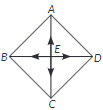
$A B C D$ is a rhombus whose diagonals intersects at $E$. Then $\overrightarrow{E A}+\overrightarrow{E B}+\overrightarrow{E C}+\overrightarrow{E D}$ equals to
View full question & answer→Question 101 Mark
If $(\hat{i}+\lambda \hat{j}) \times(5 \hat{i}+3 \hat{j}+\sigma \hat{k})=0$, what are the values of $\lambda$ and $\sigma$ ?
Answer$\lambda=\frac{3}{5}, \sigma=0$
View full question & answer→Question 111 Mark
For which of these vectors is the projection on the $y$-axis zero?
(i) $2 \hat{j}$ (ii) $-5 \hat{k}$ (iii) $\hat{i}-4 \hat{k}$
View full question & answer→Question 121 Mark
If $\text{A B C D}$ is a parallelogram and $A C$ and $B D$ are its diagonals, then $\overrightarrow{A C}+\overrightarrow{B D}$ is:
AnswerGiven, $\text{A B C D}$ is a parallelogram, then $A B \| C D$ and $B C \| D A$
$\overrightarrow{A C}=\overrightarrow{A B}+\overrightarrow{B C} \quad$ [Triangle law of addition]
$\overrightarrow{B D}=\overrightarrow{B C}+\overrightarrow{C D}$ [Triangle law of addition]
$\therefore \overrightarrow{A C}+\overrightarrow{B D}=\overrightarrow{A B}+\overrightarrow{B C}+\overrightarrow{B C}+\overrightarrow{C D}$
$=\overrightarrow{A B}+2 \overrightarrow{B C}-\overrightarrow{A B} \quad[\because \overrightarrow{A B}=-\overrightarrow{C D}]$
$=2 \overrightarrow{B C}$
View full question & answer→Question 131 Mark
The projection of vector $\hat{i}$ on the vector $\hat{i}+\hat{j}+2 \hat{k}$ is:
AnswerLet, $\vec{a}=\hat{i}$ and $\vec{b}=\hat{i}+\hat{j}+2 \hat{k}$
We know that, projection of vector $\vec{a}$ on $\vec{b}=\frac{\vec{a} \cdot \vec{b}}{|\vec{b}|}$
$
=\frac{\hat{i} \cdot(\hat{i}+\hat{j}+2 \hat{k})}{\sqrt{1^2+1^2+2^2}}=\frac{1}{\sqrt{6}}$
View full question & answer→Question 141 Mark
If $\vec{a}+\vec{b}=\hat{i}$ and $\vec{a}=2 \hat{i}-2 \hat{j}+2 \hat{k}$, then $|\vec{b}|$ equals:
Answer$\text {Given, } \hat{a}+\hat{b}=\hat{i} \text { and } \vec{a}=2 \hat{i}-2 \hat{j}+2 \hat{k}$
$\Rightarrow 2 \hat{i}-2 \hat{j}+2 \hat{k}+\vec{b}=\hat{i} \Rightarrow \vec{b}=\hat{i}-(2 \hat{i}-2 \hat{j}+2 \hat{k})$
$\Rightarrow -\hat{i}+2 \hat{j}-2 \hat{k}$
$\therefore |\vec{b}|=\sqrt{(-1)^2+(2)^2+(-2)^2}$
$=\sqrt{1+4+4}=\sqrt{9}=3$
View full question & answer→Question 151 Mark
The value of $(\hat{i} \times \hat{j}) \cdot \hat{j}+(\hat{j} \times \hat{i}) \cdot \hat{k}$ is:
AnswerSince, $\hat{ i } \times \hat{ j }=\hat{ k }$ and $\hat{ j } \times \hat{ i }=-\hat{ k }$
$
\therefore \quad(\hat{i} \times \hat{j}) \cdot \hat{j}+(\hat{j} \times \hat{i}) \cdot \hat{k}=\hat{k} \cdot \hat{j}+(-\hat{k}) \cdot \hat{k}=0-\hat{k} \cdot \hat{k}=-1$
View full question & answer→Question 161 Mark
The magnitude of the vector $6 \hat{i}-2 \hat{j}+3 \hat{k}$ is
AnswerGiven vector is $6 \hat{ i }-2 \hat{ j }+3 \hat{k}$
$\therefore \text { Its magnitude }=\sqrt{6^2+(-2)^2+3^2}$
$=\sqrt{36+4+9}=\sqrt{49}=7 \text { units }$
View full question & answer→Question 171 Mark
The value of $p$ for which the vectors $2 \hat{i}+p \hat{j}+\hat{k}$ and $-4 \hat{i}-6 \hat{j}+26 \hat{k}$ are perpendicular to each other, is :
AnswerGiven vector are $2 \hat{i}+p \hat{j}+\hat{k}$ and $-4 \hat{i}-6 \hat{j}+26 \hat{k}$.
Since, the given vectors are perpendicular to each other.
$\therefore \quad(2 \hat{i}+p \hat{j}+\hat{k}) \cdot(-4 \hat{i}-6 \hat{j}+26 \hat{k})=0$
$\Rightarrow 2 \times(-4)+p \times(-6)+1 \times(26)=0$
$\Rightarrow \quad-8-6 p+26=0 \Rightarrow-6 p+18=0$
$\Rightarrow \quad-6 p=-18 \Rightarrow p=3 .$
View full question & answer→Question 181 Mark
If $\vec{a}, \vec{b}$ and $(\vec{a}+\vec{b})$ are all unit vectors and $\theta$ is the angle between $\vec{a}$ and $\vec{b}$, then the value of $\theta$ is :
AnswerGiven, $|\vec{a}|=|\vec{b}|=|\vec{a}+\vec{b}|=1$
Now, $|\vec{a}+\vec{b}|^2=|\vec{a}|^2+|\vec{b}|^2+2|\vec{a}||\vec{b}| \cos \theta$
$\Rightarrow 1^2=1^2+1^2+2 \cdot 1 \cdot 1 \cos \theta$
$\Rightarrow \cos \theta=\frac{-1}{2} \Rightarrow \theta=\cos ^{-1}\left(\frac{-1}{2}\right)$
$\Rightarrow \theta=\frac{2 \pi}{3}$
View full question & answer→Question 191 Mark
A unit vector along the vector $4 \hat{i}-3 \hat{k}$ is
Answer$\text {Let } \vec{v}=4 \hat{i}-3 \hat{k}$
$\therefore|\vec{v}|=\sqrt{4^2+(3)^2}=\sqrt{16+9}=\sqrt{25}=5$
$\text { Now, } \hat{v}=\text { unit vector along } \vec{v}$
$\quad=\frac{\vec{v}}{|\vec{v}|}=\frac{1}{5}(4 \hat{i}-3 \hat{k})$
View full question & answer→Question 201 Mark
Two vectors $\vec{a}=a_1 \hat{i}+a_2 \hat{j}+a_3 \hat{k}$ and $\vec{b}=b_1 \hat{i}+b_2 \hat{j}+b_3 \hat{k}$ are collinear if
Answer$a_1=b_1, a_2=b_2, a_3=b_3$
View full question & answer→Question 211 Mark
If $\theta$ is the angle between two vectors $\vec{a}$ and $\vec{b}$, then $\vec{a} \cdot \vec{b} \geq 0$ only when
AnswerGiven, $\vec{a} \cdot \vec{b} \geq 0 \Rightarrow|\vec{a}||\vec{b}| \cos \theta \geq 0$
Assuming $|\vec{a}| \neq 0$ and $|\vec{b}| \neq 0$
$
\Rightarrow \cos \theta \geq 0 \quad[\because|\vec{a}| \geq 0,|\vec{b}| \geq 0] \Rightarrow \theta \in\left[0, \frac{\pi}{2}\right]
$
View full question & answer→Question 221 Mark
If two vectors $\vec{a}$ and $\vec{b}$ are such that $|\vec{a}|=2,|\vec{b}|=3$ and $\vec{a} \cdot \vec{b}=4$, then $|\vec{a}-2 \vec{b}|$ is equal to
Answer$\|\vec{a}-2 \vec{b}|^2=(\vec{a}-2 \vec{b}) \cdot(\vec{a}-2 \vec{b})$
$=\vec{a} \cdot \vec{a}-4 \vec{a} \cdot \vec{b}+4 \vec{b} \cdot \vec{b}=|\vec{a}|^2-4 \vec{a} \cdot \vec{b}+4|\vec{b}|^2=4-16+36=24$
$\therefore|\vec{a}-2 \vec{b}|=2 \sqrt{6}$
View full question & answer→Question 231 Mark
The scalar projection of the vector $3 \hat{ i }-\hat{ j }-2 \hat{ k }$ on the vector $\hat{i}+2 \hat{j}-3 \hat{k}$ is
AnswerScalar projection of $\vec{a}$ on $\vec{b}=\frac{\vec{a} \cdot \vec{b}}{|\vec{b}|}$ Scalar projection of $3 \hat{i}-\hat{j}-2 \hat{k}$ on vector $\hat{i}+2 \hat{j}-3 \hat{k}$
$
=\frac{(3 \hat{i}-\hat{j}-2 \hat{k}) \cdot(\hat{i}+2 \hat{j}-3 \hat{k})}{1 \hat{i}+2 \hat{j}-3 \hat{k} \mid}=\frac{7}{\sqrt{14}}$
View full question & answer→Question 241 Mark
if the projection of $\dot{a}=\hat{i}-2 \hat{j}+3 \hat{k}$ on $\vec{b}=2 \hat{i}+\lambda \hat{k}$ is zero, then the value of $\lambda$ is
AnswerHere, $\vec{a}=\hat{i}-2 \hat{j}+3 \hat{k}, \vec{b}=2 \hat{i}+\lambda \hat{k}$
Since, projection of $\vec{a}$ on $\vec{b}=0$
$\Rightarrow \frac{\vec{a} \cdot \vec{b}}{|\vec{b}|}=0 \Rightarrow \frac{(\hat{i}-2 \hat{j}+3 \hat{k}) \cdot(2 \hat{i}+\lambda \hat{k})}{\sqrt{2^2+\lambda^2}}=0$
$\Rightarrow \frac{2+3 \lambda}{\sqrt{4+\lambda^2}}=0 \Rightarrow 2+3 \lambda=0 \Rightarrow \lambda=-\frac{2}{3}$
View full question & answer→Question 251 Mark
If $\hat{i}, \hat{j}, \hat{k}$ are unit vectors along three mutually perpendicular directions, then
AnswerSince, $\hat{i}, \hat{j}, \hat{k}$ are mutually perpendicular to each other.
$
\therefore \hat{ i } \cdot \hat{ k }=0
$
View full question & answer→Question 261 Mark
$A B C D$ is a rhombus, whose diagonals intersect at $E$. Then $\overrightarrow{E A}+\overrightarrow{E B}+\overrightarrow{E C}+\overrightarrow{E D}$ equals
Answer$\overrightarrow{E A}+\overrightarrow{E B}+\overrightarrow{E C}+\overrightarrow{E D}=\overrightarrow{E A}+\overrightarrow{E B}-\overrightarrow{E A}-\overrightarrow{E B}$
[As diagonals of a rhombus bisect each other] $=\overrightarrow{0}$
View full question & answer→Question 271 Mark
The value of $p$ for which $p(\hat{i}+\hat{j}+\hat{k})$ is a unit vector is
AnswerLet $\vec{a}=(\hat{i}+\hat{j}+\hat{k})$
So, unit vector of $\vec{a}=\frac{\hat{i}+\hat{j}+\hat{k}}{\sqrt{1+1+1}}=\frac{1}{\sqrt{3}}(\hat{i}+\hat{j}+\hat{k})$
$\therefore \quad$ The value of $p$ is $\frac{1}{\sqrt{3}}$.
View full question & answer→Question 281 Mark
Let $\vec{a}$ and $\vec{b}$ are non-collinear. If $\vec{c}=(x-2) \vec{a}+\vec{b}$ and $\vec{d}=(2 x+1) \vec{a}-\vec{b}$ are collinear, then find the value of $x$.
Answer$(d):$ We have, $\vec{c}=(x-2) \vec{a}+\vec{b}, \vec{d}=(2 x+1) \vec{a}-\vec{b}$ are collinear, then $\vec{c}=m \vec{d}$ where $m$ is any scalar.
$\Rightarrow \quad(x-2) \vec{a}+\vec{b}=m((2 x+1) \vec{a}-\vec{b})$
$\Rightarrow \quad-m=1$
$\Rightarrow m=-1$
$\text { and } m(2 x+1)=x-2 \Rightarrow-2 x-1=x-2 \Rightarrow x=\frac{1}{3}$
View full question & answer→Question 291 Mark
The value of $p$ for which $p(\hat{i}+\hat{j}+\hat{k})$ is a unit vector is
Answer(b) : Let $\vec{a}=(\hat{i}+\hat{j}+\hat{k})$
So, unit vector of $\vec{a}=\frac{\hat{i}+\hat{j}+\hat{k}}{\sqrt{1+1+1}}=\frac{1}{\sqrt{3}}(\hat{i}+\hat{j}+\hat{k})$
$\therefore \quad$ The value of $p$ is $\frac{1}{\sqrt{3}}$.
View full question & answer→Question 301 Mark
If $|\vec{a}|=4$ and $-3 \leq \lambda \leq 3$, then which of the following is the range of $|\lambda \vec{a}|$ ?
(i) $[0,8]$
(ii) $[-12,8]$
(iii) $[0,12]$
Answer(b) : We have, $-3 \leq \lambda \leq 3 \Rightarrow|\lambda| \leq 3$
Now, $|\lambda||\vec{a}| \leq 3|\vec{a}| \Rightarrow|\lambda \vec{a}| \leq 12$
$\therefore \quad$ Range of $|\lambda \vec{a}|$ is $[0,12]$
View full question & answer→Question 311 Mark
$(\hat{i}+\hat{j}) \times(\hat{j}+\hat{k}) \cdot(\hat{k}+\hat{i})$ is equal to
Answer$\text { (c) : }(\hat{i}+\hat{j}) \times(\hat{j}+\hat{k}) \cdot(\hat{k}+\hat{i})=(\hat{i} \times \hat{j}+\hat{i} \times \hat{k}+\hat{j} \times \hat{k}) \cdot(\hat{k}+\hat{i})$
$=(\hat{k}-\hat{j}+\hat{i}) \cdot(\hat{k}+\hat{i})=\hat{k} \cdot \hat{k}+\hat{i} \cdot \hat{i} \quad(\because \hat{i} \cdot \hat{j}=\hat{j} \cdot \hat{k}=\hat{k} \cdot \hat{i}=0)$
$=|\hat{k}|^2+|\hat{i}|^2=1+1=2$
View full question & answer→Question 321 Mark
If $\vec{a}=2 \hat{i}+\hat{j}+3 \hat{k}$ and $\vec{b}=3 \hat{i}+5 \hat{j}-2 \hat{k}$, then $|\vec{a} \times \vec{b}|$ is equal to
Answer(a): We have, $\vec{a} \times \vec{b}=\left|\begin{array}{ccc}\hat{i} & \hat{j} & \hat{k} \\ 2 & 1 & 3 \\ 3 & 5 & -2\end{array}\right|$
$
=\hat{i}(-2-15)-(-4-9) \hat{j}+(10-3) \hat{k}=-17 \hat{i}+13 \hat{j}+7 \hat{k}
$
Hence, $|\vec{a} \times \vec{b}|=\sqrt{(-17)^2+(13)^2+(7)^2}=\sqrt{507}$
View full question & answer→Question 331 Mark
If $\vec{a}=2 \hat{i}-\hat{j}+2 \hat{k}$ and $\vec{b}=4 \hat{i}+4 \hat{j}-2 \hat{k}$ then find the angle between the vectors $\vec{a}$ and $\vec{b}$.
Answer(c) : We have, $\vec{a}=2 \hat{i}-\hat{j}+2 \hat{k}$ and $\vec{b}=4 \hat{i}+4 \hat{j}-2 \hat{k}$
Now, $\vec{a} \cdot \vec{b}=(2 \hat{i}-\hat{j}+2 \hat{k}) \cdot(4 \hat{i}+4 \hat{j}-2 \hat{k})$
$=8-4-4=0$. Therefore, $\vec{a} \cdot \vec{b}=0$
$
\Rightarrow \cos \theta=0
$
So, angle between $\vec{a}$ and $\vec{b}$ is $\frac{\pi}{2}$.
View full question & answer→Question 341 Mark
If $A B C D$ is a rhombus, whose diagonals intersect at $E$, then $\overrightarrow{E A}+\overrightarrow{E B}+\overrightarrow{E C}+\overrightarrow{E D}$ equals
Answer(a) : $\overrightarrow{E A}+\overrightarrow{E B}+\overrightarrow{E C}+\overrightarrow{E D}$
$
=\overrightarrow{E A}+\overrightarrow{E B}-\overrightarrow{E A}-\overrightarrow{E B}
$ [As diagonals of a rhombus bisect each other]
$=\overrightarrow{0}$
View full question & answer→Question 351 Mark
Which of the following is the magnitude of the vector $\vec{a}=3 \hat{i}-2 \hat{j}+6 \hat{k}$ ?
Answer(b) : Here, $\vec{a}=3 \hat{i}-2 \hat{j}+6 \hat{k}$
$\therefore \quad$ Its magnitude $=|\vec{a}|$
$
=\sqrt{3^2+(-2)^2+6^2}=\sqrt{9+4+36}=\sqrt{49}=7
$
View full question & answer→Question 361 Mark
If $|\vec{a}-\vec{b}|=|\vec{a}|=|\vec{b}|=1$, then the angle between $\vec{a}$ and $\vec{b}$ is
Answer(a) : Given, $|\vec{a}-\vec{b}|=|\vec{a}|=|\vec{b}|=1$
$
\Rightarrow|\vec{a}-\vec{b}|^2=|\vec{a}|^2+|\vec{b}|^2-2 \vec{a} \cdot \vec{b} \Rightarrow 1=1+1-2|\vec{a}||\vec{b}| \cos \theta
$
(Here $\theta$ is angle between $\vec{a}$ and $\vec{b}$ )
$
\Rightarrow \cos \theta=\frac{1}{2} \Rightarrow \theta=\frac{\pi}{3}
$
View full question & answer→Question 371 Mark
Which of the following is the vector in the direction of the vector $\hat{i}-2 \hat{j}+2 \hat{k}$ that has magnitude 9?
Answer$\text { (c) : Let } \vec{a}=\hat{i}-2 \hat{j}+2 \hat{k}$
$\therefore|\vec{a}|=\sqrt{1+4+4}=\sqrt{9}=3$
$\therefore \text { Required vector }=\frac{9(\hat{i}-2 \hat{j}+2 \hat{k})}{3}=3(\hat{i}-2 \hat{j}+2 \hat{k})$
View full question & answer→Question 381 Mark
If the angle between $\hat{i}+\hat{k}$ and $\hat{i}+\hat{j}+a \hat{k}$ is $\frac{\pi}{3}$ then the value of $a$ is
Answer$(c) :$ We have, $\cos \frac{\pi}{3}=\frac{(\hat{i}+\hat{k}) \cdot(\hat{i}+\hat{j}+a \hat{k})}{\sqrt{2} \sqrt{1+1+a^2}}$
$\Rightarrow \frac{1}{2}=\frac{1+a}{\sqrt{2} \sqrt{2+a^2}}$
$\Rightarrow \frac{1}{4}=\frac{(1+a)^2}{2\left(2+a^2\right)} ...(i)$
$\Rightarrow 2+a^2=2\left(1+a^2+2 a\right)$
$\Rightarrow a^2+4 a=0$
$\Rightarrow a=0,-4$
But $a=-4$ does not satisfy equation $(i),$
Hence, the required value of $a$ is $0 .$
View full question & answer→Question 391 Mark
If $A$ and $B$ are the points $(-3,4,-8)$ and $(5,-6,4)$ respectively, then find the ratio in which $y z$-plane divides $\overrightarrow{A B}$.
Answer(c) : Let $\vec{a}=-3 \hat{i}+4 \hat{j}-8 \hat{k}, \vec{b}=5 \hat{i}-6 \hat{j}+4 \hat{k}$
Let $C(\vec{c})$ be the point in $y z$-plane which divides $\overrightarrow{A B}$ in the ratio $r: 1$ internally.
Then, $0=\frac{5 r-3}{r+1} \quad(\because$ In $y z$-plane, $x=0)$
$\Rightarrow \quad 5 r-3=0 \Rightarrow r=\frac{3}{5}$
Thus required ratio is $3: 5$
View full question & answer→Question 401 Mark
If $\vec{a}=2 \hat{i}+\hat{j}+3 \hat{k}, \vec{b}=-\hat{i}+2 \hat{j}+\hat{k}$ and $\vec{c}=3 \hat{i}+\hat{j}+2 \hat{k},$ then the value of $\vec{a} \cdot(\vec{b} \times \vec{c})$ is
Answer$(b)$ : Here, $\vec{a}=2 \hat{i}+\hat{j}+3 \hat{k}, \vec{b}=-\hat{i}+2 \hat{j}+\hat{k}$ and $\vec{c}=3 \hat{i}+\hat{j}+2 \hat{k}$
Now, $\vec{b} \times \vec{c}=\left|\begin{array}{ccc}\hat{i} & \hat{j} & \hat{k} \\ -1 & 2 & 1 \\ 3 & 1 & 2\end{array}\right|=3 \hat{i}+5 \hat{j}-7 \hat{k}$
$\therefore \vec{a} \cdot(\vec{b} \times \vec{c})=(2 \hat{i}+\hat{j}+3 \hat{k}) \cdot(3 \hat{i}+5 \hat{j}-7 \hat{k})$
$=2 \times 3+1 \times 5+3 \times(-7)$
$=6+5-21=-10$
View full question & answer→Question 411 Mark
The vector having initial and terminal points as $(2,5,0)$ and $(-3,7,4)$ respectively is
Answer(c) : Let $A(2,5,0)$ and $B(-3,7,4)$
$
\begin{aligned}
\therefore \quad \text { Required vector } & =(-3-2) \hat{i}+(7-5) \hat{j}+(4-0) \hat{k} \\
& =-5 \hat{i}+2 \hat{j}+4 \hat{k}
\end{aligned}
$
View full question & answer→Question 421 Mark
Find the projection of the vector $\hat{i}+3 \hat{j}+7 \hat{k}$ on the vector $2 \hat{i}-3 \hat{j}+6 \hat{k}$.
Answer(a) : Let $\vec{a}=\hat{i}+3 \hat{j}+7 \hat{k}$ and $\vec{b}=2 \hat{i}-3 \hat{j}+6 \hat{k}$.
Now, projection of $\vec{a}$ on $\vec{b}=\frac{\vec{a} \cdot \vec{b}}{|\vec{b}|}$
$
=\frac{(\hat{i}+3 \hat{j}+7 \hat{k}) \cdot(2 \hat{i}-3 \hat{j}+6 \hat{k})}{\sqrt{2^2+(-3)^2+6^2}}=\frac{2-9+42}{\sqrt{4+9+36}}=\frac{35}{7}=5
$
View full question & answer→Question 431 Mark
The projection of the vector $\vec{a}=2 \hat{\imath}+3 \hat{\jmath}+2 \hat{k}$ on the vector $\vec{b}=\hat{i}+2 \hat{j}+\hat{k}$ is
Answer(a): We have, $\vec{a}=2 \hat{i}+3 \hat{j}+2 \hat{k}$ and $\vec{b}=\hat{i}+2 \hat{j}+\hat{k}$
$
\therefore \quad \vec{a} \cdot \vec{b}=(2 \hat{i}+3 \hat{j}+2 \hat{k}) \cdot(\hat{i}+2 \hat{j}+\hat{k})=2+6+2=10
$
and $|\vec{b}|=\sqrt{1^2+2^2+1^2}=\sqrt{6}$
Hence, projection of $\vec{a}$ on $\vec{b}$ is $\frac{\vec{a} \cdot \vec{b}}{|\vec{b}|}=\frac{10}{\sqrt{6}}$.
View full question & answer→Question 441 Mark
The position vector of the point which divides the joining of points $2 \vec{a}-3 \vec{b}$ and $\vec{a}+\vec{b}$ in the ratio $3: 1$ is
Answer$(d) :$ Given points are $2 \vec{a}-3 \vec{b}$ and $\vec{a}+\vec{b}$.
$\text { Given ratio }=3: 1$
$\therefore \text { Required vector }=\frac{(2 \vec{a}-3 \vec{b}) \times 1+(\vec{a}+\vec{b}) \times 3}{3+1}$
$=\frac{2 \vec{a}-3 \vec{b}+3 \vec{a}+3 \vec{b}}{4}=\frac{5}{4} \vec{a}$
View full question & answer→Question 451 Mark
The angle between two vectors $\vec{a}$ and $\vec{b}$ with magnitudes $\sqrt{3}$ and 4 , respectively and $\vec{a} \cdot \vec{b}=2 \sqrt{3}$ is
Answer(b) : We have $\vec{a} \cdot \vec{b}=2 \sqrt{3},|\vec{a}|=\sqrt{3},|\vec{b}|=4$
Let $\theta$ be the angle between $\vec{a}$ and $\vec{b}$.
$
\begin{array}{ll}
\therefore & \vec{a} \cdot \vec{b}=|\vec{a}||\vec{b}| \cos \theta \\
\Rightarrow & 2 \sqrt{3}=\sqrt{3} \cdot 4 \cdot \cos \theta \quad \Rightarrow \cos \theta=\frac{1}{2} \Rightarrow \theta=\frac{\pi}{3}
\end{array}
$
View full question & answer→Question 461 Mark
Area of a parallelogram whose adjacent sides are represented by the vectors $2 \hat{i}-3 \hat{k}$ and $4 \hat{j}+2 \hat{k}$ is
Answer$(a)$ : Let $\vec{a}=2 \hat{i}-3 \hat{k}$ and $\vec{b}=4 \hat{j}+2 \hat{k}$
The area of a parallelogram with $\vec{a}$ and $\vec{b}$ as its adjacent sides is given by $|\vec{a} \times \vec{b}|$.
Now, $\vec{a} \times \vec{b}=\left|\begin{array}{ccc}\hat{i} & \hat{j} & \hat{k} \\ 2 & 0 & -3 \\ 0 & 4 & 2\end{array}\right|=12 \hat{i}-4 \hat{j}+8 \hat{k}$
$\therefore \quad|\vec{a} \times \vec{b}|=\sqrt{(12)^2+(-4)^2+(8)^2}$
$=\sqrt{144+16+64} \\$
$\quad=\sqrt{224}=4 \sqrt{14}^2$ . units.
View full question & answer→Question 471 Mark
Find the value of $\lambda$ so that the vectors $2 \hat{i}-4 \hat{j}+\hat{k}$ and $4 \hat{i}-8 \hat{j}+\lambda \hat{k}$ are perpendicular.
Answer(b): The given vectors are perpendicular if their dot product vanishes, i.e.,
$
\begin{aligned}
& (2 \hat{i}-4 \hat{j}+\hat{k}) \cdot(4 \hat{i}-8 \hat{j}+\lambda \hat{k})=0 \\
\Rightarrow & 8+32+\lambda=0 \Rightarrow \lambda=-40
\end{aligned}
$
View full question & answer→Question 481 Mark
The vectors from origin to the points $A$ and $B$ are $\vec{a}=2 \hat{i}-3 \hat{j}+2 \hat{k}$ and $\vec{b}=2 \hat{i}+3 \hat{j}+\hat{k}$, respectively, then the area of triangle $O A B$ (in sq. units) is
Answer(d) : $\vec{a}=2 \hat{i}-3 \hat{j}+2 \hat{k}$ and $\vec{b}=2 \hat{i}+3 \hat{j}+\hat{k}$
$
\vec{a} \times \vec{b}=\left|\begin{array}{ccc}
\hat{i} & \hat{j} & \hat{k} \\
2 & -3 & 2 \\
2 & 3 & 1
\end{array}\right|=-9 \hat{i}+2 \hat{j}+12 \hat{k}
$
Area of $\triangle O A B=\frac{1}{2}|\vec{a} \times \vec{b}|$
$
=\frac{1}{2} \sqrt{81+4+144}=\frac{1}{2} \sqrt{229} \text { sq. units }
$
View full question & answer→Question 491 Mark
If $|\vec{a}|=3,|\vec{b}|=4$, then the value of $\lambda$ for which $\vec{a}+\lambda \vec{b}$ is perpendicular to $\vec{a}-\lambda \vec{b}$, is
Answer$(b) :$ Given that, $|\vec{a}|=3,|\vec{b}|=4$ and $\vec{a}+\lambda \vec{b}$ is perpendicular to $\vec{a}-\lambda \vec{b}$.
$\therefore(\vec{a}+\lambda \vec{b}) \cdot(\vec{a}-\lambda \vec{b})=0$
$\Rightarrow \vec{a} \cdot \vec{a}-\vec{a} \cdot \vec{b} \lambda+\lambda \vec{b} \cdot \vec{a}-\lambda^2 \vec{b} \cdot \vec{b}=0$
$\Rightarrow|\vec{a}|^2-\lambda^2|\vec{b}|^2=0 \Rightarrow \lambda^2=\frac{|\vec{a}|^2}{|\vec{b}|^2} \Rightarrow \lambda=\frac{|\vec{a}|}{|\vec{b}|}=\frac{3}{4}$
View full question & answer→Question 501 Mark
If $\vec{u}=\hat{i}+2 \hat{j}, \vec{v}=-2 \hat{i}+\hat{j}$ and $\vec{w}=4 \hat{i}+3 \hat{j}$, then find scalars $x$ and $y$ such that $\vec{w}=x \vec{u}+y \vec{v}$.
Answer$(b):$ We have, $\vec{w}=x \vec{u}+y \vec{v}$
$\Rightarrow 4 \hat{i}+3 \hat{j}=x(\hat{i}+2 \hat{j})+y(-2 \hat{i}+\hat{j})$
$\Rightarrow \quad(x-2 y-4) \hat{i}+(2 x+y-3) \hat{j}=\overrightarrow{0}$
$\Rightarrow x-2 y-4=0 \text { and } 2 x+y-3=0$
$\Rightarrow x=2 \text { and } y=-1$
View full question & answer→