Question 15 Marks
If $ \vec{\text{a}}=2\hat{\text{i}}-\hat{\text{j}}-2\hat{\text{k}}\ \text{and}\ \vec{\text{b}}=7\hat{\text{i}}+2\hat{\text{j}}-3\hat{\text{k}}, $ then express $ \overrightarrow{\text{b}}$ in the form of $\overrightarrow{\text{b}}=\ \overrightarrow{\text{b}}_1+\overrightarrow{\text{b}}_2,$ where $ \overrightarrow{\text{b}}_1$ is parallel to $\overrightarrow{\text{a}}$ and $ \overrightarrow{\text{b}}_2$ is perpendicular to$\overrightarrow{\text{a}}$.
Answer$\overrightarrow{\text{b}}_1$||$\overrightarrow{\text{a}}$ $\Rightarrow\text{let}$ $\overrightarrow{\text{b}}_1$= $\lambda$ $(2\hat{\text{i}}-\hat{\text{j}}-2\hat{\text{k}})$
$\overrightarrow{\text{b}}_2$= $\overrightarrow{\text{b}}$- $\overrightarrow{\text{b}}_1$= $(7\hat{\text{i}}+2\hat{\text{j}}-3\hat{\text{k}})-(2\lambda\hat{\text{i}}-\lambda\hat{\text{j}}-2\lambda\hat{\text{k}})$
= $(7-2\lambda)\hat{\text{i}}+(2+\lambda)\hat{\text{j}}-(3-2\lambda)\hat{\text{k}}$
$\overrightarrow{\text{b}}_2\perp\overrightarrow{\text{a}}\Rightarrow2(7-2\lambda)-1(2+\lambda)+2(3-2\lambda)$
$\Rightarrow\lambda=2$
$\therefore\ \vec{\text{b}_1}=\ 4\hat{\text{i}}-2\hat{\text{j}}-4\hat{\text{k}}\ \text{and}\ \vec{\text{b}_2}=\ 3\hat{\text{i}}+4\hat{\text{j}}+\hat{\text{k}}$
$\Rightarrow\ (7\hat{\text{i}}+2\hat{\text{j}}-3\hat{\text{k}})=(4\hat{\text{i}}-2\hat{\text{j}}-4\hat{\text{k}})+(3\hat{\text{i}}+4\hat{\text{j}}+\hat{\text{k}})$
View full question & answer→Question 25 Marks
A manufacturing company makes two types of teaching aids A and B of Mathematics for class XII. Each type of A requires 9 labour hours of fabricating and 1 labour hour for finishing. Each type of B requires 12 labour hours for fabricating and 3 labour hours for finishing. For fabricating and finishing, the maximum labour hours available per week are 180 and 30 respectively. The company makes a profit of A and ₹ 80 on each piece of type ₹ 120 on each piece of type B. How many pieces of type A and type B should be manufactured per week to get a maximum profit? Make it as an LPP and solve graphically. What is the maximum profit per week?
AnswerLet number of pieces of type A and type B, manufactured per week be x and y respectivily
$\therefore\text{ L.P.P. is Maximise P = 80x + 120y } $
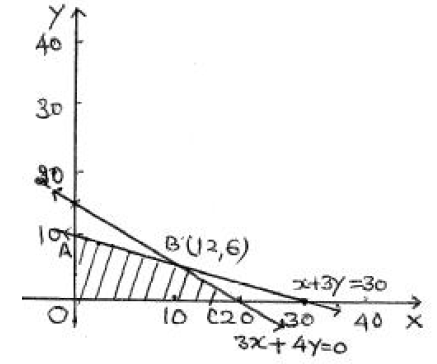
subject to 9x + 12y $\leq$ 180 or 3x + 4y $\leq$ 60
x + 3y $\leq$ 30
x $\geq$0 y $\geq$0
For correct graph:
Vertices of feasible region are
A (0, 10), B (12, 6), C (20, 0)
P(A) = 1200, P(B) = 1680, P(C) = 1600
$\therefore\text{ For Max. P, No. of type A = 12 }$
No. of type B = 6
MaximumProfit =Rs. 1680. View full question & answer→Question 35 Marks
A manufacturing company makes two types of teaching aids A and B of Mathematics for class XII. Each type of A requires 9 labour hours of fabricating and 1 labour hour for finishing. Each type of B requires 12 labour hours for fabricating and 3 labour hours for finishing. For fabricating and finishing, the maximum labour hours available per week are 180 and 30 respectively. The company makes a profit of A and ₹ 80 on each piece of type ₹ 120 on each piece of type B. How many pieces of type A and type B should be manufactured per week to get a maximum profit? Make it as an LPP and solve graphically. What is the maximum profit per week?
AnswerLet number of pieces of type A and type B, manufactured per week be x and y respectivily
$\therefore\text{ L.P.P. is Maximise P = 80x + 120y } $
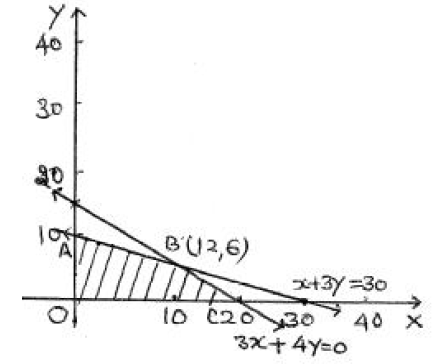
subject to 9x + 12y $\leq$ 180 or 3x + 4y $\leq$ 60
x + 3y $\leq$ 30
x $\geq$0 y $\geq$0
For correct graph:
Vertices of feasible region are
A (0, 10), B (12, 6), C (20, 0)
P(A) = 1200, P(B) = 1680, P(C) = 1600
$\therefore\text{ For Max. P, No. of type A = 12 }$
No. of type B = 6
MaximumProfit =Rs. 1680. View full question & answer→Question 45 Marks
Find the value of $\lambda,$ if four points with position vectors $3\hat{\text{i}} + 6\hat{\text{j}} + 9\hat{\text{k}}, \hat{\text{i}} + 2\hat{\text{j}} + 3\hat{\text{k}}, 2\hat{\text{i}} + 3\hat{\text{j}} + \hat{\text{k}} \text{ and } 4\hat{\text{i}} + 6\hat{\text{j}} + \lambda\hat{\text{k}}$are coplanar.
AnswerGiven points, A, B, C, D are coplanar, if the
vectors $\vec{\text{AB}} , \vec{\text{AC}} \text{ and } \vec{\text{AD}}$ are coplanar, i.e.
$\vec{\text{AB}} = -2\hat{\text{i}} - 4\hat{\text{j}} - 6\hat{\text{k}}, \vec{\text{AC}} = - \hat{\text{i}} - 3\hat{\text{j}} - 8\hat{\text{k}}, \vec{\text{AD}} = \hat{\text{i}} + (\lambda - 9) \hat{\text{k}}$
are coplanar
$\text{i.e.,}\begin{vmatrix} -2 & -4 & -6 \\ -1 & -3 & -8 \\ 1 & 0 & \lambda - 9 \end{vmatrix} = 0$
$- 2[-3\lambda +27] + 4 [ -\lambda + 17] -6 (3) = 0$
$\Rightarrow \lambda = 2.$
View full question & answer→Question 55 Marks
Show that the points A, B, C with position vectors $2\hat{\text{i}} - \hat{\text{j}} + \hat{\text{k}}, \hat{\text{i}} - 3\hat{\text{j}} - 5\hat{\text{k}} \text{ and } 3\hat{\text{i}} - 4\hat{\text{j}} - 4\hat{\text{k}}$ respectively, are the vertices of a right-angled triangle. Hence find the area of the triangle.
Answer$\vec{\text{AB}} = - \hat{\text{i}} - 2\hat{\text{j}} - 6\hat{\text{k}}, \vec{\text{BC}} = 2\hat{\text{i}} - \hat{\text{j}} + \hat{\text{k}}, \vec{\text{CA}} = -\hat{\text{i}} + 3\hat{\text{j}} + 5\hat{\text{k}}$
Since $\vec{\text{AB}}, \vec{\text{BC}}, \vec{\text{CA}},$ are not parallel vectors, and $\vec{\text{AB}} + \vec{\text{BC}} + \vec{\text{CA}} = \vec{0} \therefore \text{A, B, C}$ form a triangle
$\text{Also} \vec{\text{ BC}}. \vec{\text{CA}} = 0 \text{ }\text{ }\text{ }\text{ }\text{ } \therefore\text{A, B, C}$ form a right triangle
$\text{Area of} \Delta = \frac{1}{2} | \vec{\text{AB}} \times \vec{\text{BC}}| = \frac{1}{2} \sqrt{210}$
View full question & answer→Question 65 Marks
A manufacturing company makes two types of teaching aids A and B of Mathematics for class XII. Each type of A requires 9 labour hours of fabricating and 1 labour hour for finishing. Each type of B requires 12 labour hours for fabricating and 3 labour hours for finishing. For fabricating and finishing, the maximum labour hours available per week are 180 and 30 respectively. The company makes a profit of A and ₹ 80 on each piece of type ₹ 120 on each piece of type B. How many pieces of type A and type B should be manufactured per week to get a maximum profit? Make it as an LPP and solve graphically. What is the maximum profit per week?
AnswerLet number of pieces of type A and type B, manufactured per week be x and y respectivily
$\therefore\text{ L.P.P. is Maximise P = 80x + 120y } $
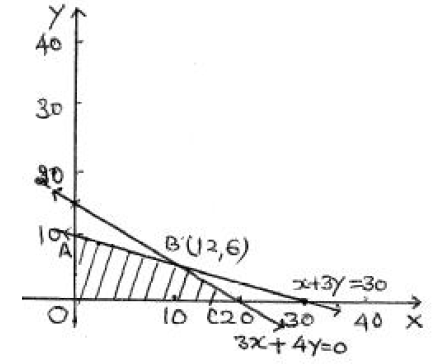
subject to 9x + 12y $\leq$ 180 or 3x + 4y $\leq$ 60
x + 3y $\leq$ 30
x $\geq$0 y $\geq$0
For correct graph:
Vertices of feasible region are
A (0, 10), B (12, 6), C (20, 0)
P(A) = 1200, P(B) = 1680, P(C) = 1600
$\therefore\text{ For Max. P, No. of type A = 12 }$
No. of type B = 6
MaximumProfit =Rs. 1680. View full question & answer→Question 75 Marks
Let $\vec{\text{a }}=\hat{\text{i}}+4\hat{\text{j}}+2\hat{\text{k}},\vec{\text{b }}=3\hat{\text{i}}-2\hat{\text{j}}+7\hat{\text{k}}\text{ and }\vec{\text{ c}}=2\hat{\text{i}}-\hat{\text{j}}+4\hat{\text{k}}.$ Find a vector $\vec{\text{ p}}$ which is perpendicular to both $\vec{\text{a }}$ and $\vec{\text{ b}}$ and $\vec{\text{ p}}\cdot\vec{\text{ c}}$ = 18.
Answer$\vec{\text{p}}\text{ is }\bot\text{ }\text{ to both }\vec{\text{a}}\text{ and }\vec{\text{b}}\Rightarrow\vec{\text{p}}=\lambda\text{ }(\vec{\text{a}}\times\vec{\text{b}})$ Now $\vec{\text{a}}\times\vec{\text{b}}$ $\begin{vmatrix} \hat{\text{i}} & \hat{\text{j}} & \hat{\text{k}} \\ 1 & 4 & 2 \\ 3 & -2 & 7 \end{vmatrix}$ =$32\hat{\text{i}}-\hat{\text{j}}-14\hat{\text{k}}$ Given that $\vec{\text{ p}}\cdot\vec{\text{ c}}$ = 18 $\Rightarrow\lambda(32\hat{\text{i}}-\hat{\text{j}}-14\hat{\text{k}})\cdot(2\hat{\text{i}}-\hat{\text{j}}+4\hat{\text{k}})=18$ OR $\lambda(64+1-56)=18\Rightarrow\lambda=2$$\therefore\vec{\text{p}}=64\hat{\text{i}}-2\hat{\text{j}}-28\hat{\text{k}}$.
View full question & answer→Question 85 Marks
The scalar product of the vector $\hat{\text{i}}+\hat{\text{j}}+\hat{\text{k}}$ with the unit vector along the sum of vectors $2\hat{\text{i}}+4\hat{\text{j}}-5\hat{\text{k}}$ and $\lambda\hat{\text{i}}+2\hat{\text{j}}+3\hat{\text{k}}$ is equal to one. Find the value of λ.
Answer$\Big(2\hat{\text{i}}+4\hat{\text{j}}-5\hat{\text{k}}\Big)+\Big(\lambda\hat{\text{i}}+2\hat{\text{j}}+3\hat{\text{k}}\Big)$
$=(2+\lambda)\hat{\text{i}}+6\hat{\text{j}}-2\hat{\text{k}}.......\text{(i)}$
A unit vector along (i) is
$\frac{(2+\lambda)\hat{\text{i}}+6\hat{\text{j}}-2\hat{\text{k}}}{\sqrt{(2+\lambda)^{2}+36+4}}=\frac{(2+\lambda)\hat{\text{i}}+6\hat{\text{j}}-2\hat{\text{k}}}{\sqrt{\lambda^{2}+4\lambda+44}}$
$\Rightarrow\frac{\Big[(2+\lambda)\hat{\text{i}}+6\hat{\text{j}}-2\hat{\text{k}\Big]}\cdot\Big[\hat{\text{i}}+\hat{\text{j}}+\hat{\text{k}}\Big]}{\sqrt{\lambda^{2}+4\lambda+44}}=1$
$\therefore(2+\lambda)+6-2=\sqrt{\lambda^{2}+4\lambda+44}$
$\text{Squaring}\Rightarrow\lambda^{2}+12\lambda+36=\lambda^{2}+4\lambda+44$
$\Rightarrow\lambda=1.$
View full question & answer→Question 95 Marks
If vector $\vec{\text{a}},\vec{\text{b}}\text{ and }\vec{\text{c}}$ are such that $\vec{\text{a}}+\vec{\text{b}}+\vec{\text{c}}=0\text{ and }|\vec{\text{a}}|=3, |\vec{\text{b}}|=5\text{ and }|\vec{\text{c}}|=7$ find the angle between $ \vec{\text{a}}$and $ \vec{\text{b}}$.
Answer$\vec{\text{a}}+\vec{\text{b}}=-\vec{\text{c}}$
$|\vec{\text{a}}|^{2}+|\vec{\text{b}}|^{2}+2\vec{\text{ a}}\cdot\vec{\text{b}}=|\vec{\text{c}}|^{2}$
$9+25+2\text{ }|\vec{\text{a}}|\text{ }|\vec{\text{b}}|\cos\theta=49$
$30\cos\theta=15\Rightarrow\cos\theta=\frac{1}{2}\Rightarrow\theta=60^{o}=\frac{\pi}{3}.$
View full question & answer→Question 105 Marks
Find the equation of the plane passing through the intersection of the planes.
$ \vec{r}.(2\hat{\text{i}}+\hat{\text{j}}+3\hat{\text{k})}=7,\text{ }\vec{r}.(2\hat{\text{i}}+5\hat{\text{j}}+3\hat{\text{k}})=9$and the point (2, 1, 3).
AnswerEquation of plane through the intersection of given two planes is $\left\{\vec{r}.\Bigg(2\hat{\text{i}}+\hat{\text{j}}+3\hat{\text{k}}\Bigg)-7\right\}+\lambda\left\{\vec{r}.\Bigg(2\hat{\text{i}}+5\hat{\text{j}}+3\hat{\text{k}}\Bigg)-9\right\}=0..........{\text{(i)}}$Since (2,1, 3) lies on it
$\therefore\left\{\Bigg(2\hat{\text{i}}+\hat{\text{j}}+3\hat{\text{k}}\Bigg)\cdot\Bigg((2\hat{\text{i}}+\hat{\text{j}}+3\hat{\text{k}}\Bigg)-7\right\}+\lambda\left\{\Bigg(2\hat{\text{i}}+\hat{\text{j}}+3\hat{\text{k}}\Bigg)\cdot\Bigg(2\hat{\text{i}}+5\hat{\text{j}}+3\hat{\text{k}}\Bigg)-9\right\}=0$ $\Rightarrow(4+1+9-7)+\lambda(4+5+9-9)=0\Rightarrow\lambda=\frac{-7}{9}$ Substituting in (i) we get $\vec{r}.\Big(18\hat{\text{i}}+9\hat{\text{j}}+27\hat{\text{k}\Big)}-63+\vec{r}\cdot(-14\hat{\text{i}}-35\hat{\text{j}-21\hat{\text{k}}})+63=0$ $\Rightarrow\vec{r}\cdot(4\hat{\text{i}}-26\hat{\text{j}}+6\hat{\text{k}})=0 \text{ OR }\vec{r}\cdot(2\hat{\text{i}}-13\hat{\text{j}}+3\hat{\text{k}})=0$OR 2x - 13y + 3z = 0.
View full question & answer→Question 115 Marks
The resultant of two forces $\vec{\text{P}}$ and $\vec{\text{Q}}$ acting at an angle $\theta$is equal to $(2m+1)\sqrt{P^{2}+Q^{2}}$ and when they act at a angle $\Bigg(\frac{\pi}{2}-\theta\Bigg)$the resultant is equal to $(2m-1)\sqrt{P^{2}+Q^{2}}$. Show that $\tan\theta=\frac{m-1}{m+1}.$
Answer$\text{P}^{2}+\text{Q}^{2}+\text{2 PQ }\cos\theta=\text{(2m + 1)}^{2}+(\text{P}^{2}+\text{Q}^{2})\Rightarrow\cos\theta=\Big[\text{(2m + 1)}^{2}-1\Big]\frac{\text{P}^{2}+\text{Q}^{2}}{\text{2PQ}}$
$\text{P}^{2}+\text{Q}^{2}+\text{2 PQ }\cos\Bigg(\frac{\pi}{2}-\theta\Bigg)=\text{(2m - 1)}^{2}+(\text{P}^{2}+\text{Q}^{2})\Rightarrow\sin\theta=\Big[\text{(2m - 1)}^{2}-1\Big]\frac{\text{P}^{2}+\text{Q}^{2}}{\text{2PQ}}$
$\therefore \tan\theta=\frac{\text{(2m - 1)}^{2}-1}{\text{(2m + 1)}^{2}-1}=\frac{\text{(2m) (2m - 2)}}{\text{(2m) (2m + 2)}}=\frac{\text{m - 1}}{\text{m + 1}}.$
View full question & answer→Question 125 Marks
Find the radius of the circular section of the sphere $|\vec{\text{r}}|=5$ by the plane $\vec{\text{r}}.(\hat{\text{i}}+\hat{\text{j}}+\hat{\text{k}})=3\sqrt{3}.$
Answer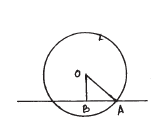
$|\vec{\text{r}}|=5$
$\Rightarrow$ Centre is $(0, 0, 0)$ and radius $= 5$
$\text{d}=\text{OB}=\frac{|-3\sqrt{3}|}{\sqrt{3}}=3$
$\therefore AB^2 = OA^2 - OB^2 $
$= (5)^2 - (3)^2 $
$= 16$
$\Rightarrow AB = 4$
i.e. radius of circular section $= 4.$ View full question & answer→Question 135 Marks
Using vectors, find the area of triangle ABC, with vertices A (1, 2, 3), B (2, –1, 4) and C (4, 5, –1).
Answer$\overrightarrow{\text{AB}}=\hat{\text{i}}-3\hat{\text{j}}+\hat{\text{k}}\ ,\overrightarrow{\text{AC}}=3\hat{\text{i}}+3\hat{\text{j}}-4\hat{\text{k}}$
$\text{Area of}\ \triangle\text{ABC}=\frac1 2\ \big|\overrightarrow{\text{AB}}\times\overrightarrow{\text{AC}}\big|$
$=\frac1 2\text{magnitude of} \begin{vmatrix} \hat{\text{i}} & \hat{\text{j}} & \hat{\text{k}} \\ 1 & -3 & 1 \\ 3 & 3 & -4 \end{vmatrix} $
$=\frac1 2|9\hat{\text{i}}+7\hat{\text{j}}+12\hat{\text{k}}|$
$=\frac1 2\sqrt{81+49+144}=\frac1 2\sqrt{274}\ \text{Sq.units}$
View full question & answer→Question 145 Marks
$\text{if } \vec{\text{a}} = 2\hat{\text{i}} + \hat{\text{j}} - \hat{\text{k}}, \vec{\text{b}} = 4\hat{\text{i}} - 7\hat{\text{j}} + \hat{\text{k}}, \text{find a vector } \vec{\text{c}} \text{ such that } \vec{\text{a}} \times \vec{\text{c}} \text{ and } \vec{\text{a }} . \vec{\text{c}} = 6.$
Answer$\text{Let } \vec{\text{c}} = \text{x}\hat{\text{i}} + \text{y}\hat{\text{j}} + \text{z} \hat{\text{k }} ; \vec{\text{ a}}.\vec{\text{c}} = 6 \Rightarrow \text{2x + y - z = 6} $ $\text{Now}, \vec{\text{a}} \times \vec{\text{c}} = \vec{\text{b}} \Rightarrow\begin{vmatrix} \hat{\text{i}} & \hat{\text{j}} & \hat{\text{k}} \\ 2 & 1 & -1 \\ \text{x} & \text{y} & \text{z} \end{vmatrix} = 4\hat{\text{i}} - 7\hat{\text{j}} + \hat{\text{k}}$$\Rightarrow \hat{\text{i}} \text{(z + y)} - \hat{\text{j}} \text{(2z + x)} + \hat{\text{k}} \text{(2y - x)} = 4\hat{\text{i}} - 7\hat{\text{j}} + \hat{\text{k}}$
$\Rightarrow \text{z + y = 4, 2z + x = 7, 2y - x = 1}$ Solving and getting $\text{ = 3, y = 2, z = 2}$ $\vec{\text{c}} = 3\hat{\text{i}} + 2\hat{\text{i}} + 2\hat{\text{k}}$
View full question & answer→Question 155 Marks
If $\vec{\text{a}} \times \vec{\text{b}} = \vec{\text{c}} \times \vec{\text{d}}$ and $\vec{\text{a}} \times \vec{\text{c}} = \vec{\text{b}} \times \vec{\text{d}},$ show that $\vec{\text{a}} - \vec{\text{d}}$ is parallel to $\vec{\text{b}} - \vec{\text{c}},$ where $\vec{\text{a}} \neq \vec{\text{d}}$ and $\vec{\text{b}} \neq \vec{\text{c}}.$
Answer$\vec{\text{a}} \times \vec{\text{b}} = \vec{\text{c}} \times \vec{\text{d}} \text{ }\text{ }\text{ }\text{ }\text{ }\text{ }\text{ } \dots \text{(i)} $
$\vec{\text{a}} \times \vec{\text{c}} = \vec{\text{b}} \times \vec{\text{d}} \text{ }\text{ }\text{ }\text{ }\text{ }\text{ }\text{ }\text{ }\dots \text{(ii)}$
$(1) - (2) \Rightarrow \vec{\text{a}} \times (\vec{\text{b}} - \vec{\text{c}}) = \vec{\text{d}} \times (\vec{\text{b}} - \vec{\text{c}})$
$\Rightarrow (\vec{\text{a}} - \vec{\text{d}}) \times (\vec{\text{b}} - \vec{\text{c}}) = \vec{0}$
$\Rightarrow (\vec{\text{a}} - \vec{\text{d}}) \parallel (\vec{\text{b}} - \vec{\text{c}})$
View full question & answer→Question 165 Marks
Find the equation of the plane which contains the line of intersection of the planes x + 2y + 3z – 4 = 0 and 2x + y – z + 5 = 0 and whose x-intercept is twice its z-intercept.
Hence write the vector equation of a plane passing through the point (2, 3, –1) and parallel to the plane obtained above.
AnswerEquation of family of planes passing through two given planes
$\Rightarrow$ (x + 2y + 3z – 4) + k (2x + y – z + 5) = 0
(1 + 2k) x + (2 + k) y + (3 – k) z = 4 – 5k $\text{ }\text{ }\text{ }\text{ }\text{ }\dots\text{(i)}$
$\Rightarrow \frac{\text{x}}{\frac{\text{4 - 5 k}}{\text{1 + 2 k}}} + \frac{\text{y}}{\frac{\text{4 - 5 k}}{\text{2 + k}}} + \frac{\text{z}}{\frac{\text{4 - 5 k}}{\text{3 - k}}} = 1$
As per condition
$\frac{\text{4 - 5k}}{\text{1 + 2k}} = \frac{2(4 - 5\text{k)}}{(\text{3 - k)}}$
$\Rightarrow \text{k} = \frac{4}{5} \text{ or } \frac{1}{5} $
For $\text{k} = \frac{1}{5},$ Eqn. of plance is 7x + 11y + 14z = 15
For $\text{k} = \frac{4}{5},$ Eqn. of plane is 13x + 14y + 11z = 0
Equation of plane passing through (2, 3, –1)
and parallel to the plane is:
7(x – 2) + 11(y – 3) + 14(z + 1) = 0
$\Rightarrow$ 7x + 11y + 14z = 33
Vector form: $\vec{\text{r}}. (7\hat{\text{i}} + 11\hat{\text{j}} + 14\hat{\text{k}}) = 33$
View full question & answer→Question 175 Marks
Find the area of a parallelogram ABCD whose side AB and the diagonal DB are given by the vectors $5\hat{\text{i}} + 7\hat{\text{k}}\ \text{and}\ 2\hat{\text{i}}+2\hat{\text{j}}+3\hat{\text{k}}$ respectively.
Answer$\vec{\text{AD}} = \vec{\text{AB}} - \vec{\text{DB}} = 3\hat{\text{i}} - 2\hat{\text{j}} + 4\hat{\text{k}}$$\text{Area}= \big|\vec{\text{AB}} \times \vec{\text{AC}}\big|= \text{magnitude of } \begin{vmatrix} \hat{\text{i}} & \hat{\text{j}} & \hat{\text{k}} \\ 5& 0 & 7 \\ 3 & -2 & 4 \end{vmatrix} $
$ = |14\hat{\text{i}} + \hat{\text{j}} - 10\hat{\text{k}}|$
$= \sqrt{297} \text{ sq. units}\ \text{or}\ 3\sqrt{33} \text{ sq. units}$
View full question & answer→Question 185 Marks
$\text{if } \vec{\text{a}} = 2\hat{\text{i}} + \hat{\text{j}} - \hat{\text{k}}, \vec{\text{b}} = 4\hat{\text{i}} - 7\hat{\text{j}} + \hat{\text{k}}, \text{find a vector } \vec{\text{c}} \text{ such that } \vec{\text{a}} \times \vec{\text{c}}=\vec{\text{b }} \text{ and } \vec{\text{a }} . \vec{\text{c}} = 6.$
Answer$\text{Let } \vec{\text{c}} = \text{x}\hat{\text{i}} + \text{y}\hat{\text{j}} + \text{z} \hat{\text{k }} ; \vec{\text{ a}}.\vec{\text{c}} = 6 \Rightarrow \text{2x + y - z = 6} $ $\text{Now}, \vec{\text{a}} \times \vec{\text{c}} = \vec{\text{b}} \Rightarrow\begin{vmatrix} \hat{\text{i}} & \hat{\text{j}} & \hat{\text{k}} \\ 2 & 1 & -1 \\ \text{x} & \text{y} & \text{z} \end{vmatrix} = 4\hat{\text{i}} - 7\hat{\text{j}} + \hat{\text{k}}$$\Rightarrow \hat{\text{i}} \text{(z + y)} - \hat{\text{j}} \text{(2z + x)} + \hat{\text{k}} \text{(2y - x)} = 4\hat{\text{i}} - 7\hat{\text{j}} + \hat{\text{k}}$
$\Rightarrow \text{z + y = 4, 2z + x = 7, 2y - x = 1}$ Solving and getting $\text{ = 3, y = 2, z = 2}$ $\vec{\text{c}} = 3\hat{\text{i}} + 2\hat{\text{i}} + 2\hat{\text{k}}$
View full question & answer→Question 195 Marks
If $\vec{\text{a}} \times \vec{\text{b}} = \vec{\text{c}} \times \vec{\text{d}}$ and $\vec{\text{a}} \times \vec{\text{c}} = \vec{\text{b}} \times \vec{\text{d}},$ show that $\vec{\text{a}} - \vec{\text{d}}$ is parallel to $\vec{\text{b}} - \vec{\text{c}},$ where $\vec{\text{a}} \neq \vec{\text{d}}$ and $\vec{\text{b}} \neq \vec{\text{c}}.$
Answer$\vec{\text{a}} \times \vec{\text{b}} = \vec{\text{c}} \times \vec{\text{d}} \text{ }\text{ }\text{ }\text{ }\text{ }\text{ }\text{ } \dots \text{(i)} $
$\vec{\text{a}} \times \vec{\text{c}} = \vec{\text{b}} \times \vec{\text{d}} \text{ }\text{ }\text{ }\text{ }\text{ }\text{ }\text{ }\text{ }\dots \text{(ii)}$
$(1) - (2) \Rightarrow \vec{\text{a}} \times (\vec{\text{b}} - \vec{\text{c}}) = \vec{\text{d}} \times (\vec{\text{b}} - \vec{\text{c}})$
$\Rightarrow (\vec{\text{a}} - \vec{\text{d}}) \times (\vec{\text{b}} - \vec{\text{c}}) = \vec{0}$
$\Rightarrow (\vec{\text{a}} - \vec{\text{d}}) \parallel (\vec{\text{b}} - \vec{\text{c}})$
View full question & answer→Question 205 Marks
Find the equation of the plane which contains the line of intersection of the planes x + 2y + 3z – 4 = 0 and 2x + y – z + 5 = 0 and whose x-intercept is twice its z-intercept.
Hence write the vector equation of a plane passing through the point (2, 3, –1) and parallel to the plane obtained above.
AnswerEquation of family of planes passing through two given planes
$\Rightarrow$ (x + 2y + 3z – 4) + k (2x + y – z + 5) = 0
(1 + 2k) x + (2 + k) y + (3 – k) z = 4 – 5k $\text{ }\text{ }\text{ }\text{ }\text{ }\dots\text{(i)}$
$\Rightarrow \frac{\text{x}}{\frac{\text{4 - 5 k}}{\text{1 + 2 k}}} + \frac{\text{y}}{\frac{\text{4 - 5 k}}{\text{2 + k}}} + \frac{\text{z}}{\frac{\text{4 - 5 k}}{\text{3 - k}}} = 1$
As per condition
$\frac{\text{4 - 5k}}{\text{1 + 2k}} = \frac{2(4 - 5\text{k)}}{(\text{3 - k)}}$
$\Rightarrow \text{k} = \frac{4}{5} \text{ or } \frac{1}{5} $
For $\text{k} = \frac{1}{5},$ Eqn. of plance is 7x + 11y + 14z = 15
For $\text{k} = \frac{4}{5},$ Eqn. of plane is 13x + 14y + 11z = 0
Equation of plane passing through (2, 3, –1)
and parallel to the plane is:
7(x – 2) + 11(y – 3) + 14(z + 1) = 0
$\Rightarrow$ 7x + 11y + 14z = 33
Vector form: $\vec{\text{r}}. (7\hat{\text{i}} + 11\hat{\text{j}} + 14\hat{\text{k}}) = 33$
View full question & answer→Question 215 Marks
Find the area of a parallelogram ABCD whose side AB and the diagonal AC are given by the vectors $3\hat{\text{i}} + \hat{\text{j}}+4\hat{\text{k}}$ and $4\hat{\text{i}} + 5\hat{\text{k}} $ respectively.
Answer$\vec{\text{BC}} = \vec{\text{AC}} - \vec{\text{AB}} = \hat{\text{i}} - \hat{\text{j}} + \hat{\text{k}}$$\text{Area}= \big|\vec{\text{AB}} \times \vec{\text{BC}}\big|= \text{magnitude of } \begin{vmatrix} \hat{\text{i}} & \hat{\text{j}} & \hat{\text{k}} \\ 3 & 1 & 4 \\ 1 & -1 & 1 \end{vmatrix} $
$ = |5\hat{\text{i}} + \hat{\text{j}} - 4\hat{\text{k}}|$
$= \sqrt{42} \text{ sq. units}$
View full question & answer→Question 225 Marks
$\text{if } \vec{\text{a}} = 2\hat{\text{i}} + \hat{\text{j}} - \hat{\text{k}}, \vec{\text{b}} = 4\hat{\text{i}} - 7\hat{\text{j}} + \hat{\text{k}}, \text{find a vector } \vec{\text{c}} \text{ such that } \vec{\text{a}} \times \vec{\text{c}} \text{ and } \vec{\text{a }} . \vec{\text{c}} = 6.$
Answer$\text{Let } \vec{\text{c}} = \text{x}\hat{\text{i}} + \text{y}\hat{\text{j}} + \text{z} \hat{\text{k }} ; \vec{\text{ a}}.\vec{\text{c}} = 6 \Rightarrow \text{2x + y - z = 6} $
$\text{Now}, \vec{\text{a}} \times \vec{\text{c}} = \vec{\text{b}} \Rightarrow\begin{vmatrix} \hat{\text{i}} & \hat{\text{j}} & \hat{\text{k}} \\ 2 & 1 & -1 \\ \text{x} & \text{y} & \text{z} \end{vmatrix} = 4\hat{\text{i}} - 7\hat{\text{j}} + \hat{\text{k}}$
$\Rightarrow \hat{\text{i}} \text{(z + y)} - \hat{\text{j}} \text{(2z + x)} + \hat{\text{k}} \text{(2y - x)} = 4\hat{\text{i}} - 7\hat{\text{j}} + \hat{\text{k}}$
$\Rightarrow \text{z + y = 4, 2z + x = 7, 2y - x = 1}$
Solving and getting $\text{ = 3, y = 2, z = 2}$
$\vec{\text{c}} = 3\hat{\text{i}} + 2\hat{\text{i}} + 2\hat{\text{k}}$
View full question & answer→Question 235 Marks
If $\vec{\text{a}} \times \vec{\text{b}} = \vec{\text{c}} \times \vec{\text{d}}$ and $\vec{\text{a}} \times \vec{\text{c}} = \vec{\text{b}} \times \vec{\text{d}},$ show that $\vec{\text{a}} - \vec{\text{d}}$ is parallel to $\vec{\text{b}} - \vec{\text{c}},$ where $\vec{\text{a}} \neq \vec{\text{d}}$ and $\vec{\text{b}} \neq \vec{\text{c}}.$
Answer$\vec{\text{a}} \times \vec{\text{b}} = \vec{\text{c}} \times \vec{\text{d}} \text{ }\text{ }\text{ }\text{ }\text{ }\text{ }\text{ } \dots \text{(i)} $
$\vec{\text{a}} \times \vec{\text{c}} = \vec{\text{b}} \times \vec{\text{d}} \text{ }\text{ }\text{ }\text{ }\text{ }\text{ }\text{ }\text{ }\dots \text{(ii)}$
$(1) - (2) \Rightarrow \vec{\text{a}} \times (\vec{\text{b}} - \vec{\text{c}}) = \vec{\text{d}} \times (\vec{\text{b}} - \vec{\text{c}})$
$\Rightarrow (\vec{\text{a}} - \vec{\text{d}}) \times (\vec{\text{b}} - \vec{\text{c}}) = \vec{0}$
$\Rightarrow (\vec{\text{a}} - \vec{\text{d}}) \parallel (\vec{\text{b}} - \vec{\text{c}})$
View full question & answer→Question 245 Marks
Find the equation of the plane which contains the line of intersection of the planes x + 2y + 3z – 4 = 0 and 2x + y – z + 5 = 0 and whose x-intercept is twice its z-intercept.
Hence write the vector equation of a plane passing through the point (2, 3, –1) and parallel to the plane obtained above.
AnswerEquation of family of planes passing through two given planes
$\Rightarrow$ (x + 2y + 3z – 4) + k (2x + y – z + 5) = 0
(1 + 2k) x + (2 + k) y + (3 – k) z = 4 – 5k $\text{ }\text{ }\text{ }\text{ }\text{ }\dots\text{(i)}$
$\Rightarrow \frac{\text{x}}{\frac{\text{4 - 5 k}}{\text{1 + 2 k}}} + \frac{\text{y}}{\frac{\text{4 - 5 k}}{\text{2 + k}}} + \frac{\text{z}}{\frac{\text{4 - 5 k}}{\text{3 - k}}} = 1$
As per condition
$\frac{\text{4 - 5k}}{\text{1 + 2k}} = \frac{2(4 - 5\text{k)}}{(\text{3 - k)}}$
$\Rightarrow \text{k} = \frac{4}{5} \text{ or } \frac{1}{5} $
For $\text{k} = \frac{1}{5},$ Eqn. of plance is 7x + 11y + 14z = 15
For $\text{k} = \frac{4}{5},$ Eqn. of plane is 13x + 14y + 11z = 0
Equation of plane passing through (2, 3, –1)
and parallel to the plane is:
7(x – 2) + 11(y – 3) + 14(z + 1) = 0
$\Rightarrow$ 7x + 11y + 14z = 33
Vector form: $\vec{\text{r}}. (7\hat{\text{i}} + 11\hat{\text{j}} + 14\hat{\text{k}}) = 33$
View full question & answer→Question 255 Marks
If $\vec{\text{a}} , \vec{\text{b}} , \vec{\text{c}}$ are mutually perpendicular vectors of equal magnitudes, show that the vector $\vec{\text{a}} + \vec{\text{b}} + \vec{\text{c}}$ is equally inclined to $\vec{\text{a}} , \vec{\text{b}}$ and $\vec{\text{c}}$ Also, find the angle which $\vec{\text{a}} + \vec{\text{b}} + \vec{\text{c}}$ makes with $\vec{\text{a}} \text{ or }\vec{\text{b}} \text{ or } \vec{\text{c}}.$
Answer$|\vec{\text{a}}| = |\vec{\text{b}}| = |\vec{\text{c}}| \text{ and } \vec{\text{a}}. \vec{\text{b}} = 0 = \vec{\text{b}}. \vec{\text{c}} = \vec{\text{c}}.\vec{\text{a}} \text{ }\text{ }\text{ }\text{ }\text{ }\text{ }\text{ }\text{ } \dots\text{(i)}$
Let $\alpha, \beta \text{ and } \gamma$ be the angles made by $(\vec{\text{a}} + \vec{\text{b}} + \vec{\text{c}}) \text{ with } \vec{\text{a}}, \vec{\text{b}} \text{ and } \vec{\text{c}}$ respectively.
$(\vec{\text{a}} + \vec{\text{b}} + \vec{\text{c}}) . \vec{\text{a}} = |\vec{\text{a}} + \vec{\text{b}} + \vec{\text{c}}| | \vec{\text{a}}| \cos \alpha$
$\Rightarrow \alpha = \cos^{-1} \Bigg(\frac{|\vec{\text{a}}|}{|\vec{\text{a}} + \vec{\text{b}} + \vec{\text{c}}|}\Bigg)$
Similarly, $\beta = \cos^{-1} \Bigg(\frac{|\vec{\text{b}}|}{|\vec{\text{a}} + \vec{\text{b}} + \vec{\text{c}}|}\Bigg) \text{ and } \gamma = \cos^{-1} \Bigg(\frac{|\vec{\text{c}}|}{|\vec{\text{a}} + \vec{\text{b}} + \vec{\text{c}}|}\Bigg)$
using (i), we get $\alpha = \beta = \gamma$
Now $|\vec{\text{a}} + \vec{\text{b}} + \vec{\text{c}}|^{2} = |\vec{\text{a}}|^{2} + |\vec{\text{b}}|^{2} + |\vec{\text{c}}|^{2} + 2 (\vec{\text{a}}.\vec{\text{b}}+ \vec{\text{b}}.\vec{\text{c}}. + \vec{\text{c}}. \vec{\text{a}})$
$\Rightarrow |\vec{\text{a}} + \vec{\text{b}} + \vec{\text{c}}|^{2} = 3 |\vec{\text{a}}|^{2} \text{(using (i))}$
$\Rightarrow |\vec{\text{a}} + \vec{\text{b}} + \vec{\text{c}}| = \sqrt{3} \text{ }|\vec{\text{a}}|$
$\therefore \alpha = \cos^{-1} \big(\frac{1}{\sqrt{3}}) = \beta = \gamma$
View full question & answer→Question 265 Marks
If the sum of lengths of the hypotenuse and a side of a right angled triangle is given, show that the area of the triangle is maximum, when the angle between them is $\frac{\pi}{3}$
Answer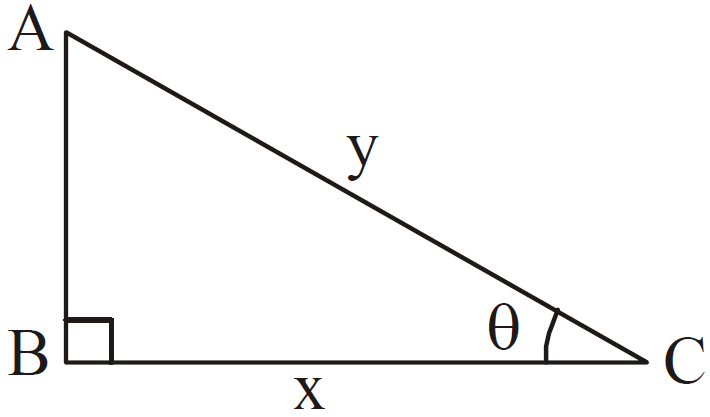
Given x + y = k
$\text{Area of } \triangle = \frac{1}{2} \text{x} \sqrt{\text{y}^{2} - \text{x}^{2}}$
$\text{Let Z} = \frac{1}{4} \text{x}^{2} \text{(y}^{2} - \text{x}^{2})$
$= \frac{1}{4} \text{x}^{2} [ \text{(k - x)}^{2} - \text{x}^{2}]$
$= \frac{1}{4} [ \text{k}^{2}\text{x}^{2} - 2\text{kx}^{3}]$
$\frac{\text{dz}}{\text{dx}} = \frac{1}{2}[ \text{2k}^{2} \text{x} - \text{6kx}^{2}] = 0 \Rightarrow \text{k}-3\text{x}=0\Rightarrow\text{x} = \frac{\text{k}}{3}$
$\Rightarrow \text{x + y – 3x = 0 or y = 2x}$
$\frac{\text{d}^{2}\text{z}}{\text{dx}^{2}} = \frac{1}{4} [\text{2k}^{2} - 12\text{kx}]$
$\frac{\text{d}^{2}\text{z}}{\text{dx}^{2}}\bigg|_{\text{x} = \frac{\text{k}}{3}} = \frac{1}{4} [ \text{2k}^{2} - \text{4k}^{2}] = -\frac{\text{k}^{2}}{2}< 0$
$\therefore$ Area will be maximum for 2x = y
$\text{but} \frac{\text{x}}{\text{y}} = \cos \theta \Rightarrow \cos \theta = \frac{\text{x}}{\text{2x}} = \frac{1}{2} \Rightarrow \theta = \frac{\pi}{3}$ View full question & answer→Question 275 Marks
$\text{if} \overrightarrow{\text{r}} = x\hat{\text{i}} + y\hat{\text{j}} + z\hat{\text{k}}, \text{find} \overrightarrow(\text{r} \times \hat{\text{i}}). (\overrightarrow{\text{r}} \times \text{j}) + xy$
Answer$\overrightarrow{\text{r}}\times \overrightarrow{\text{i}} = \bigg(\text{x}\hat{\text{i}} + \text{y}\hat{\text{j}} + \text{z}\hat{\text{k}}\bigg)\text{x}\hat{\text{i}} = -\text{y}\hat{\text{k}} + \text{z}\hat{\text{j}}$
$\overrightarrow{\text{r}}\times\overrightarrow{\text{j}} = \bigg(\text{x}\hat{\text{i}} + \text{y}\hat{\text{j}} + \text{z}\hat{\text{k}}\bigg)\hat{\text{j}} = \text{x}\hat{\text{k}} - \text{z}\hat{\text{i}}$
$\bigg(\overrightarrow{\text{r}}\times\hat{\text{i}}\bigg), \bigg(\overrightarrow{\text{r}}\times\overrightarrow{\text{j}}\bigg) = \bigg(\text{o}\hat{\text{i}} + \text{z}\hat{\text{j}} - \text{y}\hat{\text{k}}\bigg).\bigg(\text{- z}\hat{\text{i}} + \text{o}\hat{\text{j}} + \text{x}\hat{\text{k}}\bigg)= -\text{xy}$
$\bigg(\overrightarrow{\text{r}}\times\hat{\text{i}}\bigg). \bigg(\overrightarrow{\text{r}}\times\overrightarrow{\text{j}}\bigg) + \text{xy} = \text{-xy + xy = 0}$
View full question & answer→Question 285 Marks
Using vectors find the area of triangle ABC with vertices A(1, 2, 3), B(2, –1, 4) and
C(4, 5, –1).
Answer$\overrightarrow{\text{AB}}=\hat{\text{i}}-3\hat{\text{j}}+\hat{\text{k}} \ ,\overrightarrow{\text{AC}}=3\hat{\text{i}}+3\hat{\text{j}}-4\hat{\text{k}}$
$\text{Area of}\ \triangle \ \text{ABC}=\frac{1}{2}|\overrightarrow{\text{AB}}\times\overrightarrow{\text{AC}}|$
$=\frac{1}{2}\text{magnitude of} \begin{vmatrix} \hat{\text{i}} & \hat{\text{j}} & \hat{\text{k}} \\ 1 & -3 & 1 \\ 3&3 & -4 \end{vmatrix}$
$=\frac{1}{2}|9\hat{\text{i}}+7\hat{\text{j}}+12\hat{\text{k}}|=\frac{\sqrt{274}}{2}\text { Sq.units}$
View full question & answer→Question 295 Marks
$\text{if} \overrightarrow{\text{r}} = x\hat{\text{i}} + y\hat{\text{j}} + z\hat{\text{k}}, \text{find} \overrightarrow(\text{r} \times \hat{\text{i}}). (\overrightarrow{\text{r}} \times \text{j}) + xy$
Answer$\overrightarrow{\text{r}}\times \overrightarrow{\text{i}} = \bigg(\text{x}\hat{\text{i}} + \text{y}\hat{\text{j}} + \text{z}\hat{\text{k}}\bigg)\text{x}\hat{\text{i}} = -\text{y}\hat{\text{k}} + \text{z}\hat{\text{j}}$
$\overrightarrow{\text{r}}\times\overrightarrow{\text{j}} = \bigg(\text{x}\hat{\text{i}} + \text{y}\hat{\text{j}} + \text{z}\hat{\text{k}}\bigg)\hat{\text{j}} = \text{x}\hat{\text{k}} - \text{z}\hat{\text{i}}$
$\bigg(\overrightarrow{\text{r}}\times\hat{\text{i}}\bigg), \bigg(\overrightarrow{\text{r}}\times\overrightarrow{\text{j}}\bigg) = \bigg(\text{o}\hat{\text{i}} + \text{z}\hat{\text{j}} - \text{y}\hat{\text{k}}\bigg).\bigg(\text{- z}\hat{\text{i}} + \text{o}\hat{\text{j}} + \text{x}\hat{\text{k}}\bigg)= -\text{xy}$
$\bigg(\overrightarrow{\text{r}}\times\hat{\text{i}}\bigg). \bigg(\overrightarrow{\text{r}}\times\overrightarrow{\text{j}}\bigg) + \text{xy} = \text{-xy + xy = 0}$
View full question & answer→Question 305 Marks
If $\vec{\text{a}} , \vec{\text{b}} , \vec{\text{c}}$ are mutually perpendicular vectors of equal magnitudes, show that the vector $\vec{\text{a}} + \vec{\text{b}} + \vec{\text{c}}$ is equally inclined to $\vec{\text{a}} , \vec{\text{b}}$ and $\vec{\text{c}}$ Also, find the angle which $\vec{\text{a}} + \vec{\text{b}} + \vec{\text{c}}$ makes with $\vec{\text{a}} \text{ or }\vec{\text{b}} \text{ or } \vec{\text{c}}.$
Answer$|\vec{\text{a}}| = |\vec{\text{b}}| = |\vec{\text{c}}| \text{ and } \vec{\text{a}}. \vec{\text{b}} = 0 = \vec{\text{b}}. \vec{\text{c}} = \vec{\text{c}}.\vec{\text{a}} \text{ }\text{ }\text{ }\text{ }\text{ }\text{ }\text{ }\text{ } \dots\text{(i)}$
Let $\alpha, \beta \text{ and } \gamma$ be the angles made by $(\vec{\text{a}} + \vec{\text{b}} + \vec{\text{c}}) \text{ with } \vec{\text{a}}, \vec{\text{b}} \text{ and } \vec{\text{c}}$ respectively.
$(\vec{\text{a}} + \vec{\text{b}} + \vec{\text{c}}) . \vec{\text{a}} = |\vec{\text{a}} + \vec{\text{b}} + \vec{\text{c}}| | \vec{\text{a}}| \cos \alpha$
$\Rightarrow \alpha = \cos^{-1} \Bigg(\frac{|\vec{\text{a}}|}{|\vec{\text{a}} + \vec{\text{b}} + \vec{\text{c}}|}\Bigg)$
Similarly, $\beta = \cos^{-1} \Bigg(\frac{|\vec{\text{b}}|}{|\vec{\text{a}} + \vec{\text{b}} + \vec{\text{c}}|}\Bigg) \text{ and } \gamma = \cos^{-1} \Bigg(\frac{|\vec{\text{c}}|}{|\vec{\text{a}} + \vec{\text{b}} + \vec{\text{c}}|}\Bigg)$
using (i), we get $\alpha = \beta = \gamma$
Now $|\vec{\text{a}} + \vec{\text{b}} + \vec{\text{c}}|^{2} = |\vec{\text{a}}|^{2} + |\vec{\text{b}}|^{2} + |\vec{\text{c}}|^{2} + 2 (\vec{\text{a}}.\vec{\text{b}}+ \vec{\text{b}}.\vec{\text{c}}. + \vec{\text{c}}. \vec{\text{a}})$
$\Rightarrow |\vec{\text{a}} + \vec{\text{b}} + \vec{\text{c}}|^{2} = 3 |\vec{\text{a}}|^{2} \text{(using (i))}$
$\Rightarrow |\vec{\text{a}} + \vec{\text{b}} + \vec{\text{c}}| = \sqrt{3} \text{ }|\vec{\text{a}}|$
$\therefore \alpha = \cos^{-1} \big(\frac{1}{\sqrt{3}}) = \beta = \gamma$
View full question & answer→Question 315 Marks
If the sum of lengths of the hypotenuse and a side of a right angled triangle is given, show that the area of the triangle is maximum, when the angle between them is $\frac{\pi}{3}$
Answer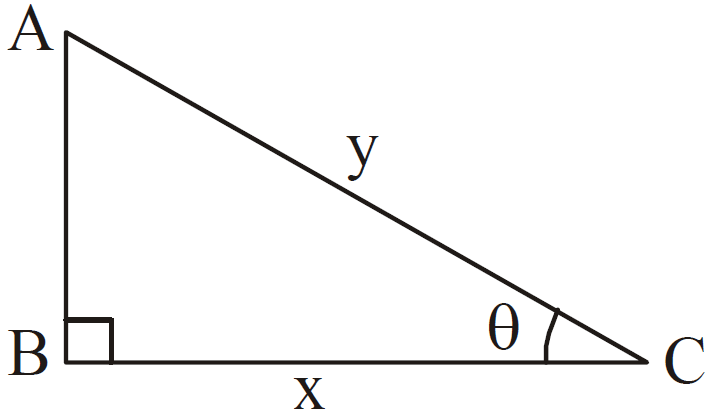
Given x + y = k
$\text{Area of } \triangle = \frac{1}{2} \text{x} \sqrt{\text{y}^{2} - \text{x}^{2}}$
$\text{Let Z} = \frac{1}{4} \text{x}^{2} \text{(y}^{2} - \text{x}^{2})$
$= \frac{1}{4} \text{x}^{2} [ \text{(k - x)}^{2} - \text{x}^{2}]$
$= \frac{1}{4} [ \text{k}^{2}\text{x}^{2} - \text{2kx}^{3}]$
$\frac{\text{dz}}{\text{dx}} = \frac{1}{4}[ \text{2k}^{2} \text{x} - \text{6kx}^{2}] = 0 \Rightarrow \text{k}-3\text{x}=0\Rightarrow\text{x} = \frac{\text{k}}{3}$
$\Rightarrow \text{x + y – 3x = 0 or y = 2x}$
$\frac{\text{d}^{2}\text{z}}{\text{dx}^{2}} = \frac{1}{4} [\text{2k}^{2} - 12\text{kx}]$
$\frac{\text{d}^{2}\text{z}}{\text{dx}^{2}}\bigg|_{\text{x} = \frac{\text{k}}{3}} = \frac{1}{4} [ \text{2k}^{2} - \text{4k}^{2}] = -\frac{\text{k}^{2}}{2}< 0$
$\therefore$ Area will be maximum for 2x = y
$\text{but} \frac{\text{x}}{\text{y}} = \cos \theta \Rightarrow \cos \theta = \frac{\text{x}}{\text{2x}} = \frac{1}{2} \Rightarrow \theta = \frac{\pi}{3}$ View full question & answer→Question 325 Marks
$\text{if} \overrightarrow{\text{r}} = x\hat{\text{i}} + y\hat{\text{j}} + z\hat{\text{k}}, \text{find} \overrightarrow(\text{r} \times \hat{\text{i}}). (\overrightarrow{\text{r}} \times \text{j}) + xy$
Answer$\overrightarrow{\text{r}}\times \overrightarrow{\text{i}} = \bigg(\text{x}\hat{\text{i}} + \text{y}\hat{\text{j}} + \text{z}\hat{\text{k}}\bigg)\text{x}\hat{\text{i}} = -\text{y}\hat{\text{k}} + \text{z}\hat{\text{j}}$
$\overrightarrow{\text{r}}\times\overrightarrow{\text{j}} = \bigg(\text{x}\hat{\text{i}} + \text{y}\hat{\text{j}} + \text{z}\hat{\text{k}}\bigg)\hat{\text{j}} = \text{x}\hat{\text{k}} - \text{z}\hat{\text{i}}$
$\bigg(\overrightarrow{\text{r}}\times\hat{\text{i}}\bigg), \bigg(\overrightarrow{\text{r}}\times\overrightarrow{\text{j}}\bigg) = \bigg(\text{o}\hat{\text{i}} + \text{z}\hat{\text{j}} - \text{y}\hat{\text{k}}\bigg).\bigg(\text{- z}\hat{\text{i}} + \text{o}\hat{\text{j}} + \text{x}\hat{\text{k}}\bigg)= -\text{xy}$
$\bigg(\overrightarrow{\text{r}}\times\hat{\text{i}}\bigg). \bigg(\overrightarrow{\text{r}}\times\overrightarrow{\text{j}}\bigg) + \text{xy} = \text{-xy + xy = 0}$
View full question & answer→Question 335 Marks
If $\overrightarrow{\text{a}}\text{ and } \overrightarrow{\text{b}}$are two vectors such that $|\overrightarrow{\text{a}} + \overrightarrow{\text{b}}| = | \overrightarrow{\text{a}}|,$ then prove that vector 2 $\overrightarrow{\text{a}} + \overrightarrow{\text{b}}$is perpendicular to vector$\overrightarrow{\text{b}}.$
Answer$\because|\overrightarrow{\text{a}} + \overrightarrow{\text{b}}| = |\overrightarrow{\text{a}}|\Rightarrow|\overrightarrow{\text{a}} +\overrightarrow{\text{b}}|^{2} =|\overrightarrow{\text{a}}|^{2}$
$\Rightarrow(\overrightarrow{\text{a}} + \overrightarrow{\text{b}}).(\overrightarrow{\text{a}} + \overrightarrow{\text{b}}) = |\overrightarrow{\text{a}}|^{2}$
$\Rightarrow\overrightarrow{\text{a}}.\overrightarrow{\text{a}} + \overrightarrow{\text{a}}.\overrightarrow{\text{b}} + \overrightarrow{\text{b}}.\overrightarrow{\text{a}}+\overrightarrow{\text{b}}.\overrightarrow{\text{b}} = |\overrightarrow{\text{a}}|^{2}$
$\Rightarrow|\overrightarrow{\text{a}}|^{2} + 2 \overrightarrow{\text{a}}.\overrightarrow{\text{b}} +\overrightarrow{\text{b}}.\overrightarrow{\text{b}} = | \overrightarrow{\text{a}}|^{2}\big[\because\overrightarrow{\text{a}}.\overrightarrow{\text{b}} = \overrightarrow{\text{b}}.\overrightarrow{\text{a}}\big]$
$\Rightarrow2\overrightarrow{\text{a}}.\overrightarrow{\text{b}} + \overrightarrow{\text{b}}.\overrightarrow{\text{b}} = 0 \Rightarrow(2\overrightarrow{\text{a}} +\overrightarrow{\text{b}}).\overrightarrow{\text{b}} = 0 $
$\Rightarrow( 2 \overrightarrow{\text{a}} + \overrightarrow{\text{b}})$ is perpendicular to $\overrightarrow{\text{b}}.$
View full question & answer→Question 345 Marks
If $\overrightarrow{a},\overrightarrow{b},\overrightarrow{c},$ are three vectors such that $|\overrightarrow{a}|=5,|\overrightarrow{b}|=12\text{ and }|\overrightarrow{c}|=13,$ and $\overrightarrow{a}+\overrightarrow{b}+\overrightarrow{c}=\overrightarrow{o},$ find the value of $\overrightarrow{a}.\overrightarrow{b}+\overrightarrow{b}.\overrightarrow{c}+\overrightarrow{c}.\overrightarrow{a}.$
Answer$\overrightarrow{a}+\overrightarrow{b}+\overrightarrow{c}=\overrightarrow{0}\Rightarrow\Bigg(\overrightarrow{a}+\overrightarrow{b}+\overrightarrow{c}\Bigg)^{2}=0$$\Rightarrow\overrightarrow{a}^{2}+\overrightarrow{b}^{2}+\overrightarrow{c}^{2}+2\Bigg(\overrightarrow{a}.\overrightarrow{b}+\overrightarrow{b}.\overrightarrow{c}+\overrightarrow{c}.\overrightarrow{a}\Bigg)=0$
OR
$|\overrightarrow{a}|^{2}+|\overrightarrow{b}|^{2}+|\overrightarrow{c}|^{2}+2\Bigg(\overrightarrow{a}.\overrightarrow{b}+\overrightarrow{b}.\overrightarrow{c}+\overrightarrow{c}.\overrightarrow{a}\Bigg)=0$
$\therefore\overrightarrow{a}.\overrightarrow{b}+\overrightarrow{b}.\overrightarrow{c}+\overrightarrow{c}.\overrightarrow{a}=-\frac{1}{2}\Bigg(|\overrightarrow{a}|^{2}+|\overrightarrow{b}|^{2}+|\overrightarrow{c}|^{2}\Bigg)$
$=-\frac{1}{2}(25+144+169)=-169$.
View full question & answer→Question 355 Marks
Find a unit vector perpendicular to each of the vectors $\overrightarrow{\text{a}}+ \overrightarrow{\text{b}}$ and $\overrightarrow{\text{a}}- \overrightarrow{\text{b}},$ where $\overrightarrow{\text{a}}=3\hat{\text{i}}+2\hat{\text{j}}+2\hat{\text{k}}$ and $\overrightarrow{\text{b}}=\hat{\text{i}}+2\hat{\text{j}}-2\hat{\text{k}}.$
Answer$\overrightarrow{\text{a}}+\overrightarrow{\text{b}}=4\hat{\text{i}}+4\hat{\text{j}},\overrightarrow{\text{ a}}-\overrightarrow{\text{b}}=2\hat{\text{i}}+4\hat{\text{k}}$
A vector perpendicular to $\overrightarrow{\text{a}}+ \overrightarrow{\text{b}}$ and $\overrightarrow{\text{a}}- \overrightarrow{\text{b}}$ is $(\overrightarrow{\text{a}}+\overrightarrow{\text{b}})\times(\overrightarrow{\text{a}}-\overrightarrow{\text{b}})$
$(\overrightarrow{\text{a}}+\overrightarrow{\text{b}})\times(\overrightarrow{\text{a}}-\overrightarrow{\text{b}})$$=\begin{vmatrix} \hat{\text{i}} & \hat{\text{j}} & \hat{\text{k}} \\ 4 & 4 & 0 \\ 2 & 0 & 4 \end{vmatrix}=16\hat{\text{i}}-16\hat{\text{j}}-8\hat{\text{k}}$
$\therefore$ Unit vector in the direction of $(\overrightarrow{\text{a}}+\overrightarrow{\text{b}})\times(\overrightarrow{\text{a}}-\overrightarrow{\text{b}})$ is
$\frac{16}{24}\hat{\text{i}}-\frac{16}{24}\hat{\text{j}}-\frac{8}{24}\hat{\text{k}}=\frac{2}{3}\hat{\text{i}}-\frac{2}{3}\hat{\text{j}}-\frac{1}{3}\hat{\text{k}}$.
View full question & answer→Question 365 Marks
Find the position vector of a point R which divides the line joining two points P and Q whose position vectors are $(2\overrightarrow{\text{a}}+\overrightarrow{\text{b}})$ and$(\overrightarrow{\text{a}}-3\overrightarrow{\text{b}})$ respectively, externally in the ratio 1:2. Also, show that P is the mid point of the line segment RQ.
Answer Position vector of R is $\frac{(\overrightarrow{\text{a}}-3\overrightarrow{\text{b}})\times1-(2\overrightarrow{\text{a}}+\overrightarrow{\text{b}})(2)}{1-2}$
$(3\overrightarrow{\text{a}}+5\overrightarrow{\text{b}})$
Mid - point of RQ is $\frac{3\overrightarrow{\text{a}}+5\overrightarrow{\text{b}}+\overrightarrow{\text{a}}-3\overrightarrow{\text{b}}}{2}$
$2\overrightarrow{\text{a}}+\overrightarrow{\text{b}}$
Which is position vector of P. View full question & answer→Question 375 Marks
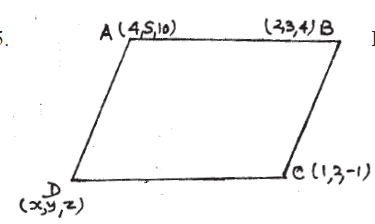
The points A(4, 5, 10), B(2, 3, 4) and C(1, 2, –1) are three vertices of a parallelogram ABCD. Find the vector equations of the sides AB and BC and also find the coordinates of point D.
AnswerP.V. of A = $4\hat{\text{i}}+5\hat{\text{j}}+10\hat{\text{k}}$
and $2\hat{\text{i}}+3\hat{\text{j}}+4\hat{\text{k}}$
Vector equation of A B is
$\overrightarrow{\text{r}}=(4\hat{\text{i}}+5\hat{\text{j}}+10\hat{\text{k}})+\lambda\Bigg[(2\hat{\text{i}}+3\hat{\text{j}}+4\hat{\text{k}})-(4\hat{\text{i}}+5\hat{\text{j}}+10\hat{\text{k}})\Bigg]$
$=(4\hat{\text{i}}+5\hat{\text{j}}+10\hat{\text{k}})+\lambda(-2\hat{\text{i}}+-2\hat{\text{j}}-6\hat{\text{k}})$
$\text{OR }\overrightarrow{\text{r}}=(4\hat{\text{i}}+5\hat{\text{j}}+10\hat{\text{k}})+\lambda(\hat{\text{i}}+\hat{\text{j}}+3\hat{\text{k}})$
Similarly, vector equation BC is
$\overrightarrow{\text{r}}=(2\hat{\text{i}}+3\hat{\text{j}}+4\hat{\text{k}})+\mu[-\hat{\text{i}}-\hat{\text{j}}-5\hat{\text{k}}]$
OR $\overrightarrow{\text{r}}=2\hat{\text{i}}+3\hat{\text{j}}+4\hat{\text{k}}+\mu(\hat{\text{i}}+\hat{\text{j}}+5\hat{\text{k}})$
Mid-point of AC is $\frac{5}{2}\hat{\text{i}}+\frac{7}{2}\hat{\text{j}}+\frac{9}{2}\hat{\text{i}}$
Mid-point of BD is $\frac{\text{x + 2}}{2}\hat{\text{i}}+\frac{\text{3 + y}}{2}\hat{\text{j}}+\frac{\text{4 + z}}{2}\hat{\text{k}}$
Coordinates of D are (3, 4, 5) View full question & answer→Question 385 Marks
$\text{If} \overrightarrow{a} \times \overrightarrow{b} = \overrightarrow{c} \times \overrightarrow{d} and \overrightarrow{a} \times\overrightarrow{c} = \overrightarrow{b} \times\overrightarrow{d},$ show that $\overrightarrow{a} - \overrightarrow{d}$ is parallel to $\overrightarrow{b}-\overrightarrow{c},$ where $\overrightarrow{a} \neq\overrightarrow{d} and \overrightarrow{b}\neq\overrightarrow{c}.$
Answer$\text{For} \overrightarrow{a} - \overrightarrow{d} \text{parallel to} \overrightarrow{b} - \overrightarrow{c}, \bigg(\overrightarrow{a} - \overrightarrow{d}\bigg)\times\bigg(\overrightarrow{b} - \overrightarrow{c} \bigg) \text{should be equal to zero}$$\bigg(\overrightarrow{a} - \overrightarrow{d}\bigg) \times\bigg(\overrightarrow{b}- \overrightarrow{c}\bigg) = \overrightarrow{a}\times\overrightarrow{b} -\overrightarrow{a} \times\overrightarrow{c}-\overrightarrow{d} \times\overrightarrow{b} + \overrightarrow{d} \times\overrightarrow{c}$
$= \overrightarrow{a}\times\overrightarrow{b}- \overrightarrow{a} \times\overrightarrow{c} +\overrightarrow{b} \times\overrightarrow{d} - \overrightarrow{c} \times\overrightarrow{d}$
$= \overrightarrow{o} \bigg[ \therefore \overrightarrow{a}\times\overrightarrow{b} = \overrightarrow{c} \times\overrightarrow{d} and \overrightarrow{a}\times\overrightarrow{c} = \overrightarrow{b}\times\overrightarrow{d}\bigg]$
$\text{Thus }\bigg(\overrightarrow{a}- \overrightarrow{d}\bigg) \text{is parallel to }\bigg(\overrightarrow{b}- \overrightarrow{c}\bigg)$
View full question & answer→Question 395 Marks
Two like parallel forces $\overrightarrow{a}$ and$\overrightarrow{b}$ act on a rigid body at A and B respectively. If $\overrightarrow{P}$ and $\overrightarrow{Q}$ are interchanged in position, show that the point of application of the resultant will be displaced through a distance $\frac{P -Q}{P + Q}.AB$
AnswerLet the forces $\overrightarrow{P}$ and $\overrightarrow{Q}$ act at A and B respectively. Let C be the point from where resultant passes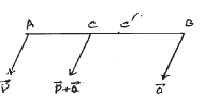
$\therefore \frac{\overrightarrow{P}}{CB} = \frac{\overrightarrow{Q}}{AC}= \frac{\overrightarrow{P} + \overrightarrow{Q}}{AB}$
$\Rightarrow AC = \frac{\overrightarrow{Q}.{AB}}{\overrightarrow{P} + \overrightarrow{Q}}$
When the forces are interchanged in position, let ' be the point from where resultant passes, then
$\Rightarrow AC = \frac{\overrightarrow{P}.{AB}}{\overrightarrow{P} + \overrightarrow{Q}}$
$\text{As P>Q, we get CC'} = AC'-AC \frac{\overrightarrow{P} - \overrightarrow{Q}}{\overrightarrow{P} + {\overrightarrow{Q}}} \times AB$ View full question & answer→Question 405 Marks
$\text{Let}\ \vec{\text{a}}=4\hat{\text{i}}+5\hat{\text{j}}-\hat{\text{k}},\vec{\text{b}}=\hat{\text{i}}-4\hat{\text{j}}+5\hat{\text{k}}$ and $\vec{\text{c}}=3\hat{\text{i}}+\hat{\text{j}}-\hat{\text{k}}$ Find a vector $\vec{\text{d}}$ which is perpendicular to both $\vec{\text{c}}\ \text{and }\vec{\text{b}}\ \text{and}\ \vec{\text{d}}\cdot\vec{\text{a}}=21.$
Answer$\vec{\text{a}}=4\hat{\text{i}}+5\hat{\text{j}}-\hat{\text{k}}$
$\vec{\text{b}}=-\hat{\text{i}}-4\hat{\text{j}}+5\hat{\text{k}}$
$\vec{\text{c}}=3\hat{\text{i}}+\hat{\text{j}}-\hat{\text{k}}$
To find vector $\vec{\text{d}}$ such that
$\vec{\text{d}}\cdot\vec{\text{c}}=0$
$\vec{\text{d}}\cdot\vec{\text{b}}=0$
$\vec{\text{d}}\cdot\vec{\text{a}}=21$
$\text{Let}\ \vec{\text{d}}=\text{x}\hat{\text{i}}+\text{y}\hat{\text{j}}+\text{z}\hat{\text{k}}$
$\Big(\text{x}\hat{\text{i}}+\text{y}\hat{\text{j}}+\text{z}\hat{\text{k}}\Big)\cdot\Big(3\hat{\text{i}}+\hat{\text{j}}-\hat{\text{k}}\Big)=0$
$3\text{x}+\text{y}-\text{z}=0\ \ \ ....(1)$
$\Big(\text{x}\hat{\text{i}}+\text{y}\hat{\text{j}}+\text{z}\hat{\text{k}}\Big)\cdot\Big(\hat{\text{i}}+5\hat{\text{j}}-\hat{\text{k}}\Big)=0$
$\text{x}-4\text{y}+5\text{z}=0\ \ \ ....(2)$
$\Big(\text{x}\hat{\text{i}}+\text{y}\hat{\text{j}}+\text{z}\hat{\text{k}}\Big)\cdot\Big(4\hat{\text{i}}+5\hat{\text{j}}-\hat{\text{k}}\Big)=21$
$4\text{x}+5\text{y}-\text{z}=21\ \ \ ....(3)$
$\text{eq}^\text{n}(1)\times4+\text{eq}^\text{n}(2)$
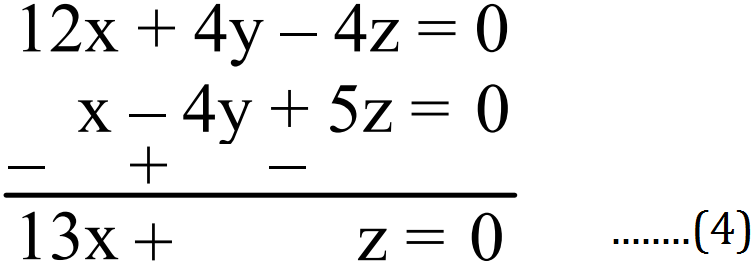
$\text{eq}^\text{n}(2)\times5+\text{eq}^\text{n}(3)\times4$
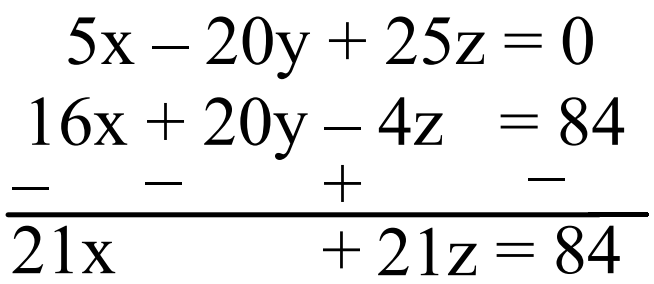
$21(\text{x}+\text{z})=84$
$\text{x}+\text{z}=4\ \ \ ....(5)$
$\text{eq}.(4)-(5)$
$12\text{x}=-4$
$\text{x}=\frac{-4}{12}=\frac{-1}{3}$
$\text{z}=4-\text{x}$
$\text{z}=4+\frac{1}{3}=\frac{13}{3}$
$\text{Put x}\ \&\ \text{z in }(1)$
$3\text{x}+\text{y}-\text{z}=0$
$3\times\Big(\frac{-1}{3}\Big)+\text{y}-\frac{13}{3}=0$
$\text{y}=\frac{13}{3}+1$
$\text{y}=\frac{16}{3}$
$\vec{\text{d}}=\text{x}\hat{\text{i}}+\text{y}\hat{\text{j}}+\text{z}\hat{\text{k}}$
$\vec{\text{d}}=\frac{-1}{3}\hat{\text{i}}+\frac{16}{3}\hat{\text{j}}+\frac{13}{3}\hat{\text{k}}$ View full question & answer→Question 415 Marks
$\text{Let}\ \vec{\text{a}}=4\hat{\text{i}}+5\hat{\text{j}}-\hat{\text{k}},\vec{\text{b}}=\hat{\text{i}}-4\hat{\text{j}}+5\hat{\text{k}}$ and $\vec{\text{c}}=3\hat{\text{i}}+\hat{\text{j}}-\hat{\text{k}}$ Find a vector $\vec{\text{d}}$ which is perpendicular to both $\vec{\text{c}}\ \text{and }\vec{\text{b}}\ \text{and}\ \vec{\text{d}}\cdot\vec{\text{a}}=21.$
Answer$\vec{\text{a}}=4\hat{\text{i}}+5\hat{\text{j}}-\hat{\text{k}}$
$\vec{\text{b}}=-\hat{\text{i}}-4\hat{\text{j}}+5\hat{\text{k}}$
$\vec{\text{c}}=3\hat{\text{i}}+\hat{\text{j}}-\hat{\text{k}}$
To find vector $\vec{\text{d}}$ such that
$\vec{\text{d}}\cdot\vec{\text{c}}=0$
$\vec{\text{d}}\cdot\vec{\text{b}}=0$
$\vec{\text{d}}\cdot\vec{\text{a}}=21$
$\text{Let}\ \vec{\text{d}}=\text{x}\hat{\text{i}}+\text{y}\hat{\text{j}}+\text{z}\hat{\text{k}}$
$\Big(\text{x}\hat{\text{i}}+\text{y}\hat{\text{j}}+\text{z}\hat{\text{k}}\Big)\cdot\Big(3\hat{\text{i}}+\hat{\text{j}}-\hat{\text{k}}\Big)=0$
$3\text{x}+\text{y}-\text{z}=0\ \ \ ....(1)$
$\Big(\text{x}\hat{\text{i}}+\text{y}\hat{\text{j}}+\text{z}\hat{\text{k}}\Big)\cdot\Big(\hat{\text{i}}+5\hat{\text{j}}-\hat{\text{k}}\Big)=0$
$\text{x}-4\text{y}+5\text{z}=0\ \ \ ....(2)$
$\Big(\text{x}\hat{\text{i}}+\text{y}\hat{\text{j}}+\text{z}\hat{\text{k}}\Big)\cdot\Big(4\hat{\text{i}}+5\hat{\text{j}}-\hat{\text{k}}\Big)=21$
$4\text{x}+5\text{y}-\text{z}=21\ \ \ ....(3)$
$\text{eq}^\text{n}(1)\times4+\text{eq}^\text{n}(2)$
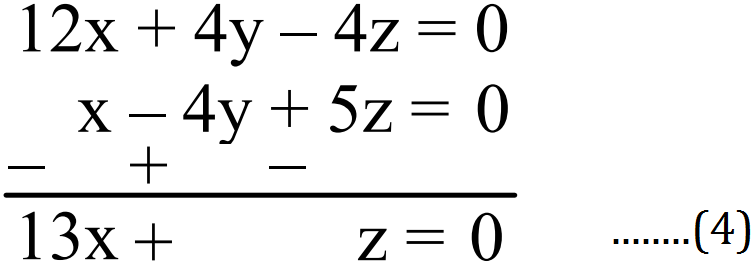
$\text{eq}^\text{n}(2)\times5+\text{eq}^\text{n}(3)\times4$
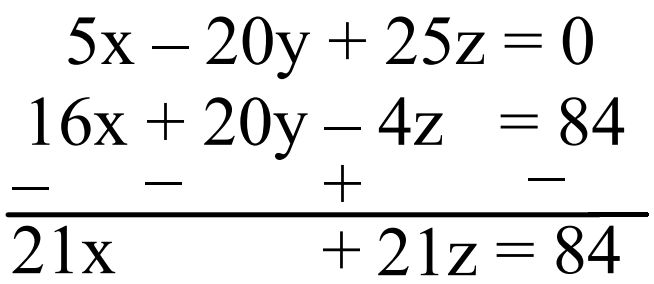
$21(\text{x}+\text{z})=84$
$\text{x}+\text{z}=4\ \ \ ....(5)$
$\text{eq}.(4)-(5)$
$12\text{x}=-4$
$\text{x}=\frac{-4}{12}=\frac{-1}{3}$
$\text{z}=4-\text{x}$
$\text{z}=4+\frac{1}{3}=\frac{13}{3}$
$\text{Put x}\ \&\ \text{z in }(1)$
$3\text{x}+\text{y}-\text{z}=0$
$3\times\Big(\frac{-1}{3}\Big)+\text{y}-\frac{13}{3}=0$
$\text{y}=\frac{13}{3}+1$
$\text{y}=\frac{16}{3}$
$\vec{\text{d}}=\text{x}\hat{\text{i}}+\text{y}\hat{\text{j}}+\text{z}\hat{\text{k}}$
$\vec{\text{d}}=\frac{-1}{3}\hat{\text{i}}+\frac{16}{3}\hat{\text{j}}+\frac{13}{3}\hat{\text{k}}$ View full question & answer→Question 425 Marks
$\text{Let}\ \vec{\text{a}}=4\hat{\text{i}}+5\hat{\text{j}}-\hat{\text{k}},\vec{\text{b}}=\hat{\text{i}}-4\hat{\text{j}}+5\hat{\text{k}}$ and $\vec{\text{c}}=3\hat{\text{i}}+\hat{\text{j}}-\hat{\text{k}}$ Find a vector $\vec{\text{d}}$ which is perpendicular to both $\vec{\text{c}}\ \text{and }\vec{\text{b}}\ \text{and}\ \vec{\text{d}}\cdot\vec{\text{a}}=21.$
Answer$\vec{\text{a}}=4\hat{\text{i}}+5\hat{\text{j}}-\hat{\text{k}}$
$\vec{\text{b}}=\hat{\text{i}}-4\hat{\text{j}}+5\hat{\text{k}}$
$\vec{\text{c}}=3\hat{\text{i}}+\hat{\text{j}}-\hat{\text{k}}$
To find vector $\vec{\text{d}}$ such that
$\vec{\text{d}}\cdot\vec{\text{c}}=0$
$\vec{\text{d}}\cdot\vec{\text{b}}=0$
$\vec{\text{d}}\cdot\vec{\text{a}}=21$
$\text{Let}\ \vec{\text{d}}=\text{x}\hat{\text{i}}+\text{y}\hat{\text{j}}+\text{z}\hat{\text{k}}$
$\Big(\text{x}\hat{\text{i}}+\text{y}\hat{\text{j}}+\text{z}\hat{\text{k}}\Big)\cdot\Big(3\hat{\text{i}}+\hat{\text{j}}-\hat{\text{k}}\Big)=0$
$3\text{x}+\text{y}-\text{z}=0\ \ \ ....(1)$
$\Big(\text{x}\hat{\text{i}}+\text{y}\hat{\text{j}}+\text{z}\hat{\text{k}}\Big)\cdot\Big(\hat{\text{i}}-4\hat{\text{j}}+5\hat{\text{k}}\Big)=0$
$\text{x}-4\text{y}+5\text{z}=0\ \ \ ....(2)$
$\Big(\text{x}\hat{\text{i}}+\text{y}\hat{\text{j}}+\text{z}\hat{\text{k}}\Big)\cdot\Big(4\hat{\text{i}}+5\hat{\text{j}}-\hat{\text{k}}\Big)=21$
$4\text{x}+5\text{y}-\text{z}=21\ \ \ ....(3)$
$\text{eq}^\text{n}(1)\times4+\text{eq}^\text{n}(2)$
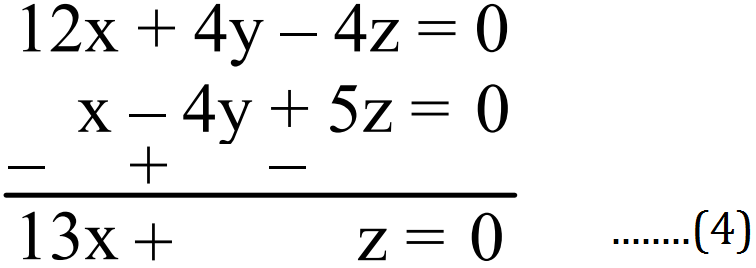
$\text{eq}^\text{n}(2)\times5+\text{eq}^\text{n}(3)\times4$
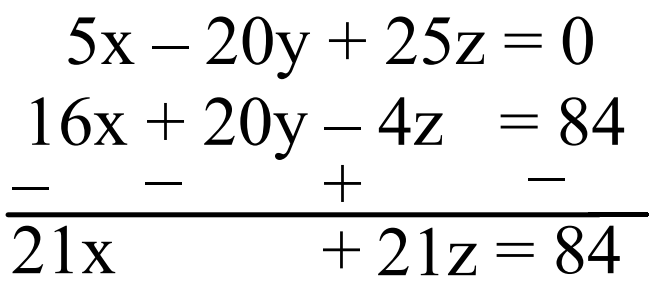
$21(\text{x}+\text{z})=84$
$\text{x}+\text{z}=4\ \ \ ....(5)$
$\text{eq}.(4)-(5)$
$12\text{x}=-4$
$\text{x}=\frac{-4}{12}=\frac{-1}{3}$
$\text{z}=4-\text{x}$
$\text{z}=4+\frac{1}{3}=\frac{13}{3}$
$\text{Put x}\ \&\ \text{z in }(1)$
$3\text{x}+\text{y}-\text{z}=0$
$3\times\Big(\frac{-1}{3}\Big)+\text{y}-\frac{13}{3}=0$
$\text{y}=\frac{13}{3}+1$
$\text{y}=\frac{16}{3}$
$\vec{\text{d}}=\text{x}\hat{\text{i}}+\text{y}\hat{\text{j}}+\text{z}\hat{\text{k}}$
$\vec{\text{d}}=\frac{-1}{3}\hat{\text{i}}+\frac{16}{3}\hat{\text{j}}+\frac{13}{3}\hat{\text{k}}$ View full question & answer→Question 435 Marks
If $\vec{\text{a}}$ and $\vec{\text{b}}$ are two non-collinear unit vectors such that $\big|\vec{\text{a}}+\vec{\text{b}}\big|=\sqrt{3},$ find $\big(2\vec{\text{a}}-5\vec{\text{b}}\big).\big(3\vec{\text{a}}+\vec{\text{b}}\big).$
AnswerGiven
$\vec{\text{a}}$ and $\vec{\text{b}}$ are unit vectors
then, $|\vec{\text{a}}|=\big|\vec{\text{b}}\big|=1$
$\big|\vec{\text{a}}+\vec{\text{b}}\big|=\sqrt{3}$
Squaring both the sides,
$\big|\vec{\text{a}}+\vec{\text{b}}\big|^2=(\sqrt{3})^2$
$|\vec{\text{a}}|^2+\big|\vec{\text{b}}\big|^2+2\vec{\text{a}}.\vec{\text{b}}=3$
$1+1+2\vec{\text{a}}.\vec{\text{b}}=3$
$2+2\vec{\text{a}}.\vec{\text{b}}=3$
$2\vec{\text{a}}.\vec{\text{b}}=3-2$
$2\vec{\text{a}}.\vec{\text{b}}=1$
$2\vec{\text{a}}.\vec{\text{b}}=\frac{1}{2}$
View full question & answer→Question 445 Marks
Decompose the vector $6\hat{\text{i}}-3\hat{\text{j}}-6\hat{\text{k}}$ into vectors which are parallal and perpendicular to the vector $\hat{\text{i}}+\hat{\text{j}}+\hat{\text{k}}.$
AnswerLet $\vec{\text{a}}=6\hat{\text{i}}-3\hat{\text{j}}-6\hat{\text{k}}$ and $\vec{\text{b}}=\hat{\text{i}}+\hat{\text{j}}+\hat{\text{k}}$
and $\vec{\text{x}}$ and $\vec{\text{y}}$ be such that
$\vec{\text{a}}=\vec{\text{x}}+\vec{\text{y}}$
$\Rightarrow\vec{\text{y}}=\vec{\text{a}}-\vec{\text{x}}\dots(1)$
Since $\vec{\text{x}}$ is parallel to $\vec{\text{b}},$
$\vec{\text{x}}=\text{t}\vec{\text{b}}$
$\Rightarrow\vec{\text{x}}=\text{t}\big(\hat{\text{i}}+\hat{\text{j}}+\hat{\text{k}}\big)=\text{t}\hat{\text{i}}+\text{t}\hat{\text{j}}+\text{t}\hat{\text{k}}\dots(2)$
Substituting the values of $\vec{\text{x}}$ and $\vec{\text{a}}$ in (1), we get
$\vec{\text{y}}=6\hat{\text{i}}-3\hat{\text{j}}-6\hat{\text{k}}-\big(\text{t}\hat{\text{i}}+\text{t}\hat{\text{j}}+\text{t}\hat{\text{k}}\big)=(6-\text{t})\hat{\text{i}}+(-3-\text{t})\hat{\text{j}}+(-6-\text{t})\hat{\text{k}}\dots(3)$
Since $\vec{\text{y}}$ is perpendicular to $\vec{\text{b}},$
$\vec{\text{y}}.\vec{\text{b}}=0$
$\Rightarrow\big[(6-\text{t})\hat{\text{i}}+(-3-\text{t})\hat{\text{j}}+(-6-\text{t})\hat{\text{k}}\big].\big(\hat{\text{i}}+\hat{\text{j}}+\hat{\text{k}}\big)=0$
$\Rightarrow1(6-\text{t})+1(-3-\text{t})+1(-6-\text{t})=0$
$\Rightarrow-3-3\text{t}=0$
$\Rightarrow\text{t}=-1$
From (2) and (3), we get
$\vec{\text{x}}=-\hat{\text{i}}-\hat{\text{j}}-\hat{\text{k}}$
$\vec{\text{y}}=7\hat{\text{i}}-2\hat{\text{j}}-5\hat{\text{k}}$
So,
$\vec{\text{a}}=\vec{\text{x}}+\vec{\text{y}}=\big(-\hat{\text{i}}-\hat{\text{j}}-\hat{\text{k}}\big)+\big(7\hat{\text{i}}-2\hat{\text{j}}-5\hat{\text{k}}\big)$
View full question & answer→Question 455 Marks
If the median to the base of a triangle is perpendicular to the base, then triangle is isosceles.
Answer
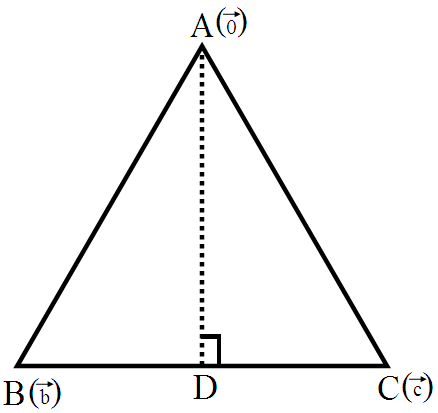 Let $\triangle \text{ABC}$ be a triangle such that AD is the median. Taking A as the origin, let the position vectors of B and C be $\vec{\text{b}}$ and $\vec{\text{c}},$ respectively. Then,position vector of $\text{D} = \frac{\vec{\text{b}} + \vec{\text{c}}}{2}$ (mid-point formula)
Now,
$\vec{\text{AD}} = $ position vector of D-podition vector of $\text{A}= \frac{\vec{\text{b}} + \vec{\text{c}}}{2}$
$\vec{\text{BC}} = $ position vector of C-position vector of $\text{B} = \vec{\text{C}} - \vec{\text{b}}$
Since $\vec{\text{AD}} \perp \vec{\text{BC}},$
$\therefore\vec{\text{AD}}.\vec{\text{BC}} = 0$
$\Rightarrow\frac{1}{2}\big(\vec{\text{b}}+ \vec{\text{c}}\big).\big(\vec{\text{c}} - \vec{\text{b}}\big)=0$
$\Rightarrow \big(\vec{\text{c}} + \vec{\text{b}}\big).\big(\vec{\text{c}}- \vec{\text{b}}\big) = 0$
$\Rightarrow|\vec{\text{c}}|^{2} - \big|\vec{\text{b}}\big|^{2} = 0$
$\Rightarrow|\vec{\text{c}}| =\big| \vec{\text{b}}\big|$
$\Rightarrow \text{AC} = \text{AB}$
Hence, the $\triangle \text{ABC }$ is an isosceles triangle. View full question & answer→Question 465 Marks
(Pythagoras's theorem) Prove by vector method that in a right angleg triang, the square of the hypotenuse is equal to the sum of the squares of the other two sides.
Answer
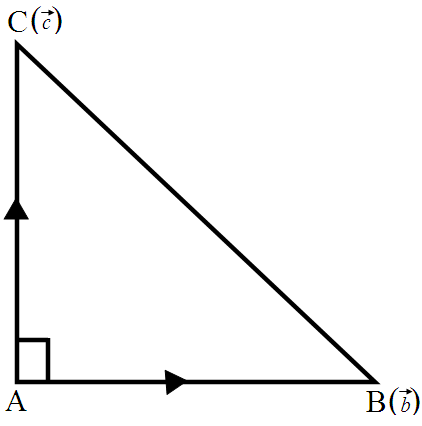 Let ABC be a right triangle with $\angle\text{BAC}=90^\circ.$ Taking A as the origin, let the position vectors of B and C be $\vec{\text{b}}$ and $\vec{\text{c}},$ respectively. Then,$\vec{\text{AB}}=\vec{\text{b}}$ and $\vec{\text{AC}}=\vec{\text{c}}$
Since $\vec{\text{AB}}\perp\vec{\text{AC}}\Rightarrow\vec{\text{b}}.\vec{\text{c}}=0\dots(1)$
Now,
$\big|\vec{\text{AB}}\big|^{2}+\big|\vec{\text{AC}}\big|^{2}=\big|\vec{\text{b}}\big|^{2}+|\vec{\text{c}}|^{2}\dots(2)$
Also,
$\big|\vec{\text{BC}}\big|^{2}=\big|\vec{\text{c}}-\vec{\text{b}}\big|^{2}$
$=\big(\vec{\text{c}}-\vec{\text{b}}\big).\big(\vec{\text{c}}-\vec{\text{b}}\big)$
$=|\vec{\text{c}}|^{2}-2\vec{\text{b}}.\vec{\text{c}}+\big|\vec{\text{b}}\big|^{2}$
$ = |\vec{\text{c}}|^{2} + \big|\vec{\text{b}}\big|^{2}\dots(3) $ [Using (1)]
From (2) and (3), we have
$\big|\vec{\text{AB}}\big|^{2}+\big|\vec{\text{AC}}\big|^{2}=\big|\vec{\text{BC}}\big|^{2}$ View full question & answer→Question 475 Marks
Prove using vector: the quadrilateral obtained by joining mid-points of adjacent sides of a rectangle is a rhombus.
Answer
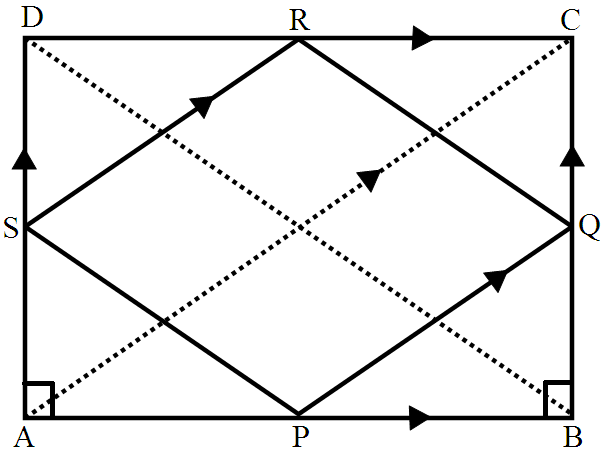 ABCD is a rectangle. Let P, Q, R and S be the mid-points of the sides AB, BC, CD and DA, respectively.Now,
$\vec{\text{PQ}} = \vec{\text{PB}} + \vec{\text{BQ}} = \frac{1}{2}\vec{\text{AB}} + \frac{1}{2}\vec{\text{BC}}$
$=\frac{1}{2}\big(\vec{\text{AB}}+\vec{\text{BC}}\big)=\frac{1}{2}\vec{\text{AC}}\dots(1)$
$\vec{\text{SR}} = \vec{\text{SD}} + \vec{\text{DR}} = \frac{1}{2}\vec{\text{AD}} + \frac{1}{2}\vec{\text{DC}}$
$=\frac{1}{2}\big(\vec{\text{AD}}+\vec{\text{DC}}\big)=\frac{1}{2}\vec{\text{AC}}\dots(2)$
From (1) and (2), we have
$\vec{\text{PQ}} = \vec{\text{SR}}$
So, the sides PQ and SR are equal and parallel. Thus, PQRS is a parallelogram.
Now,
$\big|\vec{\text{PQ}}\big|^{2}=\vec{\text{PQ}}.\vec{\text{PQ}}$
$\Rightarrow \big|\text{PQ}\big|^{2}=\big(\vec{\text{PB}} + \vec{\text{BQ}}\big).\big(\vec{\text{PB}} + \vec{\text{BQ}}\big)$
$\Rightarrow \big|\vec{\text{PQ}}\big|^2= \big|\vec{\text{PB}}\big|^{2} + 2\vec{\text{PB}}.\vec{\text{BQ}} + \big|\vec{\text{BQ}}\big|^{2}$
$\Rightarrow \big|\vec{\text{PQ}}\big|^2 = \big|\vec{\text{PB}}\big|^{2} + 0 + \big|\vec{\text{BQ}}\big|^2 $ $\big(\vec{\text{PB}} \perp \vec{\text{BQ}}\big)$
$\Rightarrow \big|\vec{\text{PQ}}\big|^{2} = \big|\vec{\text{PB}}\big|^{2} + \big|\vec{\text{BQ}}\big|^{2}\dots(3)$
Also,
$\big|\vec{\text{PS}}\big|^{2} = \vec{\text{PS}}.\vec{\text{PS}}$
$\Rightarrow\big|\vec{\text{PS}}\big|^{2} = \big(\vec{\text{PA}} + \vec{\text{AS}}\big).\big(\vec{\text{PA}} + \vec{\text{AS}}\big)$
$\Rightarrow \big|\vec{\text{PS}}\big|^{2} = \big|\vec{\text{PA}}\big|^{2}+ 2\vec{\text{PA}}.\vec{\text{AS}} + \big|\vec{\text{AS}}\big|^{2}$
$\Rightarrow \big|\vec{\text{PS}}\big|^{2} = \big|\vec{\text{PB}}\big|^{2} + 0 + \big|\vec{\text{BQ}}\big|^{2}$ $\big(\vec{\text{PA}} \perp \vec{\text{AS}}\big)$
$\Rightarrow \big|\vec{\text{PS}}\big|^{2} = \big|\vec{\text{PB}}\big|^{2} + \big|\vec{\text{BQ}}\big|^{2}\dots(4)$
From (3) and (4), we have
$\big|\vec{\text{PQ}}\big|^{2} = \big|\vec{\text{PS}}\big|^{2}$
$\Rightarrow \big|\vec{\text{PQ}}\big| = \big|\vec{\text{PS}}\big|$
So, the adjacent sides of the parallelogram are equal. Hence, PQRS is a rhombus. View full question & answer→Question 485 Marks
Find a unit vector perpendicular to the plane containing the vectors $\vec{\text{a}}=2\hat{\text{i}}+\hat{\text{j}}+\hat{\text{k}}$ and $\vec{\text{b}}=\hat{\text{i}}+2\hat{\text{j}}+\hat{\text{k}.}$
AnswerA vector perpendicular to the plane containing the vector $\vec{\text{a}}$ and $\vec{\text{b}}$ is given by $\vec{\text{a}}\times\vec{\text{b}}=\pm\vec{\text{c}}$ (say)
$\vec{\text{a}}\times\vec{\text{b}}=\begin{vmatrix}\hat{\text{i}}&\hat{\text{j}}&\hat{\text{k}}\\\text{a}_1&\text{b}_1&\text{c}_1\\\text{a}_2&\text{b}_2&\text{c}_2 \end{vmatrix}$
$\vec{\text{c}}=\begin{vmatrix}\hat{\text{i}}&\hat{\text{j}}&\hat{\text{k}}\\2&1&1\\1&2&1 \end{vmatrix}$
$\vec{\text{c}}=\hat{\text{i}}(1-2)-\hat{\text{j}}(2-1)+\hat{\text{k}}(4-1)$
$\vec{\text{c}}=-\hat{\text{i}}-\hat{\text{j}}+3\hat{\text{k}}$
$\hat{\text{c}}=\frac{\vec{\text{c}}}{|\vec{\text{c}}|}$
$=\frac{-\hat{\text{i}}-\hat{\text{j}}+3\hat{\text{k}}}{\sqrt{(-1)^2+(-1)^2+(3)^2}}$
$=\frac{-\hat{\text{i}}-\hat{\text{j}}+3\hat{\text{k}}}{\sqrt{1+1+9}}$
$=\frac{1}{\sqrt{11}}\big(-\hat{\text{i}}-\hat{\text{j}}+3\hat{\text{k}}\big)$
Unit vector perpendicular to the plane of $\vec{\text{a}}$ and $\vec{\text{b}}=\pm\frac{1}{\sqrt{11}}\big(-\hat{\text{i}}-\hat{\text{j}}+3\hat{\text{k}}\big).$
View full question & answer→Question 495 Marks
If either $\vec{\text{a}}=\vec{0}$ or $\vec{\text{b}}=\vec{0},$ then $\vec{\text{a}}.\vec{\text{b}}=0.$ But the converse need not be true. Justify your answer with an example.
AnswerLet us assume that either $|\vec{\text{a}}|=0$ or $\big|\vec{\text{b}}\big|=0$Then, $\vec{\text{a}}.\vec{\text{b}}=|\vec{\text{a}}|\big|\vec{\text{b}}\big|\cos\theta=0$ ($\theta$ is the angle between $\vec{\text{a}}$ and $\vec{\text{b}}$)
Now, let us assume that $\vec{\text{a}}.\vec{\text{b}}=0$
$\Rightarrow|\vec{\text{a}}|\big|\vec{\text{b}}\big|\cos\theta=0$
But here we cannot say that either $|\vec{\text{a}}|=0$ or $\big|\vec{\text{b}}\big|=0$. (Because even $\cos\theta$ can be zero)
For example, let
$\vec{\text{a}}=2\hat{\text{i}}+\hat{\text{j}}+3\hat{\text{k}}$ and $\vec{\text{b}}=-3\hat{\text{i}}+2\hat{\text{k}}$
Here, $|\vec{\text{a}}|=\sqrt{4+1+9}=\sqrt{14}\neq0$
$\big|\vec{\text{b}}\big|=\sqrt{9+4}=\sqrt{13}\neq0$
But $\vec{\text{a}}.\vec{\text{b}}=\big(2\hat{\text{i}}+\hat{\text{j}}+3\hat{\text{k}}\big).\big(-3\hat{\text{i}}+2\hat{\text{k}}\big)=-6+0+6=0$
View full question & answer→Question 505 Marks
If $\vec{\text{a}},\ \vec{\text{b}},\ \vec{\text{c}}$ are non-coplanar vectors, prove that the point having the following position vectors is collinear:$\vec{\text{a}}+\vec{\text{b}}+\vec{\text{c}},\ 4\vec{\text{a}}+3\vec{\text{b}},\ 10\vec{\text{a}}+7\vec{\text{b}}-2\vec{\text{c}}$
AnswerLet the points be A, B, C
Position vector of $\text{A}=\vec{\text{a}}+\vec{\text{b}}+\vec{\text{c}}$
Position vector of $\text{B}=4\vec{\text{a}}+3\vec{\text{b}}$
Position vector of $\text{C}=10\vec{\text{a}}+7\vec{\text{b}}-2\vec{\text{c}}$
$\overrightarrow{\text{AB}}=$Position vector of B - Postion vector of A
$=\big(4\vec{\text{a}}+3\vec{\text{b}}\big)-\big(\vec{\text{a}}+\vec{\text{b}}+\vec{\text{c}}\big)$
$=4\vec{\text{a}}+3\vec{\text{b}}-\vec{\text{a}}-\vec{\text{b}}-\vec{\text{c}}$
$\overrightarrow{\text{AB}}=3\vec{\text{a}}+2\vec{\text{b}}-\vec{\text{c}}$
$\overrightarrow{\text{BC}}=$Position vector of C - Postion vector of B
$=\big(10\vec{\text{a}}+7\vec{\text{b}}-2\vec{\text{c}}\big)-\big(4\vec{\text{a}}+3\vec{\text{b}}\big)$
$=10\vec{\text{a}}+7\vec{\text{b}}-2\vec{\text{c}}-4\vec{\text{a}}-3\vec{\text{b}}$
$\overrightarrow{\text{BC}}=6\vec{\text{a}}+4\vec{\text{b}}-2\vec{\text{c}}$
Using $\overrightarrow{\text{AB}}$ and $\overrightarrow{\text{BC}}$
$\overrightarrow{\text{BC}}=2\Big(\overrightarrow{\text{AB}}\Big)$
So, $\overrightarrow{\text{AB}}$ is parallel to $\overrightarrow{\text{BC}}$ but $\vec{\text{B}}$ is a common vector. Hence,
A, B, C are collinear.
View full question & answer→