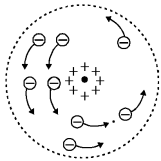
Write first and second postulates of Bohr's Atomic Model. Obtain the expression for radius and velocity of stable orbit of electron.###Explain Bohr's two postulates for hydrogen atom.
On the basis of Bohr's postulates, derive the expression for orbital speed of electron for $n ^{\text {th }}$ stable orbit in hydrogen atom.
Energy in ground state of hydrogen atom is $(-) XeV$. What will be the kinetic energy in this state?
Answer
Bohr's first postulate :
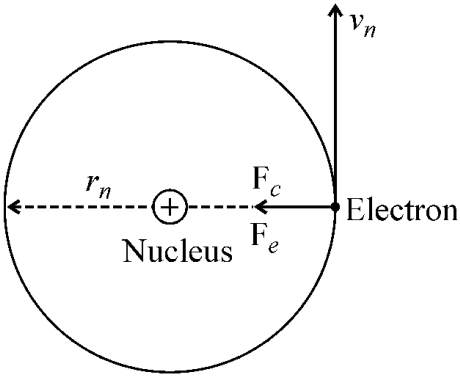
The electrons revolves around the nucleus in different stable circular orbits of the atom.
The required contripetal force to more the electron in circular orbit provided by the Coloumb's force, works between the electron and charge of the nucleus.
Therefore, from the Bohr's first postulate,
$\frac{m v^2}{r} =\frac{KZ e^2}{r^2}$
$\frac{m v^2}{r} =\frac{1}{4 \pi \epsilon_0} \frac{Z e^2}{r^2} $
$\Rightarrow m v^2 r=\frac{Z e^2}{4 \pi \epsilon_0} \ldots(1)$ Bohr's second postulate :
Electron revolves only there orbits in which angular momentum $(L =m v r)$ is multiple integer of $\frac{h}{2 \pi}$.
According to Bohr's this postulate:
$L=\frac{n h}{2 \pi} \text { or } m v r=n\left(\frac{h}{2 \pi}\right) \ldots(2) $
Where $h=$ Planck's constant and $n=1,2,3, \ldots$ are the principal quantum numbers.
From $(1)\ m v^2 r=\frac{Z e^2}{4 \pi \epsilon_0}$
or $ m v r . v=\frac{Z e^2}{4 \pi \epsilon_0} \ldots(3) $
Put the value of $m v r$ from eqn. $(2)$
$n\left(\frac{h}{2 \pi}\right) v=\frac{Z e^2}{4 \pi \epsilon_0}$
or $v=\frac{Z e^2}{4 \pi \epsilon_0} \times\left(\frac{2 \pi}{n h}\right) \text { or } v=\left(\frac{Z e^2}{2 \epsilon_0 h}\right) \frac{1}{n} \ldots (4) $
$($where, $n=1,2,3, \ldots)$
Equation $(4)$ is the general formula of velocity of electron in stable orbits. In this formula, $e, \epsilon_0$ and $h$ are the universal constants. $Z$ is constant specifically for atom therefore
$v \propto \frac{1}{n}$
That is, "The velocity of electron in stable orbits is inversely proportional to the orbit number i.e. principal quantum."
Value of kinetic energy of electron :
$K=-(-) XeV$
$K=XeV$
A 12.5 eV electron beam is used to bombard gaseous hydrogen at room temperature. What series of wavelengths will be emitted?
Answer
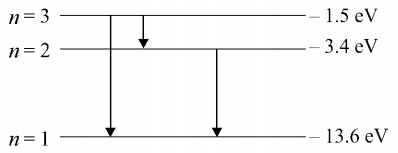
Given that, energy of electron beam = 12.5 eV Energy of electron of hydrogen atom, in ground level = -13.6 eV Therefore, energy of electron in hydrogen orbits by the bombardment of beam of electron $=-13.6+12.5=-1.1 eV$ This energy of electron in $n=3$, is greater than $E_3=-\frac{13.6}{9}=-1.5 eV$ Therefore electron will excited upto third level (orbit) by the bombardment of electron beam and transition possibly as per figure: (i) From $n_2=3$ to $n_1=1$ (ii) From $n_2=2$ to $n_1=1$ In above will be Lyman series and in (iii) From $n_3=3$ to $n_1=2$, Balmer series. Again, since $h v=\frac{h c}{\lambda}=\Delta E$ Therefore wavelength of emitted radiation will be : $\lambda=\frac{h c}{\Delta E (\text { in joule })}$ Therefore (i) transition from $n_3=3$ to $n_1=1$ $\lambda_1=\frac{6.63 \times 10^{-34} \times 3 \times 10^8}{[-1.5-(-13.6)] \times 1.6 \times 10^{-19}}$ $=\frac{19.89 \times 10^{-7}}{12.1 \times 1.6}=\frac{19.89 \times 10^{-7}}{19.36}$ $=1.027 \times 10^{-7}$ meter $=102.7 \times 10^{-9}$ meter or $\lambda_1=102.6 nm$. (ii) For transition from $n_2=2$ to $n_1=1$ $\lambda_2=\frac{6.63 \times 10^{-34} \times 3 \times 10^8}{[-3.4-(-13.6)] \times 1.6 \times 10^{-19}}$ $=\frac{19.89 \times 10^{-7}}{10.2 \times 1.6}=\frac{19.89 \times 10^{-7}}{16.32}$ meter $\begin{aligned}=1.219 \times 10^{-7} =121.9 \times 10^{-9} \text { meter } \\ =121.9 mm .\end{aligned}$ (iii) For transition, from $n_2=3$ to $n_1=2$ $\lambda_3=\frac{6.63 \times 10^{-34} \times 3 \times 10^8}{[-1.5-(-3.4)] \times 1.6 \times 10^{-19}}$ $=\frac{19.89 \times 10^{-7}}{1.9 \times 1.6}=\frac{19.89 \times 10^{-7}}{3.040}$ meter $=6.543 \times 10^{-7}$ meter $=654.3 \times 10^{-9}$ meter $\lambda_3=654.3 nm$.
Using the Bohr's model, calculate the speed of the electron in a hydrogen atom in the n = 1 2, and 3 levels.
Answer
Using Bohr's Model, we know that radius and speed of electron in nthe orbit: $r_n=\frac{n^2 h^2}{4 \pi^2 K m e^2}$ ....(1) or $\quad v_n=\frac{n h}{2 \pi m r_n}=\frac{n h}{2 \pi m} \times \frac{4 \pi^2 K m e^2}{n^2 h^2}$ $\therefore \quad v_n=\frac{2 \pi K e^2}{n h}=\frac{1}{4 \pi \in_0} \frac{2 \pi e^2}{h} \frac{1}{n} \quad \because K=\frac{1}{4 \pi \in_0}$ $v_n=\frac{1}{4 \pi \in_0} \cdot \frac{2 \pi e^2}{h} \cdot \frac{1}{n}$ ....(2) We know that, $\begin{array}{l}e=1.6 \times 10^{-19} C \\ h=6.63 \times 10^{-34} J- s ,\end{array}$ $K=\frac{1}{4 \pi \in_0}=9 \times 10^9 Nm ^2 / C ^2$ All these values put in eqn. (2) $v_n=\frac{9 \times 10^9 \times 2 \times 3.14 \times\left(1.6 \times 10^{-19}\right)^2}{6.63 \times 10^{-34}} \times \frac{1}{n}$ $v_n=\frac{21.871 \times 10^5}{n} m / s$ Let in $n=1,2$ and 3 , the speed of electron $v_1, v_2$ and $v_3$. $v_1=\frac{21.871}{1} \times 10^5=21.871 \times 10^5 m / sec$ $\simeq 2.19 \times 10^6 m / sec$ $v_2=\frac{21.871}{2} \times 10^5 m / sec =10.935 \times 10^5 m / sec$ $=1.094 \times 10^6 m / sec$ and $v_3=\frac{21.871}{3} \times 10^5 m / sec$ $=7.290 \times 10^5 m / sec =0.729 \times 10^6 m / sec$