Question
Write first and second postulates of Bohr's Atomic Model. Obtain the expression for radius and velocity of stable orbit of electron.###Explain Bohr's two postulates for hydrogen atom.

Answer

Bohr's postulates : Bohr proposed three postulates which are following :
(1) Bohr's first postulates : Any electron can revolve in the definite stable states of atom without radiating the emission energy. It is opposite to the electromagnetic principle. According to this postulate, each atom has same definite stable states in which it existed and existed total energy is definite in all possible states. All these possible states are called stable states of atom.
(2) Bohr's second postulate : Second postulate defines to these stable orbit. According to this postulate, electron revolves around the nucleus only in those orbits for which angular momentum is multiple integer of $\frac{h}{2 \pi}$. Where, $h$ Planck's constant $\left(=6.6 \times 10^{-34} Js \right)$. Therefore, L is quantised angular momentum of revolving electron. That is,
$L=\frac{n h}{2 \pi}$ $\ldots (1)$
(3) Bohr's third postulate : According to this postulate, transition of electron can be done from specially given unradiated orbits to second low energy orbits. When it does so a photon is emitted, whose energy is equal to the difference of energy of initial and final states. Frequency of emitted photon is given by following expression :
$h v=E_i-E_f$ $\ldots (2)$
Where, $E _i$ and $E _f$ are the energies of initial and final states, $E _i> E _f$
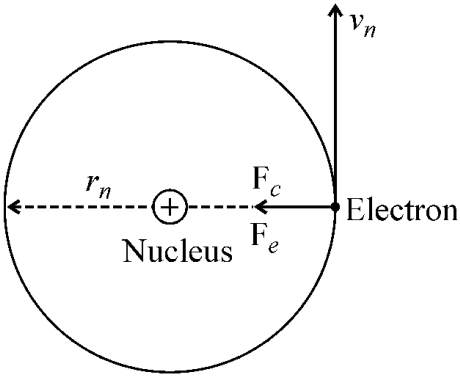
Bohr's Radius or radius of stable orbits : Let $r_n$ is the radius of $n^{\text {th }}$ orbit of any atom and in which an electron is moving with velocity $v_n$. If mass of electron is $m$ then from the Bohr's second postulate,
$m v_n r_n=n \cdot \frac{h}{2 \pi}$ $\ldots (1)$
Image
From Bohr's first postulate,
$F _e = F _c$
$\therefore \frac{1}{4 \pi \epsilon_0} \cdot \frac{Z e^2}{r_n^2}=\frac{m v^2 n}{r_n}$ $\ldots (2)$
From eqn. (1) $v_n=\frac{n h}{2 \pi m r_n}$ 
Put value of $v_n$ in eqn. (2)
$\frac{1}{4 \pi \epsilon_0} \cdot \frac{ Z e^2}{r_n^2}=\frac{m}{r_n} \times \frac{n^2 h^2}{4 \pi^2 m^2 r_n^2}$
or $\quad \frac{Z e^2}{\epsilon_o}=\frac{n^2 h^2}{r_n \cdot \pi m}$ $\quad$ $\therefore r_n=\frac{\epsilon_0 n^2 h^2}{\pi m Z e^2}$
or $\quad \underline {r_n=\frac{\epsilon_0 h^2}{\pi m Z e^2} \cdot n^2}$ $\ldots (3)$
Speed of electron in stable orbit
$\because \quad v_n=\frac{n h}{2 \pi m r_n}$
Put the value of $r_n$ from eqn. (3)
$v_n=\frac{n h}{2 \pi m\left[\frac{\epsilon_0 h^2 n^2}{\pi m e^2 Z}\right]} \Rightarrow \underline {v_n=\frac{Z e^2}{2 \epsilon_0 h n}}$

Need a full question paper?

Generate a complete, print-ready paper with questions like this in minutes — across 16+ boards, with answer keys.
Start Generating Free

Similar questions

Asha’s mother read an article in the newspaper about a disaster that took place at Chernobyl. She could not understand much from the article and asked a few questions from Asha regarding the article. Asha tried to answer her mother’s questions based on what she learnt in Class XII Physics.
  1. What was the installation at Chernobyl where the disaster took place? What, according to you, was the cause of this disaster?
  2. Explain the process of release of energy in the installation at Chernobyl.
  3. What, according to you, were the values displayed by Asha and her mother?
For the $\beta^{+} ($positron$)$ emission from a nucleus, there is another competing process known as electron capture $($electron from an inner orbit, say, the $K–$ shell, is captured by the nucleus and a neutrino is emitted$).$
$\text{e}^{+}+^{\text{A}}_{\text{Z}}\text{X}\rightarrow\ ^{\text{A}}_{\text{Z}-1}\text{Y}+\text{v}$
Show that if $\beta^{+}$ emission is energetically allowed, electron capture is necessarily allowed but not vice $–$ versa.
Is it possible that in a Coolidge tube characteristic $\text{L}_\alpha \ X-$rays are emitted but not $\text{K}_\alpha \  X-$rays?
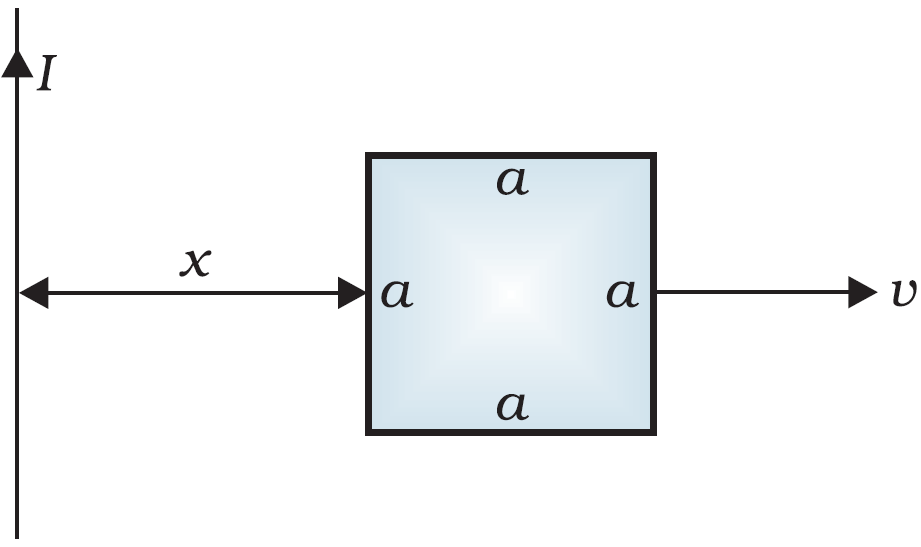
  1. Obtain an expression for the mutual inductance between a long straight wire and a square loop of side a as shown in Fig.
  2. Now assume that the straight wire carries a current of $50A$ and the loop is moved to the right with a constant velocity $, v = 10\ m/s.$ Calculate the induced emf in the loop at the instant when $x = 0.2\ m$. Take $a = 0.1\ m$ and assume that the loop has a large resistance.
A proton and an $\alpha -$particle are accelerated, using the same potential difference. How are the de$-$Broglie wavelengths $\lambda _p$ and $\lambda _a$ related to each other?
Which one of the following cannot emit radiation and why? Excited nucleus, excited electron.
A compound microscope consists of an objective lens of focal length 2.0 cm and an eyepiece of focal length 6.25 cm separated by a distance of 15 cm. How far from the objective should an object be placed in order to obtain the final image at (a) the least distance of distinct vision (25 cm), and (b) at infinity? What is the magnifying power of the microscope in each case?
A capacitor of capacitance $12.0\mu\text{F}$ is connected to a battery of emf $6.00V$ and internal resistance $1.00\Omega$ through resistanceless leads. $12.0\mu\text{s}$ after the connections are made, what will be $(a)$ the current in the circuit $(b)$ the power delivered by the battery $(c)$ the power dissipated in heat and $(d)$ the rate at which the energy stored in the capacitor is increasing.
Three rods of lengths $20\ cm$ each and area of cross section $1\ cm^2$ are joined to form a triangle $ABC$. The conductivities of the rods are $\text{K}_\text{AB}=50\text{Js}^{-1}\text{m}^{-1}{^{\circ}}\text{C}^{-1},\ \text{K}_\text{BC}=200\text{Js}^{-1}\text{m}^{-1}{^{\circ}}\text{C}^{-1}$ and $\text{K}_\text{AC}=400\text{Js}^{-1}\text{m}^{-1}{^{\circ}\text{C}}^{-1}.$ The junctions $A, B$ and $C$ are maintained at $40^\circ C, 80^\circ C$ and $80^\circ C$ respectively. Find the rate of heat flowing through the rods $AB, AC$ and $BC$.
Two equal charges, $2.0 \times 10^{-7}C$ each, are held fixed at a separation of $20\ cm.$ A third charge of equal magmtude is placed midway between the two charges. It is now moved to a point $20\ cm$ from both the charges. How much work is done by the electric field durmg the process?