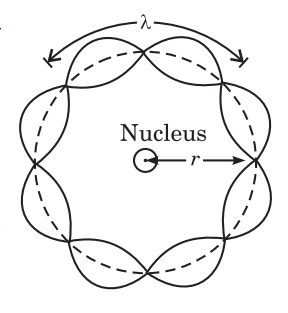
Question 14 MarksState Bohr's quantization condition for defining stationary orbits. How does de-Broglie hypothesis explain stationary orbits ?AnswerBohr's Quantization condition : It states that only those orbits are permitted in which the angular momentum of the electron about the nucleus is an integral multiple of $h / 2 \pi$, where $h$ is Planck's constant.Explanation of stationary orbits by de-Broglie hypothesis: According to de-Broglie, an electron of mass $m$ moving with speed $\lambda$ would have a wavelength a given by $\lambda=h / m v$.Now according to Bohr's postulate$m v r_n=\frac{n h}{2 \pi} \Rightarrow 2 \pi r_n=\frac{n h}{m v}$But $h / m v=\lambda$ is the de-Broglie wavelength of the electron, therefore, the above equation becomes $2 \pi r_n=n \lambda$ , where $2 \pi r_n$ , is the circumference of the permitted orbit. Thus only waves that persist are those for which the circumference of the circular orbit contains a whole number of wavelengths.View full question & answer→
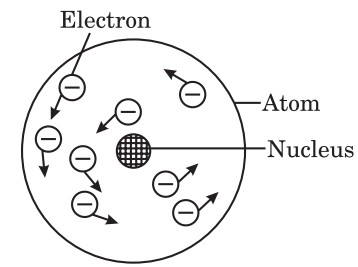
Question 24 MarksDescribe Rutherford's model of atom developed on the basis of his alpha particle scattering experiment.AnswerRutherford's Atomic Model: In the year 1911, Rutherford proposed a model of the structure of atom on the basis of $\alpha$-particle's scattering experiment. This is called Rutherford's nuclear model of the atom. According to this model :(i) Atom may be regarded as a sphere of diameter $10^{-10}$ m but whole of positive charge and almost the entire mass of the atom is concentrated in a small central core called nucleus having diameter of about $10^{-14}m$.(ii) The nucleus is surrounded by electrons. As the atom is electrically neutral, the total positive charge on the nucleus is equal to the total negative charge of the electrons in the atom. (iii) The electrons inside the atom are not stationary for if they were at rest, they would have been pulled into the positive nucleus due to strong electrostatic force of attraction between the nucleus and the electrons. He assumed that the electrons are revolving around the nucleus in circular orbits, the necessary centripetal force being provided to them by the electrostatic force of attraction between the electrons and the nucleus.The Rutherford's model of the atom found adequate support from the Mendeleef's periodic table of elements as well, because it was suggested that the charge on the nucleus of an atom increases by one unit when one passes from one element to the other in the periodic table and that the number of positive charges on the nucleus is a characteristic of the element. This number is called the atomic number of the element and it gained importance when Mosley showed in 1912, that the frequency of the lines in the characteristic X-ray spectrum is governed by atomic number of the element and not by its atomic weight.View full question & answer→