Question
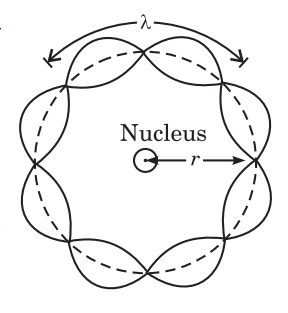
State Bohr's quantization condition for defining stationary orbits. How does de-Broglie hypothesis explain stationary orbits ?
Need a full question paper?

Generate a complete, print-ready paper with questions like this in minutes — across 16+ boards, with answer keys.

Start Generating Free

Similar questions

A uniform magnetic field of $0.20 \times 10^{-3}$ T exists in the space. Find the change in the magnetic scalar potential as one moves through $50\ cm$ along the field.
The half-life of $^{226}Ra$ is $1602y.$ Calculate the activity of $0.1g$ of $RaCl_2$ in which all the radium is in the form of $^{226}Ra.$ Taken atomic weight of $Ra$ to be $226\ g/mol^{-1}$ and that of $Cl$ to be $35.5\ g/mol^{-1}.$
Explain the use of chock coil.
The radio and TV programmes, telecast at the studio, reach our antenna by wave motion. Is it a mechanical wave or nonmechanical?
A player hits a baseball at some angle. The ball goes high up in space. The player runs and catches the ball before it hits the ground. Which of the two (the player or the ball) has greater displacement?
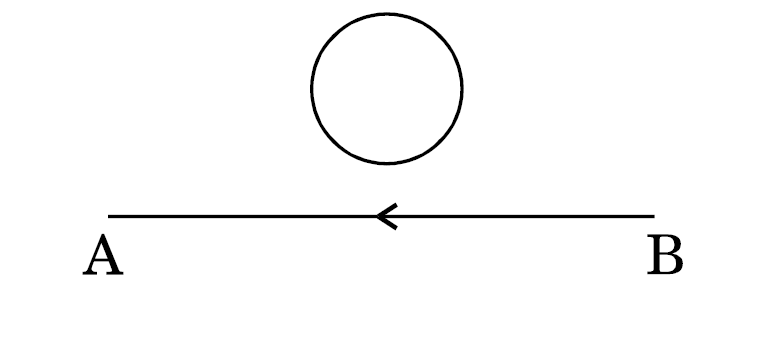
The electric current flowing in a wire in the direction from B to A is decreasing. Find out the direction of the induced current in the metallic loop kept above the wire as shown.
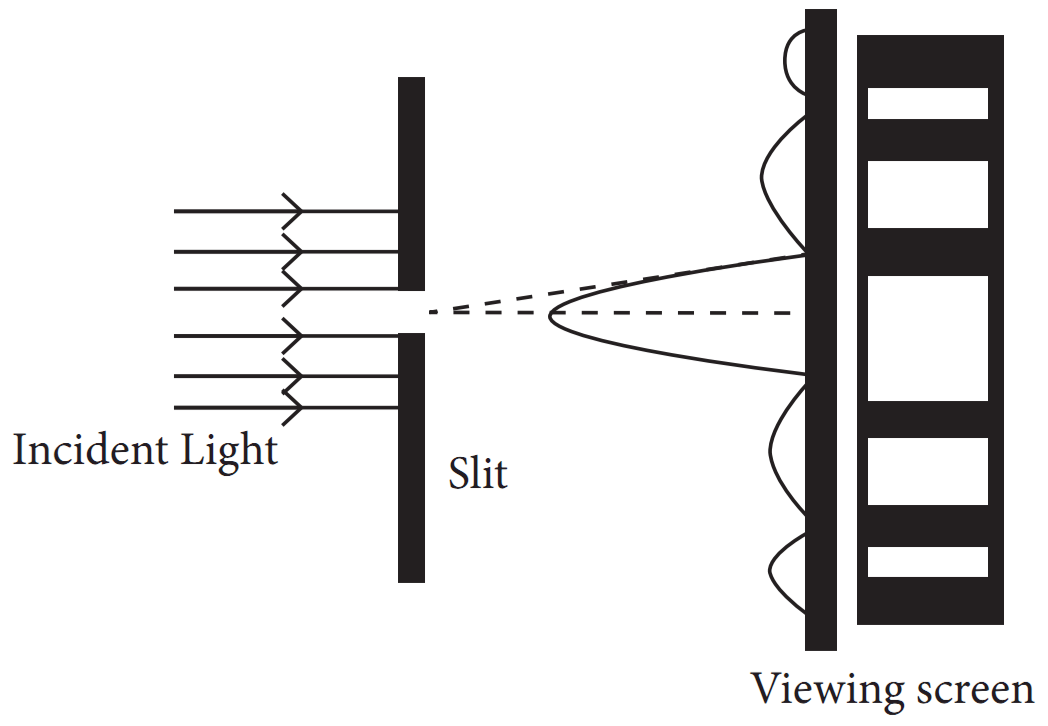
When light from a monochromatic source is incident on a single narrow slit, it gets diffracted and a pattern of ahem ate bright and dark fringes is obtained on screen, called "Diffraction Pattern" of single slit. ln diffraction pattern of single slit, it is found that.
  1. Central bright fringe is of maximum intensity and the intensity of any secondary bright fringe decreases with increase in its order.
  2. Central bright fringe is twice as wide as any other secondary bright or dark fringe.
  1. A single slit of width $0.1\ mm$ is illuminated by a parallel beam oftight of wavelength $6000\mathring{\text{A}}$ and diffraction bands are observed on a screen $0.5\ m$ from the slit. The distance of the third dark band from the central bright band is:
  1. Should be $\frac{\lambda}{2}$, where $\lambda$, is the wavelength.
  2. Should be of the order of wavelength.
  3. Has no relation to wavelength.
  4. Should be much larger than the wavelength.
  5. To observe diffraction, the size of the obstacle.
  6. Bands disappear
  7. Bands become broader and farther apart
  8. No change will take place
  9. Diffraction bands become narrower and crowded together.
  10. A diffraction pattem is obtained by using a beam of red light. What will happen, if the red light is replaced by the blue light?
  11. $6 \times 10^{-3}$ rad
  12. $4 \times 10^{-3}$ rad
  13. $2.4 \times 10^{-3}$ rad
  14. $4.5 \times 10^{-3}$ rad
  15. Light of wavelength $600\ nm$ is incident normally on a slit of width $0.2mm$. The angular width of central maxima in the diffraction pattern is $($measured from minimum to minimum$).$
  16. $10^{-1}m$
  17. $10^{-2}m$
  18. $2 \times 10^{-2}m$
  19. $2 \times 10^{-1}m$
  20. ln Fraunhofer diffraction pattern, slit width is $0.2\ mm$ and screen is at $2\ m$ away from the lens. If wavelength of tight used is $5000\mathring{\text{A}}$ then the distance between the first minimum on either side the central maximum is:
  21. $3\ mm$
  22. $1.5\ mm$
  23. $9\ mm$
  24. $4.5\ mm$
Interference is based on the superposition principle. According to this principle, at a particular point in the medium, the resultant displacement produced by a number of waves is the vector sum of the displacements produced by each of the waves.
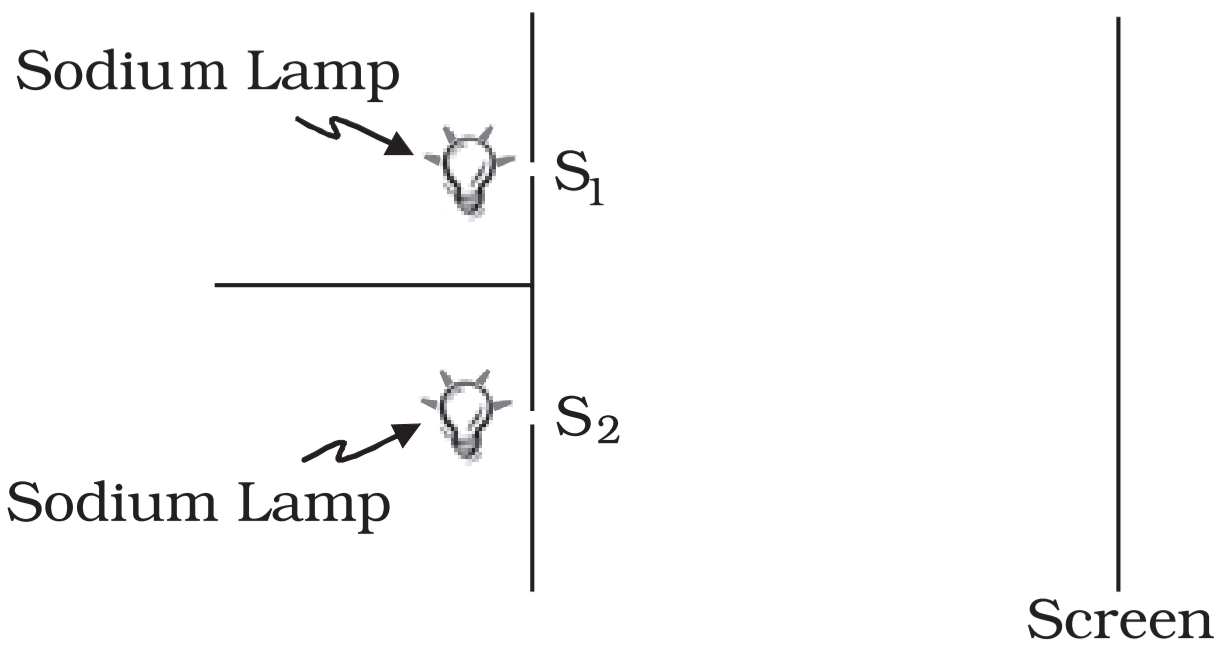
If two sodium lamps illuminate two pinholes $S_1$ and $S_2,$ the intensities will add up and no interference fringes will be observed on the screen.
Here the source undergoes abrupt phase change in times of the order of $10^{-10}$ seconds.
  1. Two coherent sources of intensity $\text{10 }\frac{\text{W}}{\text{m}^2}$ and $\text{25 }\frac{\text{W}}{\text{m}^2}$ interfere to form fringes. Find the ratio of maximum intensity to minimum intensity.
  2. $\text{y}_1=\text{a}\sin\Big[\omega\text{t}+\frac{\pi}{3}\Big]$ and $\text{y}_2=\text{a}\sin\omega\text{t}$ is:
  3. $\text{a}$
  4. $\sqrt2\text{a}$
  5. $\text{2a}$
  6. $\sqrt3\text{a}$
  7. The resultant amplitude of a vibrating particle by the superposition of the two waves.
  8. Infinite
  9. Five
  10. Three
  11. Zero
  12. The maximum number of possible interference maxima for slit separation equal to twice the wavelength in Young's double $-$ slit experiment, is:
  13. $2D$
  14. $4D$
  15. $\frac{\text{D}}{2}$
  16. $\frac{\text{D}}{4}$
  17. ln a Young's double $-$ slit experiment, the slit separation is doubled. To maintain the same fringe spacing on the screen, the screen $-$ to $-$ slit distance $D$ must be changed to:
  18. Soap bubble.
  19. Excessively thin film.
  20. A thick film.
  21. Wedge shaped film.
  22. Which of the following does not show interference?
  23. $15.54$
  24. $16.78$
  25. $19.72$
  26. $18.39$
Suppose you are inside the water in a swimming pool near an edge. A friend is standing on the edge. Do you find your friend taller or shorter than his usual height?
Motion of Charge in Magnetic Field
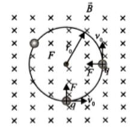
An electron with speed $V_0$ << c moves in a circle of radius $r _{\circ}$ in a uniform magnetic field. This electron is able to traverse a circular path as the magnetic force acting on the electron is perpendicular to both $V_0$ and B ,as shown in the figure. This force continuously deflects the particle sideways without changing its speed and the particle will move along a circle perpendicular to the field. The time required for one revolution of the electron is $T _{ o }$.

Image

(i) If the speed of the electron is now doubled to 2vo. The radius of the circle will change to
(A) $4 r_0$ (B) $2 r_0$ (C) $r _{ o }$ (D) $r _0 / 2$

(ii) If v = 2vo, then the time required for one revolution of the electron (To ) will change to
(A) $4 T_0$ (B) $2 T_{ O }$ (C) $T _{ o }$ (D) $T _{ d } / 2$
(iii) A charged particles is projected in a magnetic field . The acceleration of the particle is found to be. Find the value of x.
(A) $4 ms^{-2}$ (B) $-4 ms^{-2}$ (C) $-2 ms^{-2}$ (D) $2 ms^{-2}$

(iv) If the given electron has a velocity not perpendicular to B, then trajectory of the electron is
(A) straight line (B) circular (C) helical (D) zig-zag

OR

If this electron of charge (e) is moving parallel to uniform magnetic field with constant velocity v, the force acting on the electron is
(A) Bev (B) Be/v (C) B/ev (D) Zero