Questions

3 Marks Question

Take a timed test

12 questions · self-marked practice — reveal the answer and mark yourself.

Question 13 Marks
A charge of $+2.0 \times 10^{-8}C$ is placed on the positive plate and a charge of $-1.0 \times 10^{-8}C$ on the negative plate of a parallel-plate capacitor of capacitance $1.2\times10^{-3}\mu\text{F}.$ Calculate the potential difference developed between the plates.
Answer
$\text{q}_1=+2.0\times10^{-8}\text{c}$
$\text{q}_2=-1.0\times10^{-8}\text{c}$
$\text{C}=1.2\times10^{-3}\mu\text{F}=1.2\times10^{-9}\text{F}$
$\text{net q}=\frac{\text{q}_1-\text{q}_2}{2}=\frac{3.0\times10^{-8}}{2}$
$\text{V}=\frac{\text{q}}{\text{c}}=\frac{3\times10^{-8}}{2}\times\frac{1}{1.2\times10^{-9}}=12.5\text{V}$
View full question & answer
Question 23 Marks
A parallel-plate capacitor having plate area $25cm^2$ and separation 1.00mm is connected to a battery of 6.0V. Calculate the charge flown through the battery. How much work has been done by the battery during the process?
Answer


$\text{A}=25\text{cm}^2=2.5\times10^{-3}\text{cm}^2$
$\text{d}=1\text{mm}=0.01\text{m}$
$\text{V}=\text{6V},\ \text{Q}=1$
$\text{C}=\frac{\in_0\text{A}}{\text{d}}=\frac{8.854\times10^{-12}\times2.5\times10^{-3}}{0.01}$
$\text{Q}=\text{CV}=\frac{8.854\times10^{-12}\times2.5\times10^{-3}}{0.01}\times6$
$=1.32810\times10^{-10}\text{C}$
$\text{W}=\text{Q}\times\text{V}=1.32810\times10^{-10}\text{C}\times6$
$=8\times10^{-10}\text{J}.$
View full question & answer
Question 33 Marks
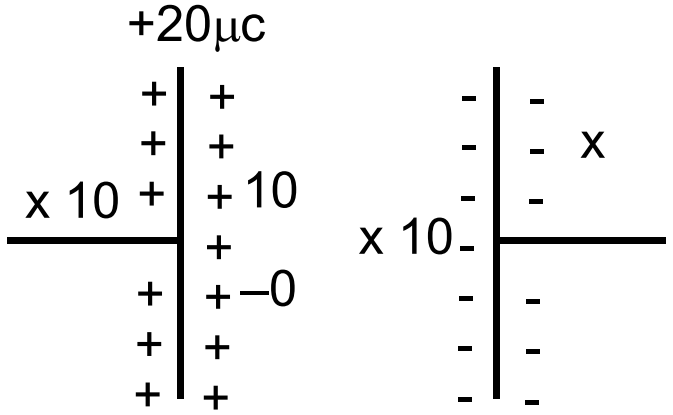
A charge of $20\mu\text{C}$ is placed on the positive plate of an isolated parallel-plate capacitor of capacitance $10\mu\text{F}.$ Calculate the potential difference developed between the plates.
Answer

$\therefore$ Given that
Capacitance $=10\mu\text{F}$
Charge $=20\mu\text{C}$
$\therefore$ The effective charge $=\frac{20-0}{2}=10\mu\text{F}$
$\therefore\text{C}=\frac{\text{q}}{\text{V}}$
$\Rightarrow\text{V}=\frac{\text{q}}{\text{C}}=\frac{10}{10}=1\text{V}$
View full question & answer
Question 43 Marks
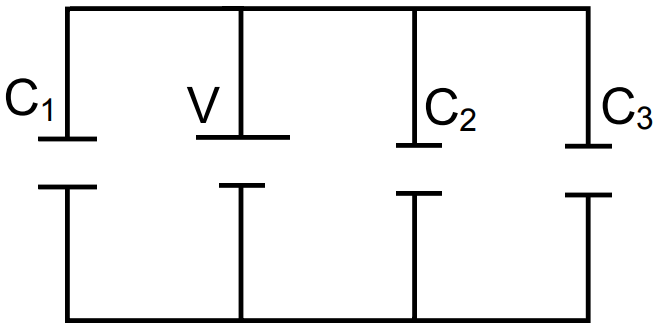
Find the charges on the three capacitors connected to a battery as shown in figure. Take $\text{C}_1=2.0\mu\text{F},\ \text{C}_2=4.0\mu\text{F},\ \text{C}_3=6.0\mu\text{F}$ and V = 12 volts.
Answer

$\text{C}_1=2\mu\text{F},\ \text{C}_2=4\mu\text{F},\ \text{C}_3=6\mu\text{F}$
$\text{V}=12\text{V}$
$\text{cq}=\text{C}_1+\text{C}_2+\text{C}_3$
$=2+4+6=12\mu\text{F}$
$=12\times10^{-6}\text{F}$
$\text{q}_1=12\times2=24\mu\text{C}$
$\text{q}_2=12\times4=48\mu\text{C}$
$\text{q}_3=12\times6=72\mu\text{C}$
View full question & answer
Question 53 Marks
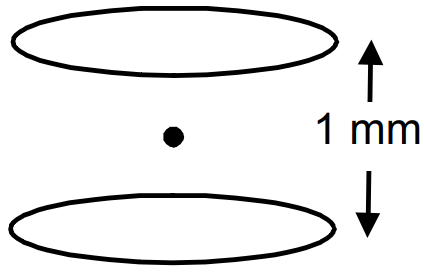
Suppose, one wishes to construct a 1.0 farad capacitor using circular discs. If the separation between the discs be kept at 1.0mm, what would be the radius of the discs?
Answer
Let the radius of the disc = R

$\therefore$ Area $=\pi\text{R}^2$
$\text{C}=1\text{f}$
$\text{D}=1\text{mm}=10^{-3}\text{m}$
$\therefore\text{C}=\frac{\in_0\text{A}}{\text{d}}$
$\Rightarrow1=\frac{8.85\times10^{-12}\times\pi\text{r}^2}{10^{-3}}$
$\Rightarrow\text{r}^2=\frac{10^{-3}\times10^{12}}{8.85\times\pi}=\frac{10^9}{27.784}$
$=5998.5\text{m}=6\text{Km}$
View full question & answer
Question 63 Marks
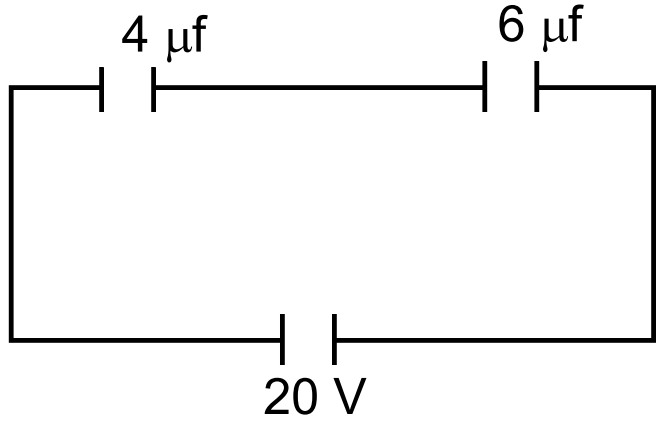
Two capacitors of capacitances $4.0\mu\text{F}$ and $6.0\mu\text{F}$ are connected in series with a battery of 20V. Find the energy supplied by the battery.
Answer

$\therefore\text{C}_1=4\mu\text{F},\ \text{C}_2=6\mu\text{F},\ \text{V}=20\text{V}$
Eq. capacitor $\text{C}_{\text{eq}}=\frac{\text{C}_1\text{C}_2}{\text{C}_1+\text{C}_2}=\frac{4\times6}{4+6}=2.4$
$\therefore$ The Eq Capacitance $\text{C}_{\text{eq}}=2.5\mu\text{F}$
$\therefore$ The energy supplied by the battery to each plate
$\text{E}=\Big(\frac{1}{2}\Big)\text{CV}^2$
$=\Big(\frac{1}{2}\Big)\times2.4\times20^2=480\mu\text{J}$
$\therefore$ The energy supplies by the battery to capacitor $=2\times480=960\mu\text{J}$
View full question & answer
Question 73 Marks
A metal sphere of radius R is charged to a potential V:
  1. Find the electrostatic energy stored in the electric field within a concentric sphere of radius 2R.
  2. Show that the electrostatic field energy stored outside the sphere of radius 2R equals that stored within it.
Answer
$\text{Q}=\text{CV}=4\pi\in_0\text{R}\times\text{V}$
$\text{E}=\frac{1}2{}\frac{\text{q}^2}{\text{C}}$ $[\therefore$ 'C' in a spherical shell $=4\pi\in_0\text{R}]$
$\text{E}=\frac{1}{2}\frac{16\pi^2\in_0^2\times\text{R}^2\times\text{V}^2}{4\pi\in_0\times2\text{R}}=2\pi\in_0\text{RV}^2$ $[$'C' of bigger shell $=4\pi\in_0\text{R}]$
View full question & answer
Question 83 Marks
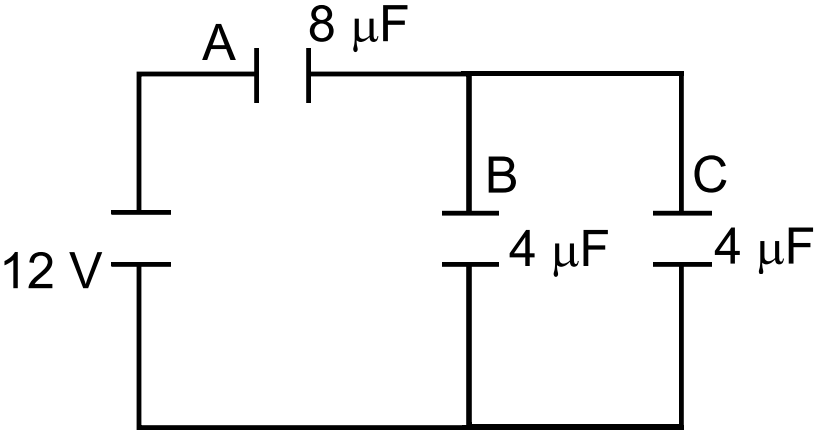
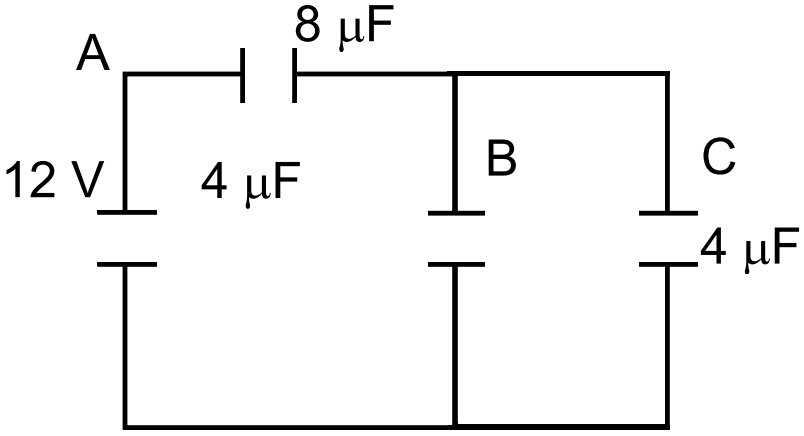
Find the charge appearing on each of the three capacitors shown in figure.
Answer

$\text{C}_1=8\mu\text{F},\ \text{C}_2=4\mu\text{F},\ \text{C}_3=4\mu\text{F}$
$\text{C}_{\text{eq}}=\frac{(\text{C}_2+\text{C}_3)\times\text{C}_1}{\text{C}_1+\text{C}_2+\text{C}_3}$
$=\frac{8\times8}{16}=4\mu\text{F}$
Since B & C are parallel & are in series with A.
So, $\text{q}_1=8\times6=48\mu\text{C}$
$\text{q}_2=4\times6=24\mu\text{C}$
$\text{q}_3=4\times6=24\text{C}\mu$
View full question & answer
Question 93 Marks
A large conducting plane has a surface charge density $1.0\times10^{-4}\text{Cm}^{-2}.$ Find the electrostatic energy stored in a cubical volume of edge 1.0cm in front of the plane.
Answer
$\sigma=1\times10^{-4}\text{c/m}^2$
$\text{a}=1\text{cm}=1\times10^{-2}\text{m}$
$\text{a}^3=10^{-6}\text{m}$
The energy stored in the plane $=\frac{1}{2}\frac{\sigma^2}{\in_0}=\frac{1}{2}\frac{(1\times10^{-4})^2}{8.85\times10^{-12}}$
$=\frac{10^4}{17.7}=564.97$
The necessary electro static energy stored in a cubical volume of edge 1cm infront of the plane $=\frac{1}{2}\frac{\sigma^2}{\in_0}\text{a}^3=265\times10^{-6}=5.65\times10^{-4}\text{J}$
View full question & answer
Question 103 Marks
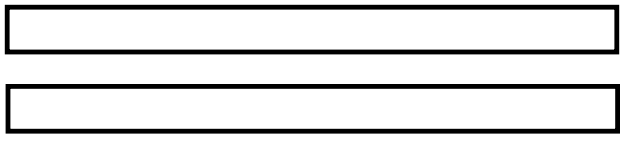
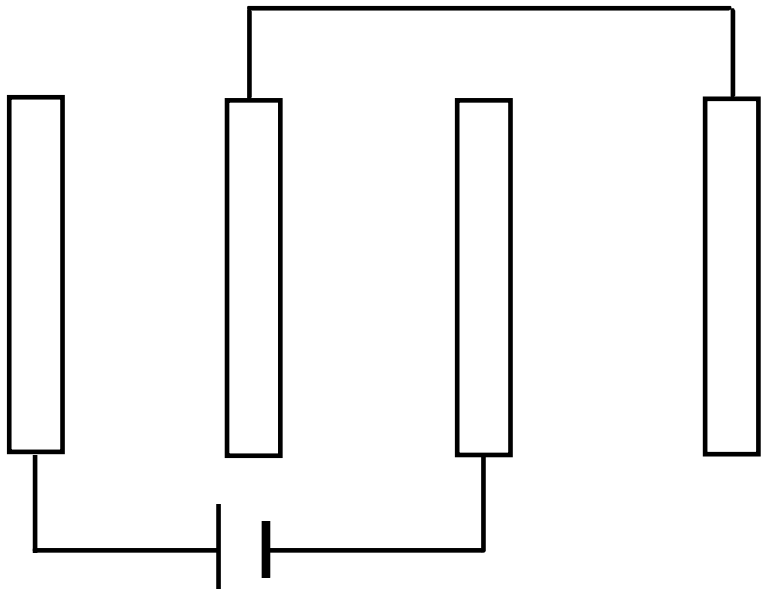
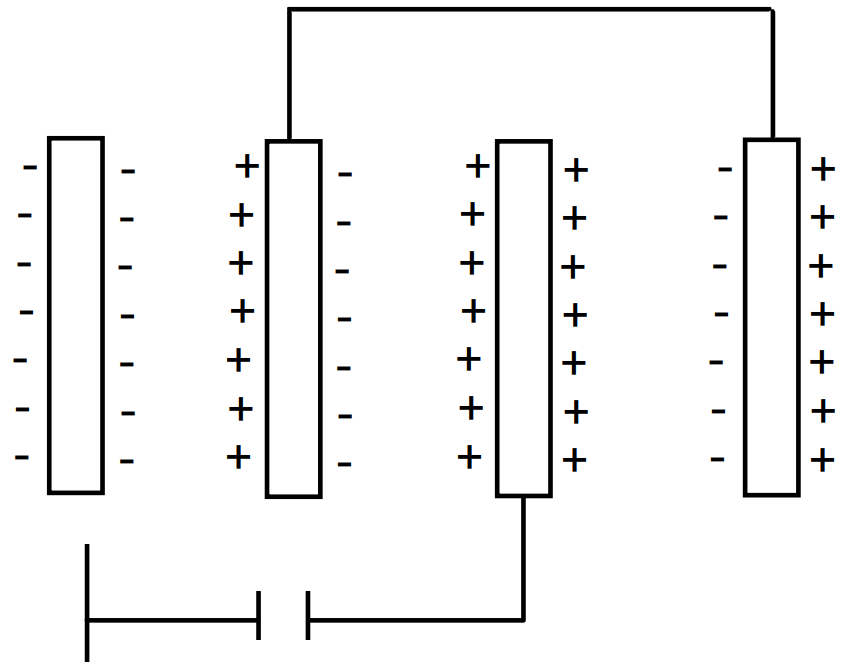
Each of the plates shown in figure has surface area $\Big(\frac{96}{\in_0}\Big)\times10^{-12}\text{Fm}$ on one side and the separation between the consecutive plates is 4.0mm. The emf of the battery connected is 10 volts. Find the magnitude of the charge supplied by the battery to each of the plates connected to it.
Answer


Here three capacitors are formed
And each of $\text{A}=\frac{96}{\in_0}\times10^{-12}\text{f.m.}$
$\text{d}=4\text{mm}=4\times10^{-3}\text{m}$
$\therefore$ Capacitance of a capacitor
$\text{C}=\frac{\in_0\text{A}}{\text{d}}=\frac{\in_0\frac{96\times10^{-12}}{\in_0}}{4\times10^{-3}}=24\times10^{-9}\text{F}$
$\therefore$ As three capacitor are arranged is series
So, $\text{C}_\text{eq}=\frac{\text{C}}{\text{q}}=\frac{24\times10^{-9}}{3}=8\times10^{-9}$
$\therefore$ The total charge to a capacitor $= 8 \times 10^{-9} \times 10 = 8 \times 10^{-8}c$
$\therefore$ The charge of a single Plate $= 2 \times 8 \times 10^{-8} = 16 \times 10^{-8} = 0.16 \times 10^{-6} = 0.16\mu c.$
View full question & answer
Question 113 Marks
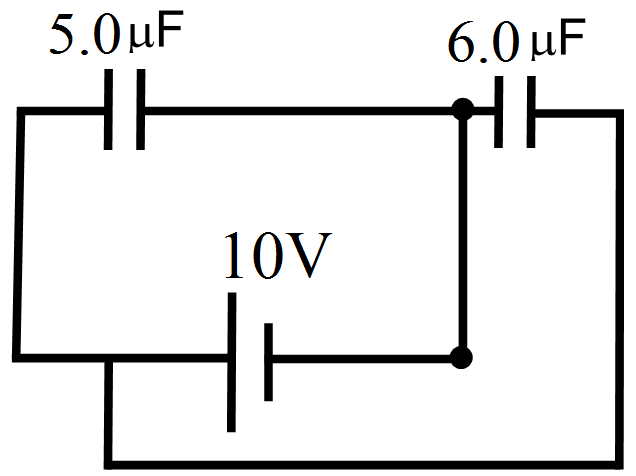
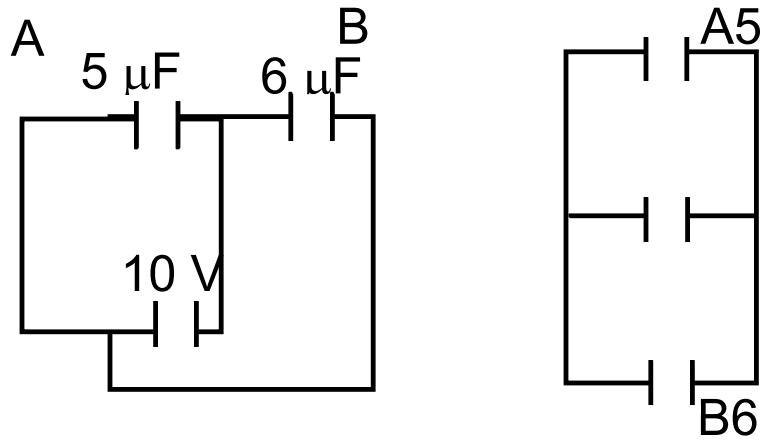
Find the charge supplied by the battery in the arrangement shown in figure.
Answer

$\text{V}=\text{10v}$
$\text{C}_{\text{eq}}=\text{C}_1+\text{C}_2$ $[\therefore$ They are parallel$]$
$=5+6=11\mu\text{F}$
$\text{q}=\text{CV}=11\times10=110\mu\text{C}$
View full question & answer
Question 123 Marks
When $1.0 \times 10^{12}$ electrons are transferred from one conductor to another, a potential difference of 10V appears between the conductors. Calculate the capacitance of the two-conductor system.
Answer
Given that
Number of electron $= 1 \times 10^{12}$
Net charge $Q = 1 \times 10^{12} \times 1.6 \times 10^{-19} = 1.6 \times 10^{-7}C$
$\therefore$ The net potential difference = 10L.
$\therefore$ Capacitance
$\text{C}=\frac{\text{q}}{\text{v}}$
$=\frac{1.6\times10^{-7}}{10}=1.6\times10^{-8}\text{F}.$
View full question & answer