Question
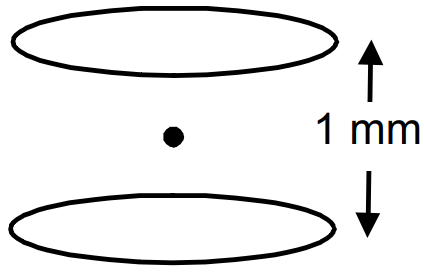
Suppose, one wishes to construct a 1.0 farad capacitor using circular discs. If the separation between the discs be kept at 1.0mm, what would be the radius of the discs?
Answer

Let the radius of the disc = R

$\therefore$ Area $=\pi\text{R}^2$
$\text{C}=1\text{f}$
$\text{D}=1\text{mm}=10^{-3}\text{m}$
$\therefore\text{C}=\frac{\in_0\text{A}}{\text{d}}$
$\Rightarrow1=\frac{8.85\times10^{-12}\times\pi\text{r}^2}{10^{-3}}$
$\Rightarrow\text{r}^2=\frac{10^{-3}\times10^{12}}{8.85\times\pi}=\frac{10^9}{27.784}$
$=5998.5\text{m}=6\text{Km}$

Need a full question paper?

Generate a complete, print-ready paper with questions like this in minutes — across 16+ boards, with answer keys.
Start Generating Free

Similar questions

The count rate from a radioactive sample falls from $4.0 \times 10^6$ per second to $1.0 \times 10^6$ per second in 20 hours. What will be the count rate 100 hours after the beginning?
A uniform wire of resistance $100\Omega$ is melted and recast as a wire of length is double that of the original. What would be the resistance of the wire?
A capacitor of capacitance $100\mu\text{F}$ is connected to a battery of 20 volts for a long time and then disconnected from it. It is now connected across a long solenoid having 4000 turns per metre. It is found that the potential difference across the capacitor drops to 90% of its maximum value in 2.0 seconds. Estimate the average magnetic field produced at the centre of the solenofd during this period.
$i$ . Using Bohr's second postulate of quantisation of orbital angular momentum show that the circumference of the electron in the nth orbital state in hydrogen atom is $n-$ times the de $-$ Broglie wavelength associated with it.
$ii$ . The electron in hydrogen atom is initially in the third excited state. What is the maximum number of spectral lines which can be emitted when it finally moves to the ground state?
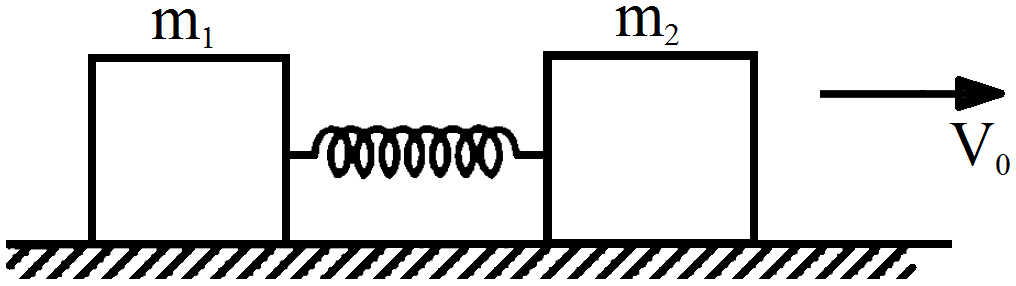
Two blocks of masses $m_1$ and $m_2$ are connected by a spring of spring constant k. The block of mass $m_2$ is given a sharp impulse so that it acquires a velocity $v_0$ towards right. Find
  1. The velocity of the centre of mass.
  2. The maximum elongation that the spring will suffer.
Suppose the circuit in Exercise 7.18 has a resistance of $15\Omega.$ Obtain the average power transferred to each element of the circuit, and the total power absorbed
A 660Hz tuning fork sets up vibration in a string clamped at both ends. The wave speed for a transverse wave on this string is 220m/s and the string vibrates in three loops.
  1. Find the length of the string.
  2. If the maximum amplitude of a particle is 0.5cm, write a suitable equation describing the motion.
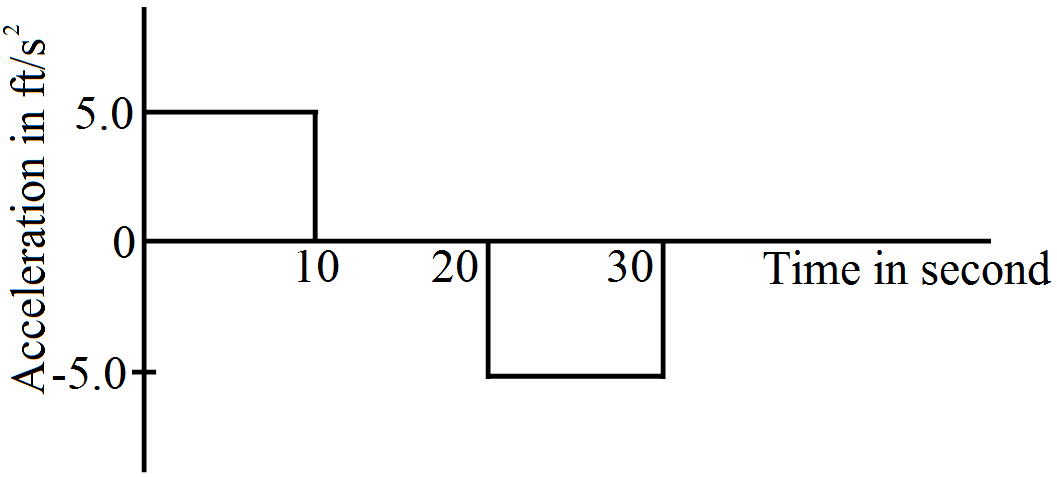
The acceleration of a cart started at t = 0, varies with time as shown in figure. Find the distance travelled in 30 seconds and draw the position-time graph.
  1. Draw a labelled ray diagram showing the formation of a final image by a compound microscope at least distance of distinct vision.
  2. The total magnification produced by a compound microscope is 20. The magnification produced by the eye piece is 5. The microscope is focussed on a-certain object. The distance between the objective and eyepiece is observed to be 14 cm. If least distance of distinct vision is 20 cm, calculate the focal length of the objective and the eye piece.
A parallel-plate capacitor with plate area $20cm^2$ and plate separation 1.0mm is connected to a battery. The resistance of the circuit is $10\text{k}\Omega.$ Find the time constant of the circuit.