Questions

M.C.Q (1 Marks)

Take a timed test

16 questions · auto-graded multiple-choice test.

MCQ 11 Mark
Two metal spheres of capacitances $C_1$ and $C_2$ carry some charges. They are put in contact and then separated. The final charges $Q_1$ and $Q_2$ on them will satisfy:
  • A
    $\frac{\text{Q}_1}{\text{Q}_2}<\frac{\text{C}_1}{\text{C}_2}$
  • $\frac{\text{Q}_1}{\text{Q}_2}=\frac{\text{C}_1}{\text{C}_2}$
  • C
    $\frac{\text{Q}_1}{\text{Q}_2}>\frac{\text{C}_1}{\text{C}_2}$
  • D
    $\frac{\text{Q}_1}{\text{Q}_2}=\frac{\text{C}_2}{\text{C}_1}$
Answer
Correct option: B.
$\frac{\text{Q}_1}{\text{Q}_2}=\frac{\text{C}_1}{\text{C}_2}$
When the spheres are connected, charges flow between them until they both acquire the same common potential $V.$
The final charges on the spheres are given by:
$\mathrm{Q}_1=\mathrm{C}_1 \mathrm{~V}$ and $\mathrm{Q}_2=\mathrm{C}_2 \mathrm{~V}$
$\therefore\frac{\text{Q}_1}{\text{Q}_2}=\frac{\text{C}_1\text{V}}{\text{C}_2\text{V}}=\frac{\text{C}_1}{\text{C}_2}$
View full question & answer
MCQ 21 Mark
If the capacitors in the previous question are joined in parallel, the capacitance and the breakdown voltage of the combination will be :
  • A
    $2C$ and $2V$
  • B
    $C$ and $2V$
  • $2C$ and $V$
     
  • D
    $C$ and $V$
Answer
Correct option: C.
$2C$ and $V$
 
In a parallel combination of capacitors, the potential difference across the capacitors remain the same, as the right $-$ hand $-$ side plates and the left $-$ hand $-$ side plates of both the capacitors are connected to the same terminals of the battery.
Therefore, the potential remains the same, that is, $V$.
For the parallel combination of capacitors, the capacitance is given by
$C_{e q}=C_1+C_2$
Here $, C_1=C_2=C $
$\therefore C_{\text {eq }}=2 C$
View full question & answer
MCQ 31 Mark
A parallel $-$ plate capacitor has plates of unequal area. The larger plate is connected to the positive terminal of the battery and the smaller plate to its negative terminal. Let $Q_+$ and $Q_-$ be the charges appearing on the positive and negative plates respectively :
  • A
    $ Q_{+}>Q_{-} $
  • $ Q_{+}=Q_{-}$
  • C
    $Q_{+}$
  • D
    The information is not sufficient to decide the relation between $ Q_{+}$ and $ Q_{\text {-. }}$
Answer
Correct option: B.
$ Q_{+}=Q_{-}$
The charge induced on the plates of a capacitor is independent of the area of the plates.
$\therefore Q_{+}=Q_{-}$
View full question & answer
MCQ 41 Mark
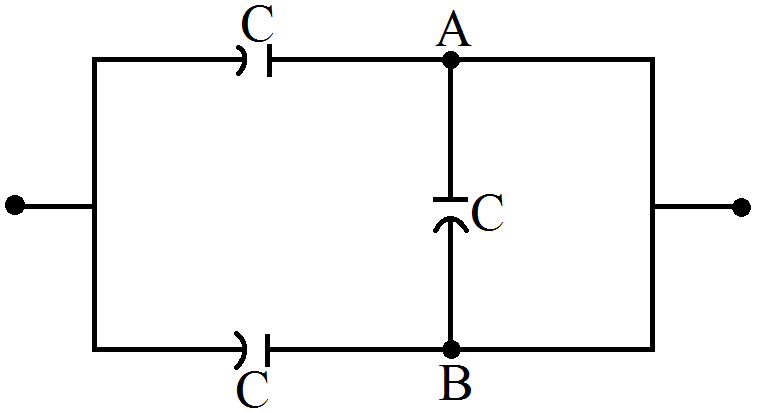
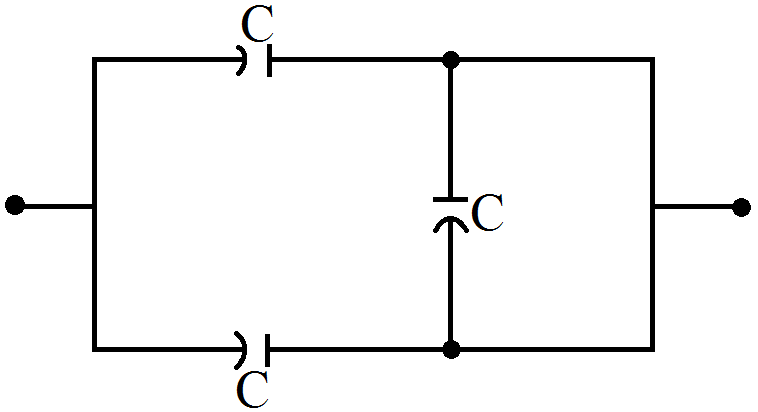
The equivalent capacitance of the combination shown in figure is:
  • A
    $C$
  • $2C$
  • C
    $\frac{\text{C}}{2}$
  • D
    None of these.
Answer
Correct option: B.
$2C$

Since the potential at point $A$ is equal to the potential at point $B,$ no current will flow along arm $AB$.
Hence, the capacitor on arm $AB$ will not contribute to the circuit.
Also, because the remaining two capacitors are connected in parallel, the net capacitance of the circuit is given by
$C_{eq}= C + C = 2C$
View full question & answer
MCQ 51 Mark
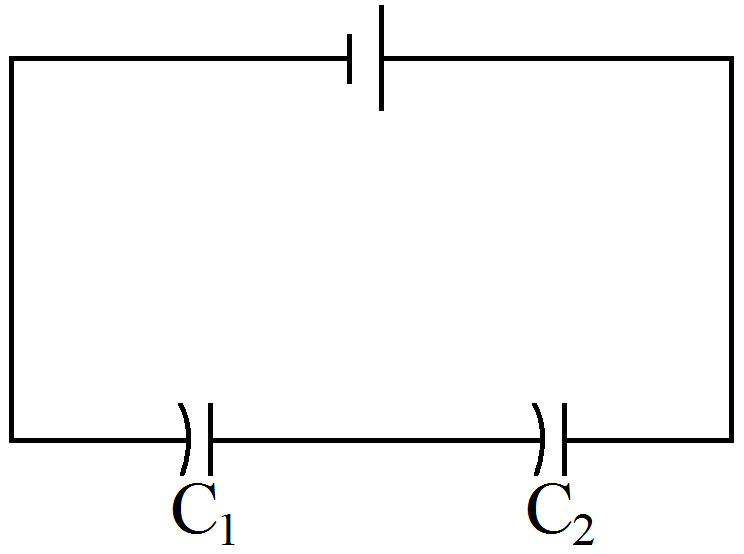
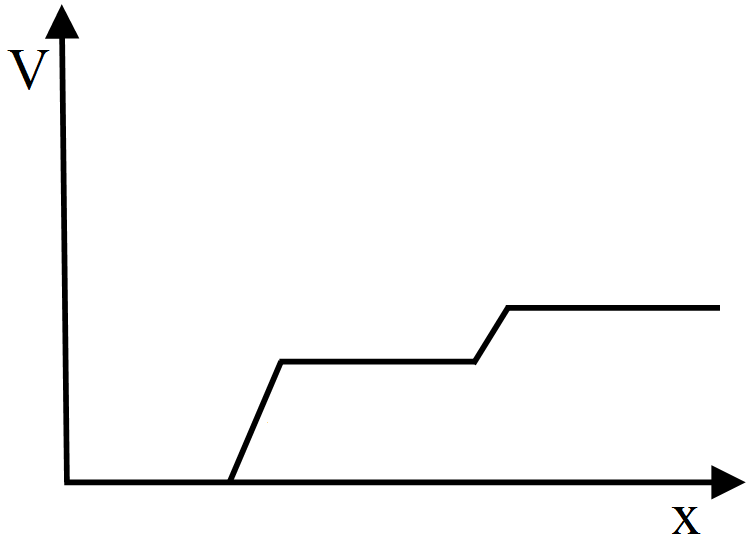
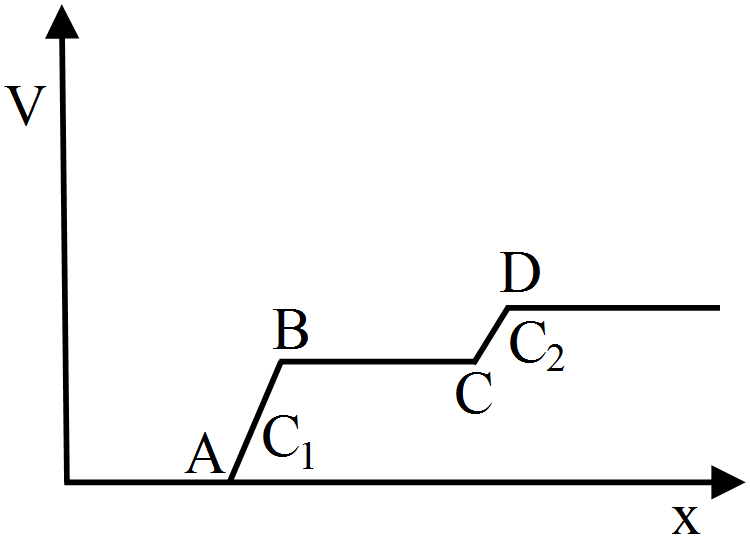
Figure shows two capacitors connected in series and joined to a battery. The graph shows the variation in potential as one moves from left to right on the branch containing the capacitors :

  • A
    $C_1 > C_2$
  • B
    $\mathrm{C}_1=\mathrm{C}_2$
  • $C_1 < C_2$
  • D
    The information is not sufficient to decide the relation between $C_1$ and $C_2$.
Answer
Correct option: C.
$C_1 < C_2$

Region $A B$ shows the potential difference across capacitor $C_1$ and region $C D$ shows the potential difference across capacitor $\mathrm{C}_2$.
​​​​​​​Now, we can see from the graph that region $A B$ is greater than region $C D$.
Therefore, the potential difference across capacitor $C_1$ is greater than that across capacitor $C_2$.
$\because$ Capacitance, $\text{C}=\frac{\text{Q}}{\text{V}}$
$\therefore\text{C}_1<\text{C}_2 \ (Q$ remains the same in series connection$)$.
View full question & answer
MCQ 61 Mark
A dielectric slab is inserted between the plates of an isolated charged capacitor. Which of the following quantities will remain the same?
  • A
    The electric field in the capacitor.
  • The charge on the capacitor.
  • C
    The potential difference between the plates.
  • D
    The stored energy in the capacitor.
Answer
Correct option: B.
The charge on the capacitor.
Explanation:
When we insert a dielectric between the plates of a capacitor, induced charges of opposite polarity appear on the face of the dielectric. They build an electric field inside the dielectric, directed opposite to the original field of the capacitor.
Thus, the net effect is a reduced electric field.
Also, as the potential is proportional to the field, the potential decreases and so does the stored energy U, which is given by
$\text{U}=\frac{\text{qV}}{2}$
Thus, only the charge on the capacitor remains unchanged, as the charge is conserved in an isolated system.
View full question & answer
MCQ 71 Mark
A dielectric slab is inserted between the plates of an isolated capacitor. The force between the plates will:
  • A
    Increase.
  • B
    Decrease.
  • Remain unchanged.
  • D
    Become zero.
Answer
Correct option: C.
Remain unchanged.
Explanation:
The force between the plates is given by
$\text{F}=\frac{\text{q}^2}{2\in_0\text{A}}$
Since the capacitor is isolated, the charge on the plates remains constant.
We know that the charge is conserved in an isolated system.
Thus, the force acting between the plates remains unchanged.
View full question & answer
MCQ 81 Mark
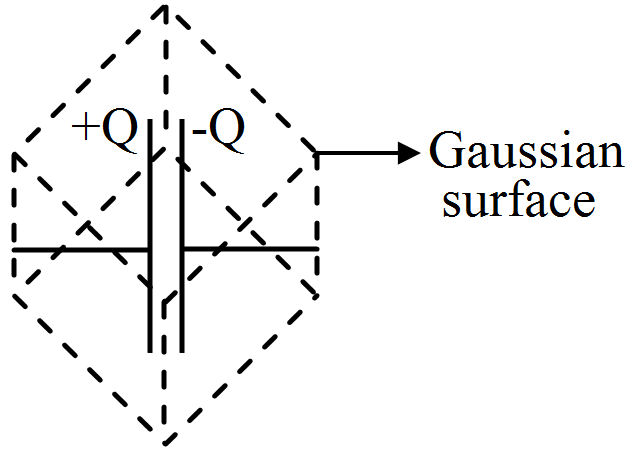
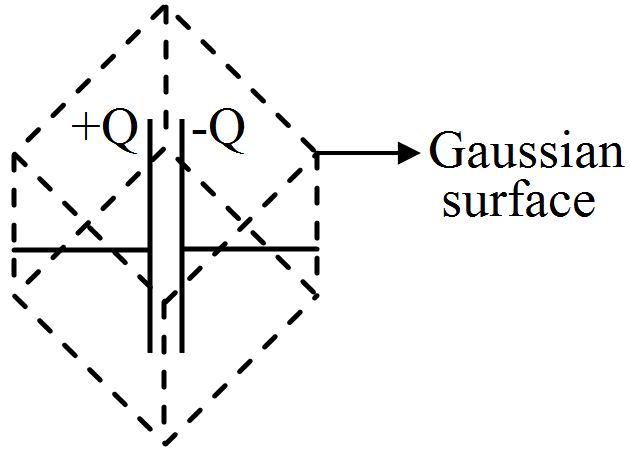
A capacitor of capacitance C is charged to a potential V. The flux of the electric field through a closed surface enclosing the capacitor is:
  • A
    $\frac{\text{CV}}{\in_0}$
  • B
    $\frac{\text{2CV}}{\in_0}$
  • C
    $\frac{\text{CV}}{2\in_0}$
  • $\text{Zero}.$
Answer
Correct option: D.
$\text{Zero}.$
Explanation:

Since the net charge enclosed by the Gaussian surface is zero, the total flux of the electric field through the closed Gaussian surface enclosing the capacitor is zero.
$\phi=\oint\text{E.ds}=\frac{\text{q}}{\in_0}=0$
Here,
$\phi=$ Electric flux
q = Total charge enclosed by the Gaussian surface.
View full question & answer
MCQ 91 Mark
Two capacitors each having capacitance $C$ and breakdown voltage $V$ are joined in series. The capacitance and the breakdown voltage of the combination will be :
  • A
    $\text{2C}\ \text{and}\ \text{2V}$
  • B
    $\frac{\text{C}}{2}\ \text{and}\ \frac{\text{V}}{2}$
  • C
    $\text{2C}\ \text{and}\ \frac{\text{V}}{2}$
  • $\frac{\text{C}}{2}\ \text{and}\ \text{2V}$
Answer
Correct option: D.
$\frac{\text{C}}{2}\ \text{and}\ \text{2V}$
Since the voltage gets added up when the capacitors are connected in series, the voltage of the combination is $2V$.
Also, the capacitance of a series combination is given by
$\frac{1}{\text{C}_{\text{net}}}=\frac{1}{\text{C}_1}+\frac{1}{\text{C}_2}$
Here,
$C_\text{net}=$ Net capacitance of the combination
$\text{C}_1=\text{C}_2=\text{C}$
$\therefore\text{C}_{\text{net}}=\frac{\text{C}}{2}$
View full question & answer
MCQ 101 Mark
Three capacitors of capacitances $6\mu\text{F}$ each are available. The minimum and maximum capacitances, which may be obtained are:
  • A
    $6\mu\text{F},\ 18\mu\text{F}$
  • B
    $3\mu\text{F},\ 12\mu\text{F}$
  • C
    $2\mu\text{F},\ 12\mu\text{F}$
  • $2\mu\text{F},\ 18\mu\text{F}$
Answer
Correct option: D.
$2\mu\text{F},\ 18\mu\text{F}$
Explanation:
The minimum capacitance can be obtained by connecting all capacitors in series. It can be calculated as follows:
$\frac{1}{\text{C}}=\frac{1}{6}+\frac{1}{6}+\frac{1}{6}=\frac{1}{2}$
$\Rightarrow\text{C}=2\mu\text{F}$
The maximum capacitance can be obtained by connecting all capacitors in parallel. It can be calculated as follows:
$\text{C}=6+6+6=18\mu\text{F}$
View full question & answer
MCQ 111 Mark
A parallel-plate capacitor is connected to a battery. A metal sheet of negligible thickness is placed between the plates. The sheet remains parallel to the plates of the capacitor:
  • A
    The battery will supply more charge.
  • B
    The capacitance will increase.
  • C
    The potential difference between the plates will increase.
  • Equal and opposite charges will appear on the two faces of the metal plate.
Answer
Correct option: D.
Equal and opposite charges will appear on the two faces of the metal plate.
Explanation:
The capacitance of the capacitor in which a dielectric slab of dielectric constant K, area A and thickness t is inserted between the plates of the capacitor of area A and separated by a distance d is given by:
$\text{C}=\frac{\in_0\text{A}}{(\text{d}-\text{t})+\big(\frac{\text{t}}{\text{K}}\big)}$
Since it is given that the thickness of the sheet is negligible, the above formula reduces to $\text{C}=\frac{\in_0\text{A}}{\text{d}}.$ In other words, there will not be any change in the electric field, potential or charge.
Only, equal and opposite charges will appear on the two faces of the metal plate because of induction due to the presence of the charges on the plates of the capacitor.
View full question & answer
MCQ 121 Mark
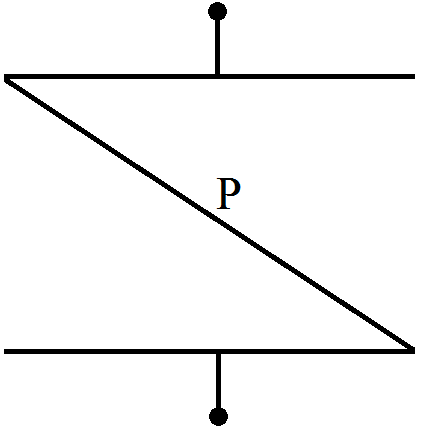
A thin metal plate P is inserted between the plates of a parallel-plate capacitor of capacitance C in such a way that its edges touch the two plates (figure). The capacitance now becomes:
  • A
    $\frac{\text{C}}{2}$
  • B
    2C
  • C
    0
  • Indeterminate.
Answer
Correct option: D.
Indeterminate.
Explanation:
The thin metal plate inserted between the plates of a parallel-plate capacitor of capacitance C connects the two plates of the capacitor; hence, the distance d between the plates of the capacitor reduces to zero. It can be observed that the charges on the plates begin to overlap each other via the metallic plate and hence begin to conduct continuously.
Mathematically,
$\text{C}=\frac{\in_0\text{A}}{\text{d}}$
In this case, d = 0.
$\therefore\text{C}=\infty$
View full question & answer
MCQ 131 Mark
The energy density in the electric field created by a point charge falls off with the distance from the point charge as:
  • A
    $\frac{1}{\text{r}}$
  • B
    $\frac{1}{\text{r}^2}$
  • C
    $\frac{1}{\text{r}^3}$
  • $\frac{1}{\text{r}^4}$
Answer
Correct option: D.
$\frac{1}{\text{r}^4}$
Explanation:
Energy density U is given by
$\text{U}=\frac{1}{2}\in_0\text{E}^2\ \dots(1)$
The electric field created by a point charge at a distance r is given by
$\text{E}=\frac{\text{q}}{4\pi\in_0\text{r}^2}$
On putting the above form of E in eq. 1, we get
$\text{U}=\frac{1}{2}\in_0\Big(\frac{\text{q}}{4\pi\in_0\text{r}^2}\Big)^2$
Thus, U is directly proportional to $\frac{1}{\text{r}^4}.$
View full question & answer
MCQ 141 Mark
Two metal plates having charges Q, -Q face each other at some separation and are dipped into an oil tank. If the oil is pumped out, the electric field between the plates will:
  • Increase.
  • B
    Decrease.
  • C
    Remain the same.
  • D
    Become zero.
Answer
Correct option: A.
Increase.
Explanation:
Oil between the plates of the capacitor acts as a dielectric. We know that the electric field decreases by a factor of $\frac{1}{\text{K}}$ of the original field when we insert a dielectric between the plates of a capacitor (K is the dielectric constant of the dielectric). So, if the oil is pumped out, the electric field between the plates will increase, as the dielectric has been removed.
View full question & answer
MCQ 151 Mark
The capacitance of a capacitor does not depend on:
  • A
    The shape of the plates.
  • B
    The size of the plates.
  • The charges on the plates.
  • D
    The separation between the plates.
Answer
Correct option: C.
The charges on the plates.
Explanation:
The capacitance of a capacitor is given by:
$\text{C}=\frac{\in_0\text{A}}{\text{d}}$
Here, A is the area of the plates of the capacitor and d is the distance between the plates.
So, we can clearly see that the capacitance of a capacitor does depend on the size and shape of the plates and the separation between the plates; it does not depend on the charges on the plates.
View full question & answer
MCQ 161 Mark
A dielectric slab is inserted between the plates of a capacitor. The charge on the capacitor is Q and the magnitude of the induced charge on each surface of the dielectric is Q':
  • A
    Q' may be larger than Q.
  • B
    Q' must be larger than Q.
  • C
    Q' must be equal to Q.
  • Q' must be smaller than Q.
Answer
Correct option: D.
Q' must be smaller than Q.
Explanation:
The relation between the induced charge Q' and the charge on the capacitor Q is given by:
$\text{Q}'=\text{Q}\Big(1-\frac{1}{\text{K}}\Big)$
Here, K is the dielectric constant that is always greater than or equal to 1.
So, we can see that for K > 1, Q' will always be less than Q.
View full question & answer