Questions

4 Marks Questions

Take a timed test

4 questions · self-marked practice — reveal the answer and mark yourself.

Question 14 Marks
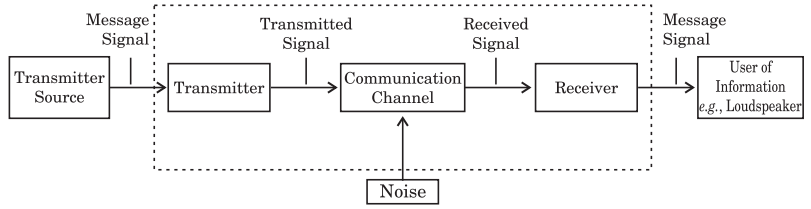
Draw a block diagram of a generalized communication system. Write the functions of each of the following:
(a) Transmitter, (b) Channel, (c) Receiver.
Answer
Communication System : A communication system transmits information from source, located at the point, to a receiver located at another place. Modern communication system consists of the following three segments: (a) Transmitter, (b) Channel, (c) Receiver.
Its block diagram is shown in the following figure :
Image
(1) Transmitter : It is a set up which first converts the message signal produced by the information source into suitable form. After this the form is modulated with radio frequency carrier waves and then amplified by an amplifier. At last these amplified signals are transmitted in the form of electromagnetic waves by an antenna attached with the transmitter.
(2) Communication channel or transmission medium : It is a physical path or medium through which transmitted modulated waves reaches the antenna of the receiver. It may be a transmission wire, free space or optical fibre.
(3) Receiver : It is a setup which first receives the transmitted signals from communication channel and then converts them back to their original form. This process is called demodulation or detection which is the reverse process of modulation process used at transmitter. This original signal is amplified by an amplifier and then transmitted to the loudspeaker which converts the signal into the information as sound waves.
During the propagation of information signal through communication channel some undesired signals called noise superimpose on the signal. Thus the signal received by the receiver is in its distorted form.

View full question & answer
Question 24 Marks
What are signals ? What do you mean by analog and digital signals ?
Answer
Signal : "The information or message converted into an electrical signal by transducer is called signal," i.e. a signal is a single valued function of time that conveys the information and which at every instant of time takes a unique value.
These are of following two types :
(i) Analog Signals : A signal in which current or voltage varies continuously with time is called analog signal.
The electronic circuits which process analog signals are called analog circuits.
A sinusoidally varying alternating voltage is the simple analog signal. An avometer (ampere-volt-ohm metre) is an analog device. When a current, voltage or a resistance is measured by it, its pointer moves gradually and continuously over a scale. The devices like amplifiers, radio, television, oscillators, etc. also make use of analog signal.
(ii) Digital Signals : A signal in which current or voltage can take only two discrete values is called a digital signal. A digital signal can take only two values 1 and 0 which are labelled as high and low values. These are in the form of pulse of equal level. The electric circuits which process digital signals are called digital circuits.
A digital multimeter is a digital device. When a current, voltage or a resistance is measured by it, the number displayed by the multimeter increase in small discrete steps. The device like pocket calculators, electronic watches, video cassette recorders, burglar alarms, robots, modern computers etc are all digital circuits.
View full question & answer
Question 34 Marks
What are different kinds of modulation ? Explain.
Answer
Kinds of modulation: The sinusoidal carrier wave can be expressed as: $e_c= E _c \sin \left(w_c t+\theta\right)$.
The three distinct characteristics of this wave are :
(i) Amplitude (Ec), (ii) Angular frequency $\left(\omega_c\right)$ and (iii) Phase angle $(\phi)$.
Either of these three characteristics can be varied in accordance with audio signal i.e. base band signal. Hence accordingly there are three possible types of modulation as given below :
(1) Amplitude Modulation (A.M.)
(2) Frequency Modulation (F.M.)
(3) Phase Modulation (P.M.)
(1) Amplitude Modulation :
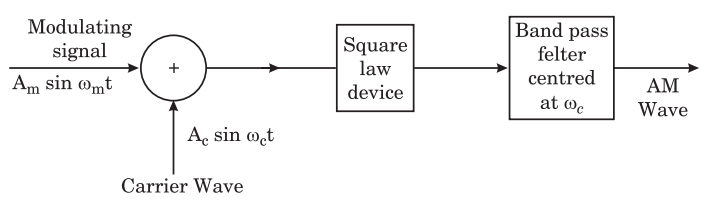
The process of modulation in which modulating wave is superimposed on a carrier wave in such a manner that the frequency of the modulated wave is the same as that of the carrier wave but its amplitude is modified in accordance with that of the modulated wave is called amplitude modulation.
Image
(2) Frequency Modulation : "The process of modulation in which the modulating wave is superimposed on a high frequency carrier wave in such a manner that the frequency of carrier wave varies by the instantaneous value of the frequency of modulating wave while the remaining two parameters viz., amplitude and phase of the carrier wave remain constant, is called frequency modulation."
In this modulation carrier waves of frequency between 80 MHz and 200 MHz are used.
(3) Phase Modulation : When the modulating wave
is superimposed with carrier wave in such a manner that the phase of modulated wave is a linear function of modulating wave signal Em, the modulation is called pulse modulation. In this process the amplitude and frequency of modulated wave is the same as that of carrier wave.

View full question & answer
Question 44 Marks
In how many bands the full range of radiowaves can be divided ? Describe about all the bands in brief.
Answer
In radio communication free space acts as a transmission medium. Since radio-waves have a very wide frequency range from a few kHz to a few GHz, hence this frequency range is further subdivided into seven bands. Brief description of these bands is given in following table :
Band Category Symbol Frequency range Wavelength range
1. Very low Frequency VLF 3 - 30 kHz 105 - 104 m
2. Low Frequency LF 30 - 300 kHz 104 - 103 m
3. Medium Frequency MF 300 - 3000 kHz 103 - 100 m
4. High Frequency HF 3 - 30 MHz 100 - 10 m
5. Very High Frequency VHF 30 - 300 kHz 10 m - 1m
6. Ultra High Frequency UHF 300 - 3000 MHz 100 - 10 cm
7. Supper High Frequency SHF 3000 - 3000 MHz 10 cm - 1 m
View full question & answer