Question
What are different kinds of modulation ? Explain.

Answer

Kinds of modulation: The sinusoidal carrier wave can be expressed as: $e_c= E _c \sin \left(w_c t+\theta\right)$.
The three distinct characteristics of this wave are :
(i) Amplitude (Ec), (ii) Angular frequency $\left(\omega_c\right)$ and (iii) Phase angle $(\phi)$.
Either of these three characteristics can be varied in accordance with audio signal i.e. base band signal. Hence accordingly there are three possible types of modulation as given below :
(1) Amplitude Modulation (A.M.)
(2) Frequency Modulation (F.M.)
(3) Phase Modulation (P.M.)
(1) Amplitude Modulation :
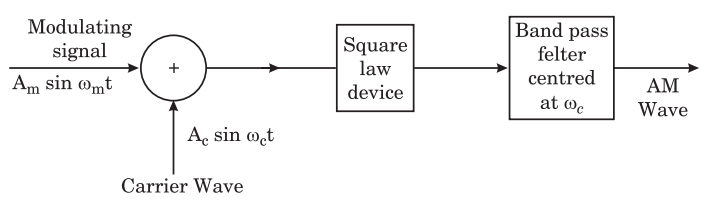
The process of modulation in which modulating wave is superimposed on a carrier wave in such a manner that the frequency of the modulated wave is the same as that of the carrier wave but its amplitude is modified in accordance with that of the modulated wave is called amplitude modulation.
Image
(2) Frequency Modulation : "The process of modulation in which the modulating wave is superimposed on a high frequency carrier wave in such a manner that the frequency of carrier wave varies by the instantaneous value of the frequency of modulating wave while the remaining two parameters viz., amplitude and phase of the carrier wave remain constant, is called frequency modulation."
In this modulation carrier waves of frequency between 80 MHz and 200 MHz are used.
(3) Phase Modulation : When the modulating wave
is superimposed with carrier wave in such a manner that the phase of modulated wave is a linear function of modulating wave signal Em, the modulation is called pulse modulation. In this process the amplitude and frequency of modulated wave is the same as that of carrier wave.

Need a full question paper?

Generate a complete, print-ready paper with questions like this in minutes — across 16+ boards, with answer keys.
Start Generating Free

Similar questions

Derive the formula for the magnetic field produced at a point on the axis of a current carrying circular loop.
A collision experiment is done on a horizontal table kept in an elevator. Do you expect a change in the results if the elevator is accelerated up or down because of the noninertial character of the frame?
A car starts from rest on a half kilometer long bridge. The coefficient of friction between the tyre and the road is $1.0$. Show that one cannot drive through the bridge in less than $10s.$
 For the past some time, Aarti had been observing some erratic body movement, unsteadiness and lack of coordination in the activities of her sister Radha, who also used to complain of severe headache occasionally. Aarti suggested to her parents to get a medical check-up of Radha. The doctor thoroughly examined Radha and diagnosed that she has a brain tumour.
  1. What, according to you, are the values displayed by Aarti?
  2. How can radioisotopes help a doctor to diagnose brain tumour? 
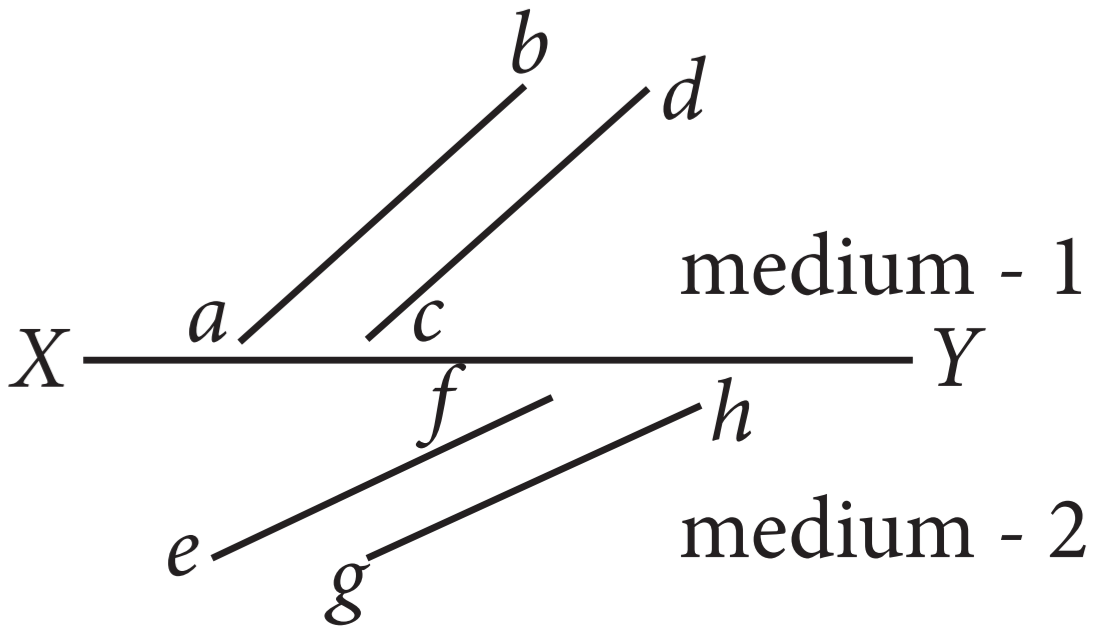
Wavefront is a locus of points which vibratic in same phase. A ray of light is perpendicular to the wavefront. According to Huygens principle, each point of the wavefront is the source of a secondary disturbance and the wavelets connecting from these points spread out in all directions with the speed of wave.
The figure shows a surface XY separating two transparent media, medium-I and medium-2. The lines ab and cd represent wavefronts of a light wave travelling in medium- 1 and incident on XY. The lines ef and gh represent wavefronts of the light wave in medium-2 after refraction.
  1. Light travels as a:
  1. Parallel beam in each medium.
  2. Convergent beam in each medium.
  3. Divergent beam in each medium.
  4. Divergent beam in one medium and convergent beam in the other medium.
  1. The phases of the light wave at c, d, e and f are $\phi_\text{c},\phi_\text{d},\phi_\text{e}$ and $\phi_\text{f}$ respectively. It is given that $\phi_\text{c}\not=\phi_\text{f}$
  1. $\phi_\text{c}$ cannot be equal $\phi_\text{d}$
  2. $\phi_\text{d}$ cannot be equal $\phi_\text{e}$
  3. $(\phi_\text{d}-\phi_\text{f})$ is equal to $(\phi_\text{c}-\phi_\text{e})$
  4. $(\phi_\text{d}-\phi_\text{c})$ is not equal to $(\phi_\text{f}-\phi_\text{e})$
  1. Wavefront is the locus of all points, where the particles of the medium vibrate with the same.
  1. Phase
  2. Amplitude
  3. Frequency
  4. Period
  1. A point source that emits waves uniformly in all directions, produces wavefronts that are:
  1. Spherical
  2. Elliptical
  3. Cylindrical
  4. Planar
  1. What are the types of wavefronts?
  1. Spherical
  2. Cylindrical
  3. Plane
  4. All of these.
Currents can be induced not only in conducting coils, but also in conducting sheets or blocks. Current is induced in solid metallic masses when the magnetic flux threading through them changes. Such currents flow in the from of irregularly shaped loops throughout the body of the metal. These currents look like eddies or whirlpools in water so they are known as eddy currents. Eddy currents have both undesirable effects and practically useful applications. For example it causes unnecessary heating and wastage of power in electric motors, dynamos and in the cores of transformers.
  1. The working of speedometers of trains is based on:
  1. Wattless currents.
  2. Eddy currents.
  3. alternating currents.
  4. pulsating currents.
  1. Identify the wrong statement.
  1. Eddy currents are produced in a steady magnetic field.
  2. Induction furnace uses eddy currents to produce heat.
  3. Eddy currents can be used to produce braking force in moving trains.
  4. Power meters work on the principle of eddy currents.
  1. Which of the following is the best method to reduce eddy currents?
  1. Laminating core.
  2. Using thick wires.
  3. By reducing hysteresis loss.
  4. None of these.
  1. The direction of eddy currents is given by:
  1. Fleming's left hand rule.
  2. Biot-Savart law.
  3. Lenz's law
  4. Ampere-circuital law.
  1. Eddy currents can be used to heat localised tissues of the human body. This branch of medical therapy is called:
  1. Hyperthermia.
  2. Diathermy.
  3. Inductothermy.
  4. None of these.
A $4.0\ kg$ block is suspended from the ceiling of an elevator through a, string having a linear mass density of $19.2 \times 10^{-3}kg/m.$ Find the speed $($with respect to the string$)$ with which a wave pulse can proceed on the string if the elevator accelerates up at the rate of $2.0m/s^2$. Take $g = 10m/s^2.$
In one of the exercises to strengthen the wrist and fingers, a person squeezes and releases a soft rubber ball. Is the work done on the ball positive, negative or zero during compression? During expansion?
A short magnet makes $40$ oscillations per minute when used in an oscillation magnetometer at a place where the earth's horizontal magnetic field is $2\mu\text{T.}$ Another short magnet of magnetic moment $1.6A-m^2$ is placed $20\ cm$ east of the oscillating magnet. Find the new frequency of oscillation if the magnet has its north pole:
  1. Towards north.
  2. Towards south.
Refer to the previous problem. Suppose, the goldsmith argues that he has not mixed copper or any other material with gold, rather some cavities might have been left inside the ornament. Calculate the volume of the cavities left that will allow the weights given in that problem.