Questions · Page 1 of 2

1 Marks Question

🎯

Test yourself on this topic

50 questions · timed · auto-graded

Question 11 Mark
Answer the following questions:
Is Ohm’s law universally applicable for all conducting elements? If not, give examples of elements which do not obey Ohm’s law.
Answer
No, Ohm's law is not universally applicable for all conducting elements. Vacuum diode semi-conductor is a non-ohmic conductor. Ohm's law is not valid for it.
View full question & answer
Question 21 Mark
Choose the correct alternative: The resistivity of a typical insulator $($e.g., amber$)$ is greater than that of a metal by a factor of the order of $(10^{22}/10^3).$
Answer
The resistivity of a typical insulator is greater than that of a metal by a factor of the order of $10^{22}.$
View full question & answer
Question 31 Mark
Choose the correct alternative:
The resistivity of the alloy manganin is nearly independent of/ increases rapidly with increase of temperature.
Answer
The resistivity of the alloy, manganin, is nearly independent of increase of temperature.
View full question & answer
Question 41 Mark
Choose the correct alternative:
Alloys of metals usually have (greater/ less) resistivity than that of their constituent metals.
Answer
Alloys of metals usually have greater resistivity than that of their constituent metals.
View full question & answer
Question 51 Mark
Choose the correct alternative:
Alloys usually have much (lower/ higher) temperature coefficients of resistance than pure metals.
Answer
Alloys usually have lower temperature coefficients of resistance than pure metals.
View full question & answer
Question 61 Mark
The resistance of the platinum wire of a platinum resistance thermometer at the ice point is $5 \Omega$ and at steam point is $5.23 \Omega$. When the thermometer is inserted in a hot bath, the resistance of the platinum wire is $5.795 \Omega$. Calculate the temperature of the bath.
Answer
$R_0=5 \Omega, R_{100}=5.23 \Omega$ and $R_t=5.795 \Omega$
Now,
$t=\frac{R_t-R_0}{R_{100}-R_0} \times 100, R_t=R_0(1+\alpha t)$
$=\frac{5.795-5}{5.23-5} \times 100$
$=\frac{0.795}{0.23} \times 100$
$=345.65^{\circ} C$
View full question & answer
Question 71 Mark
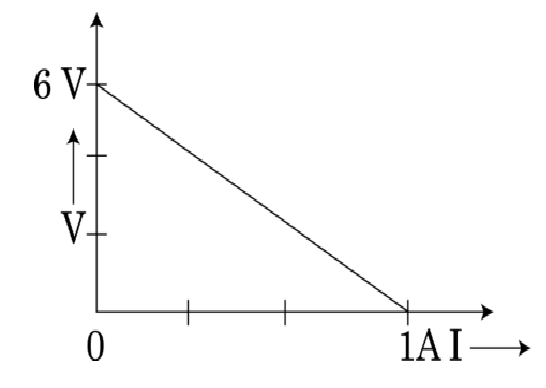
The plot of the variation of potential different across a combination of three identical cells in series, versus current is shown below. What is the emf and internal resistance of each cell?
Answer
E = 2V
$\text{r}= 2 \Omega$.
View full question & answer
Question 81 Mark
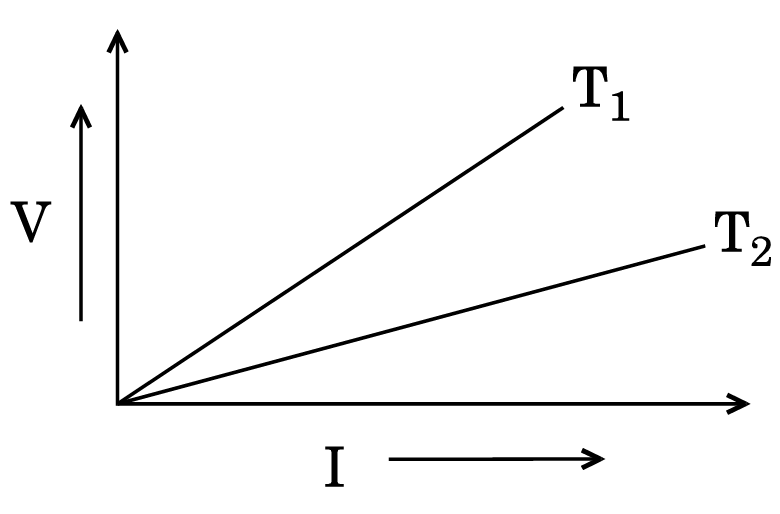
$V – I$ graph for a metallic wire at two different temperatures $T_1$ and $T_2$ is as shown in the figure. Which of the two temperatures is higher and why?
Answer
$T_1 > T_{2 }$ Slope of $T_1$ is higher than that of $T_2. ($or Resistance, at $T_1,$ is higher than that of $T_2).$
View full question & answer
Question 91 Mark
Nichrome and copper wires of same length and same radius are connected in series. Current I is passed through them. Which wire gets heated up more? Justify your answer.
Answer
  1. Nichrome
  2. RNi > RCu (or ResistivityNi > ResistivityCu)
View full question & answer
Question 101 Mark
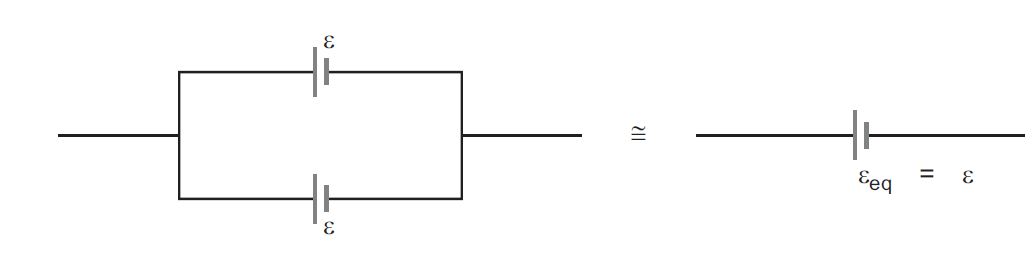
Two identical cells, each of emf $E,$ having negligible internal resistance, are connected in parallel with each other across an external resistance $R.$ What is the current through this resistance?
Answer
Current, $\text{I} = \frac{\text{E}}{\text{R}}$ Concept:
  1. emf of combination of two $($or more cells$)$ remain same.
  1. Internal resistance is negligible i.e., zero.
So, $\text{I} = \frac{\varepsilon_{eq}}{\text{R} + \text{r}_{eq}} = \frac{\varepsilon}{\text{R}}$
$(r_{eq} = 0).$
View full question & answer
Question 111 Mark
Two wires of equal length, one of copper and the other of manganin have the same resistance. Which wire is thicker?
Answer
Manganin.
View full question & answer
Question 121 Mark
Two conducting wires X and Y of same diameter but different materials are joined in series across a battery. If the number density of electrons in X is twice that in Y, find the ratio of drift velocity of electrons in the two wires.
Answer
$\text{I} = \text{n}_{x}\text{eAv}_{x} = \text{n}_{y}\text{eAv}_{y}$
$\Rightarrow\frac{\text{v}_{X}}{\text{v}_{Y}} = \frac{\text{n}_{Y}}{\text{n}_{X}} = \frac{\text{n}_{Y}}{2\text{n}_{Y}} = \frac{1}{2}.$
View full question & answer
Question 131 Mark
Define the term 'drift velocity' of charge carriers in a conductor and write its relationship with the current flowing through it.
Answer
Drift velocity $v_d$ is the directed velocity acquired by the electrons for a unit value of the applied Electric field.Current, $I=neAv_d$
View full question & answer
Question 151 Mark
Define the term 'electrical conductivity' of a metallic wire. Write its $S.I$ unit.
Answer
Electrical conductivity is defined as current density per unit electric field. $($Alternatively, Reciprocal of resistivity$)$
$SI$ Unit $: ohm^{-1} m^{-1}$​​​​​​​
View full question & answer
Question 171 Mark
Define the term 'Mobility' of charge carriers in a conductor. Write its $S.I.$ unit.
Answer
Magnitude of the drift velocity of charge carrier per unit Electric field is called mobility.
Alternate Answer
$\mu = \frac{|\text{V}_{d}|}{\text{E}}\text{ or } \frac{\text{e}\tau}{\text{m}}$
$SI$ unit $= m^2 / ($volt second$)$ or $ms^{-1}N^{-1}C.$
View full question & answer
Question 191 Mark
The emf of a cell always greater than its terminal voltage. Why? Give reason.
Answer
Because the cell has some finite internal resistance./Emf is determined when the cell is in open circuit and no current is drawn.
View full question & answer
Question 201 Mark
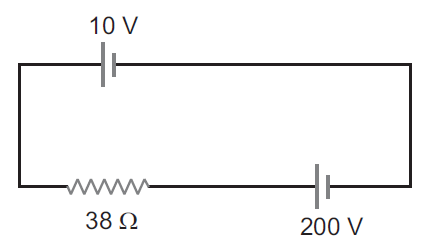
A 10 V battery of negligible internal resistance is connected across a 200 V battery and a resistance of 38 $\Omega$ as shown in the figure. Find the value of the current in circuit.
Answer
$\text{i} = \frac{\text{V}}{\text{R}} = \frac{190}{38} = 5 \text{A}.$
View full question & answer
Question 211 Mark
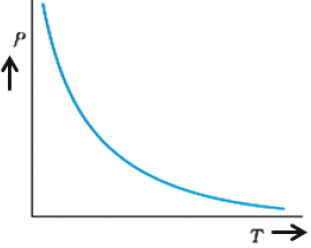
Show on a graph, the variation of resistivity with temperature for a typical semiconductor.
Answer

[If the graph is correct but the axis of the graph are not labelled, or labelled in an incorrect manner,]
View full question & answer
Question 221 Mark
A resistance R is connected across a cell of emf ε and internal resistance r. A potentiometer now measures the potential difference between the terminals of the cell as V. Write the expression for 'r' in terms of ε, V and R.
Answer
$\text{r} = \text{R}\left\{\frac{\text{E}}{\text{V}} - 1 \right\}.$
View full question & answer
Question 231 Mark
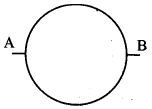
A wire of resistance $8R$ is bent in the form of a circle. What is the effective resistance between the ends of a diameter $AB$?
Answer
$\ce{R_{effective}} = \ce{2R}.$
View full question & answer
Question 241 Mark
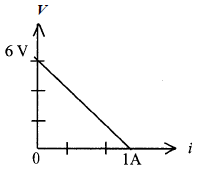
The plot of the variation of a potential difference across a combination of three identical cells in series, versus current is as shown below. What is the emf of each cell? 
Answer
2 voltsAlternate Answer
When I = 0 , E = V
$\therefore \text{Emf of each cell} = \frac{6\text{V}}{3} = 2\text{ volts}.$
View full question & answer
Question 261 Mark
When is a Wheatstone’s bridge most sensitive?
Answer
The Wheatstone’s bridge is most sensitive when all the four resistances of the bridge are equal.
View full question & answer
Question 281 Mark
Is work done by a battery always equal to the thermal energy developed in electrical circuit? What happens if a capacitor is connected in the circuit?
Answer
No, the work done by a battery is not always equal to the thermal energy developed in the electrical circuit. In case of a non$-$ideal battery, the work done by the battery is the sum of the thermal energy developed in the electric circuit and the thermal energy developed in the internal resistance of the battery. $12 C V^2$ of energy is lost in the form of heat and electromagnetic radiation.
View full question & answer
Question 291 Mark
What happens to the power dissipation if the value of electric current passing through a conductor of constant resistance is doubled?
Answer
$\text{Power P}=\text{I}^2\text{Rt}\propto\text{I}^2$
Clearly if current is doubled, the power dissipated becomes 4 times.
View full question & answer
Question 301 Mark
A fan with copper winding in its motor consumes less power as compared to an otherwise similar fan aluminium winding. Explain.
Answer
As the copper has higher conductance than aluminum so there is low power loss thus it consumes lesser power.
View full question & answer
Question 311 Mark
A steady current is flowing in a cylindrical conductor. Does electric field exist within the conductor?
Answer
Yes, electric field exists within the conductor because it is the electric field which imparts acceleration to electrons for the flow of current.
View full question & answer
Question 321 Mark
A uniform wire of resistance $50\Omega$ is cut into 5 equal parts. These parts are now connected in parallel. What is the value of equivalent resistance of the combination?
Answer
2 ohmsa.
View full question & answer
Question 331 Mark
Though we specify the direction of direct current by putting an arrow, why is it not considered a vector quantity?
Answer
Current is a scalar quantity because it does not obey the laws of vector addition.
View full question & answer
Question 351 Mark
Specific resistance of copper, silver and constantan are $1.18 \times 10^{–6}, 1 \times 10^{–6}, 45 \times 10^6 ohm \ cm$ respectively. Which is the best electrical conductor and why?
Answer
Smaller the resistivity of a substance, larger is its conductivity. The resistivity of silver is least so silver is the best conductor.
View full question & answer
Question 361 Mark
Does a conductor become charged when a current is passed through it?
Answer
Yes as charge passes through it is is charged. For example we use electrical magnets in some equipment.
View full question & answer
Question 371 Mark
The potential difference applied across a given resistance is altered so that heat produced per second increases by a factor of 16. By what factor does the applied pd change?
Answer
Power $\text{P}=\frac{\text{V}^2}{\text{R}}\Rightarrow\text{V}\propto\sqrt{\text{P}}$ for given resistance.
Hence, for making power 16-times, voltage should be made 4-times.
View full question & answer
Question 381 Mark
Sometimes it is said that "heat is developed" in a resistance when there is an electric current in it. Recall that heat is defined as the energy being transferred due to temperature difference. Is the statement in quotes technically correct?
Answer
Yes both statements are correct.
View full question & answer
Question 391 Mark
We often say, "A current is going through the wire." What goes through the wire, the charge or the current?
Answer
Only charge goes from the wire, rate of flow of charge is known as current.
View full question & answer
Question 401 Mark
The thermal energy developed in a current$-$carrying resistor is given by $U = i^2 Rt$ and also by $U = V$ it. Should we say that $U$ is proportional to $i^2$ or $i?$
Answer
As the simplest form is $= i^2Rt$
So, $U$ is directly proportional to $i^2.$
View full question & answer
Question 411 Mark
One of your friends argues that he has read in the previous chapters that there can be no electric field inside a conductor. And hence there can be no current through it. What is the fallacy of this argument?
Answer
If there can be no current inside a conductor there can be current on its surface so "there can be no current through it" is wrong.
View full question & answer
Question 421 Mark
A wire of resistivity $\rho$ is stretched to double its length. What will be its new resistivity?
Answer
New resistivity will be $\rho$ (unchanged) because resistivity is independent of dimensions of conductor.
View full question & answer
Question 431 Mark
The metallic conductor is at temperature $\theta_1.$ The temperature of metallic conductor is increased to $\theta_2.$ How will the product of its resistivity and conductivity change?
Answer
$\text{Product}\ \rho\ \sigma=\rho.\frac{1}{\rho}\Big(\sin\text{ce }\sigma=\frac{1}{\rho}\Big)$
⇒ Product is independent of temperature.
View full question & answer
Question 441 Mark
As the temperature of a conductor increases, both its resistivity as well as conductivity change. Will the ratio of its resistivity and conductivity increase, decrease or remain the same.
Answer
Increases.
View full question & answer
Question 451 Mark
When a straight wire of resistance R is bent into U-shape, does its resistance change?
Answer
No, the resistance remains same, because length and cross-sectional area of the wire remain unchanged.
View full question & answer
Question 461 Mark
The drift speed is defined as $\text{v}_\text{d}=\frac{\Delta\text{l}}{\Delta\text{t}}$ where $\Delta\text{l}$ is the distance drifted in a long time $\Delta\text{t}.$ Why don't we define the drift speed as the limit of $\frac{\Delta\text{l}}{\Delta\text{t}}\ \text{as}\ \Delta\text{t}\rightarrow0?$
Answer
As electron doesn't travel linearly so we need to calculate average time thus we need to consider drift distance for long time. That can not be calculated in case of t → 0.
View full question & answer
Question 471 Mark
A carbon resistor is marked in colour bands of red, black, orange and silver. What is the resistance and tolerance value of the resistor?
Answer
From colour-code table:
Red
Black
Orange
Silver
$\downarrow$
$\downarrow$
$\downarrow$
$\downarrow$
$2$
$0$
$3$
$\pm10\%$
$\text{R}=20\times10^3\Omega\pm10\%=20\ \text{k}\Omega\pm10\%$
View full question & answer
Question 481 Mark
Suppose you have three resistors, each of value $30\Omega.$ List all the different resistances you can obtain using them.
Answer
All in series.
All in parallel.
Two parallel and one in series.
View full question & answer
Question 491 Mark
Is it possible that the terminal potential difference across the cell be zero? If yes, state the condition.
Answer
Yes, terminal potential difference V = IR. If external resistance R = 0, V = 0; i.e. terminal potential difference is zero, when cell is short circuited.
View full question & answer
Question 501 Mark
The given circuit represents a balanced Wheatstone’s bridge. Calculate the value of resistance x.
Answer
In the balanced condition,
$\frac{\text{P}}{\text{Q}}=\frac{\text{R}}{\text{S}}$
$\therefore\frac{4+4}{1}=\frac{4\text{+}\text{x}}{2}$
$\Rightarrow\text{x}=12\Omega$
View full question & answer