Questions · Page 2 of 2

1 Marks Question

Question 511 Mark
When a current is established in a wire, the free electrons drift in the direction opposite to the current. Does the number of free electrons in the wire continuously decrease?
Answer
No the complete circuit (which is the only condition to flow current) restores number of electrons equal to the number of electrons passed through wire.
View full question & answer
Question 531 Mark
Do the electrodes in an electrolytic cell have fixed polarity like a battery?
Answer
Yes, polarity of electrolytic cell is fixed.
View full question & answer
Question 541 Mark
State the condition under which the terminal pd across a battery and its emf are equal.
Answer
The terminal pd across a battery is equal to its emf when battery is in open circuit, i.e., when no current is being drawn from the cell.
View full question & answer
Question 551 Mark
Would you prefer a voltmeter or a potentiometer to measure the emf of a battery?
Answer
Because potentiometer doesn't draw any current for itself from the primary circuit and hence gives more accurate measurement thereby acting as an ideal voltmeter. It uses null method to measure.
View full question & answer
Question 561 Mark
In a TV tube, electrons are accelerated from the rear to the front. What is the direction of the current?
Answer
Direction of current is in opposite direction of electron moving thus the current is from front to rear.
View full question & answer
Question 571 Mark
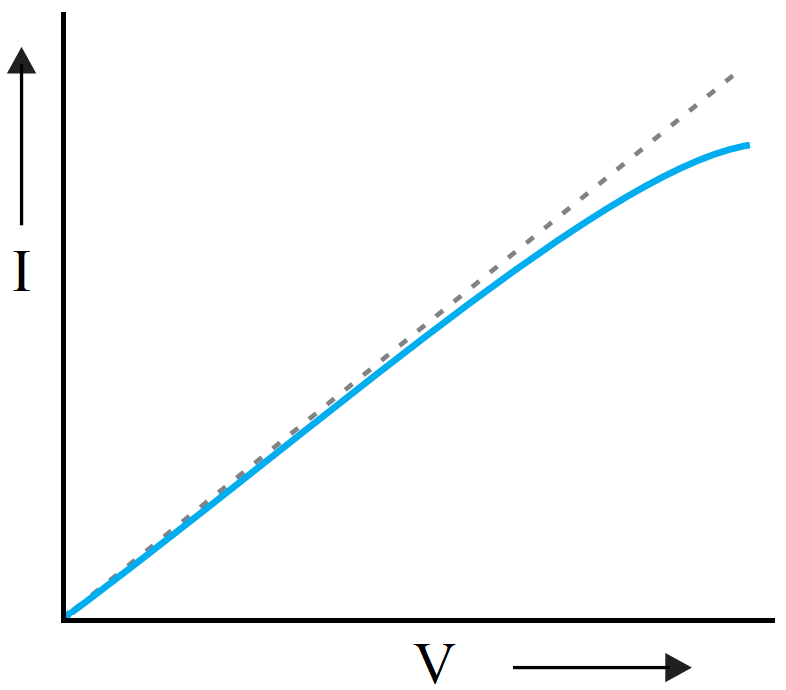
The I-V characteristics of a resistor are observed to deviate from a straight line for higher values of current as shown in the adjoining figure why?
Answer
At higher value of current, sufficient heat is produced which raises the temperature of resistor and so causes increase in resistance.
View full question & answer
Question 581 Mark
A source with e.m.f. '$\varepsilon$'and internal resistance 'r' is combined with external resistance 'R'. Write the value of voltage on resistance R.
Answer
Value of voltage on resistance $R$ is: $V=\frac{\varepsilon R}{R+r}$ or $V=\varepsilon-I r$
View full question & answer
Question 591 Mark
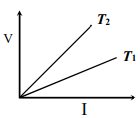
The voltage V and current I graph for a conductor at two different temperatures $T _1$ and $T _2$ are shown in the figure. Which of the highest value of temperature $T _1$ and $T _2$ is more and why?
Image
Answer
$T_2>T_1$($T_2$ is higher than $T_1$.
View full question & answer
1 Marks Question - Page 2 - Physics STD 12 Science Questions - Vidyadip