Questions

1 Marks Question

Take a timed test

35 questions · self-marked practice — reveal the answer and mark yourself.

Question 11 Mark
What is the net flux of the uniform electric field of Exercise 1.15 through a cube of side 20 cm oriented so that its faces are parallel to the coordinate planes?
Answer
All the faces of a cube are parallel to the coordinate axes. Therefore, the number of field lines entering the cube is equal to the number of field lines piercing out of the cube. As a result, net flux through the cube is zero.
View full question & answer
Question 21 Mark
Why do the electric field lines never cross each other?
Answer
At the point of intersection of the two field lines, there will be two directionsfor the electric field. This is not acceptable.
View full question & answer
Question 31 Mark
Define dielectric constant of a medium. What is its S.I. unit?
Answer
Dielectric Constant of a medium is the ratio of intensity of electric field in free space to that in the dielectric medium.Alternate Answer
It is the ratio of capacitance of a capacitor with dielectric medium to that without dielectric medium.
View full question & answer
Question 41 Mark
Why do the electrostatic field lines not form closed loops?
Answer
They start from positive charges and end on negative charges.Alternate Answer
Electric field is conservative in nature.
View full question & answer
Question 51 Mark
Two equal balls having equal positive charge ‘q’ coulombs are suspended by two insulating strings of equal length. What would be the effect on the force when a plastic sheet is inserted between the two?
Answer
Force decreases.
View full question & answer
Question 61 Mark
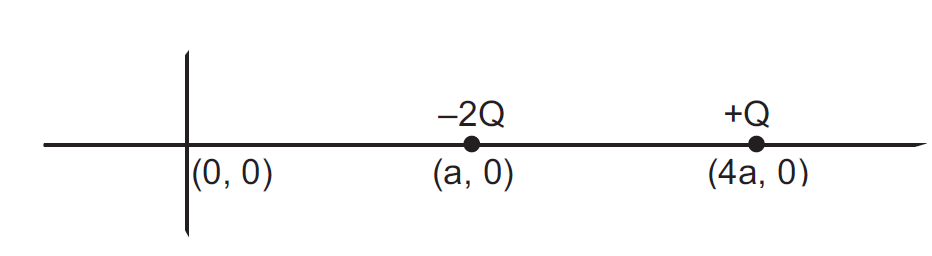
Two charges of magnitudes – 2Q and + Q are located at points (a, 0) and (4a, 0) respectively. What is the electric flux due to these charges through a sphere of radius ‘3a’ with its centre at the origin?
Answer

Electric flux,$\varphi = \frac{-2\text{Q}}{\varepsilon_{0}}.$

Concept:
  1. Mark the position of the charges on number line.
  2. Draw a sphere of radius 3a about the origin and observe that which charge is inside the sphere, and then use Gauss theorem.

 
View full question & answer
Question 71 Mark
A charge 'q' is placed at the centre of a cube of side l.What is the electric flux passing through each face of the cube?
Answer
$\phi_{e} = \text{q}60_{0}.$
View full question & answer
Question 81 Mark
Define electric dipole moment. Write its S.I. unit.
Answer
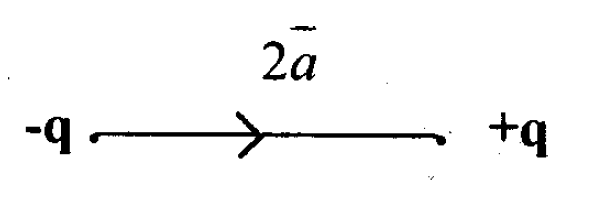
Electric dipole moment is defined as the numerical product of charge and distance between the charges, and is directed from negative to positive charge.Alternate Answer

$\overrightarrow{\text{p}} = \text{q}( 2 \overrightarrow{\text{a}})$ Unit: coulomb metre or Cm.
View full question & answer
Question 91 Mark
Which orientation of an electric dipole in a uniform electric field would correspond to stable equilibrium?
Answer
$\text{Parallel} / \phi\text{ = 0 / diagram only}.$
View full question & answer
Question 101 Mark
Define the term electric dipole moment. Is it a scalar or a vector quantity?
Answer
It is the product of charge (q) and the seperation (2a) between the pair of charges.Alternate Answer
In terms of p = Torque/normal electric field  It is a vector quantity.
View full question & answer
Question 111 Mark
Define Electric Flux. Write its SI unit.
Answer
Electric flux $\triangle\phi$, through an area element $\overrightarrow{\triangle S}$, is defined by
$\triangle\phi=\overrightarrow{E}.\overrightarrow{\triangle S}=E\triangle S\cos\theta$
where $\theta$ is the angle between$\overrightarrow{E}\text{ }\text{and}\text{ }\overrightarrow{\triangle S}.$
S.I unit of electric flux is $NC^{-1}m^2$.
View full question & answer
Question 121 Mark
Does the charge given to a metallic sphere depend on whether it is hollow or solid? Give reason for your answer.
Answer
No, Because the charge resides only on the surface of the conductor.
View full question & answer
Question 131 Mark
How does the electric flux due to a point charge enclosed by a spherical Gaussian surface get affected when its radius is increased?
Answer
Electric flux remains unaffected.
View full question & answer
Question 151 Mark
Two spherical bobs, one metallic and the other of glass, of the same size are allowed to fall freely from the same height above the ground. Which of the two would reach earlier and why?
Answer
Glass. In glass there is no effect of electromagnetic induction, due to presence of Earth’s magnetic field, unlike in the case of metallic ball.
View full question & answer
Question 161 Mark
A capacitor has been charged by a dc source. What are the magnitudes of conduction and displacement currents, when it is fully charged?
Answer
Magnitude of conduction & displacement current's are zero.
View full question & answer
Question 171 Mark
What is the geometrical shape of equipotential surfaces due to a single isolated charge?
Answer
Spherical.
View full question & answer
Question 181 Mark
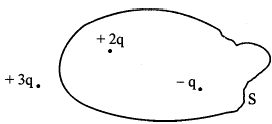
Figure shows three point charges, + 2q, – q and + 3q. Two charges + 2q and – q are enclosed within a surface ‘S’. What is the electric flux due to this configuration through the surface ‘S’?
Answer
Electric flux $\Phi = \frac{\text{q}}{\varepsilon_{0}}.$
View full question & answer
Question 191 Mark
In which orientation, a dipole placed in a uniform electric field is in (i) stable, (ii) unstable equilibrium?
Answer
When dipole is (i) parallel to field (ii) antiparallel to the field.
View full question & answer
Question 201 Mark
Define the term ‘dielectric constant’ of a medium in terms of capacitance of a capacitor.
Answer
Dielectric constant of a medium may be defined as the ratio of capacitance of a capacitor with dielectric between its plates to its capacitance with its plates separated in vacuum.Alternate Answer
$\text{k}=\frac{c}{c_{\circ}}$
$C =$ Capacitance with dielectric as medium.
$C_o =$ Capacitance with vacuum as medium.
View full question & answer
Question 211 Mark
Draw the pattern of electric field lines, when a point charge –Q is kept near an uncharged conducting plate.
View full question & answer
Question 221 Mark
An arbitrary surface encloses a dipole. What is the electric flux through this surface?
Answer
Zero.According to Gauss, law, the electric flux through an enclosed surface is given by $\oint_\text{s}\overrightarrow{\text{E}}.\text{d}\overrightarrow{\text{S}}=\frac{\text{q}_\text{enclosed}}{\epsilon_0}$
The net charge on a dipole is given by $-q + q = 0$, hence $q_{ enclosed} = 0$
Hence the electric flux through a surface enclosing dipole $=\frac{\text{-q}+\text{q}}{\epsilon_0}=\frac{\text{q}}{\epsilon_0}=0.$
View full question & answer
Question 231 Mark
NaCl molecule is bound due to the electric force between the sodium and the chlorine ions when one electron. of sodium is transferred to chlorine. Taking the separation between the ions to be 2.75 × 10cm, find the force of attraction between them· State the assumptions (if any) that you have made.
Answer
$\text{F}=\frac{\text{kq}_1\text{q}_2}{\text{r}^2}$
$=\frac{9\times10^9\times1.6\times1.6\times10^{-19}\times10^{-19}}{(2.75\times10^{-10})^2}$
$=\frac{23.04\times10^{-29}}{7.56\times10^{-20}}$
$=3.04\times10^{-9}$
View full question & answer
Question 241 Mark
The plates of a parallel-plate capacitor are given equal positive charges. What will be the potential difference between the plates? What will be the charges on the facing surfaces and on the outer surfaces?
Answer
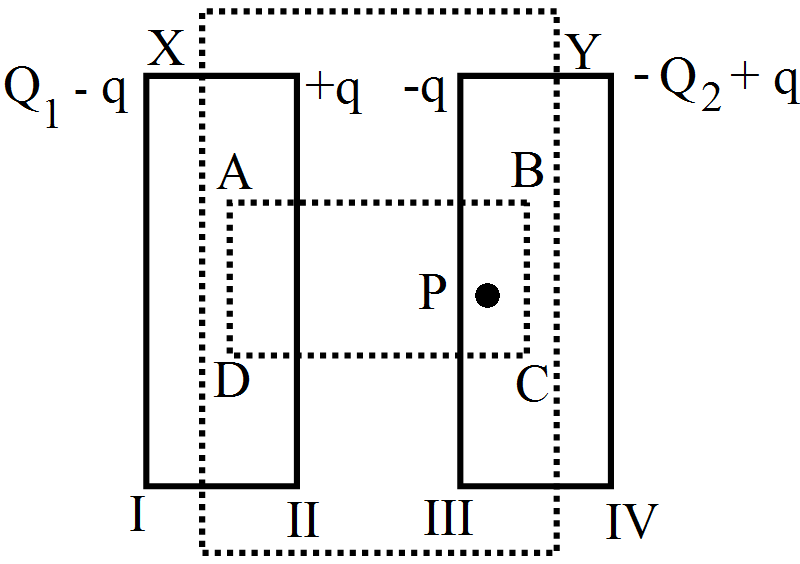
It is given that the plates of the capacitor have the same charges. In other words, they are at the same potential, so the potential difference between them is zero.(Figure)
Let us consider that the charge on face II is q so that the induced charge on face III is -q and the distribution is according to the figure. Now, if we consider Gaussian surface ABCD, whose faces lie inside the two plates, and calculate the field at point P due to all four surfaces, it will be $\text{E}_1=\frac{\text{Q}-\text{q}}{2\epsilon_0\text{A}}$ $\text{E}_2=\frac{\text{q}}{2\epsilon_0\text{A}}$ $\text{E}_3=-\frac{\text{q}}{2\epsilon_0\text{A}}$ $\text{E}_4=-\frac{\text{Q}+\text{q}}{2\epsilon_0\text{A}}$ (It is -ve because point P is on the left side of face IV.) Now, as point P lies inside the conductor, the total field must be zero.$\therefore\text{E}_1+\text{E}_2+\text{E}_3+\text{E}_4=0$
$\text{Q}-\text{q}+\text{q}-\text{q}+\text{Q}+\text{q}=0$
$\therefore\text{q}=0$
Hence, on faces II and III, the charge is equal to zero; and on faces I and IV, the charge is Q. Thus, it seems that the whole charge given is moved to the outer surfaces, with zero charge on the facing surfaces.
View full question & answer
Question 251 Mark
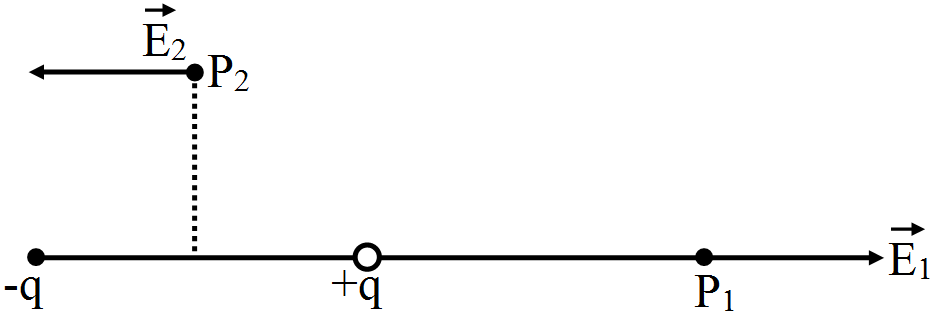
What is the angle between the directions of electric field at any $(i)$ Axial point and $(ii)$ Equatorial point due to an electric dipole?
Answer
The directions of electric field $\vec{\text{E}}_1$ at axial point $P_1$ and electric field $\vec{\text{E}}_2$ at equatorial point $P_2$ are shown in fig. Obviously, angle between $\vec{\text{E}}_1$ and $\vec{\text{E}}_2$ is $180^\circ.$
View full question & answer
Question 261 Mark
A rubber balloon is given a charge Q distributed uniformly over its surface. Is the field inside the balloon zero everywhere if the balloon does not have a spherical surface?
Answer
No, the field is not zero everywhere, as the electric field vector due to the charge distribution does not cancel out at any place inside the balloon because of its non-spherical shape.
View full question & answer
Question 271 Mark
A point charge q is placed in a cavity in a metal block. If a charge Q is brought outside the metal, will the charge q feel an electric force?
Answer
Yes, the charge Q will feel an electric force, as the charge q given to the metal block appears on the surface. Hence, it exerts an electric force on the charge Q.
View full question & answer
Question 281 Mark
A sample of $\text{HCI}$ gas is placed in an electric field of $2.5 \times 10^4NC^{-1}$ The dipole moment of each $\text{HCI}$ molecule is $3.4 \times 10^{-30}\ Cm$ Find the maximum torque that can act on a molecule.
Answer
$\text{E}=2.5\times104$
$\text{P}=3.4\times10^{-30}$
$ \text{T}=\text{PE}\sin\theta$
$=\text{P}\times\text{E}\times1$
$=3.4\times10^{-30}\times2.5\times10^4$
$=8.5\times10^{-26}\text{Nm}$
View full question & answer
Question 291 Mark
Two charged particles are placed at a distance $1.0\ cm$ apart. What is the minimum possible magnitude of the electric force acting on each charge?
Answer
Minimum charge of a body is the charge of an electron,
$\Rightarrow\text{q}=1.6\times10^{-19}\text{C}$
Given,
Separation between the charges, $r = 1\ cm = 10^{-2}\ cm$
By Coulomb's Law, force,
$\text{F}=\frac{1}{4\pi\epsilon_0}\frac{\text{q}_1\text{q}_2}{\text{r}^2}$
$=\frac{9\times10^9\times1.6\times1.6\times10^{-19}\times10^{-19}}{10^{-2}\times10^{-2}}$
$=23.04\times10^{-38+9+2+2}$
$=23.04\times10^{-25}$
$=2.3\times10^{-24}$
View full question & answer
Question 301 Mark
Find the dimensional formula of $\in_0.$
Answer
By Coulomb's Law,
$\text{F}=\frac{1}{4\pi\in_0}\frac{\text{q}_1\text{q}_2}{\text{r}^2}$
$\Rightarrow\in_0=\frac{1}{4\pi\text{F}}\frac{\text{q}_1\text{q}_2}{\text{r}^2}$
Using $[\text{F}]=\big[\text{MLT}^{-2}\big]$
$[\text{r}]=\big[\text{M}^0\text{L}^1\text{T}^0\big]$
$[\text{q}]=\big[\text{M}^2\text{L}^0\text{T}^1\text{A}^1\big],$ we get
$[\in_0]=\big[\text{M}^{-1}\text{L}^{-3}\text{T}^4\text{A}^2\big]$
View full question & answer
Question 311 Mark
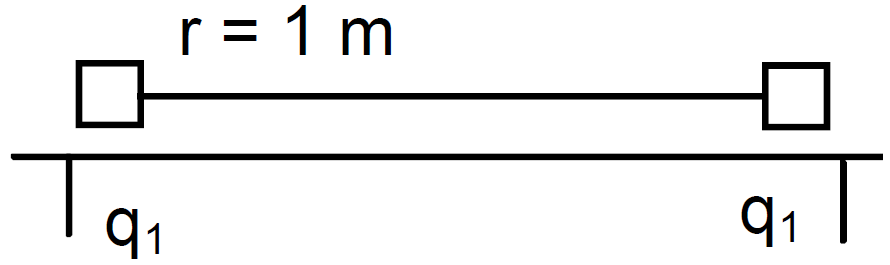
Two charged particles having charge $2.0 \times 10^{-8}C$ each are joined by an insulating string of length $1m$ and the system is kept on a smooth horizontal table. Find the tension in the string.
Answer

Force exerted $=\frac{\text{kq}_1^2}{\text{r}^2}$
$=\frac{9\times10^9\times2\times2\times10^{-16}}{1^2}$
$=3.6\times10^{-6}$ Is the force exerted on the string.
View full question & answer
Question 321 Mark
Suppose a charge $+Q_1$ is given to the positive plate and a charge $-Q_2$ to the negative plate of a capacitor. What is the ''charge on the capacitor''?
Answer
Given: 
Charge on the positive plane $= +Q_1$
Charge on the negative plate $= -Q_2$
To calculate: Charge on the capacitor
Let $\text{ABCD}$ be the Gaussian surface such that faces $AD$ and $BC$ lie inside plates $X$ and $Y,$ respectively.
Let $q$ be the charge appearing on surface $II.$ Then, the distribution of the charges on faces $I, III$ and $IV$ will be in accordance with the figure.
Let the area of the plates be $A$ and the permittivity of the free space $be\in 0\in 0.$
Now, to determine $q$​ in terms of $Q_1$ and $Q_2,$ we need to apply Gauss's law to calculate the electric field due to all four faces of the capacitor at point $P.$ Also, we know that the electric field inside a capacitor is zero.
Electric field due to face $I$ at point $P, \text{E}_1=\frac{\text{Q}_1-\text{q}}{2\epsilon_0\text{A}}$
Electric field due to face $II$ at point $P, \text{E}_2=\frac{+\text{q}}{2\epsilon_0\text{A}}$
Electric field due to face $III$ at point $P, \text{E}_3=\frac{-\text{q}}{2\epsilon_0\text{A}}$
Electric field due to face $IV$ at point $P, \text{E}_4=-\Big(\frac{-\text{Q}_2+\text{q}}{2\epsilon_0\text{A}}\Big) ($Negative sign is used as point $P$ lies on the $\text{LHS}$ of face $IV.)$
Since point $P$ lies inside the conductor,
$\text{E}_1+\text{E}_2+\text{E}_3+\text{E}_4=0$
$\therefore\text{Q}_1-\text{q}+\text{q}-\text{q}-(-\text{Q}_2+\text{q})=0$
$\Rightarrow\text{q}=\frac{\text{Q}_1+\text{Q}_2}{2}$
Thus, the charge on the capacitor is $\frac{\text{Q}_1+\text{Q}_2}{2},$ which is the charge on faces $II$ and $III.$
View full question & answer
Question 331 Mark
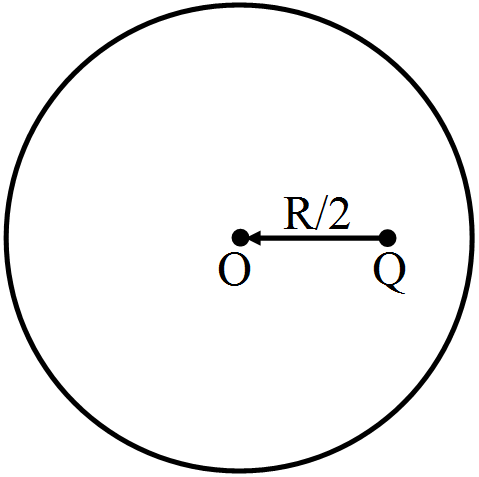
Figure shows a point charge +Q, located at a distance $\frac{\text{R}}{2}$ from the centre of a spherical metal shell. Draw the electric field lines for the given system.
View full question & answer
Question 341 Mark
Is the force acting between two point charges $q_1$ and $q_2$ kept at some distance apart in air attractive or repulsive when,
  1. $q_1\ q_2 > 0$?
  2. $q_1\ q_2 < 0$?
Answer
  1. Repulsive.
  2. Attractive.
View full question & answer
Question 351 Mark
nswer the following questions.
  1. Write $SI$ unit of electric field intensity.
  2. Write $SI$ unit of electric dipole moment.
Answer
  1. $SI$ unit of electric field intensity is newton/ coulomb $(NC^{-1}).$
  2. $SI$ unit of electric dipole moment is coulomb $\times$ metre $(Cm).$
View full question & answer