Question 14 Marks
A charge of $1.6 \times 10^{-7} C$ is uniformly distributed on the surface of a spherical conductor of radius 12 cm . What will be the electric field?(a) Inside the sphere(b) Just outside the sphere(c) At any point located 18 cm from the centre of the sphere.
Answer(a) When the point is inside the spherical conductor, then, let us imagine a Gaussian surface of radius ( $r< R$ ). The charge inside this surface is zero.
Therefore, according to Gauss's law for this surface, the flux emanating from this surface
$ \phi=\oint \overrightarrow{E} \cdot \Delta \overrightarrow{S}=\frac{\Sigma q}{\epsilon_0}=\frac{0}{\epsilon_0} $
(b) Just outside or on the surface of the spherical conductor, $E =\frac{k Q }{ R ^2}$
Here, $k=9 \times 10^9 Nm^2 C^{-2} $
$Q =1.6 \times 10^{-7} C$
$R =12 cm=12 \times 10^{-2} m$
$r=18 cm=18 \times 10^{-2} m$
On putting value, $E=\frac{9 \times 10^9 \times 1.6 \times 10^{-7}}{\left(12 \times 10^{-2}\right)^2}$
$=\frac{14.4 \times 10^2}{144 \times 10^{-4}}$
$=\frac{10^6}{10}=10^5 NC ^{-1}$ Ans.
(c) At the distance of 18 cm from the centre of sphere,
$E =\frac{k Q }{r^2}=\frac{9 \times 10^9 \times 1.6 \times 10^{-7}}{\left(18 \times 10^{-2}\right)^2}$
$=\frac{14.4 \times 10^2}{324 \times 10^{-4}}=4.44 \times 10^4 NC ^{-1}$ Ans.
View full question & answer→Question 24 Marks
An electric charge of $17.7 \times 10^{-4}$ Coulomb is distributed uniformly on a large thin sheet of area $200 m^2$. Find the intensity of the electric field in air at a distance of 20 cm from it.
AnswerSol. Given : $q=17.7 \times 10^{-4}$ Coulomb
and area of the sheet $S=200 m^2$
Therefore, surface charge density on the sheet
$\sigma=\frac{q}{S}=\frac{17.7 \times 10^{-4}}{200}$
$\sigma=8.85 \times 10^{-6} C / m ^2$
Electric field intensity near it at a distance of 20 cm from it.
$=\frac{\sigma}{2 \epsilon_0}=\frac{8.85 \times 10^{-6}}{2 \times 8.85 \times 10^{-12}}$
$=5.0 \times 10^5 N / C$ Ans.
View full question & answer→Question 34 Marks
Two cations with equal charge repel each other with a force of $3.7 \times 10^{-9}$ Newton while the distance between them is $5 A$. How many electrons are less in each ion than in the normal state?
AnswerLet the magnitude of positive charge on each ion be 1 Coulomb, the repulsion force between them
$ F=3.7 \times 10^{-9} \text { Newton } $
the distance between them
$ r=5Å=5 \times 10^{-10} m $
From the formula of Coulomb's law
$ F=\frac{1}{4 \pi \epsilon_0}\left(\frac{q_1 \times q_2}{r^2}\right) $
On putting value
$ 3.7 \times 10^{-9}=9 \times 10^9\left[\frac{q \times q}{\left(5 \times 10^{-10}\right)^2}\right] $
Therefore $q^2=\frac{3.7 \times 10^{-9} \times\left(5 \times 10^{-10}\right)^2}{9 \times 10^9}$
$=\frac{3.7 \times 25 \times 10^{-9} \times 10^{-20}}{9 \times 10^9}$
$q^2=10.28 \times 10^{-38}$
Therefore $\quad q=\sqrt{10.28 \times 10^{-38}} \approx 3.2 \times 10^{-19}$ but $q=n e$ (where $n=$ Deficiency of Electron)
Therefore, $\quad n=\frac{q}{e}=\frac{3.2 \times 10^{-19}}{1.6 \times 10^{-19}}=2$
$n=2 \quad$
View full question & answer→Question 44 Marks
The charge density of two uniformly charged parallel infinite plane sheets ' 1 ' and ' 2 ' are $+\sigma$ and $-2 \sigma$ respectively. Find the magnitude and direction of the net electric field (i) at any point between these two sheets and (ii) at any point outisde these two sheets but near sheet ' 1 '.
Answer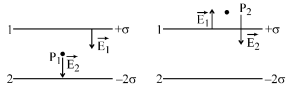
(i) Let the electric field intensities at any point P between these two sheets be $\vec{E}_1$ and $\vec{E}_2$.
$\left|E_{P_1}\right|=\left|E_1\right|+\left|E_2\right|$
$=\frac{\sigma}{\varepsilon_0}+\frac{2 \sigma}{\varepsilon_0}$ $=\frac{3 \sigma}{\varepsilon_0}$
Direction towards sheet ' 2 '
$ \overrightarrow{E}_1=\frac{3 \sigma}{\varepsilon_0}(-\hat{j})=\frac{-3 \sigma}{\varepsilon_0} \hat{j} $
(ii) Value of electric field at a point outiside but near sheet ' 1 ',
$ \begin{aligned} \left|\vec{E}_{P_2}\right| & =\vec{E}_2+\vec{E}_1 \\ & =\frac{2 \sigma}{2 \epsilon_0}-\frac{\sigma}{2 \epsilon_0}=\frac{\sigma}{2 \epsilon_0} \end{aligned} $
Direction towards sheet ' 2 '
$ \overrightarrow{E}_{P_2}=\frac{\sigma}{2 \epsilon_0}(-\hat{j})=\frac{-\sigma}{\epsilon_0} \hat{j} $ View full question & answer→Question 54 Marks
The radius of a thin hollow metal sphere (spherical shell) is 30 cm . And there is a charge of 500 $\mu C$ on that spherical shell. Find the electric field intensity at a distance.(i) 1 meter, (ii) 30 cm , (iii) 10 cm , from the centre of the cell.
AnswerIt is given that $R =30 cm=0,30$ metre
Charge $q=500 \mu C =500 \times 10^{-6}=5 \times 10^{-4}$ Coulomb
(i) Here, $r=1 m> R$, hence the observation point is outside the shell.
Therefore, $E =\frac{1}{4 \pi \epsilon_0} \frac{q}{r^2}$
$\therefore \quad E =9 \times 10^9 \times\left(\frac{5 \times 10^{-4}}{1^2}\right)$
$=4.5 \times 10^6 N / C$
(ii) Here, $r=30 cm=0.30 m= R$,
Hence, the observation point is on the surface of the shell.
$\therefore \quad E =\frac{1}{4 \pi \epsilon_0}\left(\frac{q}{ R ^2}\right)$
$=\frac{9 \times 10^9 \times 5 \times 10^{-4}}{(0.30)^2}$
$=\frac{45 \times 10^5}{30 \times 30 \times 10^{-4}}=\frac{45 \times 10^5}{9 \times 10^{-2}}$
$=5.0 \times 10^7 N / C$
(iii) Here $r=10 cm=0.10 m< R$ means the observation point is inside the shell.
Therefore, $ E=0 $
View full question & answer→Question 64 Marks
Point charge q is placed (i)at the mid-point of the core of a cube of side a meter (ii)centrally on a plane of a cube of side a meter. Calculate the total flux associated with the cube. Also find out how many surfaces of the cube will be the total flux associated?
Answer(i) Considering the point on the core of the cube where the point charge is placed as the centre, imagine a hollow sphere which cuts core of the cube at two points. The volume of the cube that will be inside such a sphere will be one-fourth of the total volume of the hollow sphere hence the solid angle made by the cube on the point charge will be$\left(\frac{360^{\circ}}{4}=90^{\circ}\right)$. If the value of point charges is q then the electric flux passing through the cube due to point charge is $ \phi=\frac{q}{4 \epsilon_o} $
No electric flux will pass through the two faces of the cube which have point charges at their core because the direction of electric flux is parallel to them and the electric flux passing through the cube will pass through the other four faces.
(ii) Considering the face of the cube on which the point charge is placed as its centre, imagine a hollow sphere which cuts it into a perfect circle. The volume of the hollow sphere inside the cube will be half of the total volume of the hollow sphere and it will make a solid angle of $180^{\circ}$ at the point charge. If the value of point charge is $q$, then the electric flux passing through the cube will be half of the electric flux emerging out of the charge $q$.
Therefore the electric flux passing through the cube $ \phi=\frac{q}{2 \epsilon_o} $
Again, since the direction of electric flux on the face of the cube which has a point charge is parallel to the face, hence the value of electric flux on it will be zero and the electric flux will come out equally from the other faces. Therefore the electric flux passes through five faces.
View full question & answer→Question 74 Marks
Two point charges $5 \mu C$ and $-5 \mu C$ are kept at a distance of 1 cm from each other. Calculate the intensity of the electric field at a distance of 0.30 cm from mid-point (i) in the axial position, (ii) in neutral position.
AnswerHere it is given,
$q=5 \mu C =5 \times 10^{-6} C$
$2 a=1 cm=10^{-2} m$
and $\quad r=0.30 m$
Dipole moment $p=2 a q$
$=10^{-2} \times 5 \times 10^{-6} C - m$
$=5 \times 10^{-8} C - m$
Here, $r \gg 2 a$
Hence, dipole is a small electric dipole. So
(i) In axial position
Electric field intensity $\quad E =\frac{1}{4 \pi \epsilon_0}\left(\frac{2 p}{r^3}\right)$
On putting value $E =\frac{9 \times 10^9 \times 2 \times 5 \times 10^{-8}}{(0.30)^3}$
$\begin{aligned} E & =\frac{9 \times 10^2}{30 \times 30 \times 30 \times 10^{-6}} \\ & =3.33 \times 10^4 N / C \quad \text { Ans. }\end{aligned}$
(ii) In neutral position
Electric field intensity $E =\frac{1}{4 \pi \epsilon_0}\left(\frac{p}{r^3}\right)$
On putting value $E=9 \times 10^9 \times\left[\frac{5 \times 10^{-8}}{(0.30)^3}\right]$
$E=\frac{9 \times 10^9 \times 5 \times 10^{-8}}{30 \times 30 \times 30 \times 10^{-6}}$
$=\frac{5}{3} \times 10^4$
$=1.67 \times 10^4 N / C $ Ans.
View full question & answer→Question 84 Marks
$q, 2 q, 3 q$ and $4 q$ Coulomb charges are located at the four corners of a square of side a meter each. Prove that the electric field at its centre will be $4 \sqrt{2} \frac{k q}{a^2} N / C$
AnswerHere $q, 2 q, 3 q$ and $4 q$ charges are placed at the four corners of the square of side a meter each respectively. Here AC and BD are the diagonals of the square which intersect at $O$ which is the centre of the square.
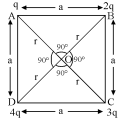
Electric field
$ E_{CA}=\frac{k(3 q-q)}{r^2}=\frac{k \times 2 q}{r^2} $
Similarly $ E_{DB}=\frac{k(4 q-2 q)}{r^2}=\frac{k \times 2 q}{r^2} $
Value of electric field at the centre of square
$E =\sqrt{ E _{ CA }^2+ E _{ DB }^2}$
$=\sqrt{\left(\frac{k \times 2 q}{r^2}\right)^2+\left(\frac{k \times 2 q}{r^2}\right)^2}$
$=\sqrt{\frac{4 k^2 q^2}{r^4}+\frac{4 k^2 q^2}{r^4}}$
$=\sqrt{\frac{8 k^2 q^2}{r^4}}=\frac{2 \sqrt{2} k q}{r^2}$
$\therefore \quad E =\frac{2 \sqrt{2} k q}{r^2}$
But from the diagram $r^2+r^2=a^2$
$2 r^2=a^2$
$r^2=\frac{1}{2} a^2$
On putting the value of $r ^2$ from equation (2) in equation
$E =\frac{2 \sqrt{2} k q}{\frac{1}{2} a^2}=\frac{2 \sqrt{2} \times 2 k q}{a^2}$
$E =\frac{4 \sqrt{2} k q}{a^2}$ Ans. View full question & answer→Question 94 Marks
Two q charges of the same nature are located at a distance d from each other, the third charge of value Q Coulomb is at the mid-point of the line joining them. For what value of Q will the system be in equilibrium?
AnswerTwo charges of similar nature are kept at a distance $d$.

A third charge $Q$ is placed at their mid-point, which will be at a distance $\frac{d}{2}$ from the $q$ charge. Force between charges $q$ and Q according to Coulomb's law,
$ F_1=\frac{k \cdot Q \cdot q}{(d / 2)^2} \quad\left(\text { where } k=\frac{1}{4 \pi \epsilon_0}\right) $
Force acting between charges $q$ and $q$
$ F_2=\frac{k \cdot q \cdot q}{(d)^2} $
For state of equilibrium $F=F_1+F_2=0$
Therefore, on putting values
$\Rightarrow \quad \frac{k \cdot Q \cdot q}{(d)^2}+\frac{k \cdot q \cdot q}{(d)^2}=0$
$\Rightarrow \quad \frac{k \cdot Q \cdot q}{\frac{d^2}{4}}+\frac{k \cdot q \cdot q}{d^2}=0$
$\Rightarrow \quad \frac{4 k Q q}{d^2}+\frac{k q^2}{d^2}=0$
$\Rightarrow \quad 4 k Q q+k q^2=0$
$\Rightarrow \quad k q(4 Q+q)=0$
$\Rightarrow \quad 4 Q+q=\frac{0}{k q}=0$
$\Rightarrow \quad 4 Q+q=0$
$\Rightarrow \quad 4 Q=-q$
$\Rightarrow \quad Q =\frac{-q}{4}$
Hence, for $Q =\frac{-q}{4}$ the system will be in equilibrium.
View full question & answer→Question 104 Marks
The distance between the centres of two insulated charged copper spheres ' $A$ ' and ' $B$ ' which are identical in size is 50 cm and the charge on each is $6.5 \times 10^{-7} C$. A third uncharged sphere ' C ' of the same size was first brought in contact with the sphere ' $A$ ', and then brought in contact with the second sphere ' $B$ ' and finally separated from both. Then find the magnitude of repulsive foce between ' $A$ ' and ' $B$ '.
AnswerLet the total charge on sphere A before contact $be = Q$. When sphere C comes in contact with A , then this charge Q will be distributed equally between both.
Therefore, after contact with A , charge $=\frac{ Q }{2}$
When B and C come in contact, total charge on both sphere $ =Q+\frac{1}{2} Q=\frac{3}{2} Q $
This charge will be equally distributed on B and C . Therefore, value of charge on B after contact $ =\frac{1}{2}\left(\frac{3}{2} Q\right)=\frac{3}{4} Q $
Finally, repulsion force between spheres A and B
$F =\frac{ K _1 Q _2}{r^2}$
$F =\frac{ K \left(\frac{1}{2} Q \right)\left(\frac{3}{4} Q \right)}{r^2}$
$F =\frac{ K \left(\frac{3}{8} Q ^2\right)}{r^2}$
(Here,$Q =6.5 \times 10^{-7} C$,
$r=50 cm=\frac{1}{2} met$,
$K =9 \times 10^9$)
On putting value,
$F =\frac{9 \times 10^9 \times \frac{3}{8} \times\left(6.5 \times 10^{-7}\right)^2}{\left(\frac{1}{2}\right)^2}$
$F=\frac{4 \times 9 \times 3 \times 6.5 \times 6.5 \times 10^9 \times 10^{-14}}{8}$
$=\frac{27 \times 42.25 \times 10^{-5}}{2}$
$=5.7 \times 10^{-3} N$
View full question & answer→Question 114 Marks
(a) What will be the charge on $12.5 \times 10^8$ electrons?(b) Which is larger between 1 Coulomb charge and 1 electron charge? How many electronic charges will there be in one Coulomb charge?
Answer(a) Charge on 1 electron $=1.6 \times 10^{-19}$ Coulomb,
Hence $q=n e=12.5 \times 10^8$ charge on electrons
$q=n e=\left(12.5 \times 10^8\right) \times\left(1.6 \times 10^{-19}\right)$ Coulomb
$=20.00 \times 10^{-11}$ Coulomb
$=2.0 \times 10^{-10}$ Coulomb (negative) Ans.
(b) 1 Coulomb charge is greater than the charge of 1 electron.
If electronic charge is $n$ in $q=1$ Coulomb of charge
From $q=n e$
$n=\frac{q}{e}=\frac{1 \text { Coulomb }}{1.6 \times 10^{-19} \text { Coulomb }}$
$n=6.25 \times 10^{18}$ Ans.
View full question & answer→Question 124 Marks
An electron revolves around an infinite positive linear charge in a circular orbit of radius 0.5 m . If the line charge density is $18.2 \times 10^{-10}$ Coulomb/ meter, then find the speed of the electron (in $m / s$ ).
(Mass of electron $m=9.1 \times 10^{-31} kg$ )
AnswerWe know : Electric field intensity due to a uniformly charged straight wire of infinite length.
$E =\frac{\lambda}{2 \pi \epsilon_0 r}$
and $F =q E$
$\therefore \quad F =\frac{q \lambda}{2 \pi \epsilon_0 r} \quad$ (on putting the value of E )
Value of this force will be equal to $\frac{m v^2}{r}$
$\therefore \quad \frac{m v^2}{r}=\frac{q \lambda}{2 \pi \epsilon_0 r}$
$v^2=\frac{q \lambda}{2 \pi \epsilon_0 m}$
$v^2=\frac{2 k q \lambda}{m} \quad \because k=\frac{1}{4 \pi \epsilon_0}$
Given : $\lambda=18.2 \times 10^{-10} C / m$
$m=9.1 \times 10^{-31} Kg$
$k=9 \times 10^9$
$q=1.6 \times 10^{-19} C$
$v^2=\frac{2 \times 9 \times 10^9 \times 1.6 \times 10^{-19} \times 18.2 \times 10^{-10}}{9.1 \times 10^{-31}}$
$=\frac{18 \times 1.6 \times 18.2 \times 10^{11}}{9.1}$
$=\frac{18 \times 16 \times 182 \times 10^{10}}{91}$
$v^2=36 \times 16 \times 10^{10}$
$\therefore \quad v=\sqrt{36 \times 16 \times 10^{10}}$
$=6 \times 4 \times 10^5=2 \times 10^4 m / s$ Ans.
View full question & answer→Question 134 Marks
The charge enclosed by a spherical Gaussian surface is $8.85 \times 10^{-8}$ Coulomb. Calculate (a) the electric flux emerging out of the Gaussian surface, (b) what will be the change in electric flux if the radius of the Gaussian surface is doubled?
AnswerHere, Value of bounded charge $q=8.85 \times 10^{-8} C$
(a)$\phi=\frac{q}{\epsilon_0}=\frac{8.85 \times 10^{-8}}{8.85 \times 10^{-12}}$
$=10^4 Nm ^2 / C$
(b) Since the electric flux $\phi$ depends only on the charge enclosed by the Gaussian surface and not on its radius, there will be no change in the electric flux.
View full question & answer→Question 144 Marks
The entering flux from a closed surface is $2 \times 10^3$ Newton-metre ${ }^2 /$ Coulomb and the emerging flux is $8 \times 10^3$ Newton-metre ${ }^2 /$ Coulomb. Find the value of charge enclosed in the surface.
AnswerEntering flux $=2 \times 10^3$ Newton meter $^2 /$ Coulomb and emerging flux $=8 \times 10^3$ Newton meter $^2 /$ Coulomb
$\therefore$ Total output flux $=8 \times 10^3-2 \times 10^3$
$=6 \times 10^3$ Newton meter $^2 /$ Coulomb
If the charge on the closed surface is $q$, then $\frac{q}{\epsilon_o}=\phi$
$\therefore \quad q=\epsilon_0 \times \phi$
$\Rightarrow \quad q=8.85 \times 10^{-12} \times 6 \times 10^3$
or $\quad q=53.1 \times 10^{-9}$ Coulomb
$=53.1 nC$ Ans.
View full question & answer→Question 154 Marks
An electric dipole of length 2 cm is placed in an electric field of intensity $10^5$ Newton/Coulomb in such a way that its axis makes an angle of $30^{\circ}$ with the direction of the field. A torque of $10 \sqrt{3}$ Newton meter acts on it. Find the magnitude of charge on the electric diple.
AnswerIt is given here
$\tau=10 \sqrt{3} Nm$
$\theta=30^{\circ}$ and $E =10^5 N / C$
Therefore, Torque $\tau=p E \sin \theta$
$p=\frac{\tau}{\operatorname{Esin} \theta}=\frac{10 \sqrt{3}}{10^5 \times \sin 30^{\circ}}$
$p=\frac{10 \sqrt{3}}{10^5 \times \frac{1}{2}}=2 \sqrt{3} \times 10^{-4} C \times m$
but $\quad 2 a =2 cm=2 \times 10^{-2} m$
As we know $\quad p=2 a q$
Therefore charge at dipole $q=\frac{p}{2 a}$
$q=\frac{2 \sqrt{3} \times 10^{-4}}{2 \times 10^{-2}}$
$=\sqrt{3} \times 10^{-2}$ Coulomb
$=1.732 \times 10^{-2} C \quad$ Ans.
View full question & answer→Question 164 Marks
Two point charges $+3.2 \times 10^{-19}$ Coulomb and $-3.2 \times 10^{-19}$ Coulomb are kept at a distance of 2.4 $\times 10^{-10}$ meters from each other. This dipole is placed at an angle of $30^{\circ}$ to the field direction in a uniform field of intensity of $3 \times 10^4$ Newton/Coulomb. Find the value of the moment of the couple acting on it. What will be the maximum value of this torque?
AnswerGiven :$q=3.2 \times 10^{-19} C$
$2 a=2.4 \times 10^{-10} m, E =3 \times 10^4 N / C$ and $\theta=30^{\circ}$
Therefore dipole moment of electric dipole $p=2 a q$
$p=2.4 \times 10^{-10} \times 3.2 \times 10^{-19}$
$=7.68 \times 10^{-29}$ Coulomb-meter
Therefore moment of couple
$\tau=p E \sin \theta$
$=\left(7.68 \times 10^{-29}\right) \times\left(3 \times 10^4\right) \times \sin 30^{\circ} Nm$
$=7.68 \times 3 \times 10^{-25} \times \frac{1}{2} Nm$
$=1.152 \times 10^{-24} Nm$
Maximum value of $\tau$
$\tau_{\max }=p E \sin 90^{\circ}=p E$
$=7.68 \times 10^{-29} \times 3 \times 10^4 Nm$
$=2.304 \times 10^{-24} Nm$ Ans.
View full question & answer→Question 174 Marks
The electric field intensity at a point at a distance of 20 cm from the centre of a sphere is 10 Volt/meter. Find the intensity of the electric field at a point located at a distance 8 cm from the centre of that circle. The radius of the sphere is 5 cm.
AnswerGiven:
$E_{20}=10 N / C$
$E _8=?, r=20 cm=0.2 m$
Here, we need to calculate the value of $E _8$
$E _{20}=\frac{k q}{(0.2)^2}$
$\therefore \quad 10=\frac{k q}{(0.2)^2}$
Similarly, $E _8=\frac{k q}{(0.08)^2}$
$x=\frac{k q}{(0.08)^2}$
$\because$ Charge is same in both equations
$\frac{ E _{20}}{ E _8}=\left(\frac{k q}{(0.2)} \times \frac{(0.08)^2}{k q}\right)$
$=\frac{10}{ E _8}=\left(\frac{0.08}{k q}\right)^2=\left(\frac{8}{20}\right)^2=\left(\frac{2}{5}\right)^2$
$\Rightarrow \quad \frac{10}{ E _8}=\frac{4}{25}$
$4 E_8=250$
$\Rightarrow \quad \therefore \quad E_8=\frac{250}{4}=62.5$
Electric field intensity at the far point $8 cm=62.5$ Volts/ meter.
Ans.
View full question & answer→Question 184 Marks
A sphere of diameter 10 cm is charged so that the electric field intensity on its surface becomes $5 \times 10^6$ Volt per meter. What will be the force exerted on a charge of $5 \times 10^{-2}$ micro Coulomb located at a distance 25 cm from the centre of the circle?
AnswerGiven : $2 r=10 cm=0.1 m$
$r=0.05 m$
$E =5 \times 10 v V / m$
Force on a $5 \times 10^{-2} \mu C$ charge located at a distance 25 cm from the centre of sphere $=$ ?
Let the value of charge on the surface of sphere be $q$ Coulomb.
Electric field intensity on the surface of sphere is
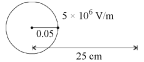
$E =\frac{k q}{r^2}$
$\therefore \quad q =\frac{ E r^2}{k}$
$=\frac{5 \times 10^6 \times(0.05)^2}{k} C$
Let force acting between two charges be F .
By Coulomb's law $\therefore \quad F =\frac{k q_1 q_2}{r^2}$
On putting value
$F =\frac{\frac{k \times 5 \times 10^6 \times(0.05)^2}{k} \times 5 \times 10^{-2} \times 10^{-6}}{\left(25 \times 10^{-2}\right)^{-2}}$
$F =\frac{5 \times 10^6 \times 25 \times 10^{-4} \times 5 \times 10^{-8}}{625 \times 10^{-4}}=\frac{625 \times 10^{-2}}{625}$
$F =1 \times 10^{-2}=0.01 N$ View full question & answer→Question 194 Marks
Calculate the intensity of the electric field due to the helium nucleus at a distance of $1Å$ from it.
AnswerCharge on the helium nucleus
$=$ Charge of 2 protons
$=2 \times 1.6 \times 10^{-19} C =3.2 \times 10^{-19} C$
$\therefore$ Electric field at a distance of $1Å$ or $10^{-10} m$ from nucleus
$\tau=\frac{k q}{r^2}$
$=\frac{9 \times 10^9 \times 2 \times 1.6 \times 10^{-19}}{\left(10^{-10}\right)^2}$
$=9 \times 10^9 \times 2 \times 16=288 \times 10^9$
$=2.88 \times 10^{11} N / C $
View full question & answer→Question 204 Marks
Two point charges +9e and +e are located at a distance of 16 cm apart from each other. Where should a charge q be placed between them so that there is no force on it?
AnswerForce between charge $+9 e$ and $q$
$ F_1(\text { assume })=k \frac{9 e \times q}{x^2} \quad\left(\because \frac{1}{4 \pi \epsilon_{o}}=k\right) $
Similarly, force between charge $q$ and $+e$
$ F_2 \text { (assume) }=\frac{k q \times e}{(16-x)^2} $
Since charge $q$ is in equilibrium
$\begin{array}{ll}\therefore & F _1= F _2\end{array}$
$\Rightarrow \quad \frac{k 9 e \times q}{x^2}=\frac{k q e}{(16-x)^2}$
$\Rightarrow \quad \frac{9}{x^2}=\frac{1}{(16-x)^2}$
Taking square roots of both sides $\frac{3}{x}=\frac{1}{16-x} $
$\Rightarrow \quad 3(16-x)=x$
$\Rightarrow \quad 48-3 x= x$
$\Rightarrow \quad 4 x=48$
$x=\frac{48}{4}=12 cm$
Therefore, if charge $q$ is placed at a distance of 12 cm from $+9 e$, then system will be in the state of equilibrium.
Ans.
View full question & answer→Question 214 Marks
To convert two atoms into ions, 2 electrons have been removed from each of them. When these ions are placed in a vacuum, they repel each other with a force of $3.7 \times 10^{-9}$ Newton. Find the distance between them.
AnswerGiven :
$q_1=q_2=+2 e =2 \times\left(1.6 \times 10^{-19}\right) C$
$=3.2 \times 10^{-19} C$
Repulsion force between them
$ F=3.7 \times 10^{-9} N $
Therefore from formula of electric force
$ F=\frac{1}{4 \pi \epsilon_0}\left(\frac{q_1 \times q_2}{r^2}\right) $
On putting value
$3.7 \times 10^{-9}=9 \times 10^9\left[\frac{\left(3.2 \times 10^{-19}\right) \times\left(3.2 \times 10^{-19}\right)}{r^2}\right]$
or $r^2=\frac{9 \times 10^9 \times\left(3.2 \times 10^{-19}\right)^2}{3.7 \times 10^{-9}}$
$r^2=\frac{9 \times 3.2 \times 3.2 \times 10^9 \times 10^{-38}}{3.7 \times 10^{-9}}$
$r^2=24.91 \times 10^{-20}$
Therefore, $r=\sqrt{24.91 \times 10^{-20}}$
$r=4.99 \times 10^{-10} m=4.99Å \quad$
View full question & answer→Question 224 Marks
Two point charges $+3 \mu C$ and $-3 \mu C$ are kept at a distance of 20 cm from each other in vacuum. (i) What will be the electric field at the mid-point of the line joining the two charges? (ii) If a charge of $1.5 \times 10^{-9} C$ is placed at this mid-point, then how much force will be applied on this charge?
AnswerSol. (i) $q_1=3 \mu C$
The intensity of the electric field $\overrightarrow{ E }$ produced at M at the mid-point of AB by $q_1=3 \mu C =3 \times 10^{-6} C$ charge where $r= AM =10 cm .=0.10 m$.
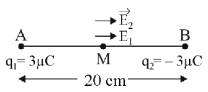
$E _1=\frac{1}{4 \pi \epsilon_0} \frac{q_1}{r^2}$
$=9 \times 10^9 \times \frac{3 \times 10^{-6}}{(0.10)^2} N / C$
$=2.7 \times 10^6 N / C$
The direction of $\overrightarrow{ E }$ will be away from the positive charge i.e. from M towards B .
Similarly, the magnitude of electric field intensity $\vec{E}_2$ due to charge $q_2=-3 \mu C =-3 \times 10^{-6} C$ will be $2.7 \times 10^6$ Newton/Coulomb and the direction of $\overrightarrow{ E }_2$ will be (towards negative charge) i.e. from M towards B .
At point M both $\overrightarrow{ E }_1$ and $\overrightarrow{ E }_2$ are in the same direction. Hence the magnitude of resultant intensity $\overrightarrow{ E }$ at $M$ is equal to the sum of magnitude $\vec{E}_1$ and $\overrightarrow{E_2}$. And its direction will also be from M towards B .
Therefore, $\quad \vec{E}=\vec{E}_1+\vec{E}_2$
$=2.7 \times 10^6+2.7 \times 10^6$
$=5.4 \times 10^6 N / C$
(ii) Charge at point $M , q=1.5 \times 10^{-9} C$
The magnitude of force $\vec{F}$ experienced by the charge can be determined from
$\overrightarrow{ F }=q E$
$\vec{F}=1.5 \times 10^{-9} \times 5.4 \times 10^6$
$\vec{F}=8.10 \times 10^{-3} N$
Since $q$ is positive charge, therefore the direction of force $\vec{F}$ on it will also be in the direction of $\vec{E}$. View full question & answer→Question 234 Marks
Two large, thin metal plates are parallel and close to each other. On their inner faces, the plates have surface charge densities of opposite signs and of magnitude $17.0 \times 10^{-22} C / m ^2$. What is E: (a) in the outer region of the first plate, (b) in the outer re-gion of the second plate, and (c) between the plates?
AnswerGiven :
$\sigma=17 \cdot 0 \times 10^{-22} C / m ^2$
Electric field produced due to layer of charge
$E =\frac{\sigma}{2 \in_0}$
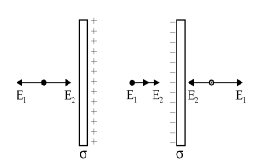
If the electric field due to the positive charge layer is E1 end ,the electric field due to the negative charge layer is E2 then
(a) and (b) Electric field at the outer points of the plates
$E=E_1-E_2$
or$E=\frac{\sigma}{2 \in_0}-\frac{\sigma}{2 \in_0}=0$
(c)$E=\frac{\sigma}{2 \in_0}+\frac{\sigma}{2 \in_0}=\frac{\sigma}{\in_0}$
[From positive to negative plate]
On putting values $E =\frac{17 \times 10^{-}}{8.85 \times 10^{-12}}$
$=1.92 \times 10^{-10} N / C$
View full question & answer→Question 244 Marks
A uniformly charged conducting sphere of 2.4 m diameter has a surface charge density of$80.0 \mu C / m ^2$.
(a) Find the charge on the sphere.
(b) What is the total electric flux leaving the sur-face of the sphere?
Answersurface charge gensity $\sigma=80.0 \mu C m ^{-2}$
$=80 \times 10^{-6} Cm ^{-2}$
R = Radius of charged sphere
$=\frac{2.4}{2}=1.2 m$
(a) $q=$ charge of sphere $=$ ?
charge $q=\sigma \times 4 \pi r^2$
On putting values $g=80 \times 10^{-6} \times 4 \times 3.14 \times(1.2)^2$
$\begin{aligned} q & =80 \times 4 \times 3.14 \times 1.44 \times 10^{-} \\ &
=1446.912 \times 10^{-6}\end{aligned}$
$\begin{aligned} q & =1.446 \times 10^{-3} C
\\ & \cong 1.45 \times 10^{-3} C \end{aligned}$
(b) $\phi$ = Total electric flux coming out from the surface of sphere
$\phi=\frac{q}{\in_0}$
On putting values $\phi=\frac{1.45 \times 10^{-3} C }{8.854 \times 10^{-12} N^{-1} m^{-2} C ^2}$
$=1.64 \times 10^8 Nm ^2 C ^{-1}$
View full question & answer→Question 254 Marks
The electrostatic force on a small sphere of charge $0.4 \mu C$ due to another small sphere of charge $-0.8 \mu C$ in air is 0.2 N (a) What is the distance between the two spheres? (b) What is the force on the second sphere due to the first?
AnswerGiven :
$q_1=0.4 \mu C =0.4 \times 10^{-6} C$
$q_2=0.8 \mu C =0.8 \times 10^{-6} C$
Value of electrostatic force between
$q_1$ and $q_2=0.2 N$
$\frac{1}{4 \pi \in_0}=9 \times 10^9 Nm ^2 C ^{-2}$
(a) On using the formula of electrostatic force between $q_1$ and $q_2$
$F =\frac{1}{4 \pi \in_0} \frac{\left|q_1 q_2\right|}{r^2}$
Or $\quad r^2=\frac{1}{4 \pi \in_0} \frac{\left|q_1 q_2\right|}{ F }$
On putting values
$=\frac{9 \times 10^9 \times 0.4 \times 10^{-6} \times 0.8 \times 10^{-6}}{0.2}$
$=\frac{9 \times 0.4 \times 0.8}{0.2} \times 10^{-3}=\frac{9 \times 4 \times 8}{2}=10^{-4}$
$=144 \times 10^{-4}$
$\therefore \quad r=\sqrt{144 \times 10^{-4}}=12 \times 10^{-2} m$.
Or $\quad r=12 \times 10^{-2} \times 10^2 cm=12 cm$.
(b) Coulomb's law follows Newton's action-reaction law, hence the forces acting on the first charge by the second charge and on the second charge by the first charge are equal in magnitude.
View full question & answer→Question 264 Marks
Figure shows track of three charged particles in a uniform elecrostatic field. Give the signs of the three charges. Which particle has the highest charge to mass ratio?
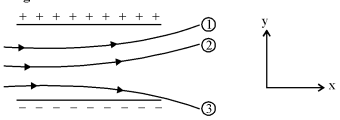
AnswerSince particles (1) and (2) are attracted towards the positive plate, hence they are negatively charged (3). The particle is attracted towards the negative plate, hence it has a positive charge. Here the direction of the electric field is from + ve to -ve towards the plate. If the charge on the particle is q, then the force experienced by it will be $\overrightarrow{ F }=\overrightarrow{q E }$
The direction of the force will be along the direction of $\overrightarrow{ E }$ and perpendicular to the initial direction of motion of the charge.
Therefore the value acceleration produce in the charge
$a=\frac{ F }{ m }$
$a=\frac{qE}{m}$ .....(1)
$\because F =q E$
From IInd equation of motion $S =u t+\frac{1}{2} a t^2$
$S =0+\frac{1}{2} a t^2$
On putting value of $a$ in equation (1)
$S =\frac{1}{2}\left(\frac{q E }{m}\right) t^2$
Since E and t are equal, hence $S \propto\left(\frac{q}{m}\right)$. Since the charged particle (3) is deflected maximum towards vertical hence the value of S is maximum for it. Hence the ratio of mass to charge (specific charge) will be maximum for it.
View full question & answer→Question 274 Marks
(a) Two insulated charged copper spheres A and B have their centres separated by a distance of 50 cm. What is the mutual force of electrostatic repulsion if the charge on each is 6.5 x $10^{-7} C$ ? The radii of A and B are negligible compared to the distance of separation.
(b) What is the force of repulsion if each sphere is charged double the above amount, and the distance between them is halved?
Answer(a) Given:
$\begin{aligned} r & =50 cm=50 \times 10^{-2} m \\ q_1 & =6.5 \times 10^{-7} C \\ q_2 & =6.5 \times 10^{-7} C \\ F & =\frac{1}{4 \pi \in_0} \frac{q_1 q_2}{r^2}\end{aligned}$
On putting values F$=\frac{9 \times 10^9 \times 6.5 \times 10^{-1} \times 6.5 \times 10^{-1}}{\left(50 \times 10^{-2}\right)^2}$
$=\frac{9 \times 6.5 \times 6.5 \times 10^{-5}}{2500 \times 10^{-4}}$
|=$\begin{array}{l}=\frac{9 \times 6.5 \times 6.5 \times 10^{-3}}{25} \\ =15.21 \times 10^{-3}=1.521 \times 10^{-2} N \\ \text { or } 1.52 \times 10^{-2} N \text . \end{array}$
(b) When the amount of charge on each sphere is doubled and the distance between the spheres is halved, then the value of force F will be
F =$F =\frac{1}{4 \pi \in_0} \frac{\left(2 q_1\right)\left(2 q_2\right)}{(r / 2)^2}$
$=16 \times \frac{1}{4 \pi \in_0} \frac{q_1 q_2}{r^2}$
$=16 \times 1.52 \times 10^{-2}$
$=0.24 N$ .
View full question & answer→