Question
Two large, thin metal plates are parallel and close to each other. On their inner faces, the plates have surface charge densities of opposite signs and of magnitude $17.0 \times 10^{-22} C / m ^2$. What is E: (a) in the outer region of the first plate, (b) in the outer re-gion of the second plate, and (c) between the plates?
Answer

Given :
$\sigma=17 \cdot 0 \times 10^{-22} C / m ^2$
Electric field produced due to layer of charge
$E =\frac{\sigma}{2 \in_0}$
Image

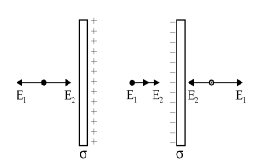
If the electric field due to the positive charge layer is E1 end ,the electric field due to the negative charge layer is E2 then (a) and (b) Electric field at the outer points of the plates
$E=E_1-E_2$
or$E=\frac{\sigma}{2 \in_0}-\frac{\sigma}{2 \in_0}=0$
(c)$E=\frac{\sigma}{2 \in_0}+\frac{\sigma}{2 \in_0}=\frac{\sigma}{\in_0}$
[From positive to negative plate]
On putting values $E =\frac{17 \times 10^{-}}{8.85 \times 10^{-12}}$
$=1.92 \times 10^{-10} N / C$

Need a full question paper?

Generate a complete, print-ready paper with questions like this in minutes — across 16+ boards, with answer keys.

Start Generating Free

Similar questions

$q, 2 q, 3 q$ and $4 q$ Coulomb charges are located at the four corners of a square of side a meter each. Prove that the electric field at its centre will be $4 \sqrt{2} \frac{k q}{a^2} N / C$
The lens maker's formula is a relation that connects focal length of a lens to radii of curvature of two surfaces of the lens and refractive index of the material of the lens. It is $\frac{1}{\text{f}}=(\mu-1)(\frac{1}{\text{R}_1}-\frac{1}{\text{R}_2}),$ where $\mu$ is refractive index of lens material $\text{w.r.t.}$ the medium in which lens is held. As $\mu_\text{v}>\mu_\text{r}$ therefore $\text{f}_\text{r}>\text{f}_\text{v}.$ Mean focal length of lens for yellow colour is $\text{F}=\sqrt{\text{f}_\text{r}\times\text{f}_\text{v}}.$
  1. Focal length of a equiconvex lens of glass $\mu=\frac{3}{2}$ in air is $20\ cm.$ The radius of curvature of each surface is:
  1. $10\ cm$
  2. $-10\ cm$
  3. $20\ cm$
  4. $-20\ cm$
  1. A substance is behaving as convex lens in air and concave in water, then its refractive index is:
  1. Greater than air but less than water.
  2. Greater than both air and water.
  3. Smaller than air.
  4. Almost equal to water.
  1. For a thin lens with radii of curvatures $R_1$ and $R_2,$ refractive index $n$ and focal length $f,$ the factor $(\frac{1}{\text{R}_1}-\frac{1}{\text{R}_2})$ is equal to :
  1. $\frac{1}{\text{f}(\text{n}-1)}$
  2. $\text{f}(\text{n}-1)$
  3. $\frac{(\text{n}-1)}{\text{f}}$
  4. $\frac{\text{n}}{\text{f}(\text{n}-1)}$
  1. A given convex lens of glass $(\mu=\frac{3}{2})$ can behave as concave when it is held in a medium of $\mu$ equal to:
  1. $1$
  2. $\frac{3}{2}$
  3. $\frac{2}{3}$
  4. $\frac{7}{4}$
  1. The radii of curvature of the surfaces of a double convex lens are $20\ cm$ and $40\ cm$ respectively, and its focal length is $20\ cm$. What is the refractive index of the material of the lens?
  1. $\frac{5}{2}$
  2. $\frac{4}{3}$
  3. $\frac{5}{3}$
  4. $\frac{4}{5}$   
(a) Two insulated charged copper spheres A and B have their centres separated by a distance of 50 cm. What is the mutual force of electrostatic repulsion if the charge on each is 6.5 x $10^{-7} C$ ? The radii of A and B are negligible compared to the distance of separation.
(b) What is the force of repulsion if each sphere is charged double the above amount, and the distance between them is halved?
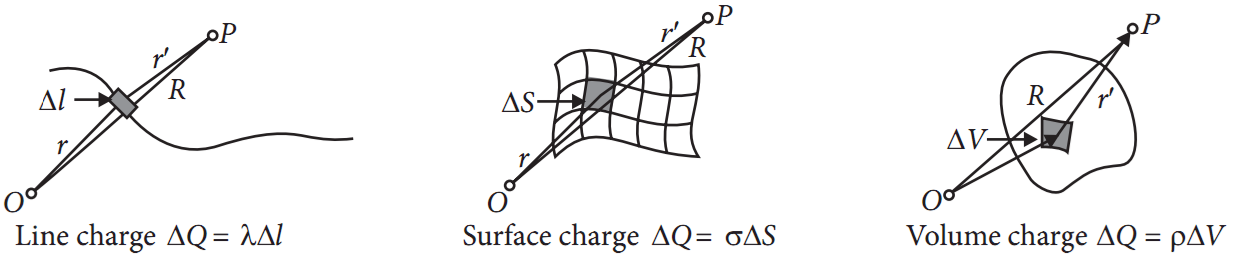
ln practice, we deal with charges much greater in magnitude than the charge on an electron, so we can ignore the quantum nature of charges and imagine that the charge is spread in a region in a continuous manner. Such a charge distribution is known as continuous charge distribution. There are three types of continuous charge distribution : $(i)$ Line charge distribution $(ii)$ Surface charge distribution $(iii)$ Volume charge distribution as shown in figure.
  1. Statement $1$ : Gauss's law can't be used to calculate an electric field near an electric dipole.
Statement $2$ : Electric dipole don't have symmetrical charge distribution.
  1. Statement $1$ and statement $2$ are true.
  2. Statement $1$ is false but statement $2$ is true.
  3. Statement $1$ is true but statement $2$ is false.
  4. Both statements are false.
  1. An electric charge of $8.85 \times 10^{-13}C$ is placed at the centre of a sphere of radius $1m$. The electric flux through the sphere is:
  1. $0.2NC^{-1} m^2$
  2. $0.1NC^{-1} m^2$
  3. $0.3NC^{-1} m^2$
  4. $0.01NC^{-1} m^2$
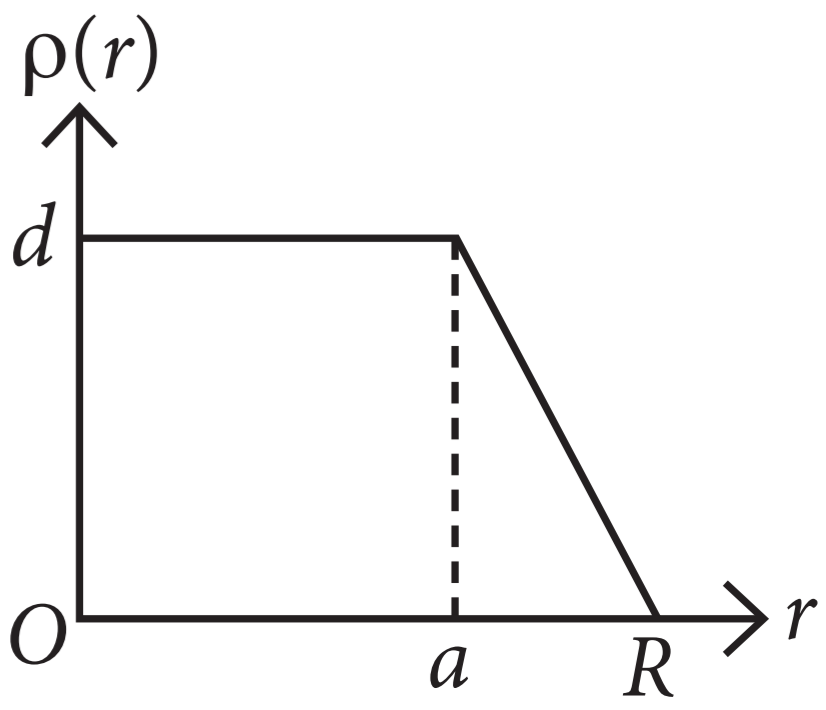
  1. The electric field within the nucleus is generally observed to be linearly dependent on $r$. So,
  1. $a = 0$
  2. $\text{a}=\frac{\text{R}}{2}$
  3. $a = R$
  4. $\text{a}=\frac{\text{2R}}{3}$
  1. What charge would be required to electrify a sphere of radius $25\ cm$ so as to get a surface charge density of $\frac{3}{\pi}\text{Cm}^{-2}?$
  1. $0.75C$
  2. $7.5C$
  3. $75C$
  4. Zero
  1. The $\text{SI}$ unit of linear charge density is :
  1. $Cm$
  2. $Cm^{-1}$
  3. $Cm^{-2}$
  4. $Cm^{-3}$
Explain diffraction by a single slit and write down the conditions for central maximum, secondary maxima and minima.
Suppose in an imaginary world the angular momentum is quantized to be even integral multiples of $\frac{\text{h}}{2\pi}$ What is the longest possible wavelength emitted by hydrogen atoms in visible range in such a world according to Bohr's model?
Establish the expression for equivalent resistance of series combination and parallel combination of resistance separately.
(a) A circular coil of 30 turns and radius 8.0 cm carrying a current of 6.0 A is suspended vertically in a uniform horizontal magnetic field of magnitude 1.0 T. The field lines make an angle of $60^{\circ}$ with the normal of the coil. Calculate the magnitude of the counter torque that must be applied to prevent the coil from turning.
(b) Would your answer change, if the circular coil in (a) were replaced by a planar coil of some irregular shape that encloses the same area? (All other particulars are also unaltered.)
For a single slit of width "a", the first minimum of the interference pattem of a monochromatic light of wavelength$\lambda$. Occurs at an angle of$\frac{\lambda}{\text{a}}$. At the same angle of$\frac{\lambda}{\text{a}},$ we get a maximum for two narrow slits separated by a distance "a". Explain.
A uniform magnetic field of $0.20 \times 10^{-3}$ T exists in the space. Find the change in the magnetic scalar potential as one moves through $50\ cm$ along the field.