Question types

Electric Field and Potential question types

104 questions across 5 question groups — pick any mix to generate a Physics paper with step-by-step answer keys.

104
Questions
5
Question groups
5
Question types
Sample Questions

Electric Field and Potential questions

One sample from each question group in this chapter. Select any group above to see the full set with answer keys.

The electric field and the electric potential at a point are E and V respectively.
  • A
    If E = 0, V must be zero.
  • If V = 0, E must be zero.
  • C
    If $\text{E}\neq0,$ V cannot be zero.
  • D
    If $\text{V}\neq0,$ E cannot be zero.

Answer: B.

View full solution
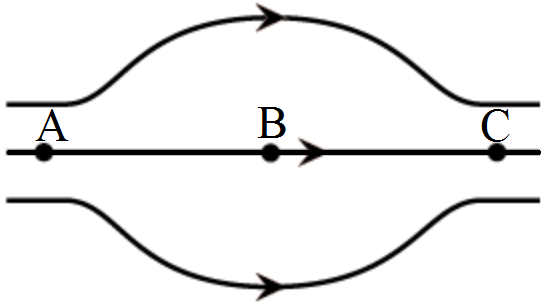
Figure, shows some of the electric field lines corresponding to an electric field. The figure suggests that,
  • A
    $\mathrm{E}_{\mathrm{A}}>\mathrm{E}_8>\mathrm{E}_{\mathrm{e}}$
  • B
    $\mathrm{E}_{\mathrm{A}}=\mathrm{E}_{\mathrm{B}}=\mathrm{E}_{\mathrm{e}}$
  • $ \mathrm{E}_{\mathrm{A}}=\mathrm{E}_{\mathrm{C}}>\mathrm{E}_{\mathrm{B}}$
  • D
    $ \mathrm{E}_{\mathrm{A}}=\mathrm{E}_{\mathrm{C}}<\mathrm{E}_{\mathrm{B}}$

Answer: C.

View full solution
When the separation between two charges is increased the electric potential energy of the charges.
  • A
    Increases.
  • B
    Decreases.
  • C
    Remains the same.
  • May increase or decrease.

Answer: D.

View full solution
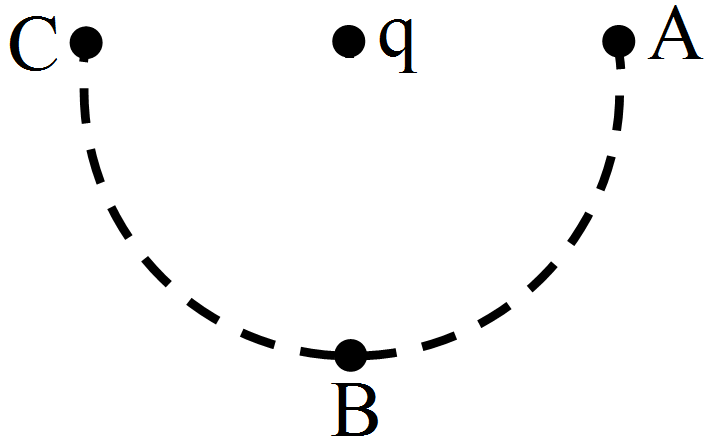
Two equal positive charges are kept at points A and B. The electric potential at the points between A and B (excluding these points) is studied while moving from A to B. The potential.
  • Continuously increases.
  • B
    Continuously decreases.
  • C
    Increases then decreases.
  • D
    Decreases then increases.

Answer: A.

View full solution
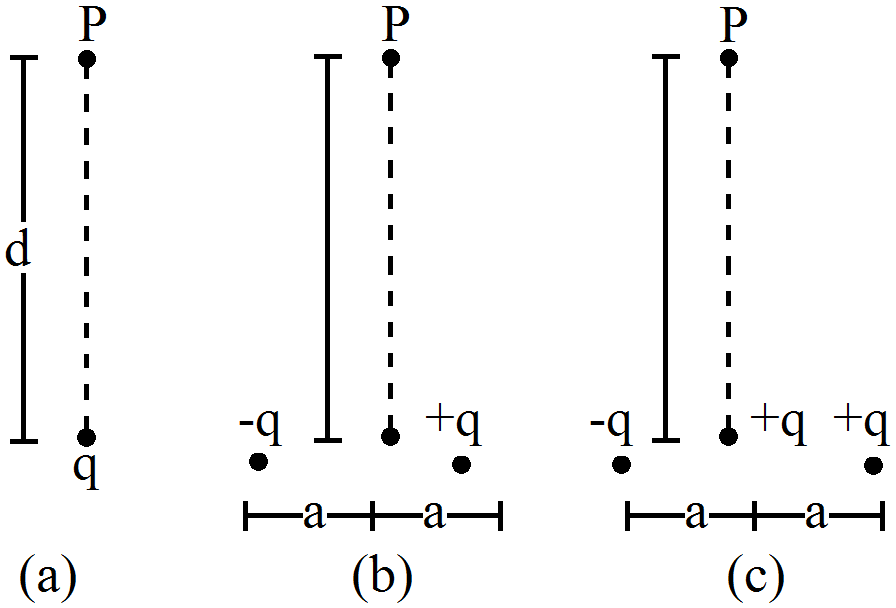
Consider the situation of figure. The work done in taking a point charge from $P$ to A is $W_A$, from $P$ to $B$ is $W_B$ and from $P$ to $C$ is $W_C$.
  • A
    $ W_A $
  • B
    $W_A>W_B>W_C $
  • $W_A=W_B=W_C$
  • D
    None of these.

Answer: C.

View full solution
NaCl molecule is bound due to the electric force between the sodium and the chlorine ions when one electron. of sodium is transferred to chlorine. Taking the separation between the ions to be 2.75 × 10cm, find the force of attraction between them· State the assumptions (if any) that you have made.
View full solution
$\text { A sample of } \mathrm{HCl} \text { gas is placed in an electric field of } 2.5 \times 10^4 \mathrm{NC}^{-1} \text {. The dipole moment of each } \mathrm{HCl} \text { molecule is } 3.4 \times 10^{-30} \mathrm{Cm} \text {. }$ Find the maximum torque that can act on a molecule.
View full solution
Two charged particles are placed at a distance 1.0cm apart. What is the minimum possible magnitude of the electric force acting on each charge?
View full solution
Two charged particles having charge $2.0 × 10^{-8}\ C$ each are joined by an insulating string of length 1m and the system is kept on a smooth horizontal table. Find the tension in the string.
View full solution
A circular wire-loop of radius a carries a total charge Q distributed uniformly over its length. A small length dL of the wire is cut off. Find the electric field at the centre due to the remaining wire.
View full solution
A hydrogen atom contains one proton and one electron. It may be assumed that the electron revolves in a circle of radius 0.53 angstrom (1 angstrom $= 10^{-10}m$ and is abbreviated as A) with the proton at the centre. The hydrogen atom is said to be in the ground state in this case. Find the magnitude of the electric force between the proton and the electron of a hydrogen atom in its ground state.
View full solution
The electric force experienced by a charge of $1.0 \times 10^{-6} \mathrm{C}$ is $1.5 \times 10^{-3} \mathrm{~N}$. Find the magnitude of the electric field at the position of the charge.
View full solution
Q 163 Marks Question3 Marks
Two particles have equal masses of 5.0g each and opposite charges of $+4.0 \times 10^{-5}\ C$ and $-4.0 \times 10^{-5}C.$ They are released from rest with a separation of 1.0m between them. Find the speeds of the particles when the separation is reduced to 50cm.
View full solution
Q 173 Marks Question3 Marks
Assume that each atom in a copper wire contributes one free electron. Estimate the number of free electrons in a copper wire having a mass of 6.4g (take the atomic weight of copper to be $64g\  mol^{-1}.$
View full solution
Q 183 Marks Question3 Marks
A charge of 1.0C is placed at the top of your college building and another equal charge at the top of your house. Take the separation between the two charges to be 2.0km. Find the force exerted by the charges on each other. How many times of your weight is this force?
View full solution
Q 193 Marks Question3 Marks
A water particle of mass 10.0mg and having a charge of $1.50 \times 10^{-6} C$ stays suspended in a room. What is the magnitude of electric field in the room? What is its direction?
View full solution
A particle of mass 1g and charge $2.5 \times 10^{-4}C$ is released from rest in an electric field of $1.2 \times 10^4NC^{-1}.$​​​​​​​
  1. Find the electric force and the force of gravity acting on this particle. Can one of these forces be neglected in comparison with the other for approximate analysis?
  2. How long will it take for the particle to travel a distance of 40cm?
  3. What will be the speed of the particle after travelling this distance?
  4. How much is the work done by the electric force on the particle during this period?
View full solution
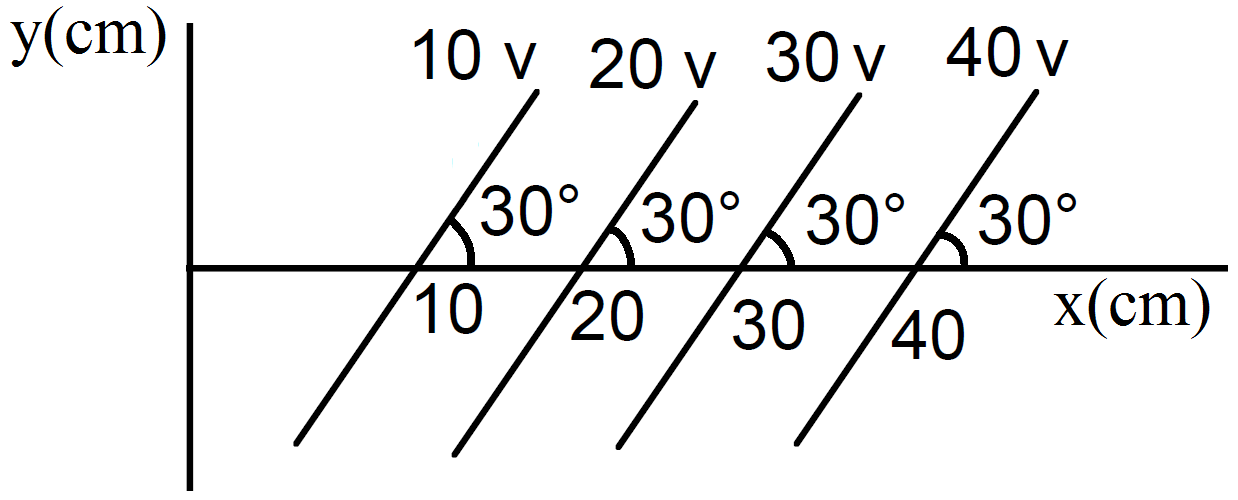
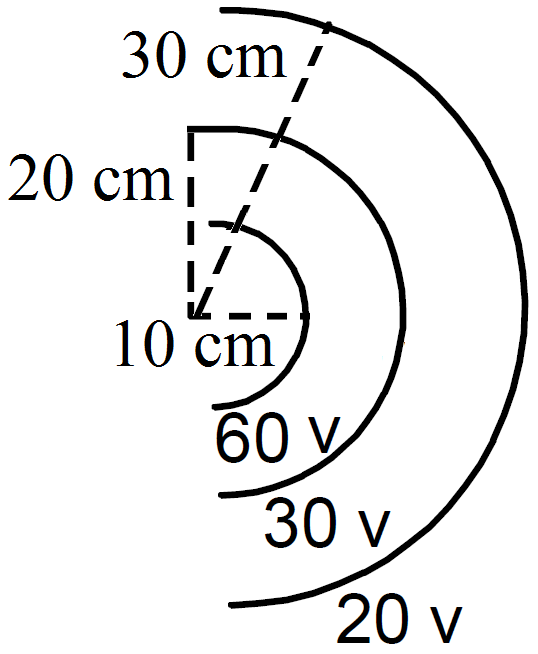
The electric potential existing m space is V(x, y, z) = A(xy + yz + zx).
  1. Write the dimensional formula of A.
  2. Find the expression for the electric field.
  3. If A is 10 SI units, find the magnitude of the electric field at (1m, 1m, 1m).
View full solution

Generate a Electric Field and Potential paper free

Pick question groups from the list above, set marks and difficulty, and export a branded PDF with step-by-step answer keys. First 3 chapters free — no signup.

Download App