Question
Assume that each atom in a copper wire contributes one free electron. Estimate the number of free electrons in a copper wire having a mass of 6.4g (take the atomic weight of copper to be $64g\  mol^{-1}.$

Answer

64 grams of copper have 1 mole
6.4 grams of copper have 0.1 mole
1 mole = No atoms
0.1 mole = (no × 0.1) atoms
$= 6 \times 10^{23}\times 0.1$ atoms $= 6 \times 10^{22} $ atoms
1 atom contributes 1 electron
$6 \times 10^{22}$ atoms contributes $6 \times 10^{22} $ electrons.

Need a full question paper?

Generate a complete, print-ready paper with questions like this in minutes — across 16+ boards, with answer keys.
Start Generating Free

Similar questions

How much energy is released in the following reaction?
$\text{ }^7\text{Li + p}\rightarrow\alpha+\alpha.$
Atomic mass of $^7Li = 7.0160u$ and that of $^4He = 4.0026u.$
  1. Describe the working of photodiode by drawing the circuit diagram.
  2. Draw the characteristics of a photodiode for different illumination intensities.
  3. Why is photodiode operated in reverse bias even though the reverse bias current is much weaker than the current in forward bias?
A ball of mass 0.50kg moving at a speed of 5.0m/s collides with another ball of mass 1.0kg. After the collision the balls stick together and remain motionless. What was the velocity of the 1.0kg block before the collision?
Explain Electro static potential energy.
Draw the intensity distributions for (i) the fringes produced in interference, and (ii) the diffraction bands produced due to single slit. Write two points of difference between the phenomena of interference and diffraction.
Would the Bohr formula for the H-atom remain unchanged if proton had a charge (+4/3)e and electron a charge (-3/4)e, where $e = 1.6 \times 10^{-19}C.$ Give reasons for your answer?
Indium antimonide has a band gap of 0.23eV between the valence and the conduction band. Find the temperature at which kT equals the band gap.
A long, straight wire carries a current. Is Ampere's law valid for a loop that does not enclose the wire? That encloses the wire but is not circular?
If both the number of protons and number of neutrons are conserved in each nuclear reaction, in what way is mass converted into energy (or vice-versa) in a nuclear reaction?
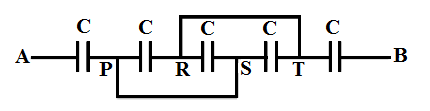
  1. Find equivalent capacitance between A and B in the combination given below. Each capacitor is of 2 μF capacitance.
  1. If a dc source of 7 V is connected across AB, how much charge is drawn from the source and what is the energy stored in the network?