Questions

M.C.Q (1 Marks)

Take a timed test

22 questions · 4 auto-graded MCQ + 18 self-marked written.

Question 11 Mark
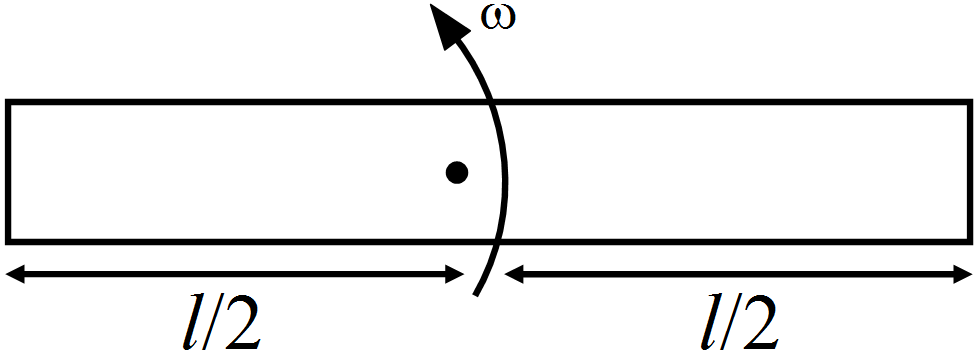
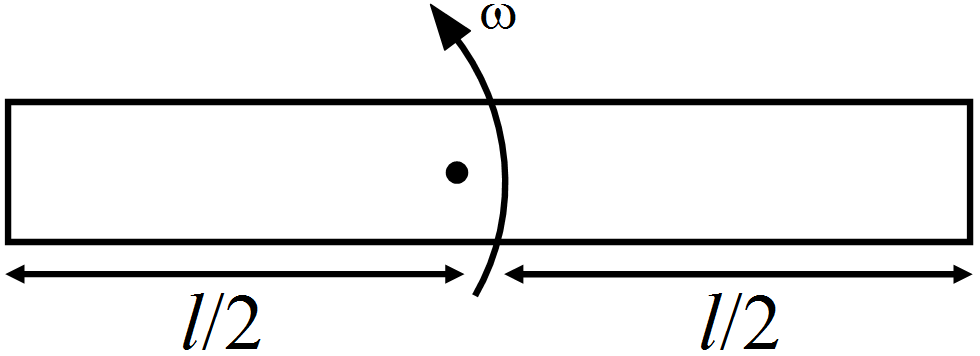
 A rod of length l rotates with a small but uniform angular velocity $\omega$ about its perpendicular bisector. A uniform magnetic field B exists parallel to the axis of rotation. The potential difference between the centre of the rod and an end is:
  1. $\text{zero}$
  2. $\frac{1}{8}\omega\text{Bl}^2$
  3. $\frac{1}{2}\omega\text{Bl}^2$
  4. $\text{B}\omega\text{l}^2$ 
Answer
  1. $\frac{1}{8}\omega\text{Bl}^2$
Explanation:

Take a small element dx at a distance of 'x' centre
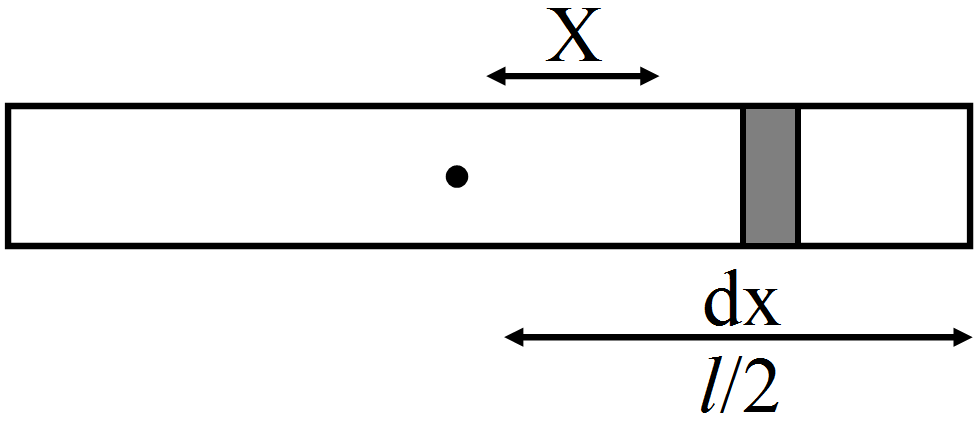
 $\text{Þ}\text{d}\in\int_{0}^{\frac{1}{2}}\text{B}\omega\text{x}\text{dx}=\frac{\text{B}\omega\text{x}^2}{2}\Big|_{0}^{\frac{1}{2}}$
$\in=\frac{1}{8}\omega\text{Bl}^2$
View full question & answer
MCQ 21 Mark
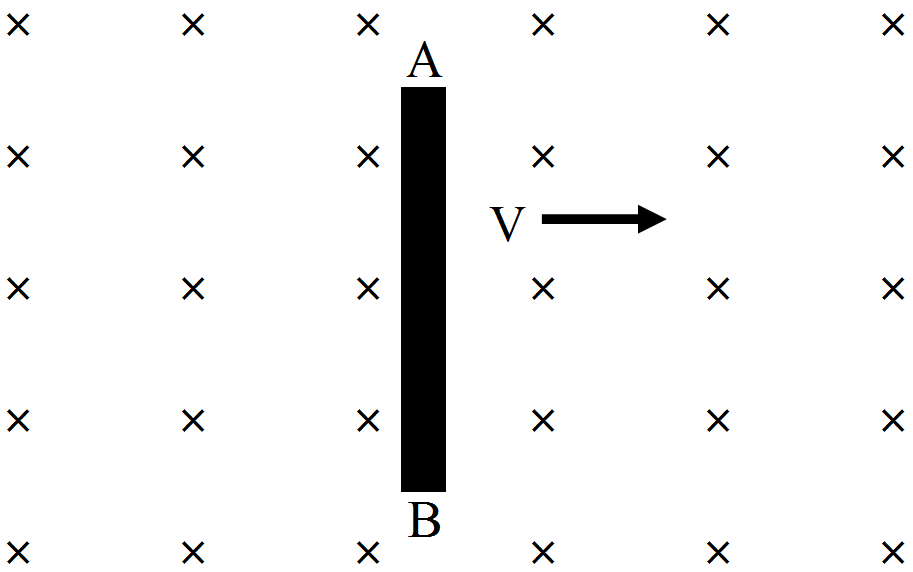
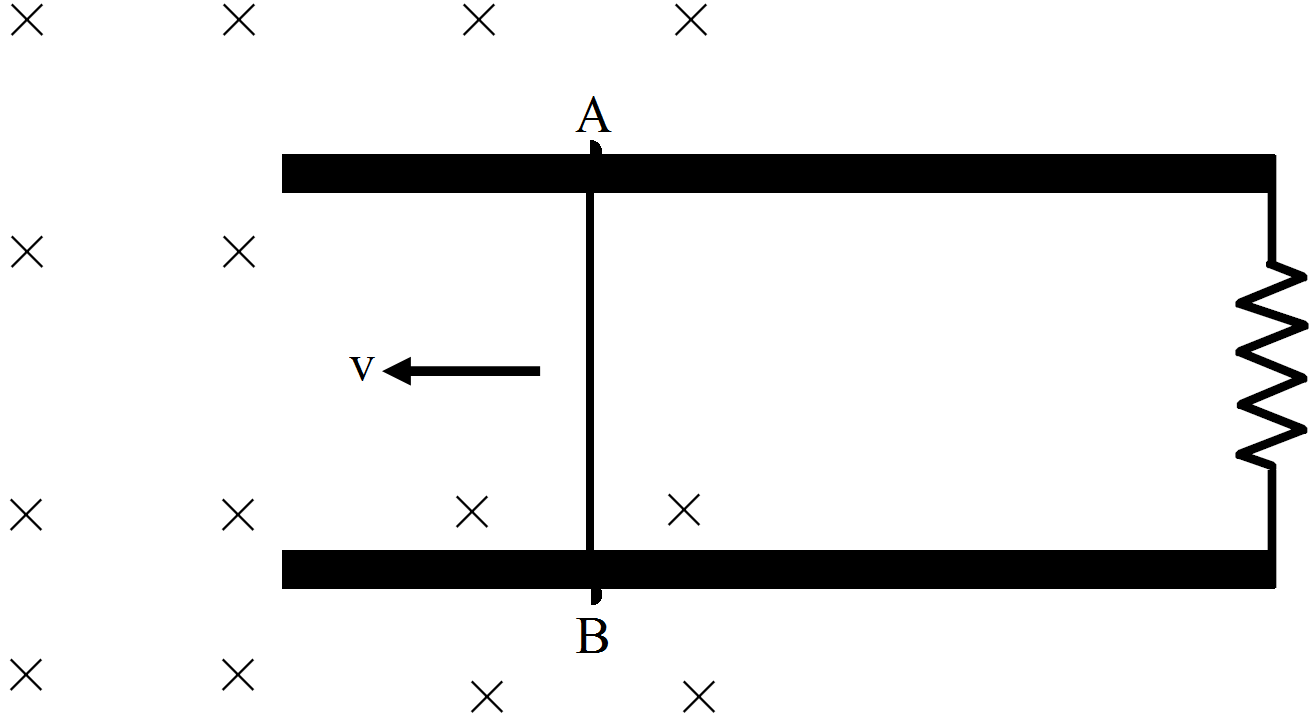
A rod $AB$ moves with a uniform velocity $v$ in a uniform magnetic field as shown in figure.
  • A
    The rod becomes electrically charged.
  • B
    The end $A$ becomes positively charged.
  • The end $B$ becomes positively charged.
  • D
    The rod becomes hot because of Joule heating.
Answer
Correct option: C.
The end $B$ becomes positively charged.
The end '$A$' becomes, positively charged.
Because magnetic field exerts an average Force $\overrightarrow{\text{F}}_0=\text{q}\vec{\text{v}}\times\vec{\text{B} } n$ each free electron where $q = 1. 6 \times 10^{19}C$ is the charge on the electron.
This Force is towards $AB$ and hence the free electrons will move towareds $B$. Negative charge is accumulated at $'B'$ and positive charge appears at $A$.
View full question & answer
Question 31 Mark
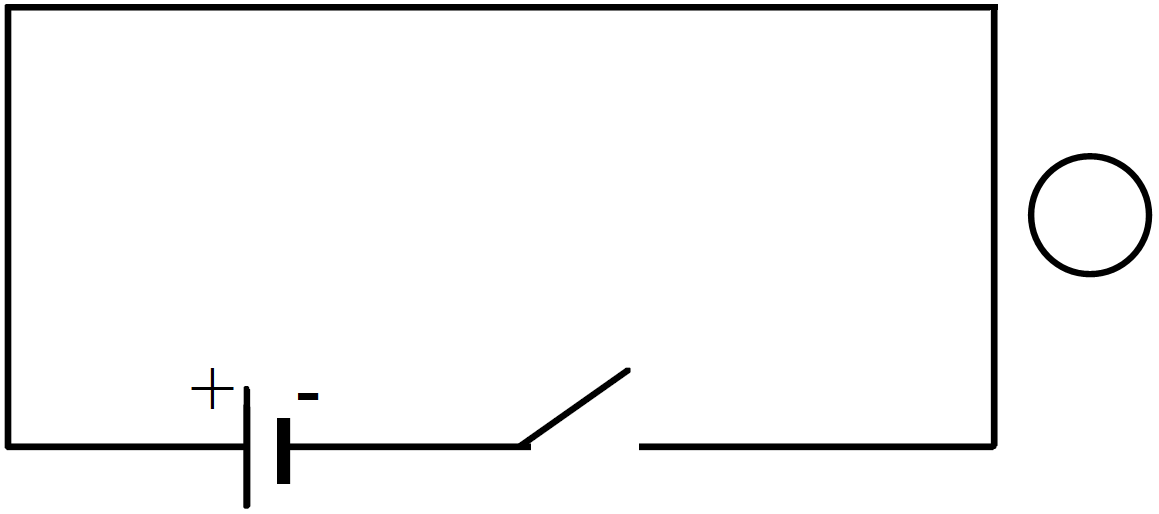
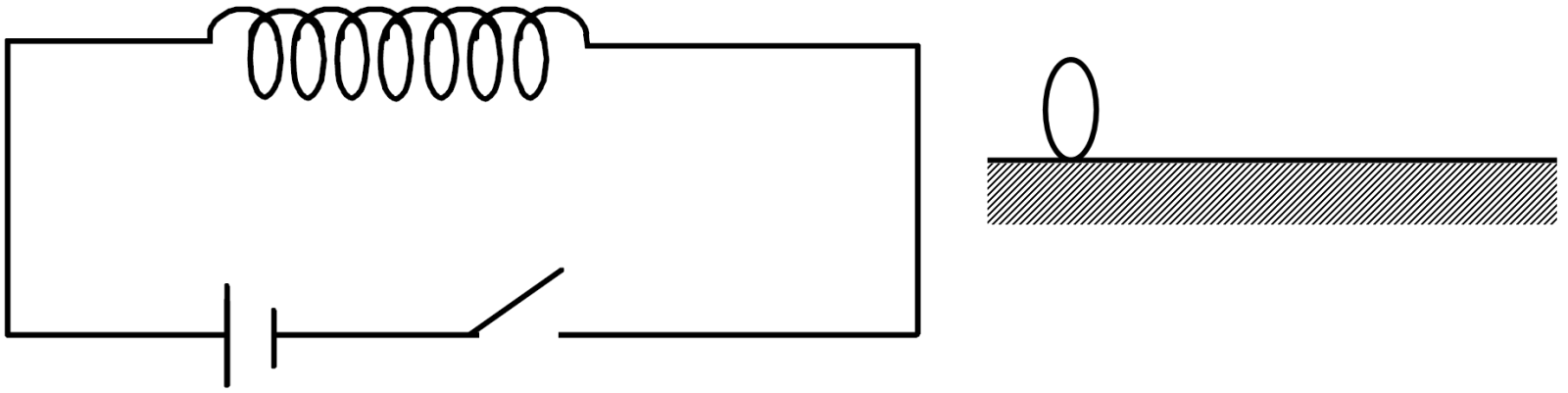
Consider the situation shown in figure. If the switch is closed and after some time it is opened again, the closed loop will show:
  1. An anticlockwise current-pulse.
  2. A clockwise current-pulse.
  3. An anticlockwise current-pulse and then a clockwise current-pulse.
  4. A clockwise current-pulse and then an anticlockwise current-pulse.
Answer
  1. A clockwise current-pulse and then an anticlockwise current-pulse.
Explanation:

When the switch is closed than a clock wise current pulse generated (Because initially current flow the terminal to negative terminal).
Due to Mutual Induction, current is generated in the loop. If circuit is open after some time. Dut to loop an anticlock wise current pulse generated in the circuit.
View full question & answer
Question 41 Mark
Consider the following statements:
  1. An emf can be induced by moving a conductor in a magnetic field.
  2. An emf can be induced by changing the magnetic field.
  1. Both A and B are true.
  2. A is true but B is false.
  3. B is true but A is false.
  4. Both A and B are false.
Answer
  1. Both A and B are true.
Explanation:
Þ An emf con be induced by moving a condcutor in a magnetic field.
$\hat{\text{I}}=\text{Bvl}$
Þ An emf can be induced by charging the magnetic field.
$\in=\frac{-\text{d}\phi}{\text{dt}} \phi\rightarrow\text{flux}$
View full question & answer
Question 51 Mark
A conducting loop is placed in a uniform magnetic field with its plane perpendicular to the field. An emf is induced in the loop if:
  1. It is translated.
  2. It is rotated about its axis.
  3. It is rotated about a diameter.
  4. It is deformed.
Answer
  1. It is rotated about a diameter.
  2. It is deformed.
​​​​​​​Explanation:
þ An emf is induced in the loop is it is rotated about a diameter
þ An emf is induced in the loop if it is deformed.
View full question & answer
MCQ 61 Mark
The switches in figure are closed at $t = 0$ and reopened after a long time at $t = t_0:$
  • A
    The charge on $C$ just after $t = 0$ is $\epsilon\text{C}.$
  • B
    The charge on $C$ long after $t = 0$ is $\epsilon\text{C}.$
  • C
    The current in $L$ just before $t = t_{0 }$ is $\frac{\epsilon}{\text{R}}.$
  • $B$ and $C$ both
Answer
Correct option: D.
$B$ and $C$ both

$þ$ long time after capacitor is fully charged is equal to
$\text{Q}=\text{CV}=\text{C}\hat{\text{I}}$
$\text{Q}=\text{C}\hat{\text{I}}\Big(1-\text{e}^{-\frac{\text{t}}{\text{t}}}\Big)$
$þ$ The current in $'L\ '$ just before $t = t_0$ is
$\text{i}=\frac{\hat{\text{I}}}{\text{R}}\Big(1-\text{e}^{-\frac{\text{t}}{\text{t}}}=\frac{\hat{\text{I}}}{\text{R}}\Big)$
View full question & answer
MCQ 71 Mark
A small, conducting circular loop is placed inside a long solenoid carrying a current. The plane of the loop contains the axis of the solenoid. If the current in the solenoid is varied, the current induced in the loop is:
  • A
    Clockwise.
  • B
    Anticlockwise.
  • Zero.
  • D
    Clockwise or anticlockwise depending on whether the resistance in increased or decreased.
Answer
Correct option: C.
Zero.
The angle between magnetic field and area vector is $90^\circ$ , so the flux associated with coil is zero.
Although magnetic field is changing but flux is remaining constant equal to zero, so emf induced and hence current in the loop is equal to zero.
View full question & answer
Question 81 Mark
A metal sheet is placed in front of a strong magnetic pole. A force needed to:
  1. Hold the sheet there if the metal is magnetic.
  2. Hold the sheed there if the metal is nonmagnetic.
  3. Move the sheet away from the pole with uniform velocity if the metal is magnetic.
  4. Move the sheet away from the pole with uniform velocity if the metal is nonmagnetic. Negative any effect if oaramagnetism, diamagnetism and gravity.
Answer
  1. Hold the sheet there if the metal is magnetic.
  1. Move the sheet away from the pole with uniform velocity if the metal is magnetic.
  2. Move the sheet away from the pole with uniform velocity if the metal is nonmagnetic. Negative any effect if oaramagnetism, diamagnetism and gravity.
View full question & answer
Question 91 Mark
A bar magnet is moved along the axis of a copper ring placed far away from the magnet, Looking from the side of the magnet an anticlockwise current is found to be induced in the ring. Which of the following may be true?
  1. The south pole faces the ring and the magnet moves towards it.
  2. The north pole faces the ring and the magnet moves towards it.
  3. The south pole faces the ring and the magnet moves away from it.
  4. The north pole faces the ring and the manget moves away from it.
Answer
  1. The north pole faces the ring and the magnet moves towards it.
  2. The south pole faces the ring and the magnet moves away from it.
Explanation:
þ The north pole faces the ring and the magnet moves towards it.
þ The south pole faces the ring and the magnet moves away from it.
View full question & answer
Question 101 Mark
A constant current i is maintained in a solenoid. Which of the following quantities will increase if an iron rod is inserted in the soleniod along axis?
  1. Magnetic field at the centre.
  2. Mangetic flux linked with the solenoid.
  3. Self-inductance of the solenoid.
  4. Rate of Joule heating.
Answer
  1. Magnetic field at the centre.
  2. Mangetic flux linked with the solenoid.
  3. Self-inductance of the solenoid.
View full question & answer
MCQ 111 Mark
Two solenoids have identical geometrical construction but one is made of thick wire and the other of thin wire. Which of the following quantities are different for the two solenoids?
  • A
    Self$-$inductance.
  • Rate of Joule heating if the same current goes through them.
  • C
    Magnetic field energy if the same current goes through them.
  • D
    Time constant if one solenoid is connected to one battery and the other is connected to another battery.
Answer
Correct option: B.
Rate of Joule heating if the same current goes through them.
$\text{R}=\frac{\rho\text{l}}{\text{A}}$
$A -$ Crossectional Area
Thick wire $"A"$ is large than thin wire.
$þ$ time constant
$þ \tau=\frac{\text{L}}{\text{R}}$
$þ$ Power dissipatedin Heating $=\text{I}^2\text{R}$
View full question & answer
Question 121 Mark
A conducting rod is moved with a constant velocity v in a magnetic field. A potential difference appears across the two ends:
  1. If $\vec{\text{v}}\parallel\vec{\text{l}}$
  2. If $\vec{\text{v}}\parallel\vec{\text{B}}$
  3. If $\vec{\text{l}}\parallel\vec{\text{B}}$
  4. None of these.
Answer
  1. None of these.
​​​​​​​Explanation:
Potential difference appears across the two ends $=\text{Bvl}$
$\text{v}^\hat{}\text{B}, \ \text{v}^\hat{}\text{I}, \ \text{I}^\hat{}\text{B}$
View full question & answer
Question 131 Mark
An LR circuit with a battery is connected at t = 0. Which of the following quantities is not zero just after the connection?
  1. Current in the circuit.
  2. Magnetic field energy in the inductor.
  3. Power delivered by the battery.
  4. Emf induced in the inductor.
Answer
  1. Emf induced in the inductor.
Explanation:
Current will be zero at t = 0+
if the current is zero magnetic field will be zero at t = 0+
power delivered will be zero at t = 0+
The EMF induced will be equal to the applied voltage in the inductor to oppose the current.
View full question & answer
Question 141 Mark
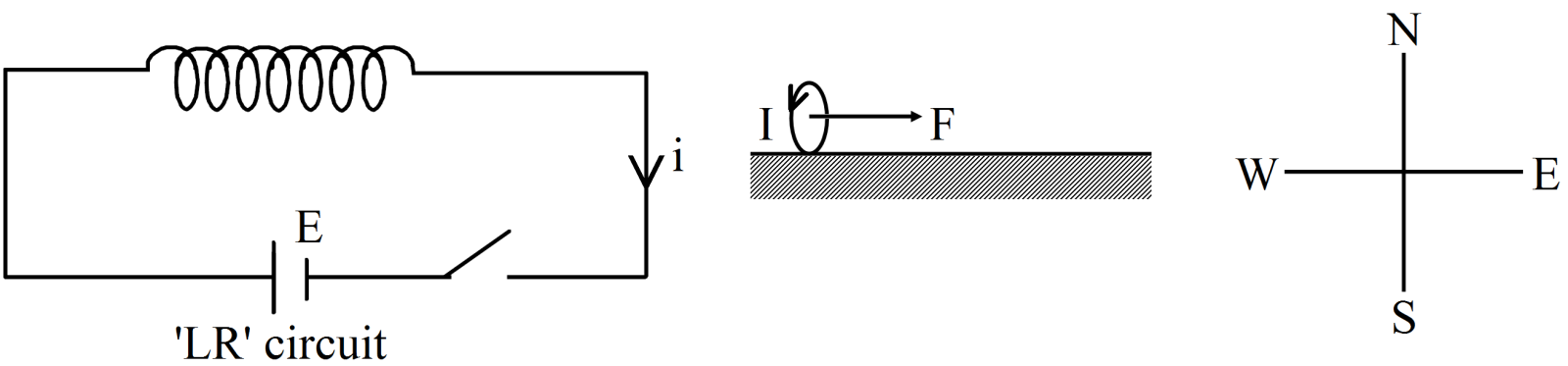
Figure shows a horizontal solenoid connected to a battery and a switch. A copper ring is placed on a frictionless track, the axis of the ring being along the axis of the solenoid. As the switch is closed, the ring will:
  1. Remain stationary.
  2. Move towards the solenoid.
  3. Move away from the solenoid.
  4. Move towards the solenoid or away from it depending on which terminal (positive or negative) of the battery is connected to the left end of the solenoid.
Answer
  1. Move away from the solenoid.
Explanation:

$\text{e}=-\text{L}\frac{\text{di}}{\text{dt}}$
Current flow in the CKt is clock wise direction, due to Mutual Induction current flow in the loop anti clockwise direction. The net force applied on the loop in east direction. So we can say that the ring will move away from the solenoid.
View full question & answer
Question 151 Mark
A rod of legth l rotates with a uniform angular velocity $\omega$ about its perpendicular bisector. A uniform magnetic field B exists parallel to the axis of rotation. The potential difference between the two ends of the rod is:
  1. $\text{zero}$
  2. $\frac{1}{2}\text{Bl}\omega^2$
  3. $\text{Bl}\omega ^2$
  4. $2\text{B}\text{l}\omega^2$ 
Answer
  1. $\text{zero}$
Explanation:

Emf at both end is same $=\frac{1}{8}\text{Bwl}^2$
So the potential difference between the two ends of therod is zero.
View full question & answer
Question 161 Mark
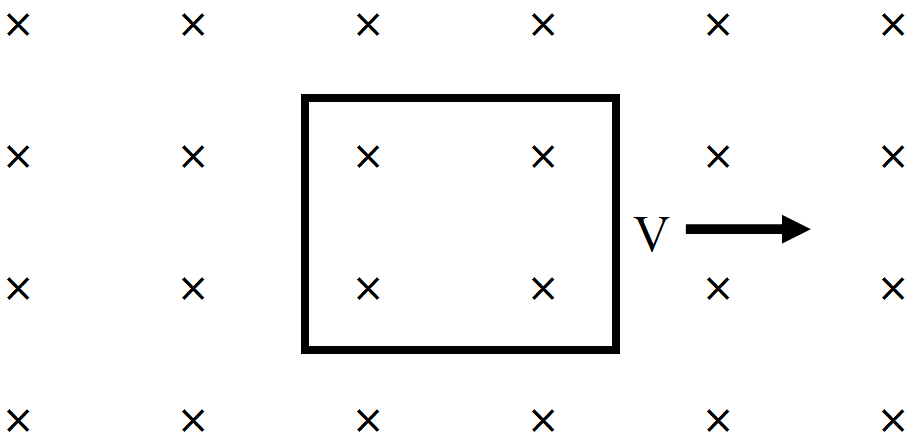
A conducting square loop of side l and resistance R moves in its plane with a uniform velocity u perpendicular to one of its sides. A uniform and constant magnetic field B exists along the perpendicular to the plane of the loop as shown in figure. The current induced in the loop is:
  1. $\frac{\text{Blv}}{\text{R}}$ clockwise.
  2. $\frac{\text{Blv}}{\text{R}}$ anticlockwise.
  3. $\frac{2\text{Blv}}{\text{R}}$ anticlockwise.
  4. $\text{Zero.}$
Answer
  1. $\text{Zero.}$
Explanation:
Induced emf is AB is Bvl and Induced emf is DC is also Bvl.
Net emf in the closed circuit (loop) is zero.
So induced current in the loop is zero.
View full question & answer
Question 171 Mark
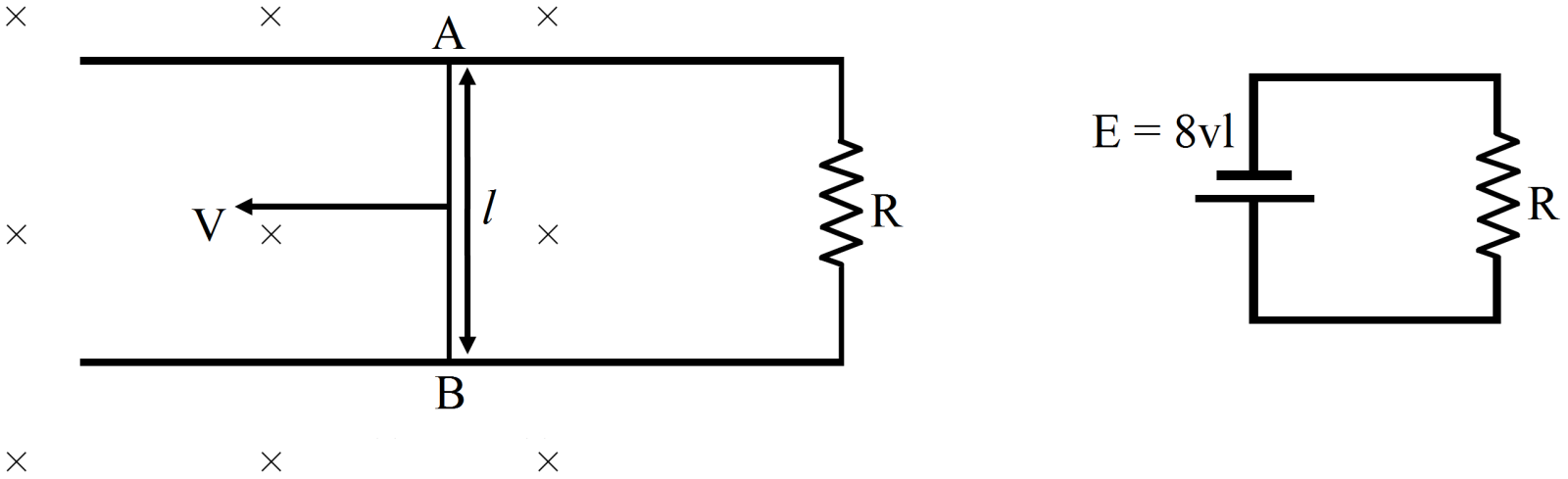
Consider the situation shown in figure. The wire AB is slid on the fixed rails with a constant velocity. If the wire AB is replaced by a semicircular wire, the magnitude of the induced current will: 
  1. Increase.
  2. Remain the same.
  3. Decrease.
  4. Increase or decrease depending on whether the semicircle bulges towards the resistance or away from it.
Answer
  1. Remain the same.
Explanation:

E = Bvl
If the wire AB is replaced by a semicircular wire, the magnitude of the induced current will be same. Because it is depend on the velcoty & lenght of the wire.
View full question & answer
Question 181 Mark
Two circular loops of equal radii are placed coaxially at some separation. The first is cut and a battery is inserted in between to drive a current in it. The current c~anges slightly because of the variation in resistance with temperature. During this period, the two loops:
  1. Attract each other.
  2. Repel each other.
  3. Do not exert any force on each other.
  4. Attract or repel each other depending on the sense of the current.
Answer
  1. Attract each other.
Explanation:
Due to Mutual induction, current is generated in second loop and that causes the two loops attract each other.
View full question & answer
Question 191 Mark
L, C and R represent the physical quantities inductance, capacitance and resistance respectively. Which of the following combinations have dimensions of frequency?
  1. $\frac{1}{\text{RC}}$
  2. $\frac{\text{R}}{\text{L}}$
  3. $\frac{1}{\sqrt{\text{LC}}}$
  4. $\text{C}/\text{L}$
Answer
  1. $\frac{1}{\text{RC}}$
  2. $\frac{\text{R}}{\text{L}}$
  3. $\frac{1}{\sqrt{\text{LC}}}$
Explanation:
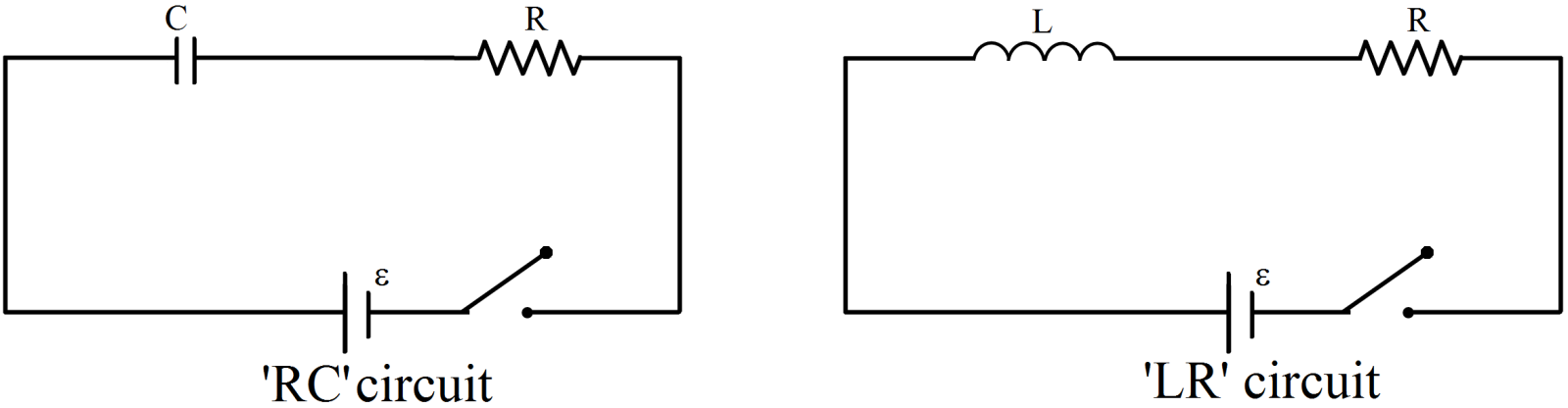
þ Time constant t = RC in RC circuit
frequency $=\frac{1}{\tau}=\frac{1}{\text{RC}} \ ...(\text{i})$
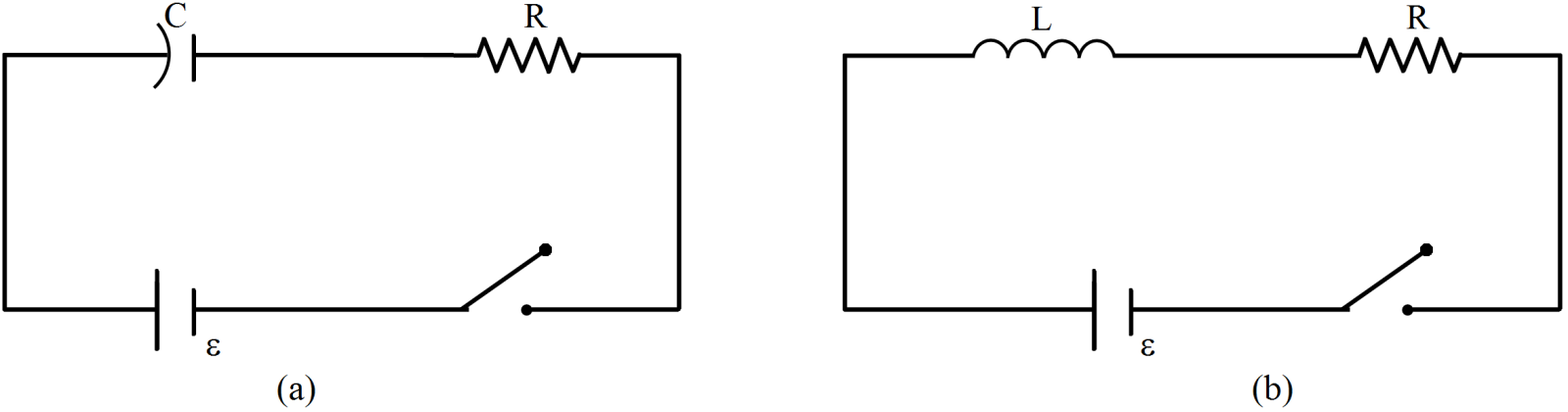
þ Time constant in LR circuit is $\tau=\frac{\text{L}}{\text{RC}}$
frequency $\frac{1}{\tau}=\frac{\text{R}}{\text{L}} \ ...(\text{ii})$
þ eq. (i) & (ii) multiply
frequency $=\frac{1}{\text{LC}}$
frequency $=\frac{1}{\sqrt{2\text{C}}}$
View full question & answer
Question 201 Mark
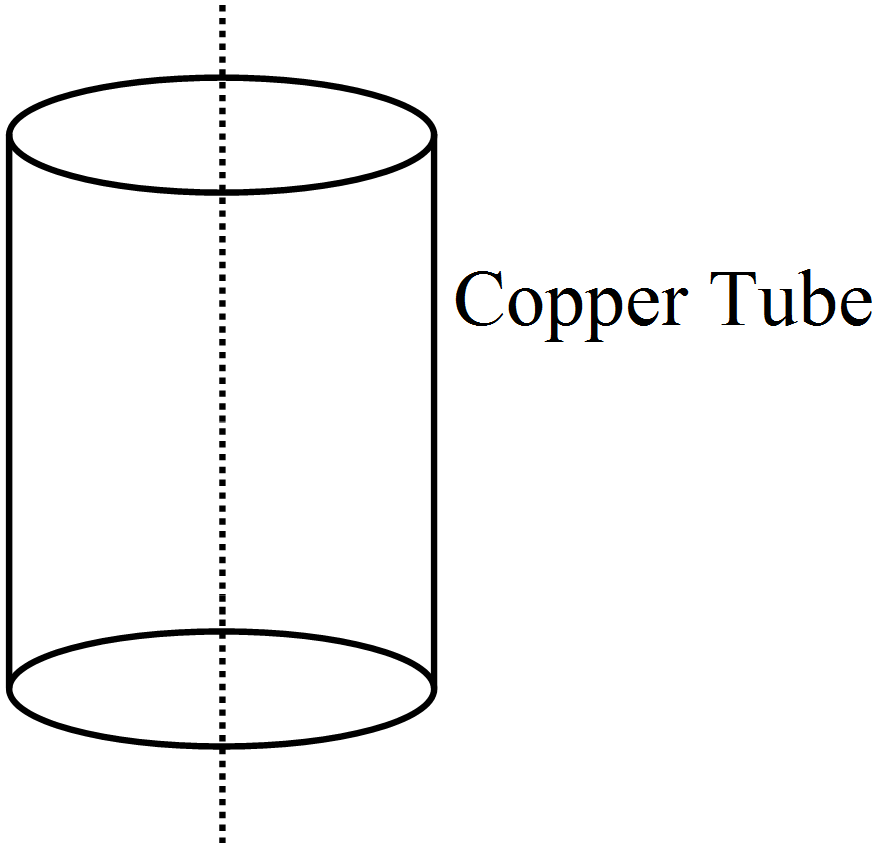
A bar magnet is released from rest along the axis of a very long, vertical copper tube. After some time the magnet:
  1. Will stop in the tube.
  2. Will move with almost content speed.
  3. Will move with an acceleration g.
  4. Will oscillate.
Answer
  1. Will move with almost content speed.
Explanation:

After sometime the Magnet will move with almost contant speed.
View full question & answer
Question 211 Mark
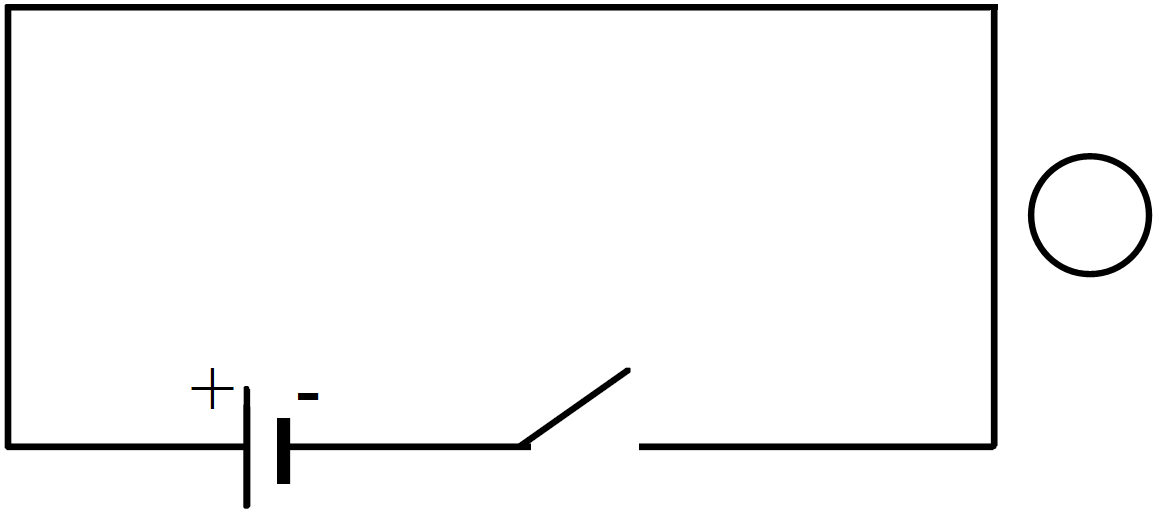
Solve the previous question if the closed loop is completely enclosed in the circuit containing the switch.
  1. An anticlockwise current-pulse.
  2. A clockwise current-pulse.
  3. An anticlockwise current-pulse and then a clockwise current-pulse.
  4. A clockwise current-pulse and then an anticlockwise current-pulse.
Answer
  1. An anticlockwise current-pulse and then a clockwise current-pulse.
Explanation:
An anticlockwise current-pulse generated and then a clock-wise current pulse.
View full question & answer
Question 221 Mark
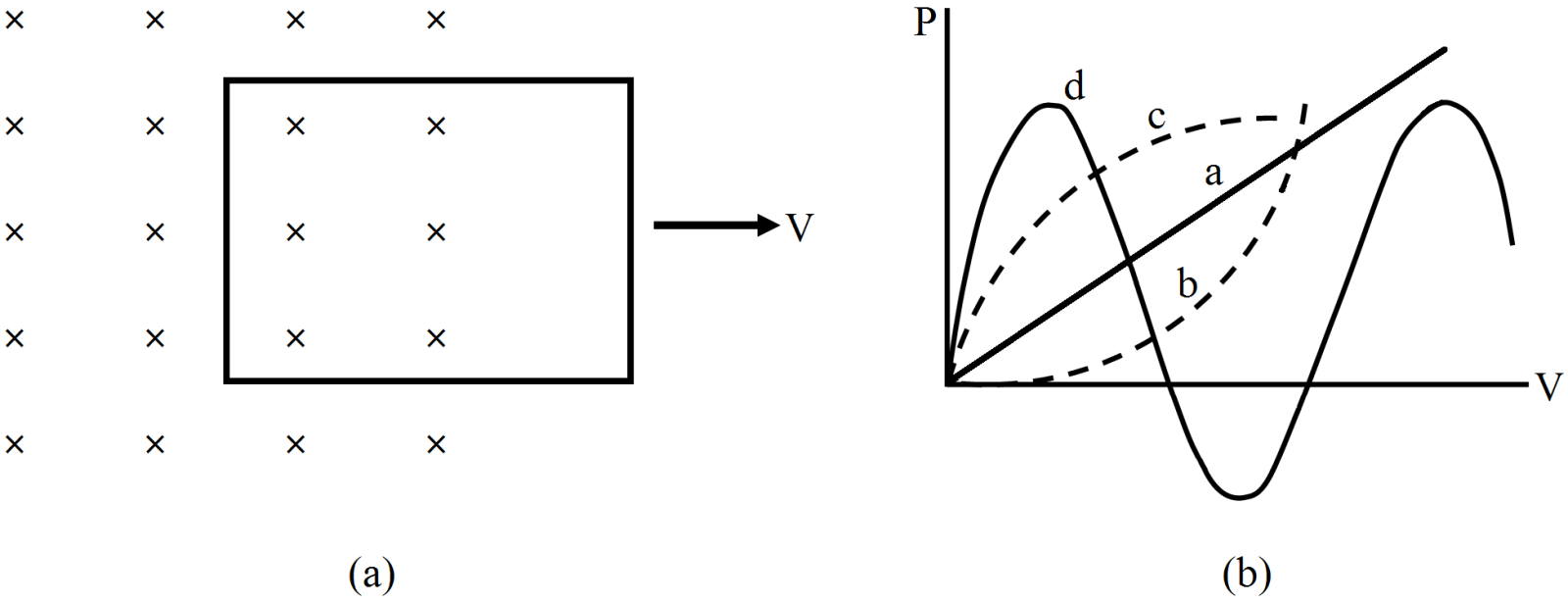
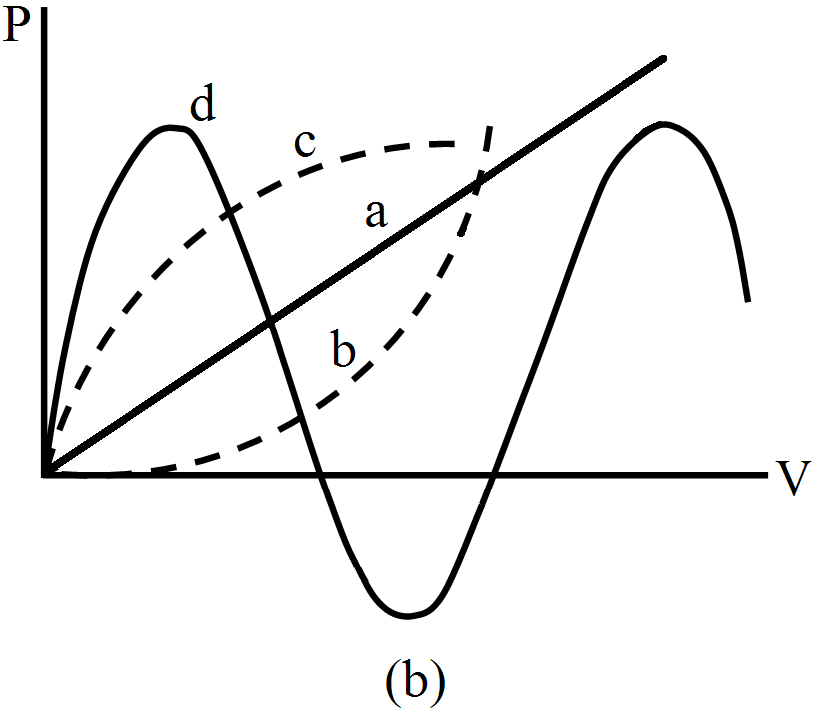
Figure shows a conducting loop being pulled out of a magnetic field with a speed u. Which of the four plots shown in figure may represent the power delivered by the pulling agent as a function of the speed u?
Answer
  1.  

Explanation:
$\in=\text{Bvl}$
Power $=\frac{\text{v}^2}{\text{R}}=\frac{\in^2}{\text{R}}=\frac{\text{B}^2\text{v}^2\text{l}^2}{\text{R}}$
P → Power
v → velocity
B → Magnetic field
Here, $\text{P}\times\text{v}^2$
View full question & answer