Questions

4 Marks Questions

Take a timed test

4 questions · self-marked practice — reveal the answer and mark yourself.

Question 14 Marks
(a) Define mutual inductance and write its S.I. unit.
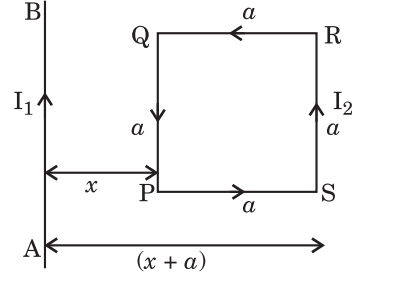
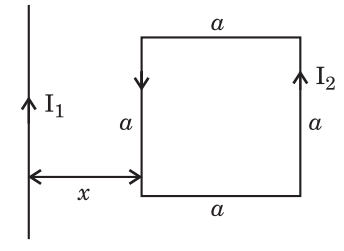
(b) A square loop of side 'a' carrying a current $I_{2}$ is kept at distance x from an infinitely long straight wire carrying a current $I_{1}$ as shown in the figure. Obtain the expression for the resultant force acting on the loop.
Image
View full question & answer
Question 24 Marks
Define self-inductance and write its S.I. unit. Find the self inductance for a solenoid of N turns, length $l$ and radius $r$.
Answer
The self inductance is defined as the emf induced in the coil, when the rate of change of current in the coil is $l$ ampere/second. The SI unit of self inductance is henry (H).
Let a solenoid of length/and area of cross section A consists of N number of turns. Then the number of turns per unit length of the solenoid is $n=N/l$
Then magnetic field, well inside the solenoid is
$B=\mu_{0}nI=\mu_{0}(\frac{N}{l})I$ ...(i)
where $\mu_{0}$ is the permitivity of the air filling the core of the inductor and its value is $4\pi \times 10^{-7} Hm^{-1}$
The magnetic flux linked with each turn of the solenoid is
$\Phi=BA=\mu_{0}(\frac{N}{l})IA$
Hence, the total flux linked with all the turns of the solenoid is
$N\Phi=\mu_{0}N(\frac{N}{l})IA=(\frac{\mu_{0}N^{2}}{l})IA$
From equation $L=\frac{N\Phi}{I}$ the self-inductance of the solenoid is, therefore,
$L=\frac{N\Phi}{I}=\frac{\mu_{0}N^{2}A}{l}$ ...(ii)
If the core of the solenoid is filled with a material of permitivity $\mu$ then its self-inductance will be given by
$L=\frac{\mu N^{2}A}{l}=\frac{\mu_{0}\mu_{r}N^{2}A}{l}$ ....(iii)
where $\mu_{r}$ is the relative permitivity of the material of the core.
View full question & answer
Question 34 Marks
How is Lenz's law based on conservation of energy ?
Answer
Lenz's law states that the polarity of induced emf is such that it tends to produce a current with opposes the change in magnetic flux that produces it.
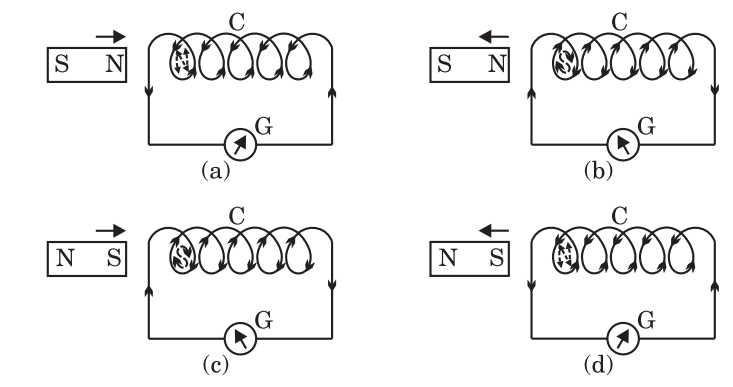
The following experiment shows that Lenz's law is based on conservation of energy. The experiment is carried out with a bar magnet NS and a coil C connected to a sensitive galvanometer G as shown in the adjoining figure.
When the bar magnet is suddenly moved towards the coil pointing its N pole towards the coil, galvanometer indicates deflection showing that the electric current is flowing in the coil [Fig. (a)]. If the motion of the magnet ceases, the needle of the galvanometer returns to zero mark indicating that the current in the coil has stopped. If the magnet is carried away from the coil quickly the galvanometer shows a deflection but in the opposite direction to that of Fig. (a) [Fig. (b)]. When the bar magnet is suddenly moved towards or away from the coil pointing its S pole towards the coil the deflection in the galvanometer is opposite to that observed in fig. (a) and fig. (b) respectively. This is shown in fig. (c) and fig. (d), respectively.
Image
In this experiment, it is clear that in each case in order to move the bar magnet some mechanical work has to be done against the opposing force and the electrical energy obtained is the coil is equivalent to this work obeying law of conservation of energy.
It should also be noted here that if the direction of induced current in the coil does not oppose the motion of the magnet, then electric energy will be obtained without doing any work which is impossible. Hence Lenz's law is in accordance with law of conservation of energy.
View full question & answer
Question 44 Marks
Define eddy currents. How are they produced? In what sense are these currents undesirable in a transformer and how are these reduced in a device ?
Answer
Eddy Currents : In 1824 Gambey discovered that the oscillations of a magnet are rapidly damped if a copper sheet is placed under it and close to it. In 1895 Facault observed that when a metal piece is moved in a constant magnetic field or a varying magnetic field is subjected to the metal piece then the magnetic flux linked with the metal piece changes due to which induced current is generated in the whole volume of the piece. According to Lenz's law these currents oppose the change in magnetic flux. These currents look like eddies or whirlpool's in a fluid and are called eddy currents. These are also called Facault current after the name of their discoverer.
Image
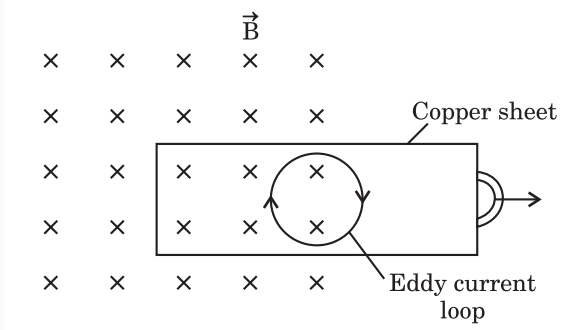
In adjoining figure, a copper sheet in the plane of the paper and a magnetic field is subjected is placed to it in the perpendicular direction to the plane of the paper directed inward represented by cross signs. If we withdraw the sheet out of the field, there is a decrease in its area A within the field and so the magnetic flux $(\Phi= BA )$ linked with the sheet also decreases. Because of this flux change, current loops are induced in the sheet coming out of the field and according to Lenz's law direction of currents is such that the magnetic field produced due to them is in the same direction as the original magnetic field. Thus, eddy currents oppose the decrease in magnetic flux i.e. the drawing out of the sheet. Similarly, if we insert the sheet into the magnetic field the eddy currents are generated in opposite direction to the previous one and oppose the entry of the sheet into the field.
Image
Eddy Currents undesirable in a device (transformer) and means of their reduction : Eddy currents produce a large amount of heat. This heating effect of eddy currents is undesirable in a number of cases like dynamos, transformers, etc. where the coil is wound on iron core. On the other hand, the heating effect of eddy currents is used to make induction furnaces. Similarly, the braking effect of eddy currents is also undesirable in a number of cases. On the other hand, the braking effect of eddy currents is used in electric brakes and ballistic galvanometers. Let us now see how the breaking and heating effects of eddy currents can be minimised.
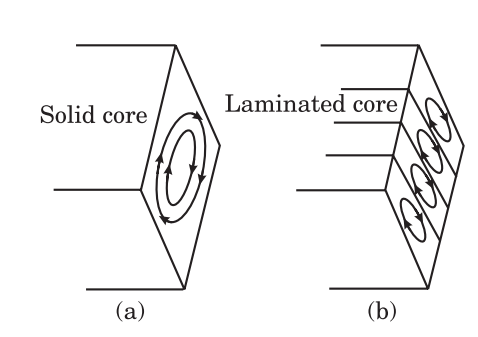
The solid iron core [Fig. (a)] is divided into a number of thin sheets as shown in Fig. (b). These thin sheets are electrically insulated from each other. Moreover, these sheets are so placed that the path of the induced eddy currents is broken by the insulating material between the sheets. In this way, the eddy currents are considerably reduced. Such cores are called laminated cores as used in transformer.

View full question & answer