Question
(a) Define mutual inductance and write its S.I. unit.
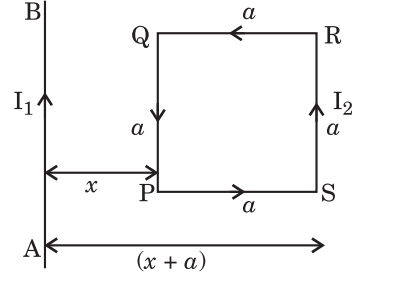
(b) A square loop of side 'a' carrying a current $I_{2}$ is kept at distance x from an infinitely long straight wire carrying a current $I_{1}$ as shown in the figure. Obtain the expression for the resultant force acting on the loop.
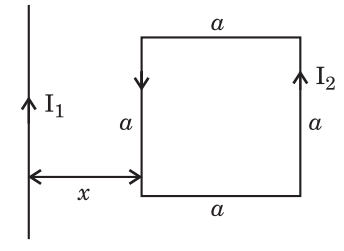
Image

Need a full question paper?

Generate a complete, print-ready paper with questions like this in minutes — across 16+ boards, with answer keys.

Start Generating Free

Similar questions

A tangent galvanometer shows a deflection of $45^\circ $ when $10mA$ of current is passed through it. If the horizontal component of the earth's magnetic field is $B_H = 3.6\times 10^{-5} T$ and radius of the coil is $10\ cm$, find the number of turns in the coil.
There are materials which absorb photons of shorter wavelength and emit photons of longer wavelength. Can there be stable substances which absorb photons of larger wavelength and emit light of shorter wavelength.
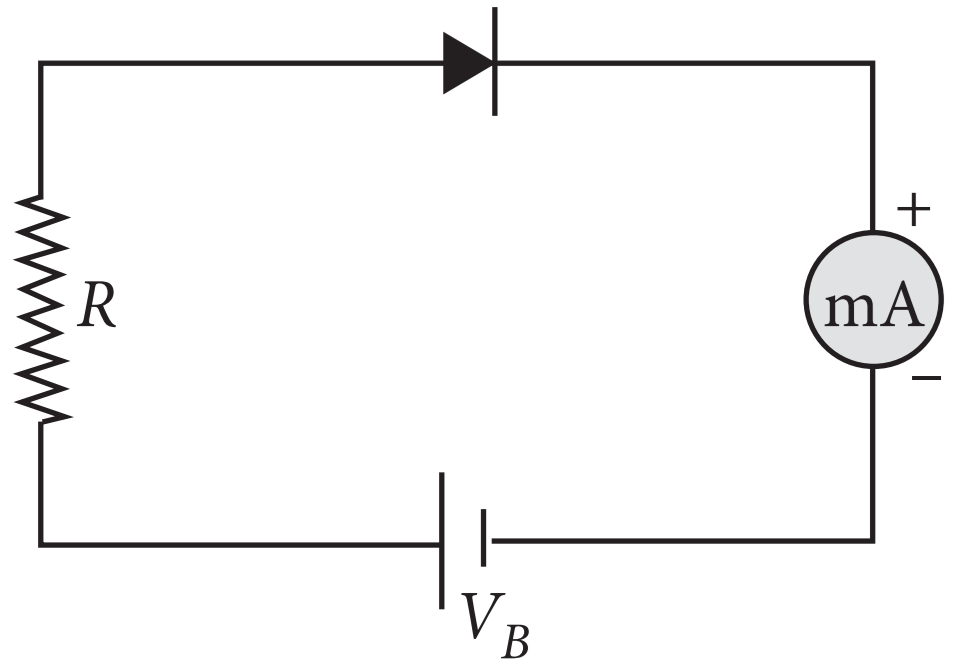
A silicon $p-n$ junction diode is connected to a resistor Rand a battery of voltage $V_B$ through milliammeter $(mA)$ as shown in figure. The knee voltage for this junction diode is $V_N = 0.7V$. The $p-n$ junction diode requires a minimum current of $1 mA$ to attain a value higher than the knee point on the $I-V$ characteristics of this junction diode. Assuming that the voltage Vacross the junction is independent of the current above the knee point. A $p-n$ junction is the basic building block of many semiconductordevices like diodes. Important process occurring during the formation of a $p-n$ junction are diffusion and drift. ln an $n-$type semiconductor concentration of electrons is more as compared to holes. ln a $p-$ type semiconductor concentration of holes is more as compared to electrons.
  1. If $V_{B }= 5V,$ the maximum value of $R$ so that the voltage $V$ is above the knee point voltage is:
  1. $40\text{k}\Omega$
  2. $4.3\text{k}\Omega$
  3. $5.0\text{k}\Omega$
  4. $5.7\text{k}\Omega$
  1. If $V_B = 5V,$ the value of $R$ in order to establish a current to $6mA$  in the circuit is:
  1. $833\Omega$
  2. $717\Omega$
  3. $950\Omega$
  4. $733\Omega$
  1. If $V_B = 6V,$ the power dissipated in the resistor $R,$ when a current of $6mA$ flows in the circuit is:
  1. $30.2mW$
  2. $30.8mW$
  3. $31.2mW$
  4. $31.8mW$
  1. When the diode is reverse biased with a voltage of $6V$ and $V_{bi} = 0.63V$. Calculate the total potential.
  1. $9.27V$
  2. $6.63V$
  3. $5.27V$
  4. $0.63V$
  1. Which of the below mentioned statement is false regarding a $p-n$ junction diode?
  1. Diodes are uncontrolled devices.
  2. Diodes are rectifying devices.
  3. Diodes are unidirectional devices.
  4. Diodes have three terminals.
The entering flux from a closed surface is $2 \times 10^3$ Newton-metre ${ }^2 /$ Coulomb and the emerging flux is $8 \times 10^3$ Newton-metre ${ }^2 /$ Coulomb. Find the value of charge enclosed in the surface.
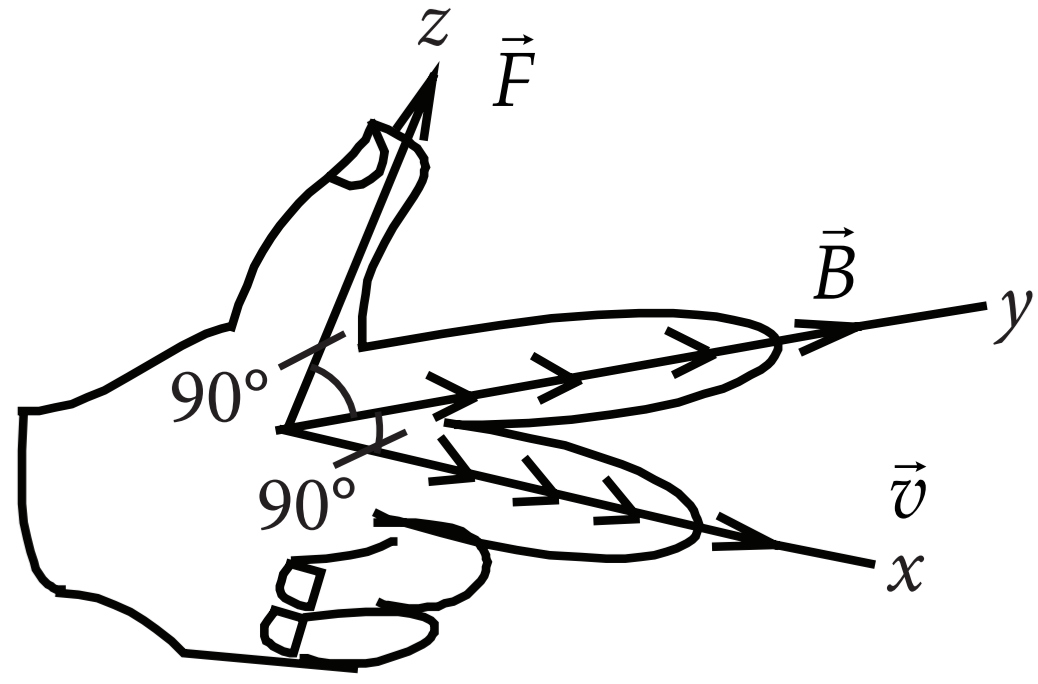
A charged particle moving in a magnetic field experiences a force that is proportional to the strength of the magnetic field, the component of the velocity that is perpendicular to the magnetic field and the charge of the particle. This force is given by $\vec{\text{F}}=\text{q}(\vec{\text{v}}\times\vec{\text{B}})$ where $q$ is the electric charge of the particle, $v$ is the instantaneous velocity of the particle, and Bis the magnetic field $($in tesla$).$ The direction of force is determined by the rules of cross product of two vectors. Force is perpendicular to both velocity and magnetic field. Its direction is same as $\vec{\text{v}}\times\vec{\text{B}}$ if $q$ is positive and opposite of $\vec{\text{v}}\times\vec{\text{B}}$ if $q$ is negative. The force is always perpendicular to both the velocity of the particle and the magnetic field that created it. Because the magnetic force is always perpendicular to the motion, the magnetic field can do no work on an isolated charge. It can only do work indirectly, via the electric field generated by a changing magnetic field.
  1. When a magnetic field is applied on a stationary electron, it:
  1. Electric field only.
  2. Magnetic field only.
  3. Both electric and magnetic field.
  4. None of these.
  5. Moving charge will produce.
  6. In $z-y$ plane.
  7. Along $-y$ axis.
  8. Along $+z$ axis.
  9. Along $-z$ axis.
  10. A charge $q$ moves with a velocity $2m s^{-1}$ along $x-$axis in a uniform magnetic field $\vec{\text{F}}=(\vec{\text{i}}+2\vec{\text{j}}+3\vec{\text{k}})\text{T,}$ charge will experience a force.
  11. The particle is stationary and magnetic field is perpendicular.
  12. The particle is moving and magnetic field is perpendicular to the velocity.
  13. The particle is stationary and magnetic field is parallel.
  14. The particle is moving and magnetic field is parallel to velocity.
  15. A charged particle experiences magnetic force in the presence of magnetic field. Which of the following statement is correct?
  16. The proton will be accelerated along the axis.
  17. The proton path will be circular about the axis.
  18. The proton moves along helical path.
  19. The proton will continue to move with velocity $v$ along the axis.
  20. A proton is projected with a uniform velocity $v$ along the axis of a current carrying solenoid, then,
  21. Remains stationary.
  22. Spins about its own axis.
  23. Moves in the direction of the field.
  24. Moves perpendicular to the direction of the field.
What do you mean by nuclear fission ?
On disintegration of one atom of ${}^{235}U$ the amount of energy obtained is 200 MeV. The power obtained in a reactor is 1000 kilowatt. How many atoms are disintegrated per second in the reactor? What is the decay in mass per hour?
The photon picture of electromagnetic radiations and the characteristic properties of photons are as follows: ln the interaction ofradiation with matter, radiation behaves as ifit is made of particles like photons. 
Each photon has energy $\text{E}\Big(=\text{h}\upsilon=\frac{\text{hc}}{\lambda}\Big)$ and momentum $\text{p}\Big(=\frac{\text{h}\upsilon}{\text{c}}=\frac{\text{h}}{\lambda}\Big),$ where h is Planck's constant, $\upsilon$ and $\lambda$ are the frequency and wavelength of radiation and c is the velocity of light.
The photon energy is independent of the intensity of radiations.
All the photons emitted from a source of radiations travel through space with the same speed c. The frequency of photon gives the radiation, a definite energy (or colour) which does not change when photon travels through different media.
Photons are not deflected by electric and magnetic fields. This shows that photons are electrically neutral.
  1. Which one among the following shows particle nature of tight?
  1. Photoelectric effect
  2. Interference
  3. Refraction
  4. Polarization
  1. Which of the following statements about photon is incorrect?
  1. Photons exert no pressure.
  2. Momentum of photon is $\frac{\text{h}\upsilon}{\text{c}}$.
  3. Rest mass of photon is zero.
  4. Energy of photon is $\text{h}\upsilon$.
  1. The rest mass of photon is:
  1. $\frac{\text{h}\upsilon}{\text{c}}$
  2. $\frac{\text{h}\upsilon}{\text{c}^2}$
  3. $\frac{\text{h}\upsilon}{\lambda}$
  4. Zero
  1. ln a photon-particle collision (such as photon-electron collision), which of the following may not be conserved?
  1. Total energy.
  2. Number of photons.
  3. Total momentum.
  4. Both (a) and (b).
  1. 'n' photons of wavelength $'\lambda'$ are absorbed by a black body of mass 'm'. The momentum gained by the body is:
  1. $\frac{\text{h}}{\text{m}\lambda}$
  2. $\frac{\text{mnh}}{\lambda}$
  3. $\frac{\text{nh}}{\text{m}\lambda}$
  4. $\frac{\text{nh}}{\lambda}$
A stationary charge produces only an electrostatic field while a charge in uniform motion produces a magnetic field, that does not change with time. An oscillating charge is an example of accelerating charge. It produces an oscillating magnetic field, which in turn produces an oscillating electric fields and so on. The oscillating electric and magnetic fields regenerate each other as a wave which propagates through space.

Magnetic field in a plane electromagnetic wave is given by $\vec{\text{B}}=\text{B}_0\sin(\text{kx}+\omega\text{t}) \hat{\text{j}}\text{T}.$
  1. Expression for corresponding electric field will be $($Where $c$ is speed of light$)$.
  1. $\vec{\text{E}}=-\text{B}_0\text{c}\sin(\text{kx}+\omega\text{t}) \hat{\text{k}}\frac{\text{V}}{\text{m}}$
  2. $\vec{\text{E}}=\text{B}_0\text{c}\sin(\text{kx}-\omega\text{t}) \hat{\text{k}}\frac{\text{V}}{\text{m}}$
  3. $\vec{\text{E}}=\frac{\text{B}_0}{\text{c}}\sin(\text{kx}+\omega\text{t}) \hat{\text{k}}\frac{\text{V}}{\text{m}}$
  4. $\vec{\text{E}}=\text{B}_0\text{c}\sin(\text{kx}+\omega\text{t}) \hat{\text{k}}\frac{\text{V}}{\text{m}}$
  1. The electric field component ofa monochromatic radiation is given by $\vec{\text{E}} = 2\epsilon_0\hat{\text{i}}\cos\text{kz}\cos\omega\text{t}.$ Its magnetic field $\vec{\text{B}}$ is then given by:
  1. $\frac{2\epsilon_0}{\text{c}}\hat{\text{j}}\cos\text{kz}\cos\omega\text{t}$
  2. $\frac{2\epsilon_0}{\text{c}}\hat{\text{j}}\sin\text{kz}\cos\omega\text{t}$
  3. $\frac{2\epsilon_0}{\text{c}}\hat{\text{j}}\sin\text{kz}\sin\omega\text{t}$
  4. $-\frac{2\epsilon_0}{\text{c}}\hat{\text{j}}\sin\text{kz}\sin\omega\text{t}$
  1. A plane em wave of frequency $25MHz$ travels in a free space along $x-$ direction. At a particular point in space and time, $\text{E}=(6.3\ \hat{\text{j}})\frac{\text{V}}{\text{m}}.$ What is magnetic field at that time?
  1. $0.095\mu\text{T}$
  2. $0.124\mu\text{T}$
  3. $0.089\mu\text{T}$
  4. $0.021\mu\text{T}$
  1. A plane electromagnetic wave travelling along the $x-$ direction has a wavelength of $3\ mm$. The variation in the electric field occurs in the $y-$ direction with an amplitude $66Vm^1$. The equations for the electric and magnetic fields as a function of $x$ and tare respectively.
  1. $\text{E}_\text{y}=33\cos\pi\times10^{11}\Big(\text{t}-\frac{\text{x}}{\text{c}}\Big),$
    $\text{B}_\text{z}=1.1\times10^{-7}\cos\pi\times10^{11}\Big(\text{t}-\frac{\text{x}}{\text{c}}\Big)$
  2. $\text{E}_\text{y}=11\cos2\pi\times10^{11}\Big(\text{t}-\frac{\text{x}}{\text{c}}\Big),$
    $\text{B}_\text{y}=11\times10^{-7}\cos2\pi\times10^{11}\Big(\text{t}-\frac{\text{x}}{\text{c}}\Big)$
  3. $\text{E}_\text{x}=33\cos\pi\times10^{11}\Big(\text{t}-\frac{\text{x}}{\text{c}}\Big),$
    $\text{B}_\text{x}=11\times10^{-7}\cos\pi\times10^{11}\Big(\text{t}-\frac{\text{x}}{\text{c}}\Big)$
  4. $\text{E}_\text{y}=66\cos2\pi\times10^{11}\Big(\text{t}-\frac{\text{x}}{\text{c}}\Big),$
    $\text{B}_\text{z}=2.2\times10^{-7}\cos2\pi\times10^{11}\Big(\text{t}-\frac{\text{x}}{\text{c}}\Big)$
  1. A plane electromagnetic wave travels in free space along $x-$ axis. At a particular point in space, the electric field along $y-$ axis is $9.3Vm^{-1.}$ The magnetic induction $(B)$ along $z-$ axis is:
  1. $3.1 \times 10^{-8}T$
  2. $3 \times 10^{-5}T$
  3. $3 \times 10^{-6}T$
  4. $9.3 \times 10^{-6}T$
Explain Bohr's atomic model.
###
State three postulates of Bohr's atomic model.