Questions

3 Marks Question

Take a timed test

18 questions · self-marked practice — reveal the answer and mark yourself.

Question 13 Marks
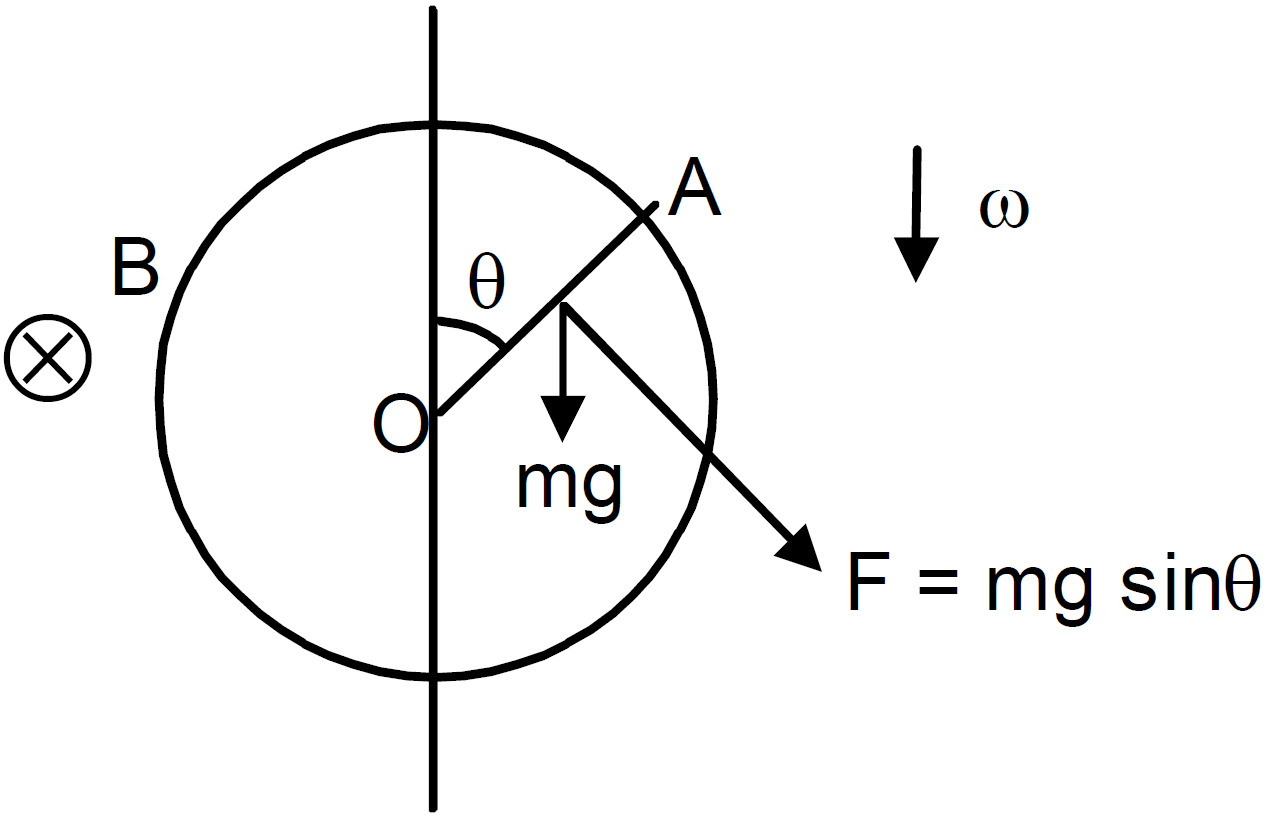
Consider a variation of the previous problem (figure). Suppose the circular loop lies in a vertical plane. The rod has a mass m. The rod and the loop have negligible resistances but the wire connecting O and C has a resistance R. The rod is made to rotate with a uniform angular velocity $\omega$ in the clockwise direction by applying a force at the midpoint of OA in a direction perpendicular to it. Find the magnitude of this force when the rod makes an angle $\theta$ with the vertical.
Answer
We know
$\text{F}=\frac{\text{B}^2\text{a}^3\omega}{2\text{R}}=\text{il}\text{B}$
Component of mg along $\text{F}=\text{mg } \sin \theta$
Net force $=\frac{\text{B}^2\text{a}^3\omega}{2\text{R}}-\text{mg }\sin\theta$
View full question & answer
Question 23 Marks
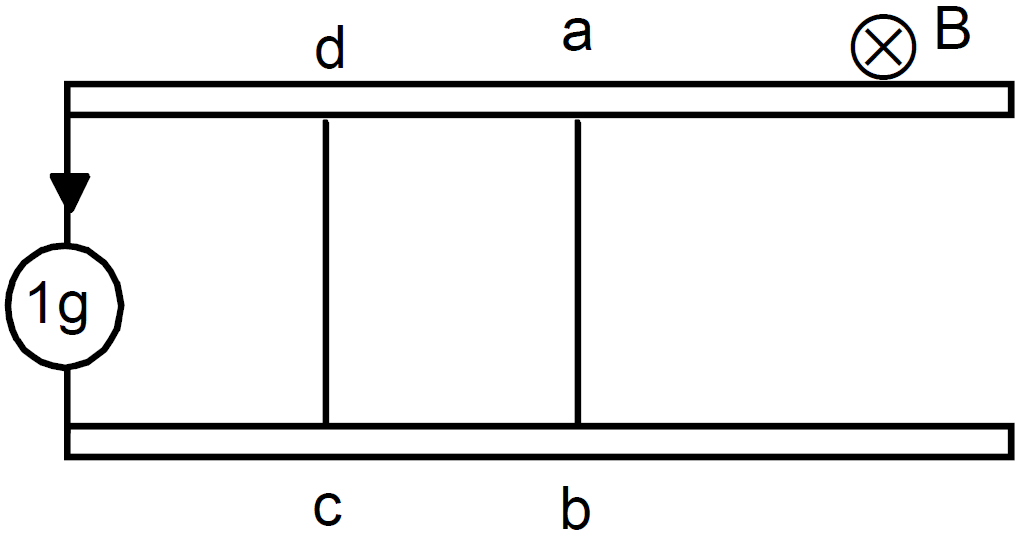
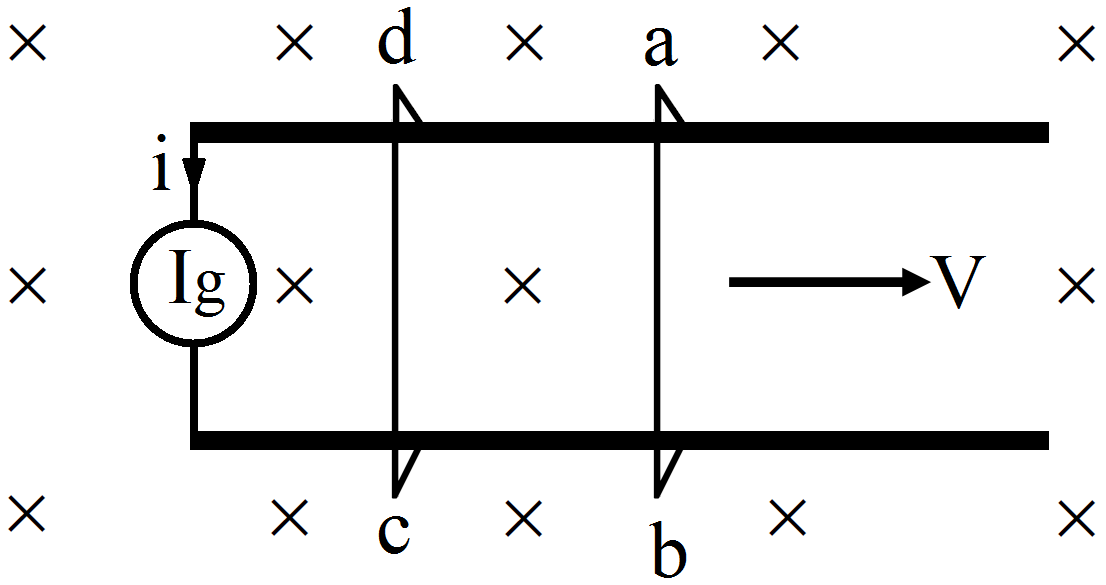
The current generator $I_g$ shown in figure, sends a constant current i through the circuit. The wire cd is fixed and ab is made to slide on the smooth, thick rails with a constant velocity v towards right. Each of these wires has resistance r. Find the current through the wire cd.
Answer

Initial current passing = i
Hence initial emf = ir
Emf due to motion of ab = Blv
Net emf = ir - Blv
Net resistance = 2r
Hence current passing $=\frac{\text{ir}-\text{Blv}}{2\text{r}}$
View full question & answer
Question 33 Marks
A circular coil of one turn of radius 5.0cm is rotated about a diameter w!th a constant angular speed of 80 revolutions per minute. A uniform magnetic field B = 0.010T exists in a direction perpendicular to the axis of rotation. Find
  1. The maximum emf induced.
  2. The average emf induced in the coil over a long period.
  3. The average of the squares of emf induced over a lone period.
Answer
emf $=\frac{\text{d}\phi}{\text{dt}}=\frac{\text{dB.A}\cos\theta}{\text{dt}}$
$=\text{BA}\sin\theta=-\text{BA}\omega\sin\theta$
$\Big(\frac{\text{dq}}{\text{dt}}=$ the rate of change of angle between arc vector and $\text{B}=\omega\Big)$
  1. For maximum emf, $\sin\theta=1$
$\therefore\text{e}=\text{BA}\omega$

$\Rightarrow\text{e}=0.010\times25\times10^{-4}\times80\times\frac{2\pi\times\pi}{60}$

$\Rightarrow\text{e}=0.66\times10^{-3}=6.66\times10^{-4}\text{V}$
  1. The direction of the induced emf changes every instant. Thus, the average emf becomes zero.
  1. The emf induced in the coil is $\text{e}=-\text{BA}\omega\sin\theta=-\text{BA}\omega\sin \ \omega\text{t}$
The average of the squares of emf induced is given by

$\text{e}_{\text{av}^2}=\frac{\int\limits_{0}^{\text{T}}\text{B}^2\text{A}^2\omega^2\sin^2\omega\text{t} \ \text{dt}}{\int\limits_{0}^{\text{T}}\text{dt}}$

$\Rightarrow\text{e}_{\text{av}^2}=\frac{\text{B}^2\text{A}^2\omega^2\int\limits_{0}^{\text{T}} \sin^2\omega\text{t} \ \text{dt}}{\int\limits_{0}^{\text{T}}\text{dt}}$

$\Rightarrow\text{e}_{\text{av}^2}=\frac{\text{B}^2\text{A}^2\omega^2\int\limits_{0}^{\text{T}} (1-\cos2\omega\text{t} )\ \text{dt}}{ \ 2\text{T}}$

$\Rightarrow\text{e}_{\text{av}^2}=\frac{\text{B}^2\text{A}^2\omega^2 }{ 2\text{T}}\Big[\frac{\text{t}-\sin2\omega\text{t}}{ \ 2\omega}\Big]_{0}^{\text{T}}$

$\Rightarrow\text{e}_{\text{av}^2}=\frac{\text{B}^2\text{A}^2\omega^2}{ \ 2\text{T}}\Big[\text{T}-\frac{\sin4\pi-\sin0}{2\omega}\Big]=\frac{\text{B}^2\text{A}^2\omega^2}{2}$

$\Rightarrow\text{e}_{\text{av}^2}=\frac{(6.66\times10^{-4})2}{2}$

$=22.1778\times10^{-8}\text{V}^2 \ \big[\because\text{BA}\omega=6.66\times10^{-4}\text{V}\big]$

$\Rightarrow\text{e}-{\text{av}^2}=2.2\times10^{-7}\text{V}^2$
View full question & answer
Question 43 Marks
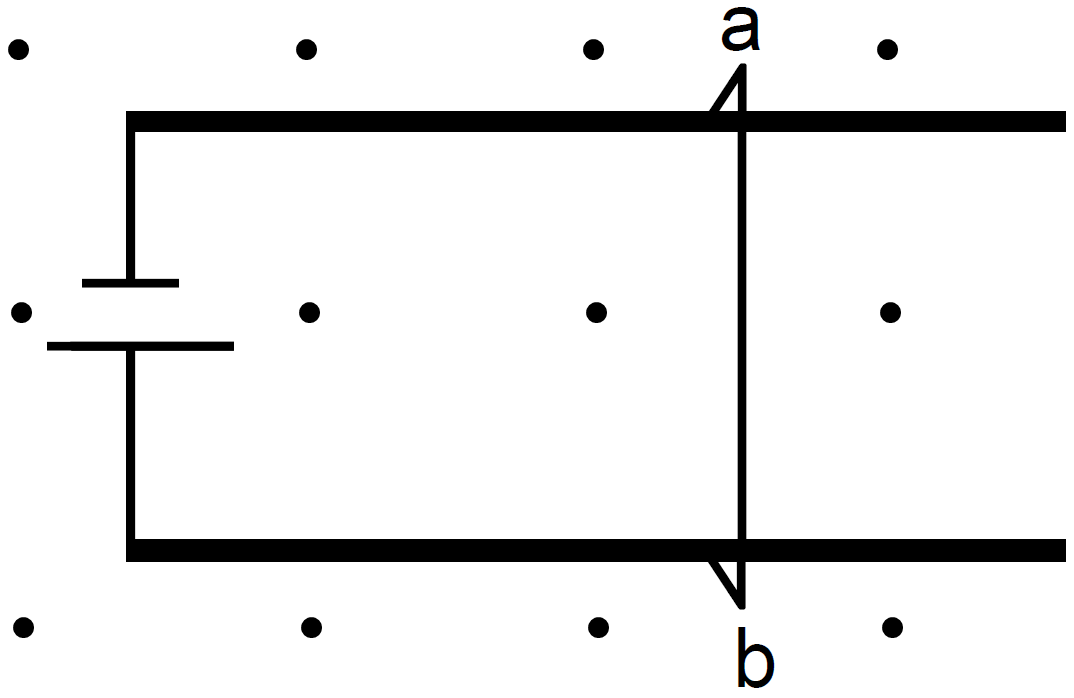
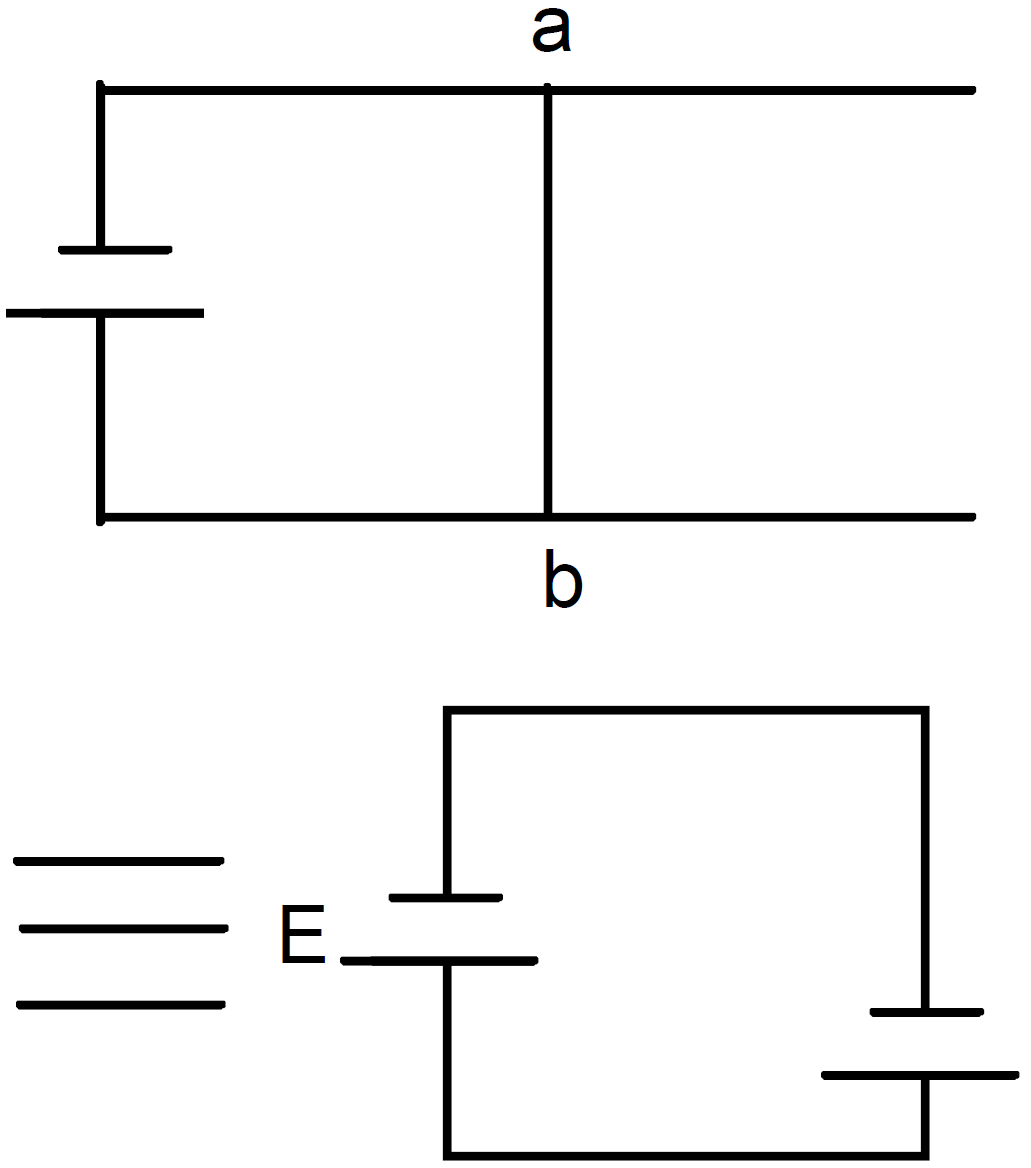
Figure shows a smooth pair of thick metallic rails connected across a battery of emf $\in$ having a negligible internal resistance. A wire ab of length l and resistance r can slide smoothly on the rails. The entire system lies in a horizontal plane and is immersed in a uniform vertical magnetic field B. At an instant t, the wire is given a small velocity u towards right.
  1. Find the current in it at this instant. What is the direction of the current?
  2. What is the force acting on the wire at this instant?
  3. Show that after some time the wire ab will slide with a constant velocity. Find this velocity.
Answer
According to Fleming's left hand rule the force in the wire ab will be in the upward direction.
Moreover, a moving wire ab is equivalent to a battery of emf vBl as shown in the figure.

At the given instant, the net emf across the wire (e) is E - Bvl.
  1. The current through the wire is given by
$\text{i}=\frac{\text{E}-\text{Bvl}}{\text{r}}$

The direction of the current is from b to a.
  1. The force acting on the wire at the given instant is given by
$\text{F}=\text{ilB}=\Big(\frac{\text{E}-\text{Bvl}}{\text{r}}\Big)$ towards right
  1. The velocity of the wire attains a value such that it satisfies E = Bvl.
The net force on the wire becomes zero. Thus, the wire moves with a constant velocity v.

$\therefore\text{v}=\frac{\text{E}}{\text{Bl}}$
View full question & answer
Question 53 Marks
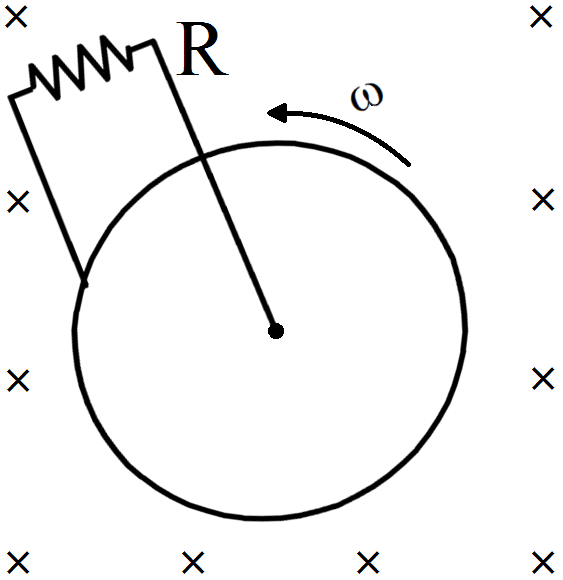
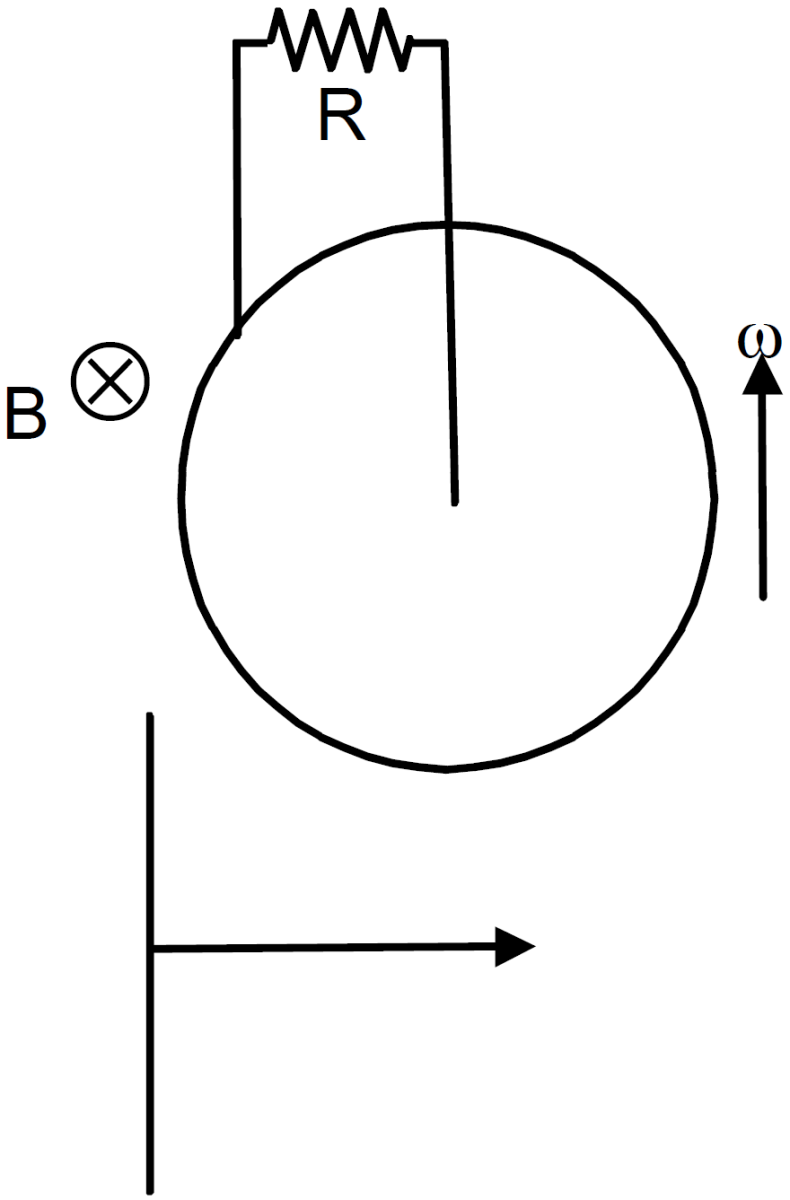
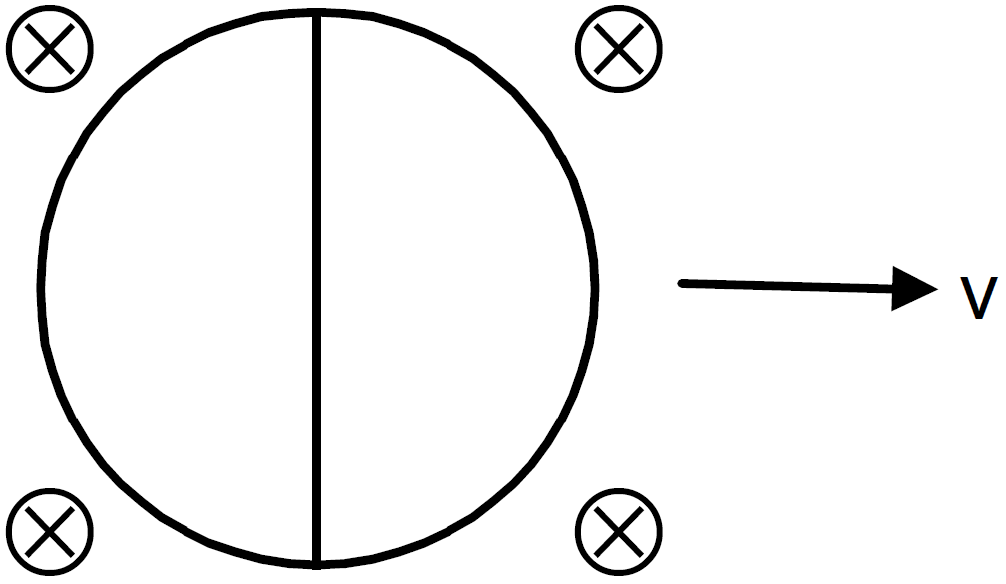
Figure shows a conducting disc rotating about its axis in a perpendicular magnetic field B. A resistor of resistance R is connected between the centre and the rim. Calculate the current in the resistor. Does it enter the disc or leave it at the centre? The radius of the disc is 5.0cm, angular speed $\omega=10 \ \text{rad/s}, \ \text{B}=0.40\text{T}$ and $\text{R}=10\Omega.$
Answer

$\text{B}=0.40\text{T},\omega=10 \ \text{rad}/',\text{r}=10\Omega$
$\text{r}=5\text{cm}=0.05\text{m}$
Considering a rod of length 0.05m affixed at the centre and rotating with the same $\omega$.
$\text{V}=\frac{\text{L}}{2}\times\omega=\frac{0.05}{2}\times10$
$\text{e}=\text{BLV}=0.40\times\frac{0.05}{2}\times10\times0.05=5\times10^{-3}\text{V}$
$\text{L}=\frac{\text{e}}{\text{R}}=\frac{5\times10^{-3}}{10}=0.5 \ \text{mA}$
It leaves from the centre.
View full question & answer
Question 63 Marks
A circular copper-ring of radius r translates in its plane with a constant velocity v. A uniform magnetic field B exists in the space in a direction perpendicular to the plane of the ring. Consider different pairs of diametrically opposite points on the ring.
  1. Between which pair of points is the emf maximum? What is the value of this maximum emf?
  2. Between which pair of points is the emf minimum? What is the value of this minimum emf?
Answer

  1. The e.m.f. is highest between diameter $\perp\text{r}$ to the velocity. Because here length $\perp\text{r}$ to velocity is highest.
$E_{max} = VB2R$
  1. The length perpendicular to velocity is lowest as the diameter is parallel to the velocity $E_{min} = 0.$
View full question & answer
Question 73 Marks
The magnetic field at a point inside a 2.0mH inductor coil becomes 0.80 of its maximum value in 20µs when the inductor is joined to a battery. Find the resistance of the circuit.
Answer
$\text{i}=\text{i}_0\Big(1-\text{e}^\frac{-\text{t}}{\tau}\Big)$
$\Rightarrow\mu_0\text{ni}=\mu\text{n }\text{i}_0\Big(1-\text{e}^\frac{-\text{t}}{\text{t}}\Big)$
$\Rightarrow\text{B}=\text{B}_0\Big(1-\text{e}^\frac{-\text{lR}}{\text{L}}\Big)$
$\Rightarrow0.8\text{ B}_0=\text{B}_0\Big(1-\text{e}^\frac{-20\times10^{-5}\times\text{R}}{2\times10^{-3}}\Big)$
$\Rightarrow0.8=\Big(1-\text{e}^\frac{-\text{R}}{100}\Big)$
$\Rightarrow\text{e}^\frac{-\text{R}}{100}=0.2$
$\Rightarrow\text{ln}\Big(\text{}e^\frac{-\text{R}}{100}\Big)=\text{ln}\big(0. 2\big)$
$\Rightarrow\frac{-\text{R}}{100}=-1.609$
$\Rightarrow\text{R}=16.9=160\Omega.$
View full question & answer
Question 83 Marks
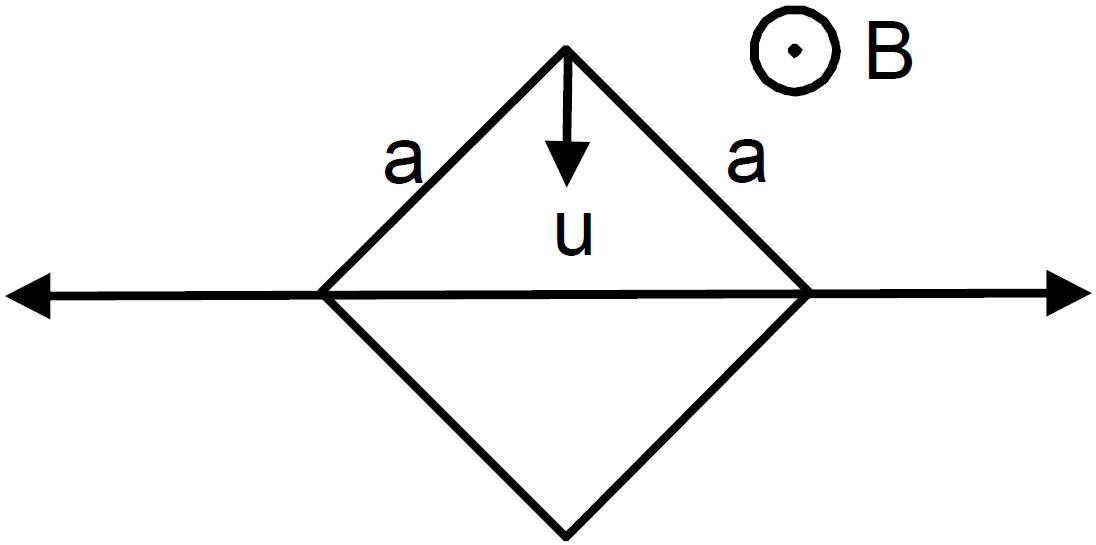
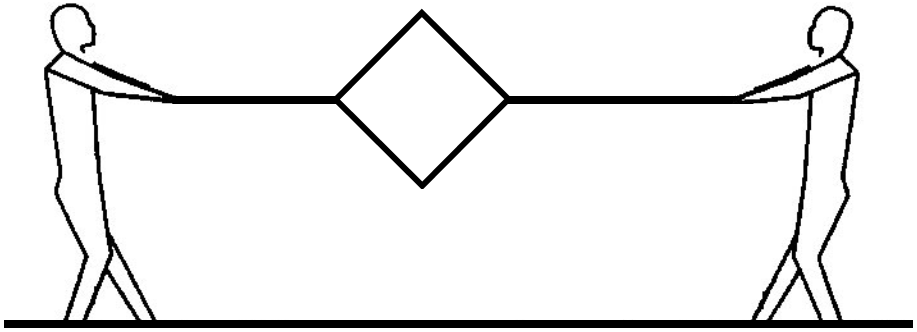
Figure shows a metallic square frame of edge a in a vertical plane. A uniform magnetic field B exists in the space in a direction perpendicular to the plane of the figure. Two boys pull the opposite corners of the square to deform it into a rhombus. They start pulling the corners at t = 0 and displace the corners at a uniform speed u.
  1. Find the induced emf in the frame at the instant when the angles at these corners reduce to 60°.
  2. Find the induced current in the frame at this instant if the total resistance of the frame is R.
  3. Find the total charge which flows through a side of the frame by the time the square is deformed into a straight line.
Answer
Speed = u
Magnetic field = B
Side = a

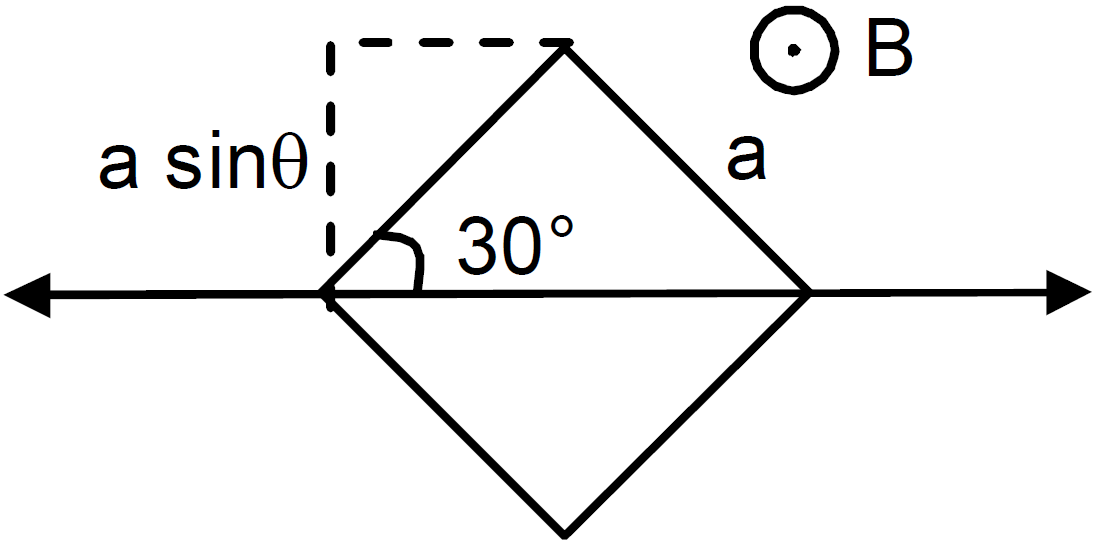
  1. The perpendicular component i.e. a $\sin\theta$ is to be taken which is $\perp\text{r}$ to velocity.
So, $\text{I}=\text{a}\sin\theta \ 30^{\circ}=\frac{\text{a}}{2}$

Net ‘a’ charge $=4\times\frac{\text{a}}{2}=2\text{a}$

So, induced emf $=\text{B}\delta\text{l}=2\text{auB}$
  1. Current $=\frac{\text{E}}{\text{R}}=\frac{2\text{auB}}{\text{R}}$
  1. Total charge q, which flows through the sides of the frame, is given by
$\text{q}=\frac{\Delta\phi}{\text{R}}$

Here,

$\Delta\phi=$ Change in the flux

R = Resistance of the coil

$\therefore \ \text{q}=\frac{\Delta\phi}{\text{R}}$

$=\frac{\text{B}(\text{a}^2-0)}{\text{R}}$

$=\frac{\text{B}\text{a}^2}{\text{R}}$
View full question & answer
Question 93 Marks
Two circular loops are placed coaxially but separated by a distance. A battery is suddenly connected to one of the loops establishing a current in it. Will there be a current induced in the other loop? If yes, when does the current start and when does it end? Do the loops attract each other or do they repel?
Answer
When there is some current in first loop it will induce same polarity current in the second loop. It starts when the current is passed through first loop and ends when the current is stopped.
Loops repel each other as loops have current in same direction thus they have same pole as magnet.
View full question & answer
Question 103 Marks
An average emf of 20V is induced in an inductor when the current in it is changed from 2.5A in one direction to the same value in the opposite direction in 0.1s. Find the self-inductance of the inductor.
Answer
$\text{V}=20\text{V}$
$\text{dl}=\text{l}_2-\text{l}_1=2.5-\big(-2.5\big)=5\text{A} $
$\text{dt}=0.1\text{s}$
$\text{V}=\text{L}\frac{\text{dl}}{\text{dt}}$
$\Rightarrow20=\text{L}\Big(\frac{5}{0.1}\Big)\Rightarrow20=\text{L}\times50$
$\Rightarrow\text{L}=\frac{20}{50}=\frac{4}{10}=0.4\text{ Henry}$
View full question & answer
Question 113 Marks
A short magnet is moved along the axis of a conducting loop. Show that the loop repels the magnet if the magnet is approaching the loop and attracts the magnet if it is going away from the loop.
Answer
Due to movement of magnet the current is induced inside loop and thus when magnet is pushed into loops the current is increased and it starts repelling the magnet. When magnet is taken away from the loop the current starts decreasing and thus acts in opposite direction so as to attract the magnet.
View full question & answer
Question 123 Marks
Suppose the resistance of the coil in the preivous problem is $25\Omega.$ Assume that the coil moves with uniform velocity during its removal and restoration. Find the thermal energy developed in the coil during:
  1. Its removal.
  2. Its restoration.
  3. Its motion.
Answer
  1. $\text{e}=50\text{V}, \ \text{T}=0.25\text{s}$
$\text{i}=\frac{\text{e}}{\text{R}}=2\text{A}, \text{H}=\text{i}^2\text{RT}$

$=4\times25\times0.25=25\text{J}$
  1. During its restoration.
$\text{e}=50\text{V}, \ \text{T}=0.25\text{s}$

$\text{i}=\frac{\text{e}}{\text{R}}=2\text{A}, \text{H}=\text{i}^2\text{RT}=25\text{J}$
  1. During its motion.
Since energy is a scalar quantity

Net thermal energy developed = 25J + 25J = 50J.
View full question & answer
Question 133 Marks
A coil having inductance 2.0H and resistance $20\Omega$ is connected to a battery of emf 4.0V. Find
  1. The current at the instant 0.20s after the connection is made.
  2. The magnetic field energy at this instant.
Answer
$\text{L}-2.0\text{H}, \ \text{R} = 20\Omega, \ \text{emf}=4.0\text{V}, \ \text{t}=0.20\text{S}$
  1. $\text{i}_{0} = \frac{\text{e}}{\text{R}}=\frac{4}{20},\tau=\frac{\text{L}}{\text{R}}=\frac{2}{20}=0.1 $
$ \text{i}=\text{i}_{0}(1-\text{e}^{\frac{-t}{\tau}})=\frac{4}{20}\Big(1-e^\frac{-0.2}{0.1}\Big) $

$= 0 .17\text{A}$
  1. $ \frac{1}{2}\text{Li}^2 =\frac{1}{2} \times2\times(0.17)^2=0.0289=0.03\text{J}$
View full question & answer
Question 143 Marks
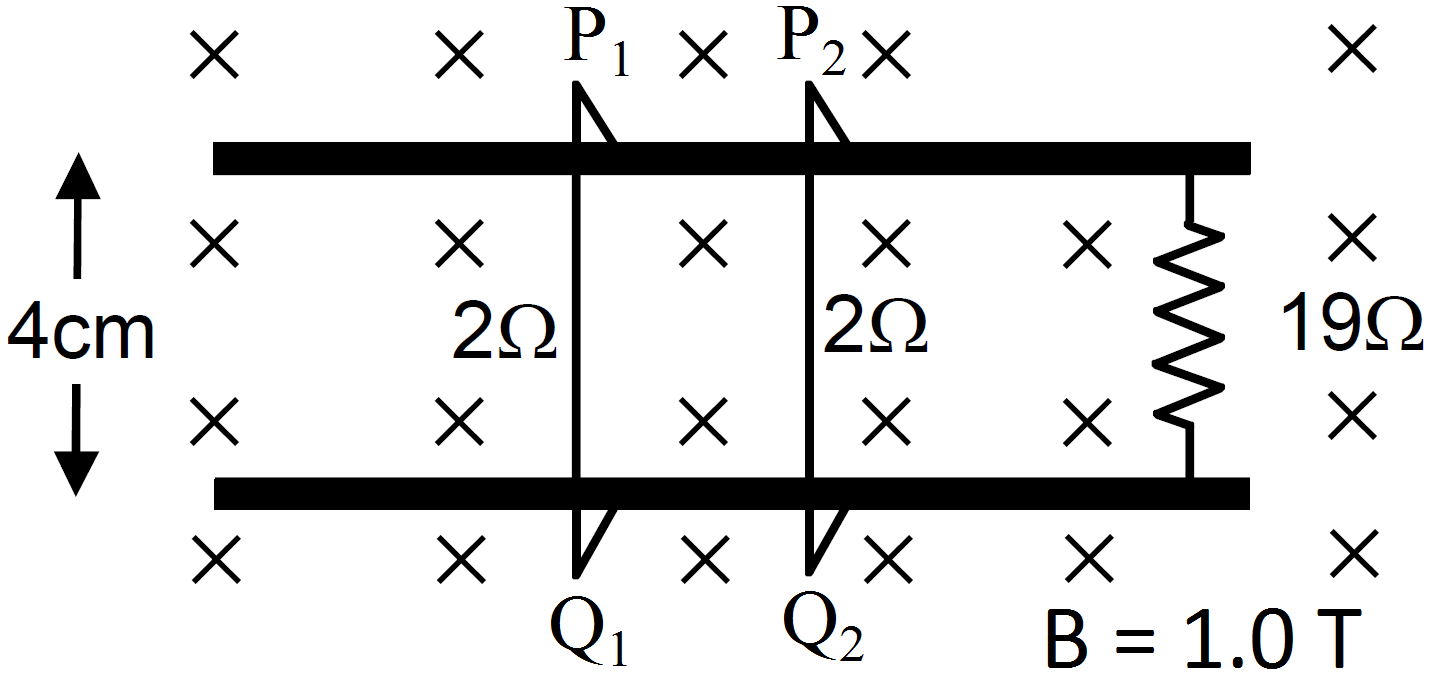
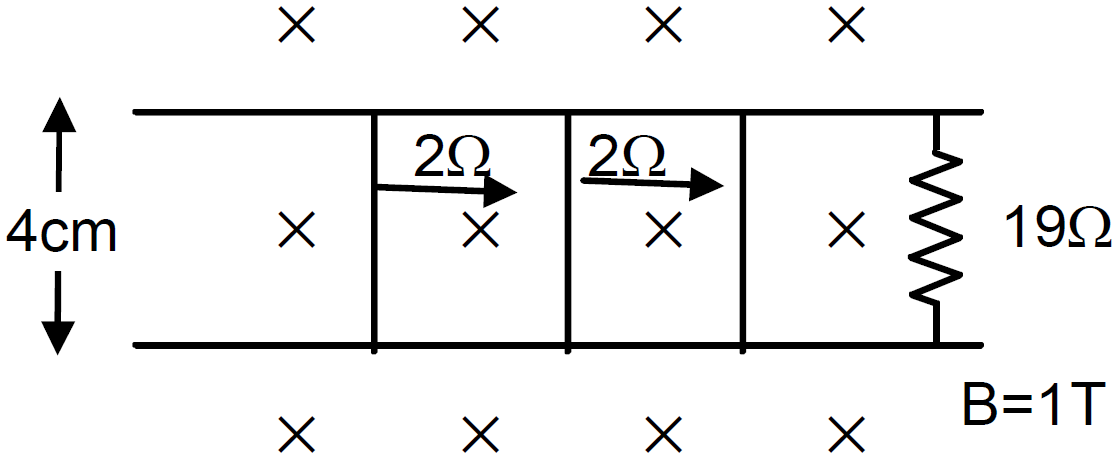
Consider the situation shown in figure. The wires $P_1Q_1$ and $P_2Q_2$ are made to slide on the rails with the same speed 5cm/s. Find the electric current in the $19\Omega$ resistor if:
  1. Both the wires move towards right.
  2. If $P_1Q_1$ moves towards left but $P_2Q_2$ moves towards right.
Answer

  1. The wires constitute 2 parallel emf.
$\therefore$ Net emf $=\text{Blv}=1\times4\times10^{-2}\times5\times10^{-2}=20\times10^{-4}$

Net resistance $=\frac{2\times2}{2+2}+19=20\Omega$

Net current $=\frac{20\times10^{-4}}{20}=0.1\text{mA}$
  1. When both the wires move towards opposite directions then not emf = 0
$\therefore$ Net current = 0
View full question & answer
Question 153 Marks
A magnetic flux of $8 \times 10^{-4}$ weber is linked with each turn of a 200-turn coil when there is an electric current of 4A in it. Calculate the self-inductance of the coil.
Answer
$\frac{\text{d}\phi}{\text{dt}}=8\times10^{-4}\text{weber}$
$\text{n}=200,\text{l}=4\text{A},\text{E}=-\text{nl}\frac{\text{dl}}{\text{dt}}$
$\text{or},\frac{-\text{d}\phi}{\text{dt}}=\frac{-\text{Ldl}}{\text{dt}}$
$\text{or},\text{L}=\text{n}\frac{-\text{d}\phi}{\text{dt}}=200\times8\times10^{-4}=2\times2\times10^{-2}\text{H}.$
View full question & answer
Question 163 Marks
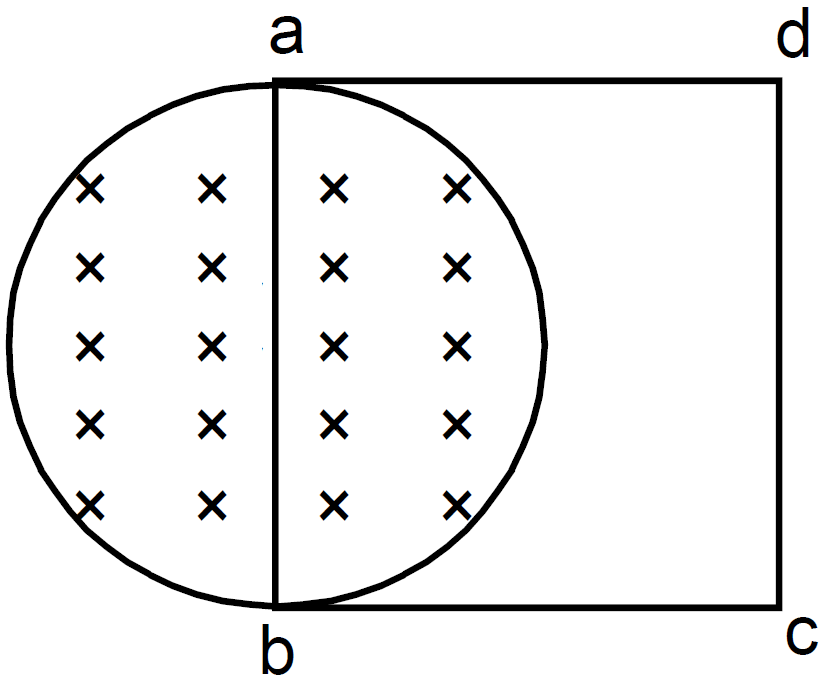
A uniform magnetic field B exists in a cylindrical region of radius 10cm as shown in figure. A uniform wire of length 80cm and resistance $4.0\Omega$ is bent into a square frame and is placed with one side along a diameter of the cylindrical region. If the magnetic field increases at a constant rate of 0.010T/s, find the current induced in the frame.
Answer
$\text{r}=10\text{cm}, \ \text{R}=4\Omega$
$\frac {\text{dB}}{\text{dt}}=0.010\text{T}/',\frac{\text{d}\phi}{\text{dt}}=\frac{\text{dB}}{\text{dt}}\text{A}$
$\text{E}=\frac{\text{d}\phi}{\text{dt}}=\frac{\text{dB}}{\text{dt}}\times\text{A}=0.01\Big(\frac{\pi\times\text{r}^2}{2}\Big)$
$=\frac{0.01\times3.14\times0.01}{2}=\frac {3.14}{2}\times10^{-4}=1.57\times10^{-4}$
$\text{i}=\frac{\text{E}}{\text{R}}=\frac{1.57\times10^{-4}}{4}=0.39\times10^{-4}=0.39\times10^{-5}\text{A}$
View full question & answer
Question 173 Marks
The current in a long solenoid of radius R and having n turns per unit length is given by $\text{i}=\text{i}_0\sin\omega\text{t}.$ A coil having N turns is wound around it near the centre. Find
  1. The induced emf in the coil.
  2. The mutual inductance between the solenoid and the coil.
Answer
$\text{B}=\mu_0\text{ni}$$\phi$ througth the coil
$\phi=\text{N.B.A}$
$\phi=\text{N.}\mu_0\text{ni}\pi\text{R}^2$
  1. $\text{e}=\frac{\text{d}\phi}{\text{dt}}$
$=\frac{\text{d}}{\text{dt}}\big(\mu_0\text{n}\text{N}\pi\text{R}^2\text{i}\big)$
$=\mu_0\text{nN}\pi\text{R}^2\frac{\text{d}}{\text{dt}}(\text{i}_0\sin\omega\text{t})$
$=\mu_0\text{nN}\pi\text{R}^2\text{i}_0\cos\omega\text{t}\times\omega$
$\text{e}=\mu_0\text{nN}\pi\text{R}^2\text{i}_0\omega\cos\omega\text{t}$
  1. $\text{E}=\text{M}\frac{\text{d}\text{I}}{\text{dt}}$
$\text{E}=\mu_0\text{nN}\pi\text{R}^2\frac{\text{d}\text{i}}{\text{dt}}$
$\text{M}=\mu_0\text{nN}\pi\text{R}^2$
View full question & answer
Question 183 Marks
The current in a solenoid of 240 turns, having a length of 12cm and a radius of 2cm, changes at a rate of 0.8A/s. Find the emf induced in it.
Answer
$\text{E}=\frac{\mu_0\text{N}^2\text{A}}{\text{l}}\frac{\text{dl}}{\text{dt}}$
$=\frac{4\pi\times10^{-7}\times\big(240\big)^2\times\pi\big(2\times10^{-2}\big)^2}{12\times10^{-2}}\times0.8$
$\frac{4\pi\times\big(24\big)^2\times\pi\times4\times8}{12}\times10^{-8}$
$=60577.3824\times10^{-8}=6\times10^{-4}\text{V}$
View full question & answer