In a crystal, the atoms are located at the position of(a) Maximum potential energy (b) Minimum potential energy(c) Zero potential energy(d) Infinite potential energy
Metallic solids are always opaque because(a) Solids effect the incident light (b) Incident light is readily absorbed by the free electron in a metal(c) Incident light is scattered by solid molecules(d) Energy band traps the incident light
Answer
(b) Incident light is readily absorbed by the free electron in a metal
The grid voltage of any triode valve is changed from $–1$ volt to $– 3$ volt and the mutual conductance is $3 \times 10^{-4}$ mho. The change in plate circuit current will be
Copper has face centered cubic (fcc) lattice with interatomic spacing equal to 2.54Å. The value of the lattice constant for this lattice is (a) 1.27 Å(b) 5.08 Å(c) 2.54 Å (d) 3.59 Å
Sodium has body centred packing. If the distance between two nearest atoms is 3.7 Å, then its lattice parameter is (a) 4.8 Å (b) 4.3 Å(c) 3.9 Å (d) 3.3 Å
The laptop PC’s modern electronic watches and calculators use the following for display(a) Single crystal(b) Poly crystal(c) Liquid crystal(d) Semiconductors
A solid reflects incident light and it’s electrical conductivity decreases with temperature. The binding in this solids(a) Ionic (b) Covalent(c) Metallic(d) Molecular
In the CB mode of a transistor, when the collector voltage is changed by 0.5 volt. The collector current changes by 0.05 mA. The output resistance will be(a) 10 kW (b) 20 kW(c) 5 kW (d) 2.5 kW
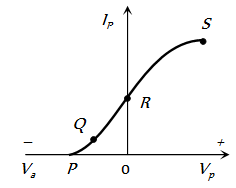
The relation between $I_p$ and $V_p$ for a triode is
$I_{p}=\left(0.125 V_{p}-7.5\right) mA$ , keeping the gria potential constant at $1 V$ , the value of $r_p$ will be
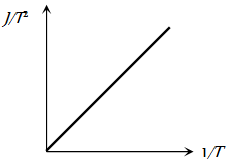
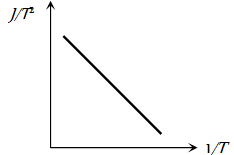
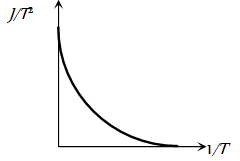
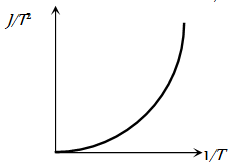
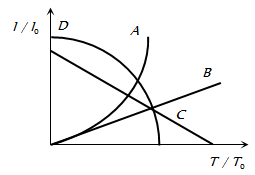
The ratio of thermionic currents $(I/I_0)$ for a metal when the temperature is slowly increased To to $T$ as shown in figure. $(I$ and $I_0$ are currents at $T$ and respectively$)$. Then which one is correct?
Assertion : $29$ is the equivalent decimal number of binary number $11101.$
Reason: $(11101)_2=\left(1 \times 2^4+1 \times 2^3+1 \times 2^2+0 \times 2^1+1 \times 2^0\right)_{10}=(16+8+4+0+1)_{10}=(29)_{10}$
✓
If both assertion and reason are true and the reason is the correct explanation of the assertion.
B
If both assertion and reason are true but reason is not the correct explanation of the assertion.
C
If assertion is true but reason is false.
D
If the assertion and reason both are false.
Answer
Correct option: A.
If both assertion and reason are true and the reason is the correct explanation of the assertion.
If both assertion and reason are true and the reason is the correct explanation of the assertion.
In the grid circuit of a triode a signal $E=2^{\sqrt{2}} {\cos \omega t}$ is applied. If $m=14$ and $r_p=10\ kW$ then root mean square current flowing through $R _{ L }=12 k \Omega$ will be
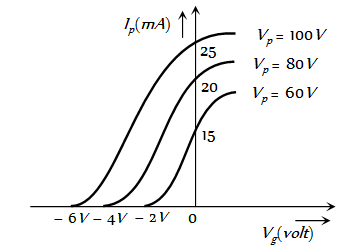
The variation of anode current in a triode corresponding to a change in grid potential at three different values of the plate potential is shown in the diagram. The mutual conductance of the triode is
The plate current in a triode is given by $I _{ p }=0.004\left(V_{ p }+10 V_{ g }\right)^{3 / 2} mA$ where $I _{ p }, V _{ p }$ and $V _{ g }$ are the values of plate current, plate voltage and grid voltage, respectively. What are the triode parameters $\mu, r_p$ and $g_m$ for the operating point at $V_p=120$ volt and $V _{ g }=-2$ volt?
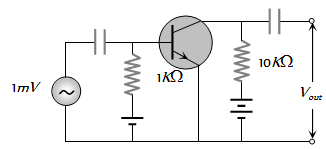
In the following common emitter configuration an $\text{NPN}$ transistor with current gain $b = 100$ is used. The output voltage of the amplifier will be
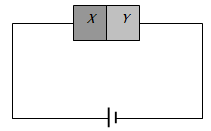
A semiconductor $X$ is made by doping a germanium crystal with arsenic $(Z = 33).$ A second semiconductor $Y$ is made by doping germanium with indium $(Z = 49).$ The two are joined end to end and connected to a battery as shown. Which of the following statements is correct
A
$X$ is $P-$type, $Y$ is $N-$type and the junction is forward biased
B
$X$ is $N-$type, $Y$ is $P-$type and the junction is forward biased
C
$X$ is $P-$type, $Y$ is $N-$type and the junction is reverse biased
✓
$X$ is $N-$type, $Y$ is $P-$type and the junction is reverse biased
Answer
Correct option: D.
$X$ is $N-$type, $Y$ is $P-$type and the junction is reverse biased
$X$ is $N-$type, $Y$ is $P-$type and the junction is reverse biased