Questions · Page 5 of 9

M.C.Q (1 Marks)

MCQ 2011 Mark
Thermionic emission from a heated filament varies with its temperature $T$ as
  • A
    $\mathrm{T}^{-1}$
  • B
    $T$
  • $\mathrm{T}^2$
  • D
    $\mathrm{T}^{3 / 2}$
Answer
Correct option: C.
$\mathrm{T}^2$
$\mathrm{T}^2$
View full question & answer
Question 2021 Mark
Which of the following logic gate is an universal gate(a) OR(b) NOT(c) AND(d) NOR
       
Answer
(d) NOR
View full question & answer
MCQ 2031 Mark
Sum of the two binary numbers $(10000)_2$ and $(11011)_2$ is
  • $(111101)_2$
  • B
    $(1111111)_2$
  • C
    $(101111)_2$
  • D
    $(111001)_2$
Answer
Correct option: A.
$(111101)_2$
$(111101)_2$
View full question & answer
Question 2041 Mark
The output of OR gate is 1(a) If both inputs are zero(b) If either or both inputs are 1(c) Only if both input are 1(d) If either input is zero
   
   
Answer
(b) If either or both inputs are 1
View full question & answer
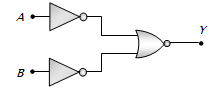
MCQ 2051 Mark
Which logic gate is represented by the following combination of logic gates
  • A
    $\text{OR}$
  • B
    $\text{NAND}$
  • $\text{AND}$
  • D
    $\text{NOR}$
Answer
Correct option: C.
$\text{AND}$
$\text{AND}$
View full question & answer
Question 2061 Mark
A gate in which all the inputs must be low to get a high output is called(a) A NAND gate(b) An inverter(c) A NOR gate(d) An AND gate
       
Answer
(b) An inverter
View full question & answer
Question 2071 Mark
The output of a NAND gate is 0(a) If both inputs are 0(b) If one input is 0 and the other input is 1(c) If both inputs are 1(d) Either if both inputs are 1 or if one of the inputs is 1 and the other 0


Answer
(c) If both inputs are 1
View full question & answer
Question 2081 Mark
If A and B are two inputs in AND gate, then AND gate has an output of 1 when the values of A and B are(a) A = 0, B = 0(b) A = 1, B = 1(c) A = 1, B = 0(d) A = 0, B = 1
       
Answer
(b) A = 1, B = 1
View full question & answer
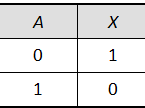
MCQ 2091 Mark
The given truth table is of
  • A
    $\text{OR}$ gate
  • B
    $\text{AND}$ gate
  • $\text{NOT}$ gate
  • D
    None of above
Answer
Correct option: C.
$\text{NOT}$ gate
$\text{NOT}$ gate
View full question & answer
Question 2111 Mark
A gate has the following truth table
P 1 1 0 0
Q 1 0 1 0
R 1 0 0 0
The gate is (a) NOR  (b) OR(c) NAND  (d) AND
       
Answer
(d) AND
View full question & answer
Question 2121 Mark
A logic gate is an electronic circuit which(a) Makes logic decisions(b) Allows electrons flow only in one direction(c) Works binary algebra(d) Alternates between 0 and 1 values


Answer
(a) Makes logic decisions
View full question & answer
Question 2131 Mark
The logic behind ‘NOR’ gate is that it gives(a) High output when both the inputs are low(b) Low output when both the inputs are low(c) High output when both the inputs are high(d) None of these


Answer
(a) High output when both the inputs are low
View full question & answer
Question 2141 Mark
Boolean algebra is essentially based on(a) Truth(b) Logic (c) Symbol(d) Numbers
       
Answer
(b) Logic 
View full question & answer
Question 2151 Mark
A truth table is given below. Which of the following has this type of truth table
A 0 1 0 1
B 0 0 1 1
y 1 0 0 0
 
(a) XOR gate(b) NOR gate(c) AND gate(d) OR gate
       
Answer
(b) NOR gate
View full question & answer
Question 2161 Mark
In a transistor in CE configuration, the ratio of power gain to voltage gain is(a) a        (b) b / a(c) ba(d) b
       
Answer
(d) b
View full question & answer
Question 2171 Mark
NPN transistor are preferred to PNP transistor because they have(a) Low cost(b) Low dissipation energy(c) Capability of handing large power(d) Electrons having high mobility than holes


Answer
(d) Electrons having high mobility than holes
View full question & answer
Question 2181 Mark
Consider an NPN transistor amplifier in common-emitter configuration. The current gain of the transistor is 100. If the collector current changes by 1 mA, what will be the change in emitter current(a) 1.1 mA(b) 1.01 mA (c) 0.01 mA(d) 10 mA
       
Answer
(b) 1.01 mA
View full question & answer
MCQ 2191 Mark
While a collector to emitter voltage is constant in a transistor, the collector current changes by $8.2\ mA$ when the emitter current changes by $8.3\ mA.$ The value of forward current ratio $h_{fe}$ is
  • $82$
  • B
    $83$
  • C
    $8.2$
  • D
    $8.3$
Answer
Correct option: A.
$82$
$82$
View full question & answer
Question 2201 Mark
Which of the following is used to produce radio waves of constant amplitude(a) Oscillator (b) FET (c) Rectifier(d) Amplifier
       
Answer
(a) Oscillator
View full question & answer
MCQ 2211 Mark
In an $NPN$ transistor circuit, the collector current is $10 mA$. If $90\%$ of the electrons emitted reach the collector, the emitter current $(i_E)$ and base current $(i_B)$ are given by
  • A
    $i_E = – 1 mA, i_B = 9 mA$
  • B
    $i_E = 9 mA, i_B = – 1 mA$
  • C
    $i_E = 1 mA, i_B = 11 mA$
  • $i_E = 11 mA, i_B = 1 mA$
Answer
Correct option: D.
$i_E = 11 mA, i_B = 1 mA$
View full question & answer
Question 2221 Mark
In NPN transistor the collector current is 10 mA. If 90% of electrons emitted reach the collector, then(a) Emitter current will be 9 mA (b) Emitter current will be 11.1 mA(c) Base current will be 0.1 mA(d) Base current will be 0.01 mA
   
   
Answer
(b) Emitter current will be 11.1 mA
View full question & answer
MCQ 2231 Mark
If $l_1, l_2, l_3$  are the lengths of the emitter, base and collector of a transistor then
  • A
    $l_1=l_2=l_3$
  • B
    $l_3<l_2<l_1$
  • C
    $l_3<l_1<l_2$
  • $l_3>l_1>l_2$
Answer
Correct option: D.
$l_3>l_1>l_2$
$l_3>l_1>l_2$
View full question & answer
Question 2241 Mark
When NPN transistor is used as an amplifier(a) Electrons move from base to emitter (b) Electrons move from emitter to base (c) Electrons moves from base to emitter (d) Holes moves from base to emitter


Answer
(b) Electrons move from emitter to base
View full question & answer
MCQ 2251 Mark
Correct relation for triode is
  • $\mu=g_m \times r_p$
  • B
    $\mu=\frac{\frac{g m}{r_p}}{r_p}$
  • C
    $\mu=2 g_m \times r_p$
  • D
    None of these
Answer
Correct option: A.
$\mu=g_m \times r_p$
View full question & answer
Question 2261 Mark
In case of NPN-transistors the collector current is always less than the emitter current because(a) Collector side is reverse biased and emitter side is forward biased(b) After electrons are lost in the base and only remaining ones reach the collector(c) Collector side is forward biased and emitter side is reverse biased(d) Collector being reverse biased attracts less electrons


Answer
(b) After electrons are lost in the base and only remaining ones reach the collector
View full question & answer
Question 2271 Mark
In a common base amplifier circuit, calculate the change in base current if that in the emitter current is 2 mA and a = 0.98(a) 0.04 mA(b) 1.96 mA(c) 0.98 mA(d) 2 mA
       
Answer
(a) 0.04 mA
View full question & answer
Question 2281 Mark
For a transistor, the current amplification factor is 0.8. The transistor is connected in common emitter configuration. The change in the collector current when the base current changes by 6 mA is (a) 6 mA(b) 4.8 mA(c) 24 mA(d) 8 mA
       
Answer
(c) 24 mA
View full question & answer
Question 2291 Mark
The part of a transistor which is heavily doped to produce a large number of majority carriers, is(a) Base(b) Emitter(c) Collector(d) None of these
       
Answer
(b) Emitter
View full question & answer
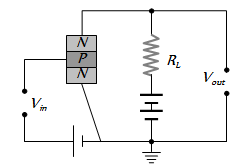
MCQ 2301 Mark
An $\text{NPN}-$transistor circuit is arranged as shown in figure. It is
  • A
    A common base amplifier circuit
  • A common emitter amplifier circuit
  • C
    A common collector amplifier circuit
  • D
    Neither of the above
Answer
Correct option: B.
A common emitter amplifier circuit
View full question & answer
Question 2311 Mark
The most commonly used material for making transistor is(a) Copper(b) Silicon(c) Ebonite(d) Silver
       
Answer
(b) Silicon
View full question & answer
Question 2321 Mark
In a PNP transistor the base is the N-region. Its width relative to the P-region is (a) Smaller(b) Larger(c) Same (d) Not related
       
Answer
(a) Smaller
View full question & answer
Question 2331 Mark
A transistor is used in common emitter mode as an amplifier. Then(a) The base-emitter junction is forward biased(b) The base-emitter junction is reverse biased(c) The input signal is connected in series with the voltage applied to the base-emitter junction(d) a, c


Answer
(d) a, c
View full question & answer
Question 2341 Mark
For a transistor the parameter b = 99. The value of the parameter a is(a) 0.9(b) 0.99(c) 1  (d) 9
       
Answer
(b) 0.99
View full question & answer
Question 2351 Mark
The transistors provide good power amplification when they are used in(a) Common collector configuration(b) Common emitter configuration(c) Common base configuration     (d) None of these
   
   
Answer
(b) Common emitter configuration
View full question & answer
Question 2361 Mark
Least doped region in a transistor(a) Either emitter or collector(b) Base(c) Emitter(d) Collector
       
Answer
(b) Base
View full question & answer
Question 2381 Mark
In P-N junction, the barrier potential offers resistance to(a) Free electrons in N region and holes in P region(b) Free electrons in P region and holes in N region(c) Only free electrons in N region(d) Only holes in P region


Answer
(a) Free electrons in N region and holes in P region
View full question & answer
Question 2391 Mark
The width of forbidden gap in silicon crystal is 1.1 eV. When the crystal is converted in to a N-type semiconductor the distance of Fermi level from conduction band is(a) Greater than 0.55 eV (b) Equal to 0.55 eV(c) Lesser than 0.55 eV (d) Equal to 1.1 eV
   
   
Answer
(c) Lesser than 0.55 eV
View full question & answer
MCQ 2401 Mark
In diode, when there is saturation current, the plate resistance $e\left({ }^{r_p}\right)$  is
  • A
    Zero
  • Infinite
  • C
    Some finite quantity
  • D
    Data is insufficient
Answer
Correct option: B.
Infinite
Infinite
View full question & answer
Question 2411 Mark
Zener diode is used as(a) Half wave rectifier(b) Full wave rectifier(c) ac voltage stabilizer(d) dc voltage stabilizer
   
   
Answer
(c) ac voltage stabilizer
View full question & answer
MCQ 2421 Mark
For a common base configuration of $\text{PNP}$ transistor $\frac{I_{c}}{l_{E}}=0.98$  then maximum current gain in common emitter configuration will be
       
  • A
    $12$
  • $24$
  • C
    $6$
  • D
    $5$
Answer
Correct option: B.
$24$
$24$
View full question & answer
MCQ 2431 Mark
If $a = 0.98$ and current through emitter $i_e = 20 \ mA,$ the value of $b$ is
  • A
    $4.9$
  • $49$
  • C
    $96$
  • D
    $9.6$
Answer
Correct option: B.
$49$
$49$
View full question & answer
Question 2441 Mark
The transfer ratio of a transistor is 50. The input resistance of the transistor when used in the common-emitter configuration is 1 KW. The peak value for an A.C input voltage of 0.01 V peak is(a) 100 mA(b) 0.01 mA(c) 0.25 mA(d) 500 mA
       
Answer
(d) 500 mA
View full question & answer
Question 2451 Mark
Which of the following is true (a) Common base transistor is commonly used because current gain is maximum(b) Common emitter is commonly used because current gain is maximum(c) Common collector is commonly used because current gain is maximum (d) Common emitter is the least used transistor


Answer
(b) Common emitter is commonly used because current gain is maximum
View full question & answer
Question 2461 Mark
In the case of constants a and b of  a transistor(a) a = b(b) b < 1   a > 1(c) ab = 1(d) b > 1  a < 1
       
Answer
(d) b > 1  a < 1
View full question & answer
Question 2471 Mark
A NPN transistor conducts when(a) Both collector and emitter are positive with respect to the base (b) Collector is positive and emitter is negative with respect to the base(c) Collector is positive and emitter is at same potential as the base(d) Both collector and emitter are negative with respect to the base


Answer
(b) Collector is positive and emitter is negative with respect to the base
View full question & answer
Question 2481 Mark
The emitter-base junction of a transistor is …… biased while the collector-base junction is ……. biased(a) Reverse, forward(b) Reverse, reverse(c) Forward, forward (d) Forward, reverse
       
Answer
(d) Forward, reverse
View full question & answer
Question 2491 Mark
An oscillator is nothing but an amplifier with(a) Positive feed back(b) Large gain(c) No feedback(d) Negative feedback
   
   
Answer
(a) Positive feed back
View full question & answer
MCQ 2501 Mark
The phase difference between input and output voltages of a $CE$ circuit is
  • A
    $0^{\circ}$
  • B
    $90^{\circ}$
  • $180^{\circ}$
  • D
    $ 270^{\circ}$
Answer
Correct option: C.
$180^{\circ}$
$180^{\circ}$
View full question & answer