Question types

Electrostatics question types

678 questions across 1 question group — pick any mix to generate a Physics paper with step-by-step answer keys.

678
Questions
1
Question groups
5
Question types
Sample Questions

Electrostatics questions

One sample from each question group in this chapter. Select any group above to see the full set with answer keys.

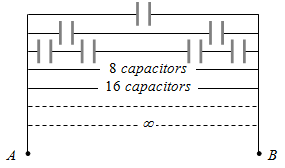
An infinite number of identical capacitors each of capacitance $1 \mu F$ are connected as in adjoining figure. Then the equivalent capacitance between $A$ and  $B$ is
  • A
    $1 \mu F$
  • $2 \mu F$
  • C
    $\frac12 \mu F$
  • D
    $\infty $

Answer: B.

View full solution
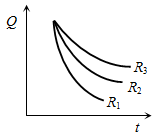
Three identical capacitors are given a charge $Q$ each and they are then allowed to discharge through resistance $R_1, R_2$ and $R_3.$ Their charges, as a function of time shown in the graph below. The smallest of the three resistance is
  • A
    $R_3$
  • B
    $R_2$
  • $R_1$
  • D
    Cannot be predicted

Answer: C.

View full solution
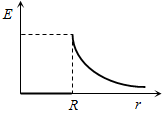
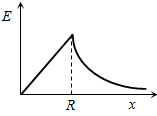
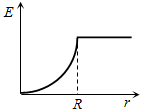
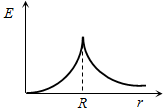
Which of the following graphs shows the variation of electric field $E$ due to a hollow spherical conductor of radius $R$ as a function of distance from the centre of the sphere
  • B
  • C
  • D

Answer: A.

View full solution
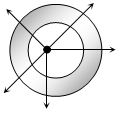
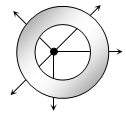
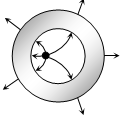
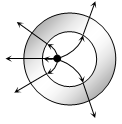
A metallic shell has a point charge $'q\ ’$ kept inside its cavity. Which one of the following diagrams correctly represents the electric lines of forces
  • A
  • B
  • D

Answer: C.

View full solution
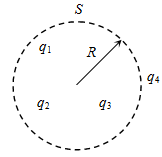
$q_1, q_2, q_3$ and $q_4$ are point charges located at points as shown in the figure and $S$ is a spherical Gaussian surface of radius $R$. Which of the following is true according to the Gauss’s law
  • A
    $\oint_s\left(\overrightarrow{E_1}+\overrightarrow{E_2}+\overrightarrow{E_3}\right) \cdot d \vec{A}=\frac{q_1+q_2+q_s}{2 \varepsilon_0}$
  • $\oint_s\left(\overrightarrow{E_1}+\overrightarrow{E_2}+\overrightarrow{E_3}\right) \cdot d \vec{A}=\frac{q_1+q_2+q_s}{\varepsilon_0}$
  • C
    $\oint_s\left(\overrightarrow{E_1}+\overrightarrow{E_2}+\overrightarrow{E_3}\right) \cdot d \vec{A}=\frac{\left(q_1+q_2+q_3+q_4\right)}{\varepsilon_0}$
  • D
    None of the above

Answer: B.

View full solution

Generate a Electrostatics paper free

Pick question groups from the list above, set marks and difficulty, and export a branded PDF with step-by-step answer keys. First 3 chapters free — no signup.

Download App