MCQ 11 Mark
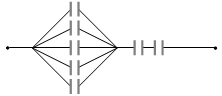
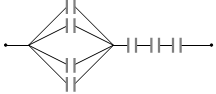
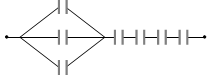
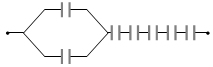
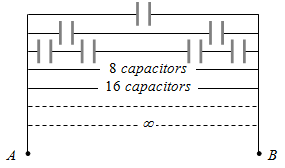
An infinite number of identical capacitors each of capacitance $1 \mu F$ are connected as in adjoining figure. Then the equivalent capacitance between $A$ and $B$ is
- A
$1 \mu F$
- ✓
$2 \mu F$
- C
$\frac12 \mu F$
- D
$\infty $
AnswerCorrect option: B. $2 \mu F$
$2 \mu F$
View full question & answer→MCQ 21 Mark
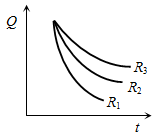
Three identical capacitors are given a charge $Q$ each and they are then allowed to discharge through resistance $R_1, R_2$ and $R_3.$ Their charges, as a function of time shown in the graph below. The smallest of the three resistance is
View full question & answer→MCQ 31 Mark
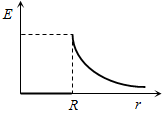
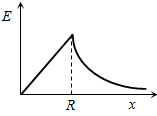
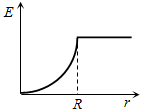
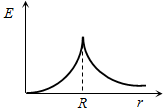
Which of the following graphs shows the variation of electric field $E$ due to a hollow spherical conductor of radius $R$ as a function of distance from the centre of the sphere
View full question & answer→MCQ 41 Mark
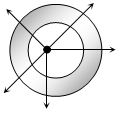
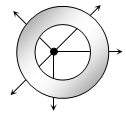
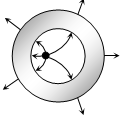
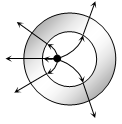
A metallic shell has a point charge $'q\ ’$ kept inside its cavity. Which one of the following diagrams correctly represents the electric lines of forces
View full question & answer→MCQ 51 Mark
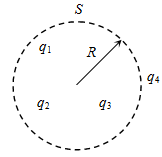
$q_1, q_2, q_3$ and $q_4$ are point charges located at points as shown in the figure and $S$ is a spherical Gaussian surface of radius $R$. Which of the following is true according to the Gauss’s law
- A
$\oint_s\left(\overrightarrow{E_1}+\overrightarrow{E_2}+\overrightarrow{E_3}\right) \cdot d \vec{A}=\frac{q_1+q_2+q_s}{2 \varepsilon_0}$
- ✓
$\oint_s\left(\overrightarrow{E_1}+\overrightarrow{E_2}+\overrightarrow{E_3}\right) \cdot d \vec{A}=\frac{q_1+q_2+q_s}{\varepsilon_0}$
- C
$\oint_s\left(\overrightarrow{E_1}+\overrightarrow{E_2}+\overrightarrow{E_3}\right) \cdot d \vec{A}=\frac{\left(q_1+q_2+q_3+q_4\right)}{\varepsilon_0}$
- D
AnswerCorrect option: B. $\oint_s\left(\overrightarrow{E_1}+\overrightarrow{E_2}+\overrightarrow{E_3}\right) \cdot d \vec{A}=\frac{q_1+q_2+q_s}{\varepsilon_0}$
$\oint_s\left(\overrightarrow{E_1}+\overrightarrow{E_2}+\overrightarrow{E_3}\right) \cdot d \vec{A}=\frac{q_1+q_2+q_s}{\varepsilon_0}$
View full question & answer→MCQ 61 Mark
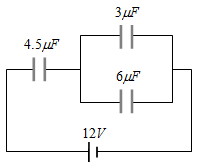
In the circuit shown in the figure, the potential difference across the $4.5\ mF$ capacitor is
- A
$\frac{8}{3}$ volts
- B
$4$ volts
- C
$6$ volts
- ✓
$8$ volts
AnswerCorrect option: D. $8$ volts
$8$ volts
View full question & answer→MCQ 71 Mark
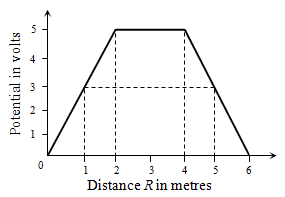
The variation of potential with distance $R$ from a fixed point is as shown below. The electric field at $R = 5 m$ is
- ✓
$2.5\ volt/m$
- B
$-2.5\ volt/m$
- C
$2/5\ volt/m$
- D
$-2/5\ volt/m$
AnswerCorrect option: A. $2.5\ volt/m$
$2.5\ volt/m$
View full question & answer→MCQ 81 Mark
A positively charged thin metal ring of radius $R$ is fixed in the $x y -$ plane with its centre at the $O$. A negatively charged particle $P$ is released from rest at the point $\left(0,0, z_0\right)$, where $z_0>0$. Then the motion of $P$ is
- A
Periodic for all values of $z_0$ satisfying $0< z _0<\infty$
- B
Simple harmonic for all values of satisfying $0< z _0<R$
- C
Approximately simple harmonic provided $z _0 \ll R$
- ✓
$a, c$
AnswerCorrect option: D. $a, c$
$a, c$
View full question & answer→MCQ 91 Mark
A charged particle $q$ is shot towards another charged particle $Q$ which is fixed, with a speed $v$. It approaches $Q$ upto a closest distance $r$ and then returns. If $q$ were given a speed $2v,$ the closest distances of approach would be

View full question & answer→MCQ 101 Mark
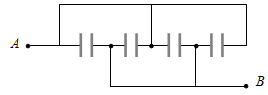
Four condensers are joined as shown in the adjoining figure. The capacity of each is $8 \mu F$. The equivalent capacity between the points $A$ and $B$ will be
- ✓
$32 \ \mu F$
- B
$2 \ \mu F$
- C
$8 \ \mu F$
- D
$16 \ \mu F$
AnswerCorrect option: A. $32 \ \mu F$
$32 \ \mu F$
View full question & answer→MCQ 111 Mark
A parallel plate capacitor of capacity $C _0$ is charged to a potential $V _0$
$(i)$ The energy stored in the capacitor when the battery is disconnected and the separation is doubled $E _1$
$(ii)$ The energy stored in the capacitor when the charging battery is kept connected and the separation between the capacitor plates is doubled is $E _2$ Then $E _1 / E _2$ value is
View full question & answer→MCQ 121 Mark
A cube of side $b$ has a charge $q$ at each of its vertices. The electric field due to this charge distribution at the centre of this cube will be
- A
$q / b^2$
- B
$q / 2 b^2$
- C
$32\ q / b^2$
- ✓
View full question & answer→MCQ 131 Mark
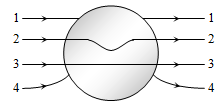
A metallic solid sphere is placed in a uniform electric field. The lines of force follow the path$(s)$ shown in figure as
View full question & answer→MCQ 141 Mark
Four charges are arranged at the corners of a square $\text{ABCD},$ as shown in the adjoining figure. The force on the charge kept at the centre $O$ is
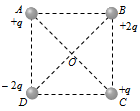
AnswerCorrect option: C. Along the diagonal $BD$
Along the diagonal $BD$
View full question & answer→MCQ 151 Mark
For a given surface the Gauss's law is stated as $\oint E . ds =0$. From this we can conclude that
AnswerCorrect option: C. The total flux through the surface is zero
The total flux through the surface is zero
View full question & answer→Question 161 Mark
The electric field due to an electric dipole at a distance r from its centre in axial position is E. If the dipole is rotated through an angle of 90° about its perpendicular axis, the electric field at the same point will be(a) E (b) E/4(c) E/2(d) 2E
MCQ 171 Mark
What is the angle between the electric dipole moment and the electric field strength due to it on the equatorial line
- A
$0^\circ$
- B
$90^\circ$
- ✓
$180^\circ$
- D
AnswerCorrect option: C. $180^\circ$
$180^\circ$
View full question & answer→MCQ 181 Mark
Two charges $+3.2 \times 10^{-19} C$ and $-3.2 \times 10^{-19} C$ kept $2.4 A$ apart forms a dipole. If it is kept in uniform electric field of intensity $4 \times 10^5\ volt / m$ then what will be its electrical energy in equilibrium
- A
$+3 \times 10^{-23}\ J$
- ✓
$-3 \times 10^{-23}\ J$
- C
$-6 \times 10^{-23}\ J$
- D
$H^2 \times 10^{-23}\ J$
AnswerCorrect option: B. $-3 \times 10^{-23}\ J$
$-3 \times 10^{-23}\ J$
View full question & answer→MCQ 191 Mark
When an electric dipole $\overrightarrow{ p }$ is placed in a uniform electric field $\overrightarrow{ E }$ then at what angle between $\overrightarrow{ p }$ and $\overrightarrow{ E }$ the value of torque will be maximum
- ✓
$90^\circ$
- B
$0^\circ$
- C
$180^\circ$
- D
$45^\circ$
AnswerCorrect option: A. $90^\circ$
$90^\circ$
View full question & answer→MCQ 201 Mark
Two electric dipoles of moment $P$ and $64 P$ are placed in opposite direction on a line at a distance of $25 \ cm$. The electric field will be zero at point between the dipoles whose distance from the dipole of moment $P$ is
- ✓
$5\ cm$
- B
$\frac{25}{9}\ cm$
- C
$10\ cm$
- D
$\frac{4}{13}\ cm$
AnswerCorrect option: A. $5\ cm$
$5 \ cm$
View full question & answer→MCQ 211 Mark
Two infinitely long parallel wires having linear charge densities $\lambda_1$ and $\lambda_2$ respectively are placed at a distance of $R$ metres. The force per unit length on either wire will be $K=\frac{1}{4 \pi \varepsilon_0}$
- A
$K \frac{2 \lambda_1 \lambda_2}{R^2}$
- ✓
$K \frac{2 \lambda_1 \lambda_2}{R}$
- C
$K \frac{\lambda_1 \lambda_2}{R^2}$
- D
$K \frac{\lambda_1 \lambda_2}{R}$
AnswerCorrect option: B. $K \frac{2 \lambda_1 \lambda_2}{R}$
$K \frac{2 \lambda_1 \lambda_2}{R}$
View full question & answer→MCQ 221 Mark
A parallel plate capacitor of area $A,$ plate separation $d$ and capacitance $C$ is filled with three different dielectric materials having dielectric constants $K_1,K_2$ and $K_3$ as shown. If a single dielectric material is to be used to have the same capacitance $C$ in this capacitor, then its dielectric constant k is given by
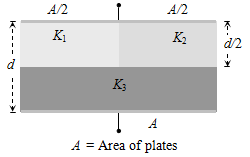
- A
$\frac{1}{ k }=\frac{1}{ k _1}+\frac{1}{ k _2}+\frac{1}{2 k _8}$
- ✓
$\frac{1}{ k }=\frac{1}{ k _1+ k _2}+\frac{1}{2 k _1}$
- C
$k =\frac{ k _1 k _2}{ k _1+ k _2}+2 k _3$
- D
$k = k _1+ k _2+2 k _3$
AnswerCorrect option: B. $\frac{1}{ k }=\frac{1}{ k _1+ k _2}+\frac{1}{2 k _1}$
$\frac{1}{ k }=\frac{1}{ k _1+ k _2}+\frac{1}{2 k _1}$
View full question & answer→MCQ 231 Mark
Force of attraction between two point charges $Q$ and $-Q$ separated by $d$ metre is $F_e$. When these charges are placed on two identical spheres of radius $R = 0.3d$ whose centres are $d$ metre apart, the force of attraction between them is
- ✓
Greater than $F_e$
- B
Equal to $F_e$
- C
Less than $F_e$
- D
Less than $F_e$
AnswerCorrect option: A. Greater than $F_e$
Greater than $F_e$
View full question & answer→MCQ 241 Mark
To charges $q_1$ and $q_2$ are placed $30 \ cm$ apart, shown in the figure. A third charge $q_3$ is moved along the arc of a circle of radius $40 \ cm$ from $C$ to $D$. The change in the potential energy of the system is $\frac{ q _{ s }}{4 \pi \varepsilon_0} k$, where $k$ is
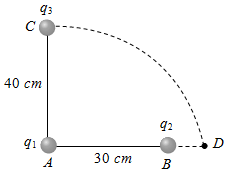
- ✓
$8q_2$
- B
$8q_1$
- C
$6q_2$
- D
$6q_1$
AnswerCorrect option: A. $8q_2$
$8q_2$
View full question & answer→MCQ 251 Mark
In the figure a potential of $+ 1200\ V$ is given to point $A$ and point $B$ is earthed, what is the potential at the point $P$
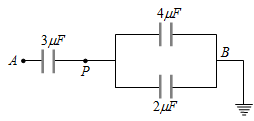
- A
$100\ V $
- B
$200\ V$
- ✓
$400\ V$
- D
$ 600\ V$
AnswerCorrect option: C. $400\ V$
$400\ V$
View full question & answer→MCQ 261 Mark
The charge on any one of the $2\ \mu F$ capacitors and $1\ \mu F$ capacitor will be given respectively $($in $\mu C )$ as
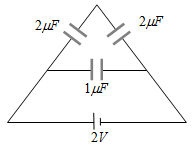
- A
$1, 2$
- B
$2, 1$
- C
$1, 1$
- ✓
$2, 2$
AnswerCorrect option: D. $2, 2$
$2, 2$
View full question & answer→MCQ 271 Mark
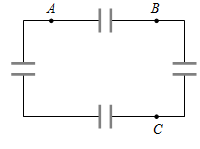
Four capacitors of each of capacity $3\ \mu F$ are connected as shown in the adjoining figure. The ratio of equivalent capacitance between $A$ and $B$ and between $A$ and $C$ will be
- ✓
$4 : 3$
- B
$3 : 4$
- C
$2 : 3$
- D
$3 : 2$
AnswerCorrect option: A. $4 : 3$
$4 : 3$
View full question & answer→MCQ 281 Mark
Seven capacitors each of capacity $2\ \mu F$ are to be so connected to have a total capacity $\frac{10}{11}\ \mu F$. Which will be the necessary figure as shown
View full question & answer→MCQ 291 Mark
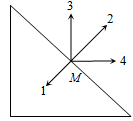
Three identical point charges, as shown are placed at the vertices of an isosceles right angled triangle. Which of the numbered vectors coincides in direction with the electric field at the mid$-$point $M$ of the hypotenuse
View full question & answer→MCQ 301 Mark
Three equal charges are placed on the three corners of a square. If the force between $q_{1}$ and $q_2$ is $F_{12}$ and that between $q_1$ and $q_3$ is $F _{13}$, the ratio of magnitudes $\frac{F_{12}}{F_{18}}$ is
- A
$1/2$
- ✓
$2$
- C
$1 / \sqrt{2}$
- D
$\sqrt{2}$
View full question & answer→MCQ 311 Mark
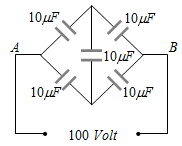
Five capacitors of $10\ \mu F$ capacity each are connected to $\text{a d.c.}$ potential of $100$ volts as shown in the adjoining figure. The equivalent capacitance between the points $A$ and $B$ will be equal to
- A
$40\ \mu F$
- B
$20\ \mu F$
- C
$30 \ \mu F$
- ✓
$10\ \mu F$
AnswerCorrect option: D. $10\ \mu F$
$10\ \mu F$
View full question & answer→MCQ 321 Mark
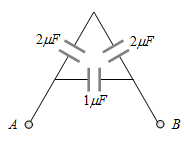
What is the effective capacitance between $A$ and $B$ in the following figure
- A
$1\ \mu F$
- ✓
$2\ \mu F$
- C
$1.5 \ \mu F$
- D
$2.5 \ \mu F$
AnswerCorrect option: B. $2\ \mu F$
$2\ \mu F$
View full question & answer→MCQ 331 Mark
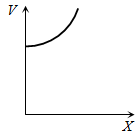
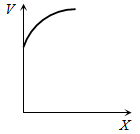
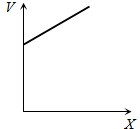
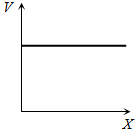
Between the plates of a parallel plate capacitor a dielectric plate is introduced just to fill the space between the plates. The capacitor is charged and later disconnected from the battery. The dielectric plate is slowly drawn out of the capacitor parallel to the plates. The plot of the potential difference across the plates and the length of the dielectric plate drawn out is
MCQ 341 Mark
Which one statement is correct ? A parallel plate air condenser is connected with a battery. Its charge, potential, electric field and energy are $Q_0, V_0, E_0$ and $U_0$ respectively. In order to fill the complete space between the plates a dielectric slab is inserted, the battery is still connected. Now the corresponding values $Q , V , E$ and $U$ are in relation with the initially stated as
- A
$Q>Q_0$
- B
$U>U_0$
- C
$V>V_0$
- ✓
$a, b$
AnswerCorrect option: D. $a, b$
$a, b$
View full question & answer→MCQ 351 Mark
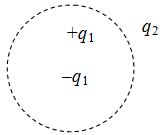
Consider the charge configuration and spherical Gaussian surface as shown in the figure. When calculating the flux of the electric field over the spherical surface the electric field will be due to
- A
$q_2$
- B
Only the positive charges
- ✓
- D
$+q_1$ and $-q_1$
View full question & answer→MCQ 361 Mark
An electron moving with the speed $5 \times 10^6$ per $\sec$ is shooted parallel to the electric field of intensity $1 \times 10^3\ N/C$. Field is responsible for the retardation of motion of electron. Now evaluate the distance travelled by the electron before coming to rest for an instant $($mass of $e = 9 \times 10^{-31}\ Kg$. charge $= 1.6 \times 10^{-19}\ C)$
- A
$7 m$
- B
$0.7\ mm$
- ✓
$7 \ cm$
- D
$0.7 \ cm$
AnswerCorrect option: C. $7 \ cm$
$7 \ cm$
View full question & answer→MCQ 371 Mark
The distance between charges $5 \times 10^{-11}\ C$ and $-2.7 \times 10^{-11}\ C$ is $0.2 m$. The distance at which a third charge should be placed in order that it will not experience any force along the line joining the two charges is
- A
$0.44 m$
- B
$0.65 m$
- ✓
$0.556 m$
- D
$0.350 m$
AnswerCorrect option: C. $0.556 m$
$0.556 m$
View full question & answer→MCQ 381 Mark
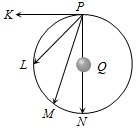
In the figure the charge $Q$ is at the centre of the circle. Work done is maximum when another charge is taken from point $P$ to
View full question & answer→MCQ 391 Mark
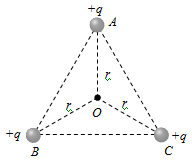
$\text{ABC}$ is an equilateral triangle. Charges $+ q$ are placed at each corner. The electric intensity at $O$ will be
- A
$\frac{1}{4 \pi z_0} \frac{q}{r^2}$
- B
$\frac{1}{4 \pi \varepsilon_0} \frac{q}{r}$
- ✓
- D
$\frac{1}{4 \pi \varepsilon_0} \frac{3 q}{r^2}$
View full question & answer→MCQ 401 Mark
Three charges each of magnitude $q$ are placed at the corners of an equilateral triangle, the electrostatic force on the charge placed at the center is $($each side of triangle is $L)$
- ✓
- B
$\frac{1}{4 \pi \varepsilon_0} \frac{q^2}{L^2}$
- C
$\frac{1}{4 \pi \varepsilon_0} \frac{3 q^2}{L^2}$
- D
$\frac{1}{12 \pi \varepsilon_0} \frac{q^2}{L^2}$
View full question & answer→Question 411 Mark
Assertion : A parallel plate capacitor is connected across battery through a key. A dielectric slab of constant K is introduced between the plates. The energy which is stored becomes K times.
Reason : The surface density of charge on the plate remains constant or unchanged.(a) If both assertion and reason are true and the reason is the correct explanation of the assertion.(b) If both assertion and reason are true but reason is not the correct explanation of the assertion.(c) If assertion is true but reason is false.(d) If the assertion and reason both are false.
Answer(c) If assertion is true but reason is false.
View full question & answer→Question 421 Mark
Assertion : The tyres of aircraft's are slightly conducting.
Reason : If a conductor is connected to ground, the extra charge induced on conductor will flow to ground.(a) If both assertion and reason are true and the reason is the correct explanation of the assertion.(b) If both assertion and reason are true but reason is not the correct explanation of the assertion.(c) If assertion is true but reason is false.(d) If the assertion and reason both are false.
Answer(b) If both assertion and reason are true but reason is not the correct explanation of the assertion.
View full question & answer→Question 431 Mark
Assertion : Circuit containing capacitors should be handled cautiously even when there is no current.
Reason : The capacitors are very delicate and so quickly break down.(a) If both assertion and reason are true and the reason is the correct explanation of the assertion.(b) If both assertion and reason are true but reason is not the correct explanation of the assertion.(c) If assertion is true but reason is false.(d) If the assertion and reason both are false.
Answer(c) If assertion is true but reason is false.
View full question & answer→Question 441 Mark
Assertion : At a point in space, the electric field points towards north. In the region, surrounding this point the rate of change of potential will be zero along the east and west.
Reason : Electric field due to a charge is the space around the charge.(a) If both assertion and reason are true and the reason is the correct explanation of the assertion.(b) If both assertion and reason are true but reason is not the correct explanation of the assertion.(c) If assertion is true but reason is false.(d) If the assertion and reason both are false.
Answer(b) If both assertion and reason are true but reason is not the correct explanation of the assertion.
View full question & answer→Question 451 Mark
Assertion : Conductors having equal positive charge and volume, must also have same potential.
Reason : Potential depends only on charge and volume of conductor. (a) If both assertion and reason are true and the reason is the correct explanation of the assertion.(b) If both assertion and reason are true but reason is not the correct explanation of the assertion.(c) If assertion is true but reason is false.(d) If the assertion and reason both are false.
Answer(d) If the assertion and reason both are false.
View full question & answer→Question 461 Mark
Assertion : The whole charge of a conductor cannot be transferred to another isolated conductor.
Reason : The total transfer of charge from one to another is not possible.(a) If both assertion and reason are true and the reason is the correct explanation of the assertion.(b) If both assertion and reason are true but reason is not the correct explanation of the assertion.(c) If assertion is true but reason is false.(d) If the assertion and reason both are false.
Answer(d) If the assertion and reason both are false.
View full question & answer→Question 471 Mark
Assertion : On going away from a point charge or a small electric dipole, electric field decreases at the same rate in both the cases.
Reason : Electric field is inversely proportional to square of distance from the charge or an electric dipole.(a) If both assertion and reason are true and the reason is the correct explanation of the assertion.(b) If both assertion and reason are true but reason is not the correct explanation of the assertion.(c) If assertion is true but reason is false.(d) If the assertion and reason both are false.
Answer(d) If the assertion and reason both are false.
View full question & answer→Question 481 Mark
Assertion : The surface charge densities of two spherical conductors of different radii are equal. Then the electric field intensities near their surface are also equal.
Reason : Surface charge density is equal to charge per unit area. (a) If both assertion and reason are true and the reason is the correct explanation of the assertion.(b) If both assertion and reason are true but reason is not the correct explanation of the assertion.(c) If assertion is true but reason is false.(d) If the assertion and reason both are false.
Answer(b) If both assertion and reason are true but reason is not the correct explanation of the assertion.
View full question & answer→MCQ 491 Mark
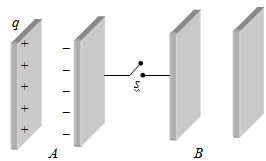
Consider the situation shown in the figure. The capacitor $A$ has a charge 4 on it whereas $B$ is uncharged. The charge appearing on the capacitor $B$ a long time after the switch is closed is
View full question & answer→MCQ 501 Mark
For the circuit shown, which of the following statements is true
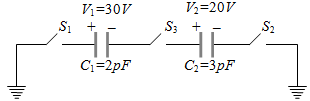
- A
With $S_1$ closed$, V_1 = 15V, V_2 = 20V$
- B
With $S_3$ closed $V_1 = V_2 = 25V$
- C
With $S_1$ and $S_2$ closed $V_1 = V_2 = 0$
- ✓
With $S_1$ and $S_3$ closed, $V_1 = 30V, V_2 = 20V$
AnswerCorrect option: D. With $S_1$ and $S_3$ closed, $V_1 = 30V, V_2 = 20V$
With $S_1$ and $S_3$ closed, $V_1 = 30V, V_2 = 20V$
View full question & answer→