Questions

M.C.Q (1 Marks)

Take a timed test

10 questions · auto-graded multiple-choice test.

MCQ 11 Mark
While walking on ice, one should take small steps to avoid slipping. This is because smaller steps ensure:
  • A
    Larger friction.
  • Smaller friction.
  • C
    Larger normal force.
  • D
    Smaller normal force.
Answer
Correct option: B.
Smaller friction.
Explanation:

According to the first law of the limiting friction,

$\text{f}=\mu\text{N}$

where f is the frictional force

$\mu$ is the coefficient of friction

N is the normal reaction force

When we take smaller steps on ice, the normal reaction force exerted by the ice is small. Therefore, the smaller steps ensure smaller friction.
View full question & answer
MCQ 21 Mark
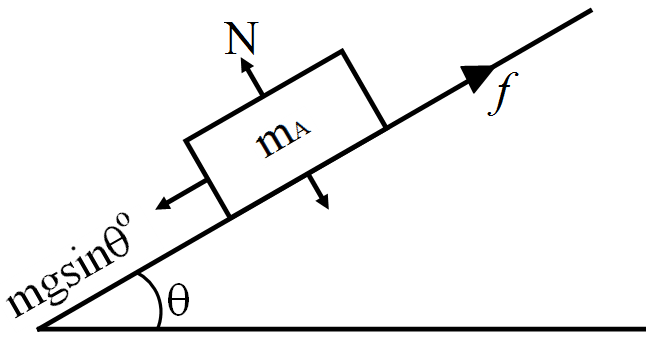
A block $A$ kept on an inclined surface just begins to slide if the inclination is $30^\circ $. The block is replaced by another block $B$ and it is found that it just begins to slide if the inclination is $40^\circ :$
  • A
    Mass of $A >$ mass of $B$.
  • B
    Mass of $A <$ mass of $B$.
  • C
    Mass of $A =$ mass of $B$.
  • All the three are possible.
Answer
Correct option: D.
All the three are possible.


We know that
$\text{N = mg}\cos\theta^{\circ}$
$\text{f}_{\text{max}}=\mu\text{N}=\mu\text{mg}\cos\theta$
where $N =$ normal reaction force
$\text{f}_{\text{max}}=$ frictional force
$\theta =$ angle of inclination
$\mu =$ coefficient of friction
When the block just begins to slide, it means
$\text{mg}\sin\theta=\text{f}_{\text{max}}$
$\text{mg}\sin\theta=\mu\text{mg}\cos\theta$
$\mu=\tan\theta$
and the coefficient of friction depends on the angle of inclination $(\theta)$ and does not depend on mass.
Now consider the block sliding condition:
$\text{mg}\sin\theta-\text{f}_{\max}=\text{ma}$
$\text{mg}\sin\theta-\mu\text{mg}\cos\theta=\text{ma}$
$\therefore\text{a = g}(\sin\theta-\mu\cos\theta)$
From the above equation it is clear that acceleration does not depend on the mass but depends on $\theta$ and $\mu.$
View full question & answer
MCQ 31 Mark
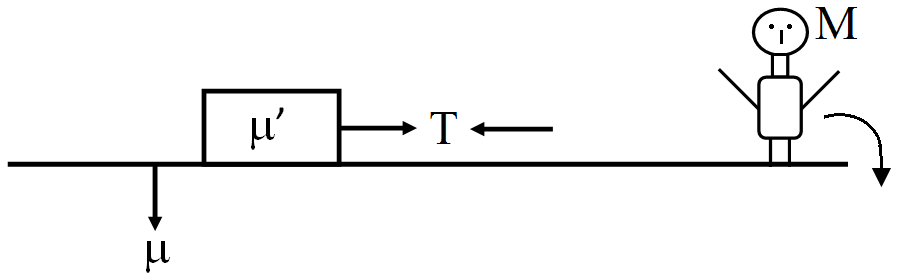
A boy of mass M is applying a horizontal force to slide a box of mass M' on a rough horizontal surface. The coefficient of friction between the shoes of the box and the floor is $\mu.$ In which of the following cases it is certainly not possible to slide the box?
  • $\mu<\mu',\text{M < M}'$
  • B
    $\mu>\mu',\text{M < M}'$
  • C
    $\mu<\mu',\text{M > M}'$
  • D
    $\mu>\mu',\text{M > M}'$
Answer
Correct option: A.
$\mu<\mu',\text{M < M}'$
Explanation:

Let T be the force applied by the boy on the block.


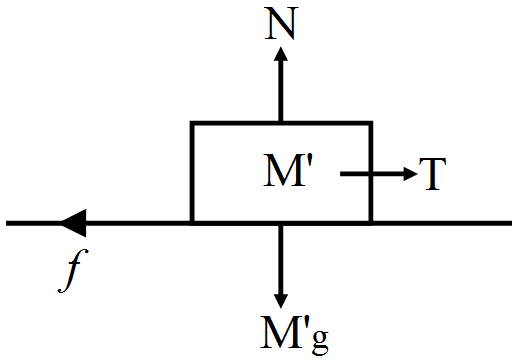
Free body diagram for the box:


The condition for preventing the slide is

$\text{f}_{\text{max}}>\text{T}$

$\mu'\text{M}'\text{g}>\text{T} \ ...(\text{i})$

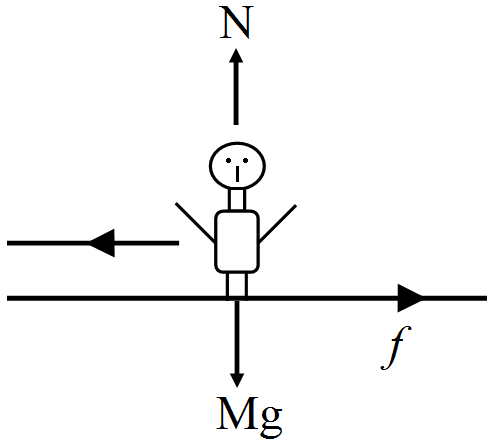
Now see the free body diagram of a boy of mass M:


$\text{f}_{\text{max}}=\mu\text{mg}$

The condition for preventing the slide is

$\text{f}_{\text{max}}>\text{T}$

$\mu\text{mg}>\text{T}$

The condition for sliding the entire system (block and boy) is f' > f (block is not slide)

$\mu'\text{M}'\text{g}>\mu\text{mg}$

$\mu'\text{M}'>\mu\text{m}$

$\mu<\mu'$

$\text{m < M}'$
View full question & answer
MCQ 41 Mark
A body of mass $M$ is kept on a rough horizontal surface $($friction coefficient $= \mu).$ A person is trying to pull the body by applying a horizontal force but the body is not moving. The force by the surface on $A$ is $F,$ where:
  • A
    $\text{F = Mg}$
  • B
    $\text{F}=\mu\text{Mg}$
  • $\text{Mg}\leq\text{F}\leq\text{Mg}\sqrt{1+\mu^2}$
  • D
    $\text{Mg}\geq\text{F}\geq\text{Mg}\sqrt{1-\mu^2}.$
Answer
Correct option: C.
$\text{Mg}\leq\text{F}\leq\text{Mg}\sqrt{1+\mu^2}$

Let $T$ be the force applied on an object of mass $M.$
If $T = 0, F_{min}= Mg.$
If T is acting in the horizontal direction, then the body is not moving.
$\therefore\text{T}=\mu(\text{mg})$
$\text{F}_{\text{max}}=\sqrt{(\text{Mg})^2+(\text{T})^2}$
$=\sqrt{(\text{Mg})^2+(\mu\text{Mg})^2}$
Thus, we have:
$\text{Mg}\leq\text{F}\leq\text{Mg}\sqrt{1+(\mu)^2}$

View full question & answer
MCQ 51 Mark
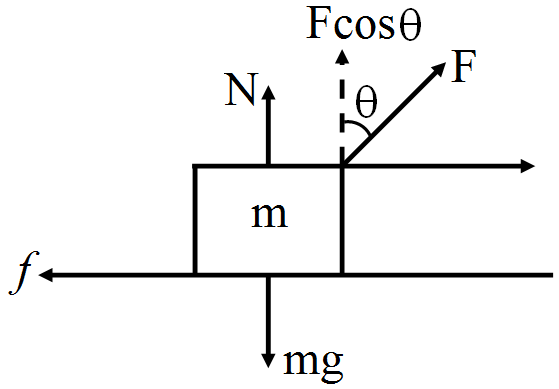
In a situation the contact force by a rough horizontal surface on a body placed on it has constant magnitude. If the angle between this force and the vertical is decreased, the frictional force between the surface and the body will:
  • A
    Increase.
  • Decrease.
  • C
    Remain the saint.
  • D
    May increase or decrease.
Answer
Correct option: B.
Decrease.
Explanation:


According to the first law of limiting friction,

$\text{f}=\mu\text{N}$

where f is the frictional force

N is the normal reaction force

$\mu$ is the coefficient of static friction

and

$\text{N = mg}-\text{F}\cos\theta$

where m is the mass of the body

F is the contact force acting on the body

If we decrease the angle between this contact force and the vertical, then $\text{F}\cos\theta$ increases and the normal reaction force (N) as well as the frictional force (f) decrease.
View full question & answer
MCQ 61 Mark
Two cars of unequal masses use similar tyres. If they are moving at the same initial speed, the minimum stopping distance:
  • A
    Is smaller for the heavier car.
  • B
    Is smaller for the lighter car.
  • Is same for both cars.
  • D
    Depends on the volume of the car.
Answer
Correct option: C.
Is same for both cars.

Given: both the cars have same initial speed.
Let the masses of the two cars be $m_1$ and $m_2$.
Frictional force on car with mass $\text{m}_1=\mu\text{m}_1\text{g}$
So, the deceleration due to frictional force $=\frac{\mu\text{m}_1\text{g}}{\text{m}_1}=\mu\text{g}$
Frictional force on car with mass $\text{m}_2=\mu\text{m}_2\text{g}$
So, the deceleration due to frictional force $=\frac{\mu\text{m}_2\text{g}}{\text{m}_2}=\mu\text{g}$
As both the acceleration are same, from the second equation of motion $\text{s = ut}+\frac{1}{2}\text{at}^2$
Thus, we can say that both the cars have same minimum stopping distance.

View full question & answer
MCQ 71 Mark
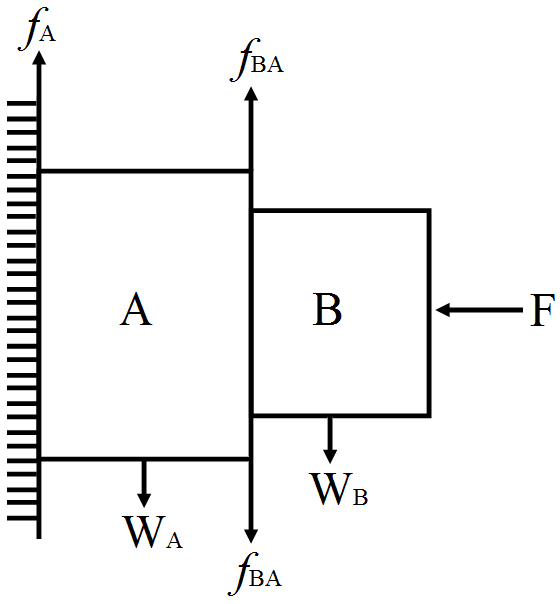
Suppose all the surfaces in the previous problem are rough. The direction of friction on B due to A:
  • Is upward.
  • B
    Is downward.
  • C
    Is zero.
  • D
    Depends on the masses of A and B.
Answer
Correct option: A.
Is upward.
Explanation:


The normal reaction force on the system (comprising of wall and contact surface of Aand B) is provided by F. As can be seen from the figure, the weight of A and B is in the downward direction. Therefore, the frictional force $f_A$ and $f_{BA}$ (friction on B due to A) is in upward direction.
View full question & answer
MCQ 81 Mark
A scooter starting from rest moves with a constant acceleration for a time $\triangle\text{t}_1,$ then with a constant velocity for the next $\triangle\text{t}_2,$ and finally with a constant deceleration for the next $\triangle\text{t}_3$ to come to rest. $A\ 500N$ man sitting on the scooter behind the driver manages to stay at rest with respect to the scooter without touching any other part. The force exerted by the seat on the man is:
  • A
    $500N$ throughout the journey.
  • B
    Less than $500N$ throughout the journey.
  • C
    More than $500N$ throughout the journey.
  • $> 500N$ for time $\triangle\text{t}_1$ and $\triangle\text{t}_3$ and $500N$ for $\triangle\text{t}_2.$
Answer
Correct option: D.
$> 500N$ for time $\triangle\text{t}_1$ and $\triangle\text{t}_3$ and $500N$ for $\triangle\text{t}_2.$
During the time interval $\triangle\text{t}_2,$ the scooter is moving with a constant velocity, which implies that the force exerted by the seat on the man is $500N\ ($for balancing the weight of the man$)$.
During the time interval $\triangle\text{t}_1$ and $\triangle\text{t}_3,$ the scooter is moving with constant acceleration and deceleration, which implies that a frictional force is also applied.
Therefore, the net force exerted by the seat on the man should be $ > 500N.$
View full question & answer
MCQ 91 Mark
In order to stop a car in shortest distance on a horizontal road, one should:
  • A
    Apply the brakes very hard so that the wheels stop rotating.
  • Apply the brakes hard enough to just prevent slipping.
  • C
    Pump the brakes $($press and release$)$.
  • D
    Shut the engine off and not apply brakes.
Answer
Correct option: B.
Apply the brakes hard enough to just prevent slipping.
When we apply hard brakes just enough to prevent slipping on wheels, it provides optimum normal reaction force, which gives the maximum friction force between tyres of the car and the road.
View full question & answer
MCQ 101 Mark
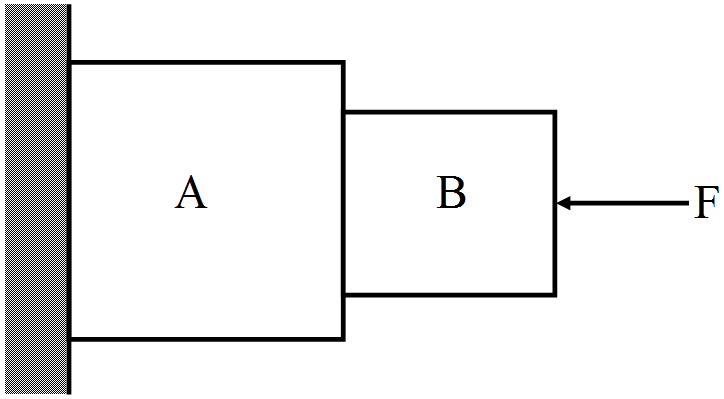
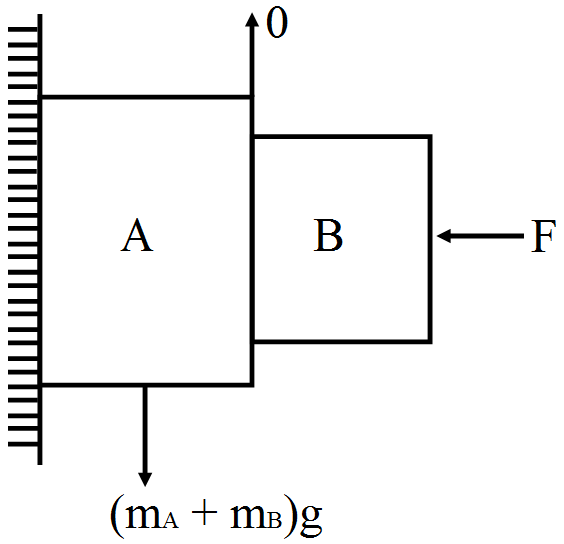
Consider the situation shown in figure. The wall smooth but the surface of A and B in contact are rough. The friction on B due to A in equilibrium:
  • A
    Is upward.
  • B
    Is downward.
  • C
    Is zero.
  • The system cannot remain in equilibrium.
Answer
Correct option: D.
The system cannot remain in equilibrium.
Explanation:


Since the wall is smooth and the surface of A and B in contact are rough, the net vertical force on the system is in the downward direction. Hence, the system cannot remain in equilibrium.
View full question & answer