Questions

M.C.Q (1 Marks)

Take a timed test

12 questions · auto-graded multiple-choice test.

MCQ 11 Mark
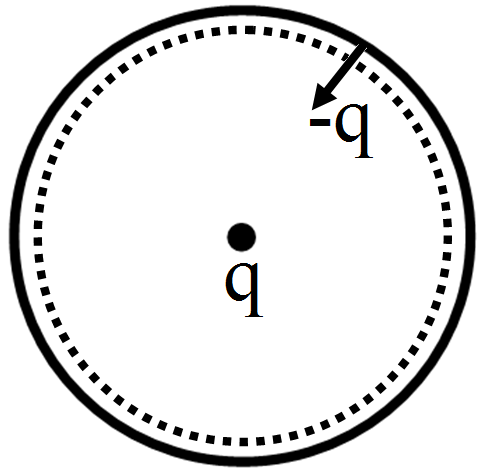
Electric charges are distributed in a small volume. The flux of the electric field through a spherical surface of radius $10\ cm$ surrounding the total charge is $25V-m.$ The flux over a concentric sphere of radius $20\ cm$ will be:
  • $25V-m$
  • B
    $50V-m$
  • C
    $100V-m$
  • D
    $200V-m$
Answer
Correct option: A.
$25V-m$
$F$ is not depend on the shape $\&$ size of the closed volume surface.
$q_m\ Þ\ q_m$ is the net charge inside the closed volume surface.
View full question & answer
MCQ 21 Mark
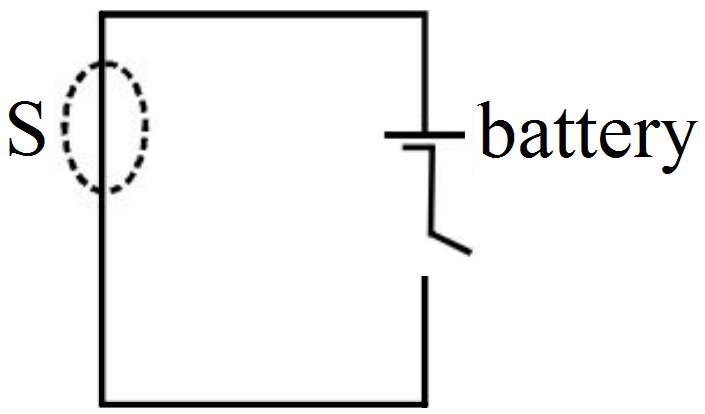
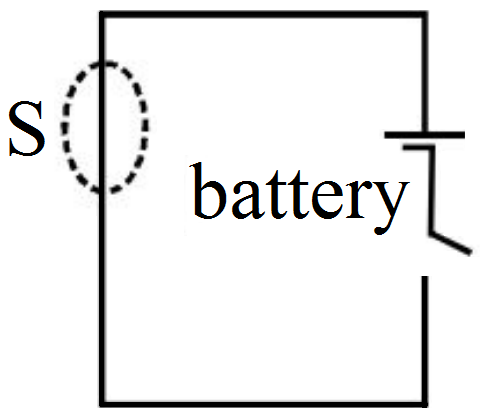
A closed surface S is constructed around a conducting wire connected to a battery and a switch (figure). As the switch is closed, the free electrons in the wire start moving along the wire. In any time interval, the number of electrons entering the closed surface S is equal to the number of electrons leaving it. On closing the switch, the flux of the electric field through the closed surface:
  • A
    Is increased.
  • B
    Is decreased.
  • Remains unchanged.
  • D
    Remains zero.
Answer
Correct option: C.
Remains unchanged.
Explanation:

The flux of the electric field through the closed surface is remain unchanged.
Because the no. of electric field lines enter in the closed path = no. of electric field lines existsin the closed path.
View full question & answer
MCQ 31 Mark
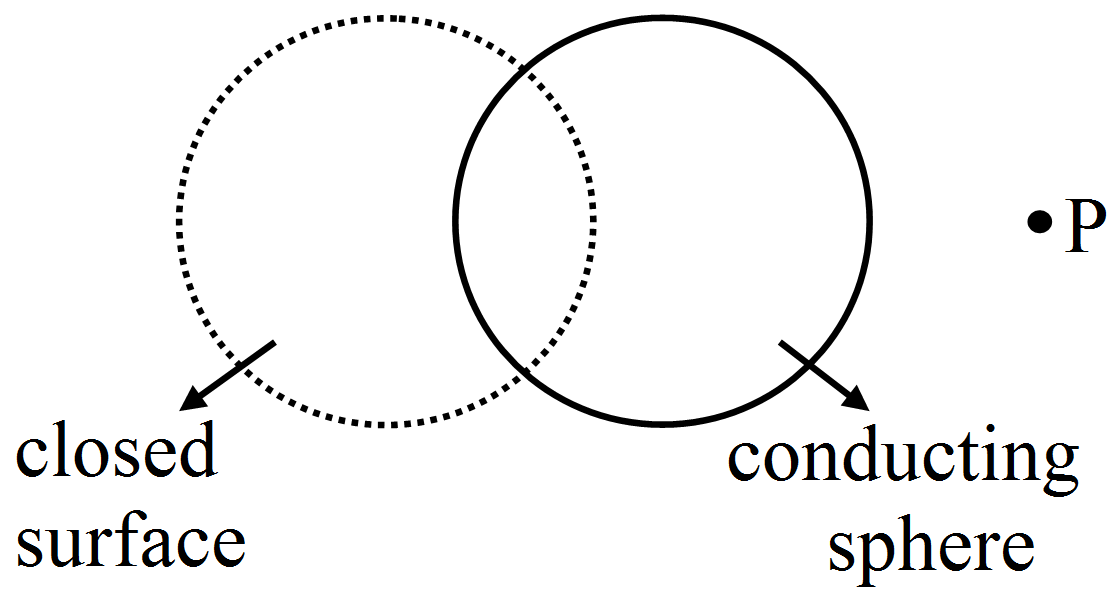
Figure shows a closed surface which intersects a conducting sphere. If a positive charged is placed at the point P, the flux of the electic field through the closed surface:
  • A
    Will remain zero.
  • Will become positive.
  • C
    Will become neagative.
  • D
    Will become undefined.
Answer
Correct option: B.
Will become positive.
Explanation:
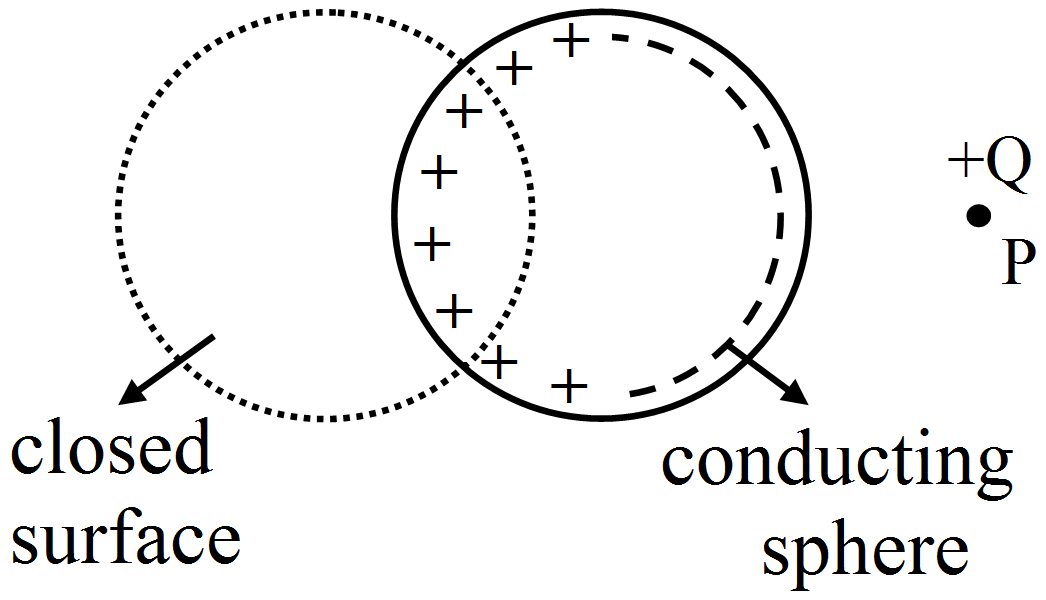
Charge distribution:

Due to charge distribution, intersection by the closed surface of conducting sphere containing the positive charge. So we can say that the flux of the electric field through the closed surface will become positive.
$\therefore\phi=\frac{\text{q}_{\text{in}}}{\in_0}\Rightarrow+\text{ve}$
View full question & answer
MCQ 41 Mark
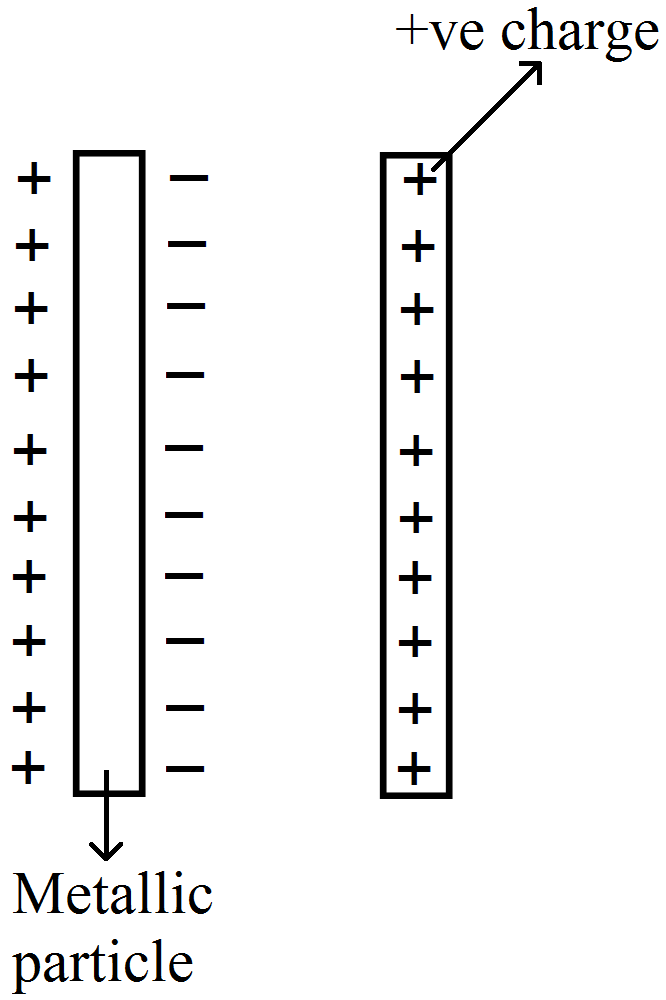
A metallic particle having no net charge is placed near a finite metal plate carrying a positive charge. The electric force on the particle will be:
  • Towards the plate.
  • B
    Away from the plate.
  • C
    Parallel to the plate.
  • D
    Zero.
Answer
Correct option: A.
Towards the plate.
Explanation:
Plase: The electric force on the particle will be owards the plate. Because the distance bewteen attraction force is Less than the distance between repulsive force. So Attractive Force > Repulsive force.
View full question & answer
MCQ 51 Mark
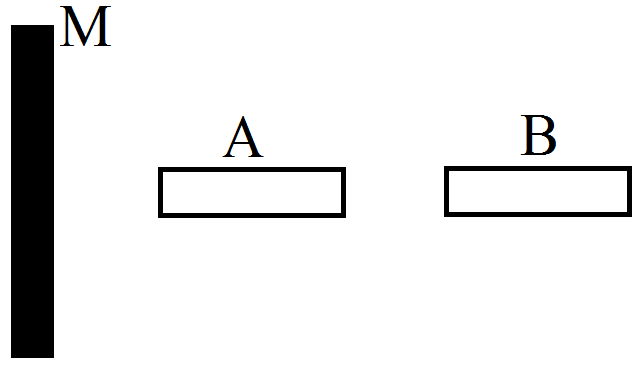
A large nonconducting sheet M is given a uniform charge density. Two uncharged small metal rods A and B are placed near the sheet as shown in figure:
  • A
    M attracts A.
  • B
    M attracts B.
  • C
    A attracts B.
  • B attracts A.
Answer
Correct option: D.
B attracts A.
Explanation:

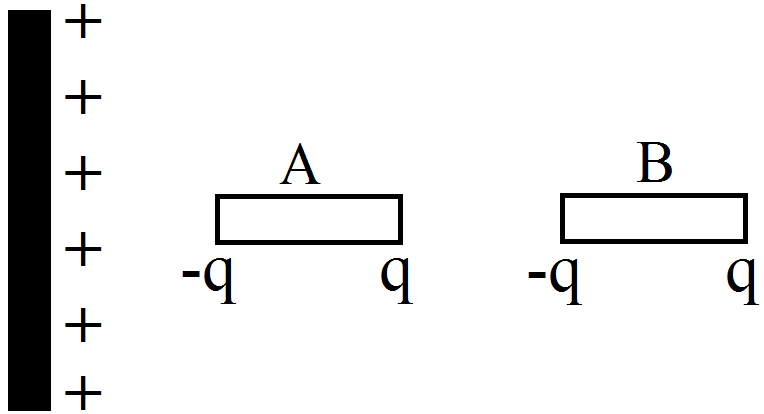
Charge distribution or M, A & B
So, we can say that M attracts A, M attracts B, A attracts B and 'B' attracts A.
View full question & answer
MCQ 61 Mark
Mark the correct options:
  • A
    Gauss's law is valid only for symmetrical charge distributions.
  • B
    Gauss's law is valid only for charges placed in vacuum.
  • C
    The electric field calculated by Gauss's law is the field due to the charges inside the Gaussian surface.
  • The flux of the electric field through a closed surface due to all the charges is equal to the flux due to the charges enclosed by the surface.
Answer
Correct option: D.
The flux of the electric field through a closed surface due to all the charges is equal to the flux due to the charges enclosed by the surface.
Explanation:
The flux of the electric field through a closed surface due to all the charges is equal to the flux due to the charges enclosed by the surface.
View full question & answer
MCQ 71 Mark
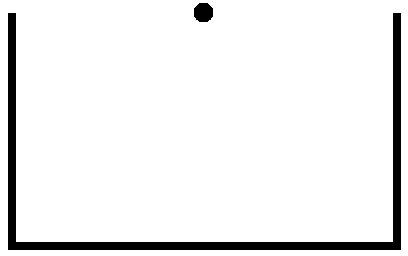
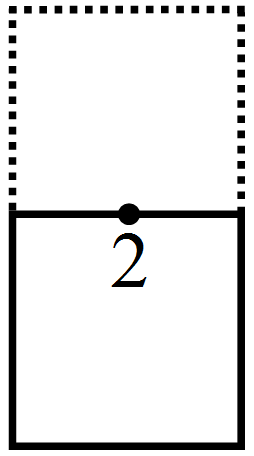
A charge q is placed at the centre of the open end of a cylindrical vessel (figure). The flux of the electric field through the surface of the vessel is:
  • A
    $\text{Zero}$
  • B
    $\frac{\text{q}}{\in_0}$
  • $\frac{\text{q}}{2\in_0}$
  • D
    $\frac{2\text{q}}{\in_0}$
Answer
Correct option: C.
$\frac{\text{q}}{2\in_0}$
Explanation:


In the charge 'q' in side closed cylinder, due to charge the flux of the electric field through the surface of the vessel is $\frac{\text{q}}{\in_0}.$ Here A charge q is placed at the centre of the open end of a cylindrical, By symmetricily Half line of flux goes outside & half flux line goes inside. So we can say that the flux of the electric field through the surface of the vessel is $\frac{\text{q}}{2\in_0}.$
View full question & answer
MCQ 81 Mark
A charge $Q$ is uniformly distributed over a large plastic plate. The electric field at a point $P$ close to the centre of the plate is $10Vm^{-1}$. If the plastic plate is replaced by a copper plate of the same geometrical dimensions and carrying the same charge $Q,$ the electric field at the point $P$ will become :
  • Zero 
  • B
    $ 5 \mathrm{Vm}^{-1}$
  • C
    $10 \mathrm{Vm}^{-1} $
  • D
    $20 \mathrm{Vm}^{-1}$
Answer
Correct option: A.
Zero 
Electric field at centre of the plastic Platcis same as the centre of the copper plate.
View full question & answer
MCQ 91 Mark
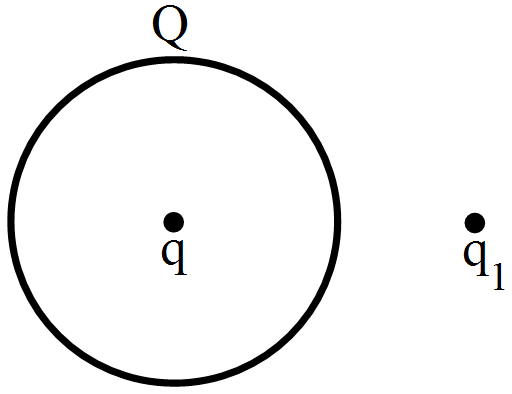
A thin, metallic spherical shell contains a charge $Q$ on it. A point charge q is placed at the centre of the shell and another charge $q_1$ is placed outside it as shown in figure. All the three charges are positive. The force on the charge at the centre is:
  • A
    Towards left.
  • B
    Towards right.
  • C
    Upward.
  • Zero.
Answer
Correct option: D.
Zero.


Electric field due to $Q\ \& \ q,$ inside the spherical shell is zero.
View full question & answer
MCQ 101 Mark
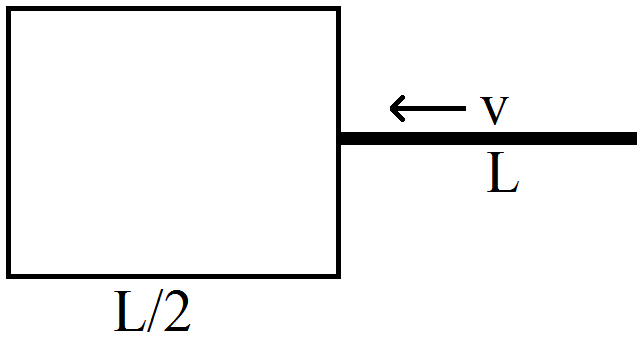
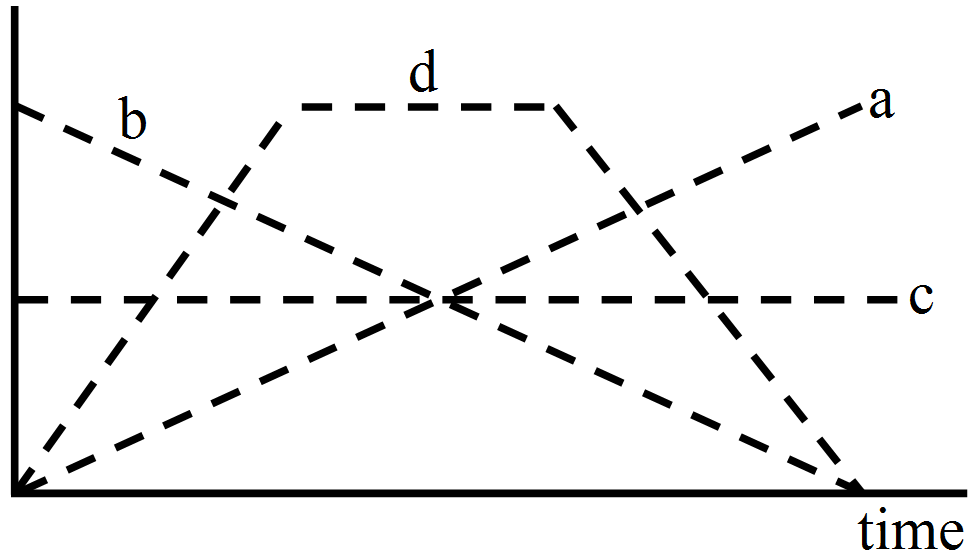
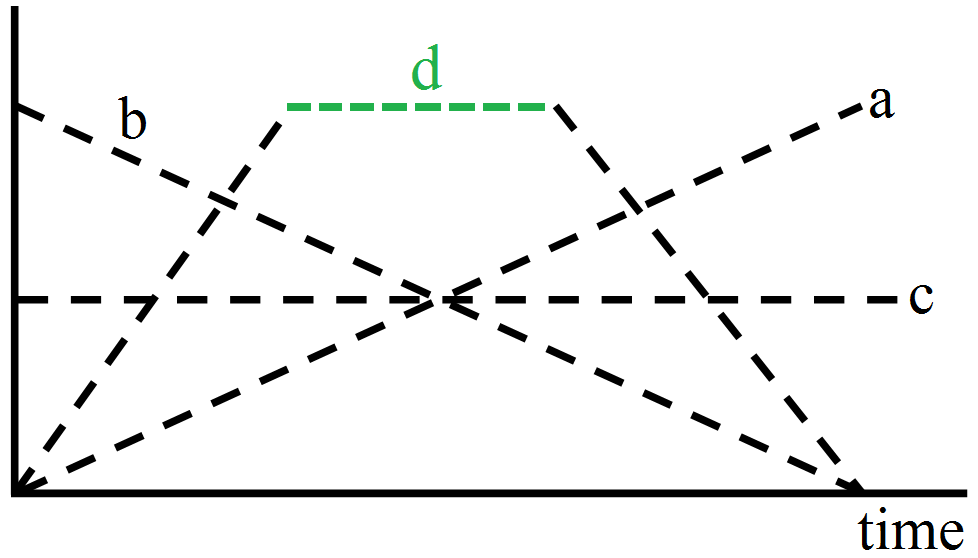
Figure shows an imaginary cube of edge $\frac{\text{L}}{2}.$ A uniformly charged rod of length L moves towards left at a small but constant speed u. At t = 0, the left end just touches the centre of the face of the cube opposite it. Which of the graphs shown in figure represents the flux of the electric field through the cube as the rod goes through it?

  • a
  • B
    b
  • C
    c
  • D
    d
Answer
Correct option: A.
a


Explanation:
Flux is constant with respect to time.
View full question & answer
MCQ 111 Mark
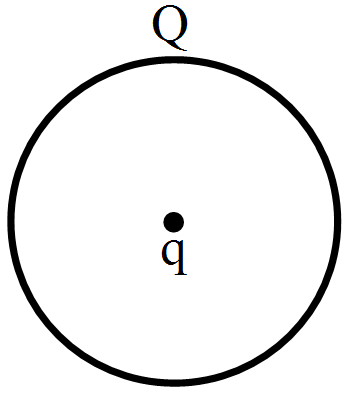
Consider the situation of the previous problem. The force on the central charge due to the shell is:
  • A
    Towards left.
  • Towards right.
  • C
    Upward.
  • D
    Zero.
Answer
Correct option: B.
Towards right.
Explanation:


Force on the central charge due to shell is right $\frac{\text{Kq}^2}{\text{r}^2}$ towards.
View full question & answer
MCQ 121 Mark
A positive point charge Q is brought near an isolated metal cube.
  • A
    The cube becomes negatively charged.
  • B
    The cube becomes positively charged.
  • C
    The interior becomes positively charged and the surface becomes negatively charged.
  • The interior remains charge free and the surface gets nonuniform charge distribution.
Answer
Correct option: D.
The interior remains charge free and the surface gets nonuniform charge distribution.
Explanation:
A positive point charge Q is brought near an 'Isolated metal cube'. So charge distributed on the surface of isolated metal is non uniformly and the interior remains charge free.
View full question & answer