Questions

5 Marks Questions

Take a timed test

13 questions · self-marked practice — reveal the answer and mark yourself.

Question 15 Marks
Suppose the gravitational potential due to a small system is $\frac{\text{k}}{\text{r}^2}$ at a distance r from it. What will be the gravitational field? Can you think of any such system? What happens if there were negative masses?
Answer
The gravitational potential due to the system is given as $\text{V}=\frac{\text{k}}{\text{r}^2}.$
Gravitational field due to the system:$\text{E}=-\frac{\text{dv}}{\text{dr}}$
$\Rightarrow\text{E}=-\frac{\text{d}}{\text{dr}}\Big(\frac{\text{k}}{\text{r}^3}\Big)=-\Big(-\frac{2\text{k}}{\text{r}^3}\Big)$
$\Rightarrow\text{E}=\frac{2\text{k}}{\text{r}^3}$
We can see that for this system, $\text{E}\propto\frac{1}{\text{r}^3}$ This type of system is not possible because $F_g$ is always proportional to inverse of square of distance(experimental fact). If there were negative masses, then this type of system is possible. This system is a dipole of two masses, i.e., two masses, one positive and the other negative, separated by a small distance. In this case, the gradational field due to the dipole is proportional to $\frac{1}{\text{r}^3}. $
View full question & answer
Question 25 Marks
A particle is fired vertically upward with a speed of 15km/s. With what speed will it move in intersteller space. Assume only earth's gravitational field.
Answer
Initial velocity of the particle = 15km/s Let its speed be ‘v’ at interstellar space.$\therefore\Big(\frac{1}{2}\Big)\text{m}[(15\times10^3)^2-\text{v}^2]=\int\limits^\infty_\text{R}\frac{\text{GMm}}{\text{x}^2}\text{dx}$
$\Rightarrow\Big(\frac{1}{2}\Big)\text{m}[(15\times10^3)^2-\text{v}^2]=\text{GMm}\Big[-\frac{1}{\text{x}}\Big]^{\infty}_\text{R}$
$\Rightarrow\Big(\frac{1}{2}\Big)\text{m}[(225\times10^6)-\text{v}^2]=\frac{\text{GMm}}{\text{R}}$
$\Rightarrow225\times10^6-\text{v}^2=\frac{2\times6.67\times10^{-11}\times6\times10^{24}}{6400\times10^{3}}$
$\Rightarrow\text{v}^2=225\times10^{6}-\frac{40.02}{32}\times10^8$
$\Rightarrow\text{v}^2=225\times10^6-1.2\times10^8=10^8(1.05)$
$\text{v}=1.01\times10^4\text{m/s}$
$=10\text{km/s}$
View full question & answer
Question 35 Marks
An apple falls from a tree. An insect in the apple finds that the earth is falling towards it with an acceleration g. Who exerts the force needed to accelerate the earth with this acceleration g?
Answer
The mutual gravitational force between the apple and the Earth is responsible for the acceleration produced in the apple falling from the tree. Although the Earth will experience the same force, it does not get attracted towards the apple because of its large mass. The insect feels that the Earth is falling towards the apple with an acceleration g because of the the relative motion.
let
$V_{ae} =$ velocity of apple w.r.t earth
$V_{ea} =$ velocity of earth w.r.t apple
$V_{ae} = va - ve = -(ve - va) = -v_{ea}$​​​​​​​
As the insect is in the frame of apple so he sees the earth moving with a relative velocity veavea.
Any other observer on earth will see the apple moving towards earth with velocity veavea. Both are opposite in direction.
View full question & answer
Question 45 Marks
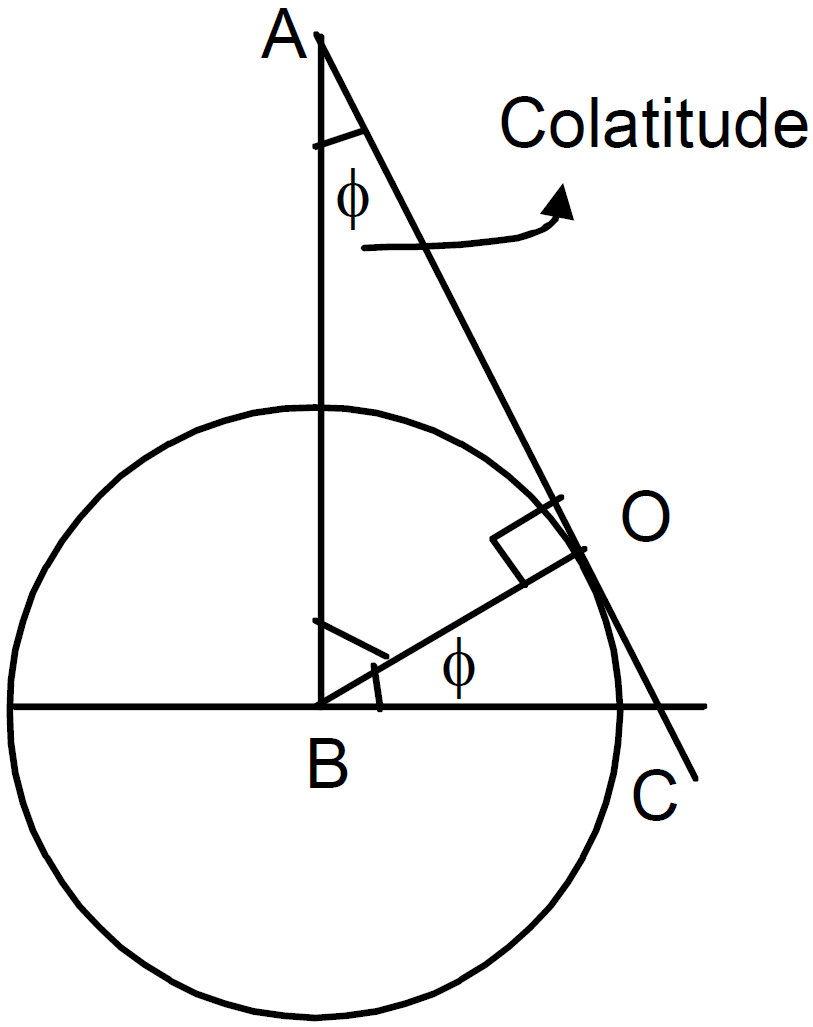
Find the minimum colatitude which can directly receive a signal from a geostationary satellite.
Answer
The colattitude is given by $\phi$$\angle\text{OAB}=90^\circ-\angle\text{ABO}$
Angle $\angle\text{OBC}=\phi=\angle\text{OAB}$$\therefore\sin\phi=\frac{6400}{42000}=\frac{8}{53}$
$\therefore\phi=\sin^{-1}\Big(\frac{8}{53}\Big)=\sin^{-1}0.15.$
View full question & answer
Question 55 Marks
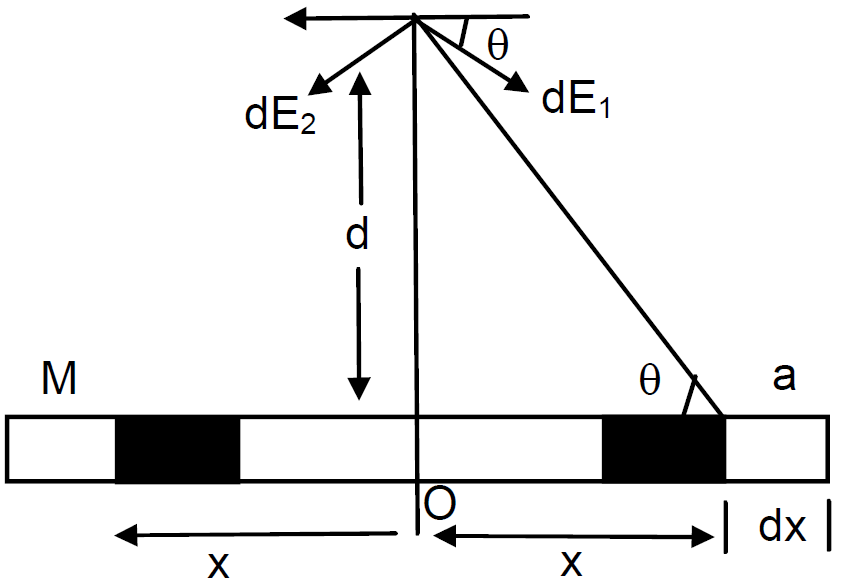
Derive an expression for the gravitational field due to a uniform rod of length L and mass M at a point on its perpendicular bisector at a distance d from the centre.
Answer
A small section of rod is considered at ‘x’ distance mass of the element = (M/L). dx = dm$\text{dE}_1=\frac{\text{G}(\text{dm})\times1}{(\text{d}^2+\text{x}^2)}=\text{dE}_2$
Resultant $\text{dE}=2\text{dE}_1\sin\theta$$=2\times\frac{\text{G(dm)}}{(\text{d}^2+\text{x}^2)}\times\frac{\text{d}}{\sqrt{(\text{d}^2+\text{x}^2})}=\frac{2\times\text{GM}\times\text{d dx}}{\text{L}(\text{d}^2+\text{x}^2)\big(\sqrt{\text{d}^2+\text{x}^2}\big)}$
Total gravitational field$\text{E}=\int\limits_{0}^{\frac{\text{L}}{2}}\frac{2\text{Gmd dx}}{\text{L}\big(\sqrt{\text{d}^2+\text{x}^2}\big)^{\frac{3}{2}}}$
Integrating the above equation it can be found that,$\text{E}=\frac{2\text{GM}}{\text{d}\sqrt{\text{L}^2+4\text{d}^2}}$
View full question & answer
Question 65 Marks
A particle is fired vertically upward from earth's surface and it goes up to a maximum height of 6400km. Find the initial speed of the particle.
Answer
The particle attain maximum height = 6400km. On earth’s surface, its P.E. & K.E.$\text{E}_{\text{e}}=\Big(\frac{1}{2}\Big)\text{mv}^2+\Big(\frac{-\text{GMm}}{\text{R}}\Big)\ ...(1)$
In space, its P.E. & K.E.$\text{E}_\text{s}=\Big(-\frac{\text{GMm}}{\text{R}+\text{h}}\Big)+0$
$\text{E}_{\text{s}}=\Big(-\frac{\text{GMm}}{2\text{R}}\Big)\ ...(2)\ (\because\text{h}=\text{R})$
Equating (1) & (2)$-\frac{\text{Gmm}}{\text{R}}+\frac{1}{2}\text{mv}^2=-\frac{\text{Gmm}}{2\text{R}}$
or $\Big(-\frac{1}{2}\Big)\text{mv}^2=\text{GMm}\Big(-\frac{1}{2\text{R}}+\frac{1}{\text{R}}\Big)$ or $\text{v}^2=\frac{\text{GM}}{\text{R}}$$=\frac{6.67\times10^{-11}\times6\times10^{24}}{6400\times10^3}$
$=\frac{40.02\times10^{13}}{6.4\times10^6}$
$=6.2\times10^7=0.62\times10^8$
or $\text{v}=\sqrt{0.62\times10^8}=0.79\times10^4\text{m/s}=7.9\text{km/s.}$
View full question & answer
Question 75 Marks
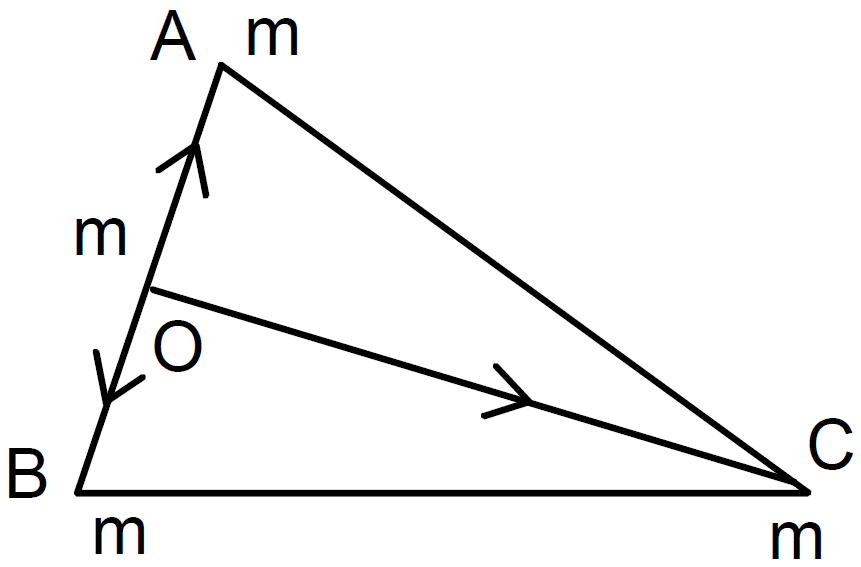
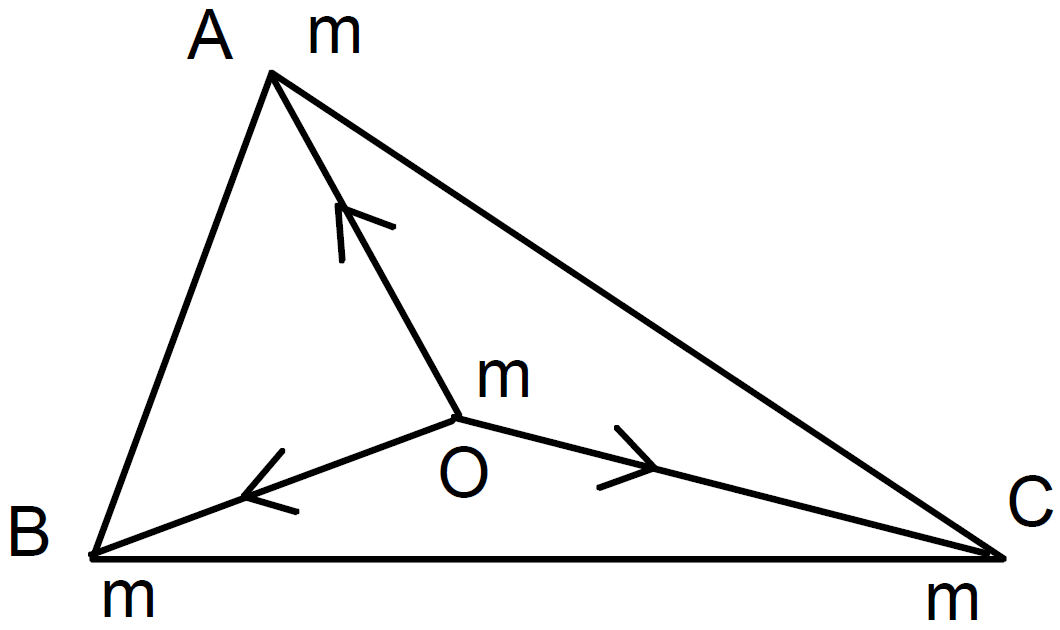
Three equal masses m are placed at the three corners of an equilateral triangle of side a. Find the force exerted by this system on another particle of mass m placed at,
  1. The mid-point of a side,
  2. At the centre of the triangle.
Answer
  1. If ‘m’ is placed at mid point of a side
Then $\overrightarrow{\text{F}_{\text{OA}}}=\frac{4\text{Gm}^2}{\text{a}^2}$ in OA direction

$\overrightarrow{\text{F}_{\text{OB}}}=\frac{4\text{Gm}^2}{\text{a}^2}$ in OB direction

Since equal & opposite cancel each other

$\overrightarrow{\text{F}_{\text{OB}}}=\frac{\text{Gm}^2}{\big[\big(\frac{\text{r}^3}{2}\text{a}\big)\big]^2}=\frac{4\text{Gm}^2}{3\text{a}^2}$ in OC direction

Net gravitational force on m $=\frac{4\text{Gm}^2}{\text{a}^2}$

  1. If placed at O (centroid)
The $\overrightarrow{\text{F}_{\text{OA}}}=\frac{\text{Gm}^2}{\big(\frac{\text{a}}{\text{r}_3}\big)}=\frac{3\text{Gm}^2}{\text{a}^2}$

$\overrightarrow{\text{F}_{\text{OA}}}=\frac{3\text{Gm}^2}{\text{a}^2}$

Resultant $\overrightarrow{\text{F}}=\sqrt{2\Big(\frac{3\text{Gm}^2}{\text{a}^2}\Big)^2-2\Big(\frac{3\text{Gm}^2}{\text{a}^2}\Big)^2\times\frac{1}{2}}=\frac{3\text{Gm}^2}{\text{a}^2}$

Since $\overrightarrow{\text{F}_{\text{OC}}}=\frac{3\text{Gm}^2}{\text{a}^3},$ equal & opposite to F, cancel

Net gravitational force = 0

View full question & answer
Question 85 Marks
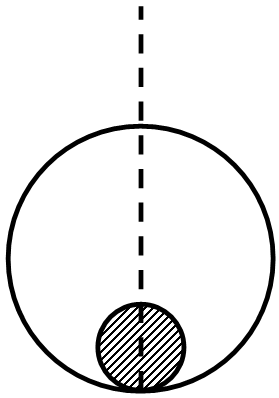
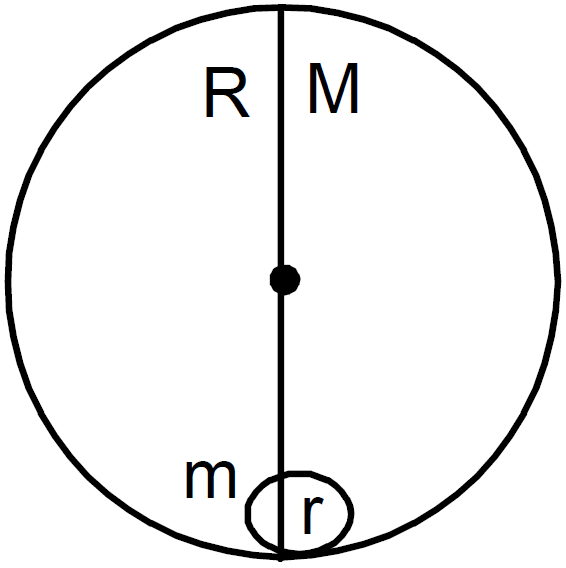
A solid sphere of mass m and radius r is placed inside a hollow thin spherical shell of mass M and radius R as shown in A particle of mass m' is placed on the line joining the two centres at a distance x from the point of contact of the sphere and the shell. Find the magnitude of the resultant gravitational force on this particle due to the sphere and the shell if,
  1. r < x < 2r.
  2. 2r < x < 2R.
  3. x > 2R.
Answer
  1. m' is placed at a distance x from ‘O’.
If r < x, 2r, Let’s consider a thin shell of man

$\text{dm}=\frac{\text{m}}{\big(\frac{4}{3}\big)\pi\text{r}^2}\times\frac{4}{3}\pi\text{x}^3=\frac{\text{mx}^3}{\text{r}^3}$

Thus $\int\text{dm}=\frac{\text{mx}^3}{\text{r}^3}$

Then gravitational force $\text{F}=\frac{\text{Gmdm}}{\text{x}^2}=\frac{\frac{\text{Gmx}^3}{\text{r}^3}}{\text{x}^2}=\frac{\text{Gmx}}{\text{r}^3}$
  1. x < 2R, then F is due to only the sphere.
$\text{F}=\frac{\text{Gmm'}}{(\text{x}-\text{r})^2}$
  1. If x > 2R, then Gravitational force is due to both sphere & shell, then due to shell,
$\text{F}=\frac{\text{GMm'}}{(\text{x}-\text{R})^2}$

due to the sphere $=\frac{\text{Gmm'}}{(\text{x}-\text{r})^2}$

So, Resultant force $=\frac{\text{Gmm'}}{(\text{x}-\text{r})^2}+\frac{\text{GMm'}}{(\text{x}-\text{R})^2}$

View full question & answer
Question 95 Marks
If the radius of the earth decreases by 1% without changing its mass, will the acceleration due to gravity at the surface of the earth increase or decrease? If so, by what per cent?
Answer
If we consider the Earth to be a perfect sphere, then the acceleration due to gravity at its surface is given by $\text{g}=\text{G}\frac{\text{M}}{\text{R}^2}$ Here, M is the mass of Earth; R is the radius of the Earth and G is universal gravitational constant. If the radius of the earth is decreased by 1%, then the new radius becomes,$\text{R'}=\text{R}-\frac{\text{R}}{100}=\frac{99}{100}\text{R}$
$\Rightarrow\text{R'}=-0.99\text{R}$
New acceleration due to gravity will be given by,$\text{g'}=\text{G}\frac{\text{M}}{\text{R}^2}=\text{G}\frac{\text{M}}{(0.99\text{R})^2}$
$\Rightarrow\text{g'}=1.02\times\Big(\text{G}\frac{\text{M}}{\text{R}^2}\Big)=1.02\text{g}$
Hence, the value of the acceleration due to gravity increases when the radius is decreased. Percentage increase in the acceleration due to gravity is given by,$\frac{\text{g'}-\text{g}}{\text{g}}\times100$
$=\frac{0.02\text{g}}{\text{g}}\times100$
$=2\%$
View full question & answer
Question 105 Marks
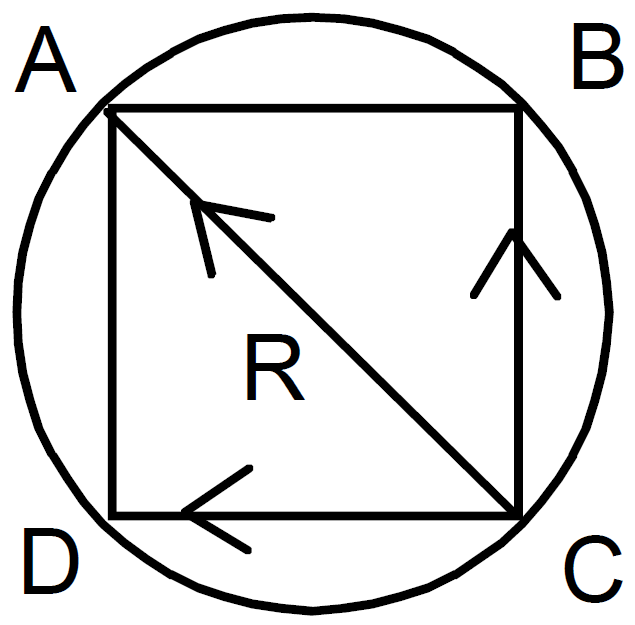
Four particles of equal masses M move along a circle of radius R under the action of their mutual gravitational attraction. Find the speed of each particle.
Answer
Force on M at C due to gravitational attraction.$\overrightarrow{\text{F}_{\text{CB}}}=\frac{\text{Gm}^2}{2\text{R}^2}\hat{\text{j}}$
$\overrightarrow{\text{F}_{\text{CD}}}=\frac{-\text{Gm}^2}{4\text{R}^2}\hat{\text{j}}$
$\overrightarrow{\text{F}_{\text{CA}}}=\frac{-\text{Gm}^2}{4\text{R}^2}\cos45\hat{\text{j}}+\frac{\text{GM}^2}{4\text{R}^2}\sin45\hat{\text{j}}$
So, resultant force on C,
$\therefore\overrightarrow{\text{F}_{\text{C}}}=\overrightarrow{\text{F}_{\text{CA}}}+\overrightarrow{\text{F}_{\text{CB}}}+\overrightarrow{\text{F}_{\text{CD}}}$
$=-\frac{\text{GM}^2}{4\text{R}^2}\Big(2+\frac{1}{\sqrt{2}}\Big)\hat{\text{i}}+\frac{\text{Gm}^2}{4\text{R}^2}\Big(2+\frac{1}{\sqrt{2}}\Big)\hat{\text{j}}$
$\therefore\text{F}_{\text{c}}=\frac{\text{Gm}^2}{4\text{R}^2}\big(2\sqrt{2}+1\big)$
For moving along the cricle, $\overrightarrow{\text{F}}=\frac{\text{mv}^2}{\text{R}}$
or $\frac{\text{GM}^2}{4\text{R}^2}\big(2\sqrt{2}+1\big)=\frac{\text{MV}^2}{\text{R}}$ or $\text{v}=\sqrt{\frac{\text{GM}}{\text{R}}\Big(\frac{2\sqrt{2}+1}{\text{4}}\Big)}$
View full question & answer
Question 115 Marks
  1. Find the radius of the circular orbit of a satellite moving with an angular speed equal to the angular speed of earth's rotation.
  2. If the satellite is directly above the north pole at some instant, find the time it takes to come over the equatorial plane. Mass of the earth $= 6 \times 10^{24}kg.$
Answer
Angular speed f earth & the satellite will be same$\frac{2\pi}{\text{T}_{\text{e}}}=\frac{2\pi}{\text{T}_{\text{s}}}$ or $\frac{1}{24\times3600}=\frac{1}{2\pi\sqrt{\frac{(\text{R}+\text{h})^3}{\text{gR}^2}}}$
$3600=3.14\sqrt{\frac{(\text{R}+\text{h})^3}{\text{gR}^2}}$
$\frac{(\text{R}+\text{h})^2}{\text{gR}^2}=\frac{(12\times3600)^2}{(3.14)^2}$
$\frac{(6400+\text{h})^3\times10^9}{9.8\times(6400)^2\times10^6}=\frac{(12\times3600)^2}{(3.14)^2}$
$\frac{(6400+\text{h})^3\times10^9}{6272\times10^9}=432\times10^4$
$(6400+\text{h})^3=6272\times432\times10^4$
$6400+\text{h}=\big(6272\times432\times10^4\big)^{\frac{1}{3}}$
$\text{h}=\big(6272\times432\times10^4\big)^{\frac{1}{3}}-6400$
$=42300\text{cm}$
Time taken from north pole to equator $=\frac{1}{2}\text{t}$$=\Big(\frac{1}{2}\Big)\times6.28\sqrt{\frac{(43200+6400)^3}{10\times(6400)^2\times10^6}}$
$=3.14\sqrt{\frac{(497)^3\times10^6}{(64)^2\times10^{11}}}$
$=3.14\sqrt{\frac{497\times497\times497}{64\times64\times10^5}}$
$=6\text{ hour.}$
View full question & answer
Question 125 Marks
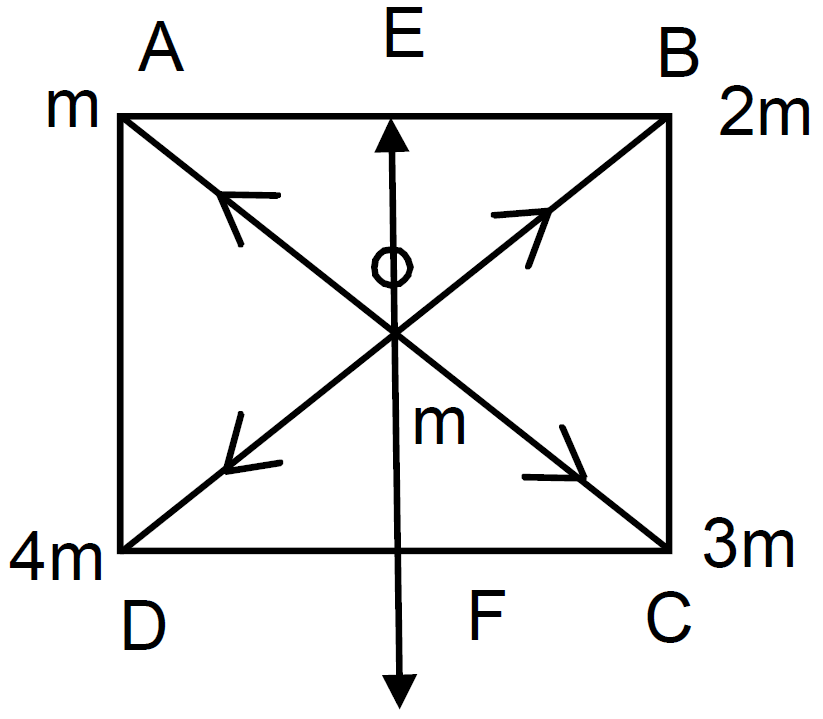
Four particles having masses m, 2m, 3m and 4m are placed at the four corners of a square of edge a. Find the gravitational force acting on a particle of mass m placed at the centre.
Answer
To calculate the gravitational force on ‘m’ at unline due to other mouse.
$\overrightarrow{\text{F}_{\text{OD}}}=\frac{\text{G}\times\text{m}\times4\text{m}}{\big(\frac{\text{a}}{\text{r}^2}\big)^2}=\frac{8\text{Gm}^2}{\text{a}^2}$
$\overrightarrow{\text{F}_{\text{OI}}}=\frac{\text{G}\times\text{m}\times2\text{m}}{\big(\frac{\text{a}}{\text{r}^2}\big)^2}=\frac{6\text{G}\text{m}^2}{\text{a}^2}$
$\overrightarrow{\text{F}_{\text{OB}}}=\frac{\text{G}\times\text{m}\times2\text{m}}{\big(\frac{\text{a}}{\text{r}^2}\big)^2}=\frac{4\text{Gm}^2}{\text{a}^2}$
$\overrightarrow{\text{F}_{\text{OA}}}=\frac{\text{G}\times\text{m}\times2\text{m}}{\big(\frac{\text{a}}{\text{r}^2}\big)^2}=\frac{2\text{Gm}^2}{\text{a}^2}$
Resultant $\overrightarrow{\text{F}_{\text{OF}}}=\sqrt{64\Big(\frac{\text{Gm}^2}{\text{a}^2}\Big)^2+36\Big(\frac{\text{Gm}^2}{\text{a}^2}\Big)^2}=10\frac{\text{Gm}^2}{\text{a}^2}$
Resultant $\overrightarrow{\text{F}_{\text{OE}}}=\sqrt{64\Big(\frac{\text{Gm}^2}{\text{a}^2}\Big)^2+4\Big(\frac{\text{Gm}^2}{\text{a}^2}\Big)^2}=2\sqrt{5}\frac{\text{Gm}^2}{\text{a}^2}$
The net resultant force will be,
$\text{F}=\sqrt{100\Big(\frac{\text{Gm}^2}{\text{a}^2}\Big)^2+20\Big(\frac{\text{Gm}}{\text{a}^2}\Big)^2-2\Big(\frac{\text{Gm}^2}{\text{a}^2}\Big)\times20\sqrt{5}}$
$=\sqrt{\Big(\frac{\text{Gm}^2}{\text{a}^2}\Big)^2(120-40\sqrt{5})}$
$=\sqrt{\Big(\frac{\text{Gm}^2}{\text{a}^2}\Big)^2(120-89.6)}$
$=\frac{\text{Gm}^2}{\text{a}^2}\sqrt{40.4}=4\sqrt{2}\frac{\text{Gm}^2}{\text{a}^2}$
View full question & answer
Question 135 Marks
The gravitational pontential in a region is given by V = (20N/kg) (x + y).
  1. Show that the equation is dimensionally correct.
  2. Find the gravitational field at the point (x, y). Leave your answer in terms of the unit vectors $\overrightarrow{\text{i}},\ \overrightarrow{\text{j}},\ \overrightarrow{\text{k}}.$
  3. Calculate the magnitude of the gravitational force on a particle of mass 500g placed at the origin.
Answer
  1. $\text{V}=(20\text{N/kg})(\text{x}+\text{y})$
$\frac{\text{GM}}{\text{R}}=\frac{\text{MLT}^{-2}}{\text{M}}$ or $\frac{\text{M}^{-1}\text{L}^3\text{T}^{-2}\text{M}^1}{\text{L}}=\frac{\text{ML}^2\text{T}^{-2}}{\text{M}}$

or $\text{M}^0\text{L}^2\text{T}^{-2}=\text{M}^0\text{L}^2\text{T}^{-2}$

$\therefore$ L.H.S = R.H.S
  1. $\overrightarrow{\text{E}}_{(\text{x, y})}=-(20\text{N/kg})\hat{\text{i}}-20(\text{N/kg})\hat{\text{j}}$
  2. $\overrightarrow{\text{F}}=\overrightarrow{\text{E}}\text{m}$
$=0.5\text{Kg}[-(20\text{N/kg})\hat{\text{i}}-(20\text{N/kg})\hat{\text{j}}=-10\text{N}\hat{\text{i}}-10\text{N}\hat{\text{j}}]$

$\therefore\Big|\overrightarrow{\text{F}}\Big|=\sqrt{100+100}=10\sqrt{2}\text{N}$
View full question & answer