Question
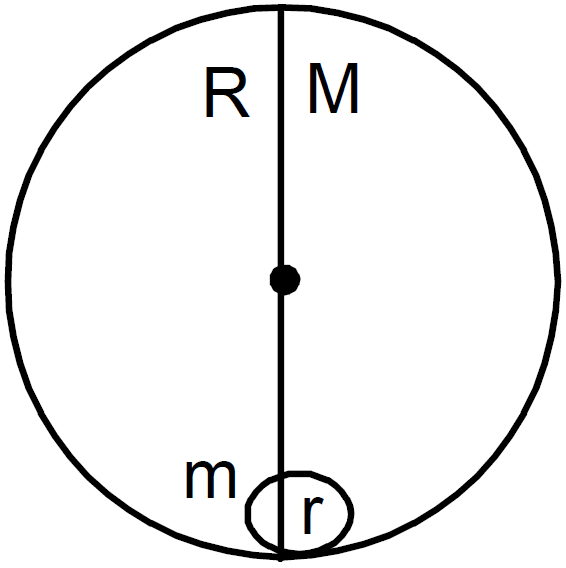
A solid sphere of mass m and radius r is placed inside a hollow thin spherical shell of mass M and radius R as shown in A particle of mass m' is placed on the line joining the two centres at a distance x from the point of contact of the sphere and the shell. Find the magnitude of the resultant gravitational force on this particle due to the sphere and the shell if,
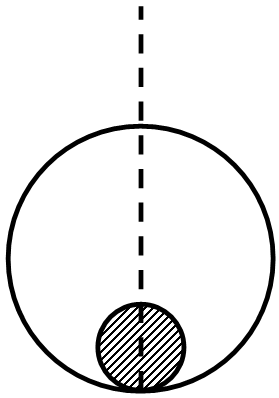
  1. r < x < 2r.
  2. 2r < x < 2R.
  3. x > 2R.

Answer

  1. m' is placed at a distance x from ‘O’.
If r < x, 2r, Let’s consider a thin shell of man

$\text{dm}=\frac{\text{m}}{\big(\frac{4}{3}\big)\pi\text{r}^2}\times\frac{4}{3}\pi\text{x}^3=\frac{\text{mx}^3}{\text{r}^3}$

Thus $\int\text{dm}=\frac{\text{mx}^3}{\text{r}^3}$

Then gravitational force $\text{F}=\frac{\text{Gmdm}}{\text{x}^2}=\frac{\frac{\text{Gmx}^3}{\text{r}^3}}{\text{x}^2}=\frac{\text{Gmx}}{\text{r}^3}$
  1. x < 2R, then F is due to only the sphere.
$\text{F}=\frac{\text{Gmm'}}{(\text{x}-\text{r})^2}$
  1. If x > 2R, then Gravitational force is due to both sphere & shell, then due to shell,
$\text{F}=\frac{\text{GMm'}}{(\text{x}-\text{R})^2}$

due to the sphere $=\frac{\text{Gmm'}}{(\text{x}-\text{r})^2}$

So, Resultant force $=\frac{\text{Gmm'}}{(\text{x}-\text{r})^2}+\frac{\text{GMm'}}{(\text{x}-\text{R})^2}$

Need a full question paper?

Generate a complete, print-ready paper with questions like this in minutes — across 16+ boards, with answer keys.

Start Generating Free

Similar questions

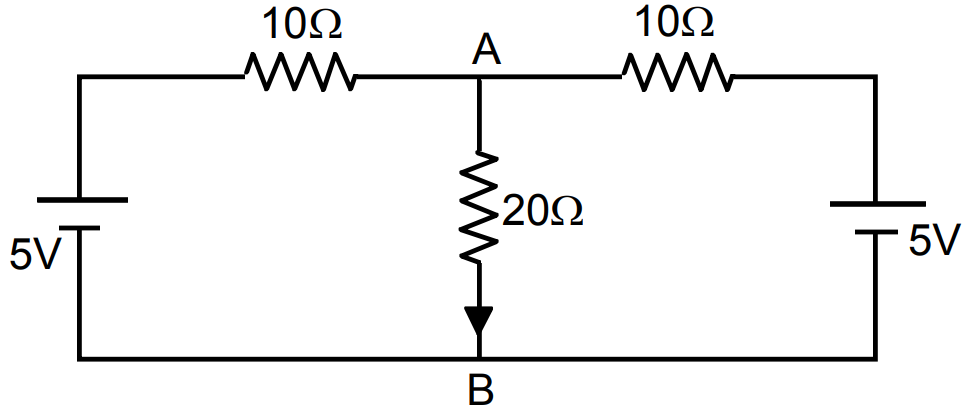
(a) Find the current in the $20\Omega$ resistor shown in the figure. (b) If a capacitor of capacitance $4\mu\text{F}$ is joined between the points A and B, what would be the electrostatic energy stored in it in steady state?
  1. Using Ampere's circuital law, obtain the expression for the magnetic field due to a long solenoid at a point inside the solenoid on its axis.
  2. In what respect is a toroid different from a solenoid? Draw and compare the pattern of the magnetic field lines in the two cases.
  3. How is the magnetic field inside a given solenoid made strong?
Consider the situation of the previous problem:
  1. Find the tension in the string in equilibrium.
  2. Suppose the ball is slightly pushed aside and released. Find the time period of the small oscillations.
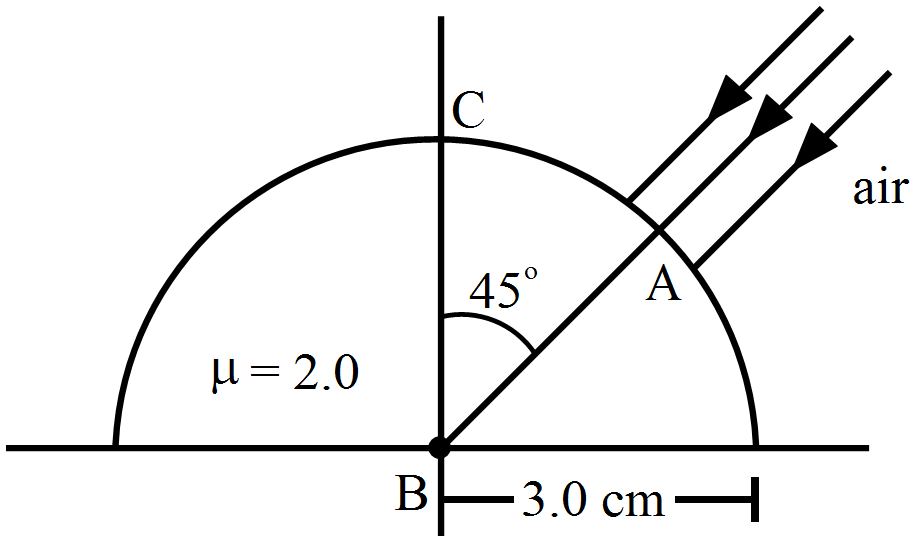
Figure shows a transparent hemisphere of radius 3.0cm made of a material of refractive index 2.0.
  1. A narrow beam of parallel rays is incident on the hemisphere as shown in the figure. Are the rays totally reflected at the plane surface?
  2. Find the image formed by the refraction at the first surface.
  3. Find the image formed by the reflection or by the refraction at the plane surface.
  4. Trace qualitatively the final rays as they come out of the hemisphere.
$(I)$ Explain briefly, with the help of a labelled diagram, the basic principle of the working of an a.c. generator. In an a.c. generator, coil of $N$ turns and area $A$ is rotated at an angular velocity $ω$ in a uniform magnetic field $B$. Derive an expression for the instantaneous value of the emf induced in coil. What is the source of energy generation in this device?
A certain element emits $\text{K}_\alpha$ X-ray of energy 3.69keV. Use the data from the previous problem to identify the element.
$a.$ Two$-$point charges $q _1$ and $q _2$ are kept $r$ distance apart in a uniform external electric field $\overrightarrow{ E }$. Find the amount of work done in assembling this system of charges.
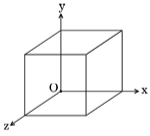
$b.$ A cube of side $20 \ cm$ is kept in a region as shown in the figure. An electric field $\vec{E}$ exists in the region such that the potential at a point is given by $V =10 x +5$, where $V$ is in volt and $x$ is in m .
Image

Find the
$i.$ electric field $\vec{E}$, and
$ii.$ total electric flux through the cube.
Match the following
Image
Half mole of an ideal gas $\Big(\gamma=\frac{5}{3}\Big)$ is taken through the cycle abcda, as shown in the figure. Take $\text{R}=\frac{25}{3}\text{JK}^{-1}\text{mol}^{-1}.$
  1. Find the temperature of the gas in the states a, b, c and d.
  2. Find the amount of heat supplied in the processes ab and bc.
  3. Find the amount of heat liberated in the processes cd and da.
  1. Draw a ray diagram showing the image formation by a compound microscope. Hence obtain expression for total magnification when the image is formed at infinity.
  2. Distinguish between myopia and hypermetropia. Show diagrammatically how these defects can be corrected.