Questions

Case study (4 Marks)

Take a timed test

6 questions · self-marked practice — reveal the answer and mark yourself.

Question 14 Marks
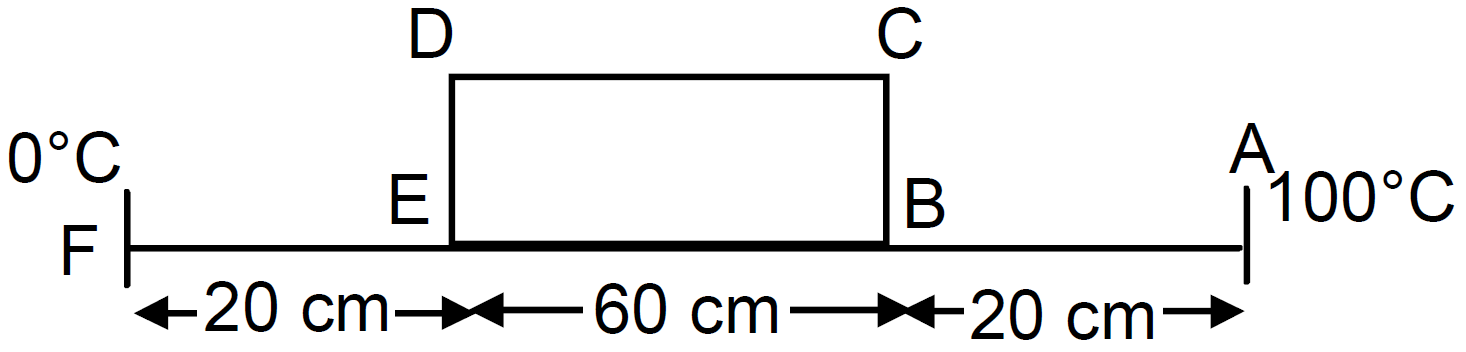
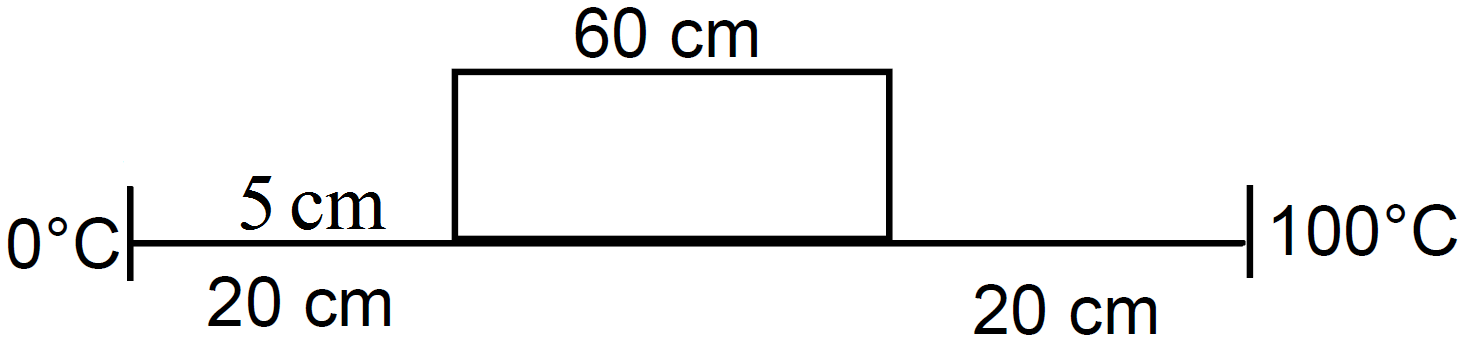
Suppose the bent part of the frame of the previous problem has a thermal conductivity of ${780Js^{-1}m^{-1}}^\circ C^{-1}$ whereas it is ${390Js^{-1}m^{-1}}^\circ C^{-1}$ for the straight part. Calculate the ratio of the rate of heat flow through the bent part to the rate of heat flow through the straight part.
Answer
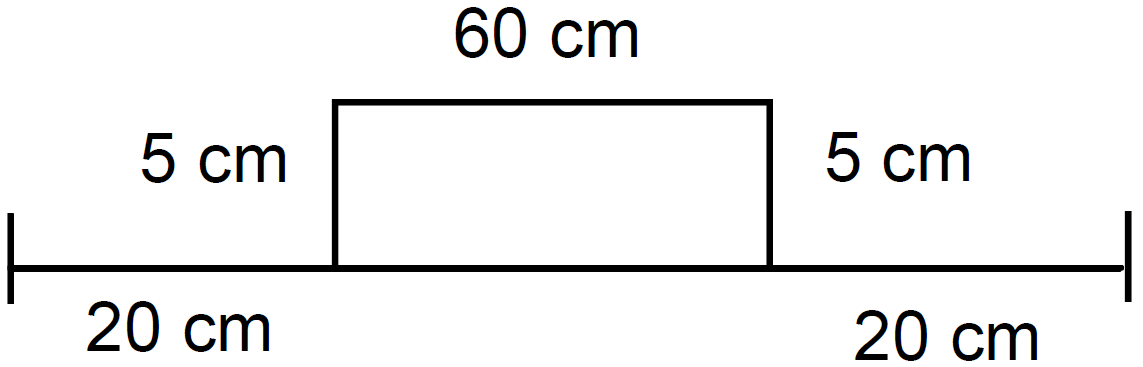
$\frac{\text{Q}}{\text{t}}\text{bent}=\frac{780\times\text{A}\times100}{70}$
$\frac{\text{Q}}{\text{t}}\text{str}=\frac{390\times\text{A}\times100}{60}$
$\frac{\Big(\frac{\text{Q}}{\text{t}}\Big)\text{bent}}{\Big(\frac{\text{Q}}{\text{t}}\Big)\text{str}}=\frac{780\times\text{A}\times100}{70}\times\frac{60}{390\times\text{A}\times100}$
$=\frac{12}{7}$
View full question & answer
Question 24 Marks
Cloudy nights are warmer than the nights with clean sky. Explain.
Answer
During night, the earth's surface radiates infrared radiation of larger wavelength. Gas molecules in the air absorb some of this energy and radiate energy of their own in all directions. Also, water molecules, like the vapour that makes the clouds, absorb more frequencies of infrared energy than clear air does.
Both these factors contribute to the fact that clouds radiate more heat in all directions (including the earth) than clear air does. In turn, this makes the overall temperature on the earth warmer when there is a cloud cover. The heat energy radiated by the earth is reflected back to earth. Due to this, cloudy nights are warmer than the nights with clean sky.
View full question & answer
Question 34 Marks
Consider the situation shown in figure. The frame is made of the same material and has a uniform cross-sectional area everywhere. Calculate the amount of heat flowing per second through a cross section of the bent part if the total heat taken out per second from the end at 100°C is 130J.
Answer
$\Big(\frac{\text{Q}}{\text{t}}\Big)_\text{AB}=\Big(\frac{\text{Q}}{\text{t}}\Big)_\text{BE bent}+\Big(\frac{\text{Q}}{\text{t}}\Big)_\text{BE}$
$\Rightarrow\Big(\frac{\text{Q}}{\text{t}}\Big)_\text{BE bent}=\frac{\text{KA}(\theta_1-\theta_2)}{70}$
$\Rightarrow\Big(\frac{\text{Q}}{\text{t}}\Big)_\text{BE}=\frac{\text{KA}(\theta_1-\theta_2)}{60}$
$\Rightarrow\frac{\Big(\frac{\text{Q}}{\text{t}}\Big)_\text{BE bent}}{\Big(\frac{\text{Q}}{\text{t}}\Big)_\text{BE}}=\frac{60}{70}$
$=\frac{6}{7}$

$\Big(\frac{\text{Q}}{\text{t}}\Big)_\text{BE bent}+\Big(\frac{\text{Q}}{\text{t}}\Big)_\text{BE}=130$
$\Rightarrow\Big(\frac{\text{Q}}{\text{t}}\Big)_\text{BE bent}+\Big(\frac{\text{Q}}{\text{t}}\Big)_\text{BE}\times\frac{7}{6}=130$
$\Rightarrow\Big(\frac{7}{6}+1\Big)\Big(\frac{\text{Q}}{\text{t}}\Big)_\text{BE bent}=130$
$\Rightarrow\Big(\frac{\text{Q}}{\text{t}}\Big)_\text{BE bent}=\frac{130\times6}{13}$
$=60$
View full question & answer
Question 44 Marks
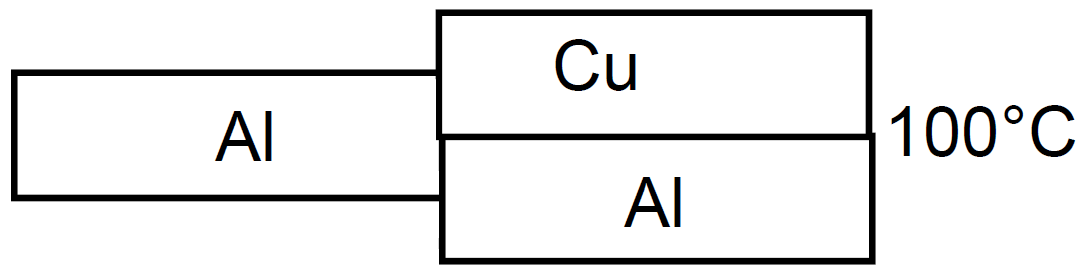
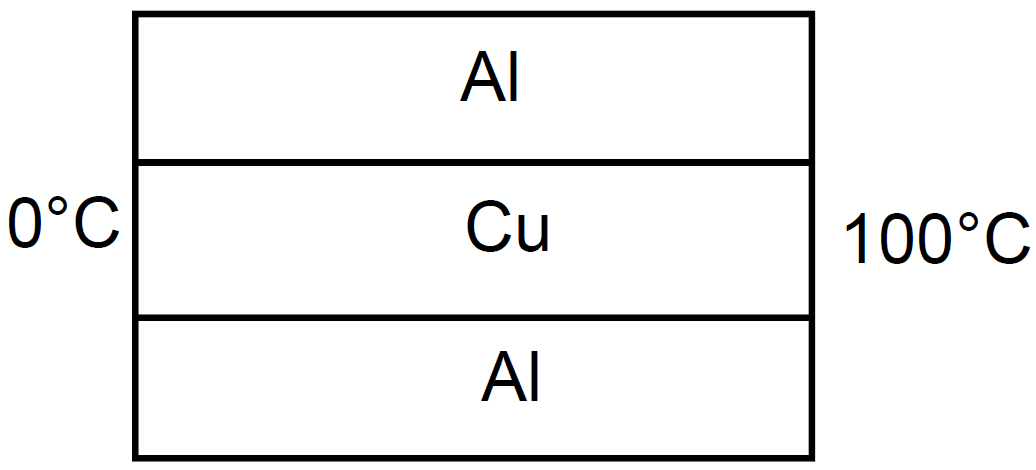
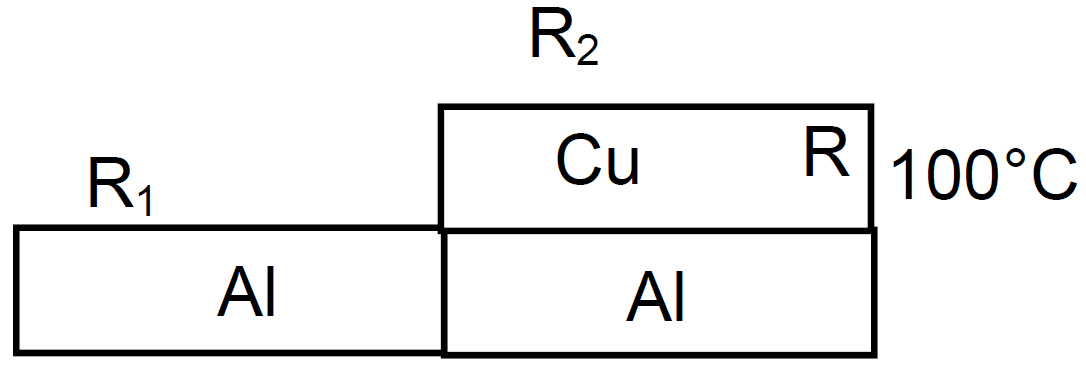
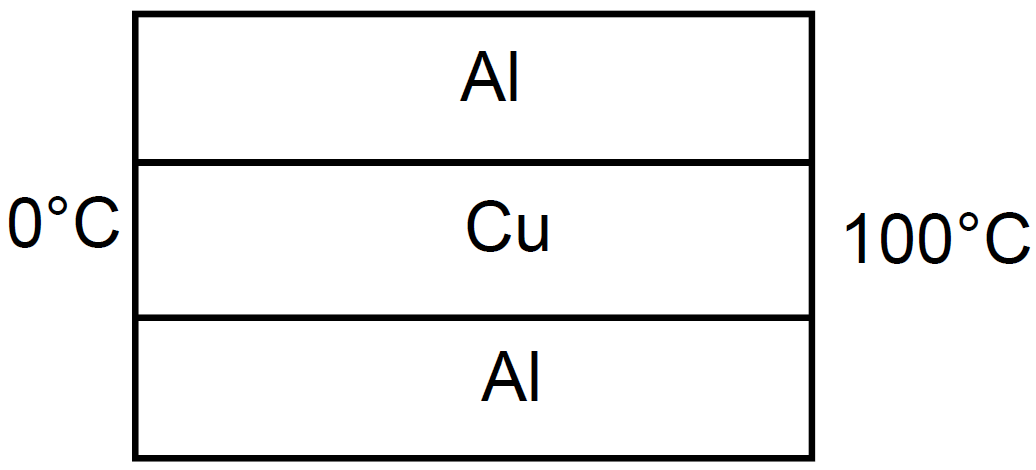
The three rods shown in figure, have identical geometrical dimensions. Heat flows from the hot end at a rate of 40 Win the arrangement (a) Find the rates of heat flow when the rods are joined as in arrangement (b) and in (c) Thermal conductivities of aluminium and copper are ${200Wm^{-1}}^\circ C^{-1}$ and ${400Wm^{-1}}^\circ C^{-1}$ respectively.
  1.  
  1.  
  1.  
Answer
$\theta_1-\theta_2=100$
$\frac{\text{Q}}{\text{t}}=\frac{\theta_1-\theta_2}{\text{R}}$
  1.  

$\text{R}=\text{R}_1+\text{R}_2+\text{R}3=\frac{\ell}{\text{aK}_\text{Al}}+\frac{\ell}{\text{aK}_\text{Cu}}+\frac{\ell}{\text{aK}_\text{Al}}$

$=\frac{\ell}{\text{a}}\Big(\frac{2}{200}+\frac{1}{400}\Big)$

$=\frac{\ell}{\text{a}}\frac{1}{80}$

$\frac{\text{Q}}{\text{t}}=\frac{100}{\Big(\frac{\ell}{\text{a}}\Big)\Big(\frac{1}{80}\Big)}$

$\Rightarrow40=80\times100\times\frac{\text{a}}{\ell}$

$\Rightarrow\frac{\text{a}}{\ell}=\frac{1}{200}$
  1. $\text{R}=\text{R}_1+\text{R}_2=\text{R}_1+\frac{\text{R}_\text{cu}\text{R}_\text{Al}}{\text{R}_\text{Cu}+\text{R}_\text{Al}}$
$=\text{R}_\text{Al}+\frac{\text{R}_\text{cu}\text{R}_\text{Al}}{\text{R}_\text{Cu}+\text{R}_\text{Al}}$

$=\frac{\frac{\text{l}}{\text{AK}_\text{Al}}+\frac{\text{l}}{\text{AK}_\text{Cu}}+\frac{\text{l}}{\text{AK}_\text{Al}}}{\frac{\text{l}}{\text{A}_\text{Cu}}+\frac{\text{l}}{\text{A}_\text{al}}}$


$=\frac{\text{l}}{\text{AK}_\text{Al}}+\frac{\text{l}}{\text{A}}+\frac{\text{l}}{\text{K}_\text{Cu}}$

$=\frac{\text{l}}{\text{A}}\Big(\frac{1}{200}+\frac{1}{200+400}\Big)$

$=\frac{\text{l}}{\text{A}}\times\frac{4}{600}$

$\frac{\text{Q}}{\text{t}}=\frac{\theta_1-\theta_2}{\text{R}}$

$=\frac{100}{\Big(\frac{\text{l}}{\text{A}}\Big)\Big(\frac{4}{600}\Big)}$

$=\frac{100\times600}{4}\times\frac{1}{200}$

$=75$
  1. $\frac{1}{\text{R}}=\frac{1}{\text{R}_1}+\frac{1}{\text{R}_2}+\frac{1}{\text{R}_3}=\frac{1}{\frac{\text{l}}{\text{aK}_\text{Al}}}+\frac{1}{\frac{\text{l}}{\text{aK}_\text{Cu}}}+\frac{1}{\frac{\text{l}}{\text{aK}_\text{Al}}}+$

$=\frac{\text{a}}{\text{l}}(\text{K}_\text{Al}+\text{K}_\text{Cu}+\text{K}_\text{Al})$

$=\frac{\text{a}}{\text{l}}(2\times200+400)$

$=\frac{\text{a}}{\text{l}}(800)$

$\Rightarrow\text{R}=\frac{\text{l}}{\text{a}}\times\frac{1}{800}$


$\Rightarrow\frac{\text{Q}}{\text{t}}=\frac{\theta_1-\theta_2}{\text{R}}$

$=\frac{100\times800\times\text{a}}{\text{l}}$

$=\frac{100\times800}{200}$

$=400\text{W}$
View full question & answer
Question 54 Marks
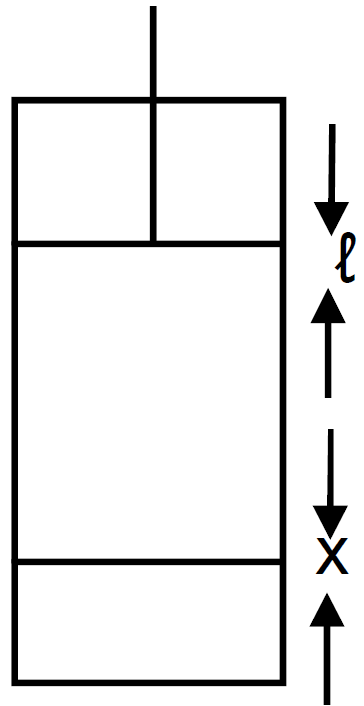
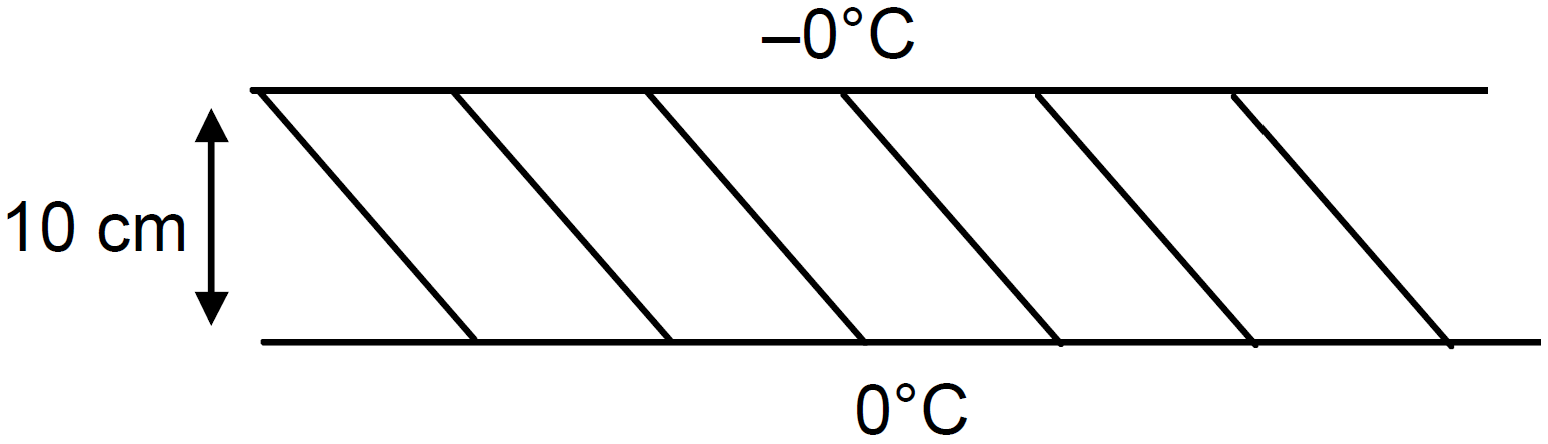
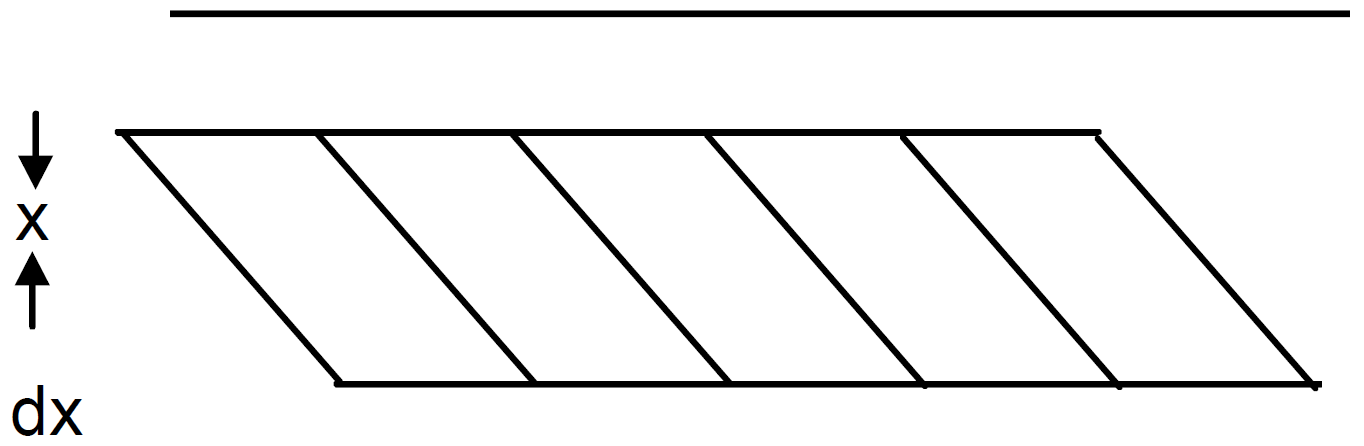
An amount n (in moles) of a monatomic gas at an initial temperature $T_0$ is enclosed in a cylindrical vessel fitted with a light piston. The surrounding air has a temperature $T_s(> T_0)$ and the atmospheric pressure is $P_a.$ Heat may be conducted between the surrounding and the gas through the bottom of the cylinder. The bottom has a surface area A, thickness x and thermal conductivity K. Assuming all changes to be slow, find the distance moved by the piston in time t.
Answer

$\frac{\text{Q}}{\text{t}}=\frac{\text{KA}(\text{T}_\text{s}-\text{T}_0)}{\text{x}}$
$\Rightarrow\frac{\text{n}\text{C}_\text{p}\text{dT}}{\text{dt}}=\frac{\text{KA}(\text{T}_\text{s}-\text{T}_0)}{\text{x}}$
$\Rightarrow\frac{\text{n}\Big(\frac{5}{2}\Big)\text{RdT}}{\text{dt}}=\frac{\text{KA}(\text{T}_\text{s}-\text{T}_0)}{\text{x}}$
$\Rightarrow\frac{\text{dT}}{\text{dt}}=\frac{-2\text{LA}}{5\text{nRx}}(\text{T}_\text{s}-\text{T}_0)$
$\Rightarrow\frac{\text{dt}}{(\text{T}_\text{s}-\text{T}_0)}=-\frac{2\text{KAdt}}{5\text{nRx}}$
$\Rightarrow\text{ln}(\text{T}_\text{s}-\text{T}_0)^\text{T}_{\text{T}_0}=-\frac{2\text{KAdt}}{5\text{nRx}}$
$\Rightarrow\text{ln}\frac{\text{T}_\text{s}-\text{T}}{\text{T}_\text{s}-\text{T}_0}=-\frac{2\text{KAdt}}{5\text{nRx}}$
$\Rightarrow\text{T}_\text{s}-\text{T}=(\text{T}_\text{s}-\text{T}_0)\text{e}^{-\frac{2\text{KAdt}}{5\text{nRx}}}$
$\Rightarrow\text{T}=\text{T}_\text{s}-(\text{T}_\text{s}-\text{T}_0)\text{e}^{-\frac{2\text{KAt}}{5\text{nRx}}}\\=\text{T}_\text{s}+(\text{T}_\text{s}+\text{T}_0)\text{e}^{+\frac{2\text{KAt}}{5\text{nRx}}}$
$\Rightarrow\triangle\text{T}=\text{T}-\text{T}_0=(\text{T}_\text{s}-\text{T}_0)+(\text{T}_\text{s}-\text{T}_0)\text{e}^{+\frac{2\text{KAt}}{5\text{nRx}}}$
$\Rightarrow\Delta\text{T}=(\text{T}_\text{s}-\text{T}_0)+\bigg(1+\text{e}^{+\frac{2\text{KAt}}{5\text{nRx}}}\bigg)$
$\Rightarrow\frac{\text{P}_\text{a}\text{AL}}{\text{nR}}=(\text{T}_\text{s}-\text{T}_0)+\bigg(1+\text{e}^{+\frac{2\text{KAt}}{5\text{nRx}}}\bigg)$
$\Big[\text{P}_\text{a}\text{dv}=\text{nRdt},\ \text{P}_\text{a}\text{Al}=\text{nRdt},\ \text{dT}=\frac{\text{P}_\text{a}\text{AL}}{\text{nR}}\Big]$
$\Rightarrow\text{L}=\frac{\text{nR}}{\text{P}_\text{a}\text{A}}(\text{T}_\text{s}-\text{T}_0)\bigg(1-\text{e}^{-\frac{2\text{KAt}}{5\text{nRx}}}\bigg)$
View full question & answer
Question 64 Marks
On a winter day when the atmospheric temperature drops to -10°C, ice forms on the surface of a lake.
  1. Calculate the rate of increase of thickness of the ice when 10cm of ice is already formed.
  2. Calculate the total time taken in forming 10cm of ice. Assume that the temperature of the entire water reaches 0°C before the ice starts forming. Density of water $= 1000kgm^{-3},$ latent heat of fusion of ice $=3.36\times10^5\text{Jkg}^{-1}$ and thermal conductivity of ice $=1.7\text{Wm}^{-1}{^{\circ}}\text{C}^{-1}.$ Neglect the expansion of water on freezing.
Answer
$\text{K}=1.7\text{W/m-}^\circ\text{C},\ \text{f}_\text{w}=1000\text{Kg/m}^3$
$\text{L}_\text{ice}=3.36\times10^5\text{J/kg},\ \text{T}=10\text{cm}\times10^{-2}\text{m}$
  1. $\frac{\text{Q}}{\text{t}}=\frac{\text{KA}(\theta_1-\theta_2)}{\ell}$
$\Rightarrow\frac{\ell}{\text{t}}=\frac{\text{KA}(\theta_1-\theta_2)}{\text{Q}}=\frac{\text{KA}(\theta_1-\theta_2)}{\text{mL}}$

$=\frac{\text{KA}(\theta_1-\theta_2)}{\text{Atf}_\text{w}\text{L}}=\frac{1.7\times\big[0-(-10)\big]}{10\times10^{-2}\times1000\times3.36\times10^5}$

$=\frac{17}{3.36}\times10^{-7}=5.059\times10^{-7}$

$=5\times10^7\text{m/sec}$
  1. Let us assume that x length of ice has become formed to form a small strip of ice of length dx, dt time is required.

$\frac{\text{dQ}}{\text{dt}}=\frac{\text{KA}(\triangle\theta)}{\text{x}}$

$\Rightarrow\frac{\text{dmL}}{\text{dt}}=\frac{\text{KA}(\triangle\theta)}{\text{x}}$

$\Rightarrow\frac{\text{Adxf}\omega\text{L}}{\text{dt}}=\frac{\text{KA}(\triangle\theta)}{\text{x}}$

$\Rightarrow\frac{\text{dxf}\omega\text{L}}{\text{dt}}=\frac{\text{K}(\triangle\theta)}{\text{x}}$

$\Rightarrow\text{dt}=\frac{\text{xdxf}\omega\text{L}}{\text{K}(\triangle\theta)}$

$\Rightarrow\int\limits_0^\text{t}\text{dt}=\frac{\text{f}\omega\text{L}}{\text{K}(\triangle\theta)}\int\limits_0^\text{t}\text{xdx}$

$\Rightarrow\text{t}=\frac{\text{f}\omega\text{L}}{\text{K}(\triangle\theta)}\Big[\frac{\text{x}^2}{2}\Big]_0^\text{l}=\frac{\text{f}\omega\text{L}}{\text{K}\triangle\theta}\frac{\text{l}^2}{2}$

Putting values:

$\Rightarrow\text{t}=\frac{1000\times3.36\times10^5\times(10\times10^{-2})^2}{1.7\times10\times2}$

$=\frac{3.36}{2\times17}\times10^6\text{sec}$

$=\frac{3.36\times10^6}{2\times17\times3600}\text{hrs}$

$=27.45\text{hrs}\approx27.5\text{hrs}.$
View full question & answer