Question types

Laws of Thermodynamics question types

51 questions across 6 question groups — pick any mix to generate a Physics paper with step-by-step answer keys.

51
Questions
6
Question groups
5
Question types
Sample Questions

Laws of Thermodynamics questions

One sample from each question group in this chapter. Select any group above to see the full set with answer keys.

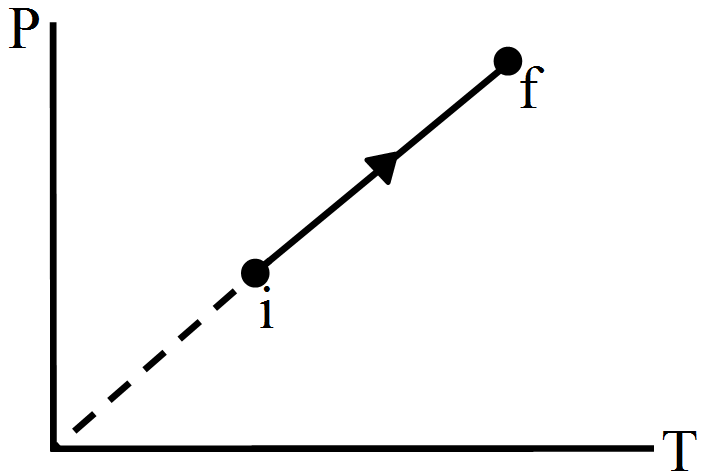
An ideal gas goes from the state i to the state fas shown in figure. The work done by the gas during the process:
  1. Is positive.
  2. Is negative.
  3. Is zero.
  4. Cannot be obtained from this information.
View full solution
The internal energy of an ideal gas decreases by the same amount as the work done by the system:
  1. The process must be adiabatic.
  2. The process must be isothermal.
  3. The process must be isobaric.
  4. The temperature must decrease.
View full solution
In a process on a system, the initial pressure and volume are equal to the final pressure and volume.
  1. The initial temperature must be equal to the final temperature.
  2. The initial internal energy must be equal to the final internal energy.
  3. The net heat given to the system in the process must be zero.
  4. The net work done by the system in the process must be zero.
View full solution
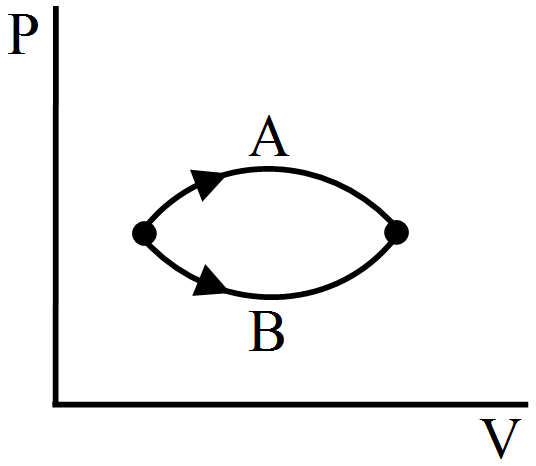
Figure. shows two processes A and B on a system. Let $\Delta\text{Q}_1$ and $\Delta\text{Q}_2$ be the heat given to the system in processes A and B respectively. Then,
  1. $\Delta\text{Q}_1>\Delta\text{Q}_2$
  2. $\Delta\text{Q}_1=\Delta\text{Q}_2$
  3. $\Delta\text{Q}_1<\Delta\text{Q}_2$
  4. $\Delta\text{Q}_1\le\Delta\text{Q}_2$
View full solution
The first law of thermodynamics is a statement of:
  1. Conservation of heat.
  2. Conservation of work.
  3. Conservation of momentum.
  4. Conservation of energy.
View full solution
The pressure of a gas changes linearly with volume from $10\ kPa, 200\ cc$ to $50\ kPa, 50\ cc$.
  1. Calculate the work done by the gas.
  2. If no heat is supplied or extracted from the gas, what is the change in the internal energy of the gas?
View full solution
A gas is enclosed in a cylindrical vessel fitted with a frictionless piston. The gas is slowly heated for some time. During the process, $10J$ of heat is supplied and the piston is found to move out $10\ cm$. Find the increase in the internal energy of the gas. The area of cross section of the cylinder $= 4\ cm^2$ and the atmospheric pressure $= 100\ kPa.$
View full solution
An ideal gas is taken from an initial state $i$ to a final state $f$ in such a way that the ratio of the pressure to the absolute temperature remains constant. What will be the work done by the gas?
View full solution
A force F is applied on a block of mass M. The block is displaced through a distance d in the direction of the force. What is the work done by the force on the block? Does the internal energy change because of this work?
View full solution
Q 143 Marks Question3 Marks
When we heat an object, it expands. Is work done by the object in this process ? Is heat given to the object equal to the increase in its internal energy?
View full solution
Q 163 Marks Question3 Marks
A cylinder containing a gas is lifted from the first floor to the second floor. What is the amount of work done on the gas? What is the amount of work done by the gas? Is the internal energy of the gas increased? Is the temperature of the gas increased?
View full solution
An ideal gas is pumped into a rigid container having diathermic walls so that the temperature remains constant. In a certain time interval, the pressure in the container is doubled. Is the internal energy of the contents of the container also doubled in the interval?
View full solution
A closed bottle contains some liquid. The bottle is shaken vigorously for 5 minutes. It is found that the temperature of the liquid is increased. Is heat transferred to the liquid? Is work done on the liquid? Neglect expansion on heating.
View full solution
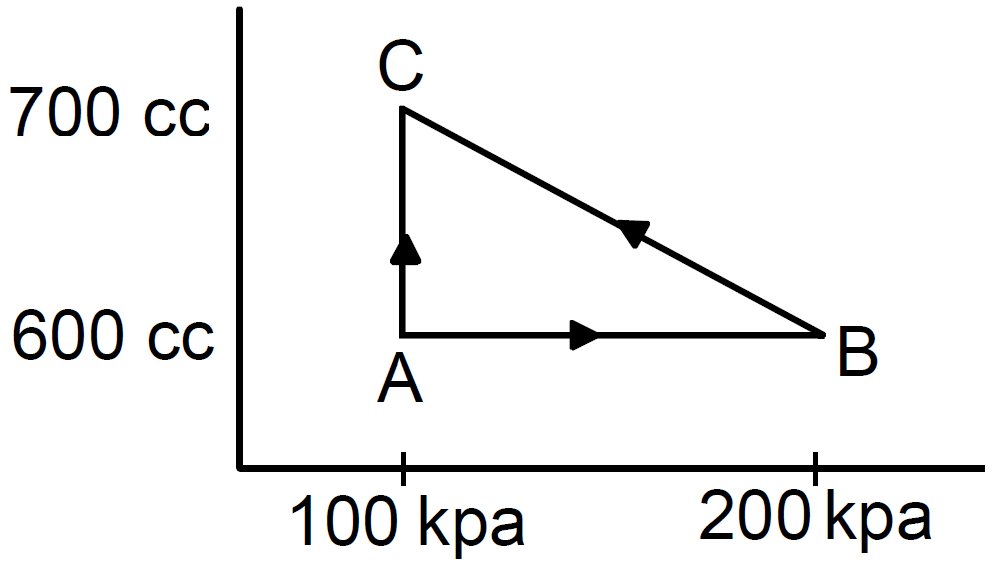
A gas is taken through a cyclic process $\text{ABCA}$ as shown in figure. If $2.4$ cal of heat is given in the process, what is the value of $J?$
View full solution
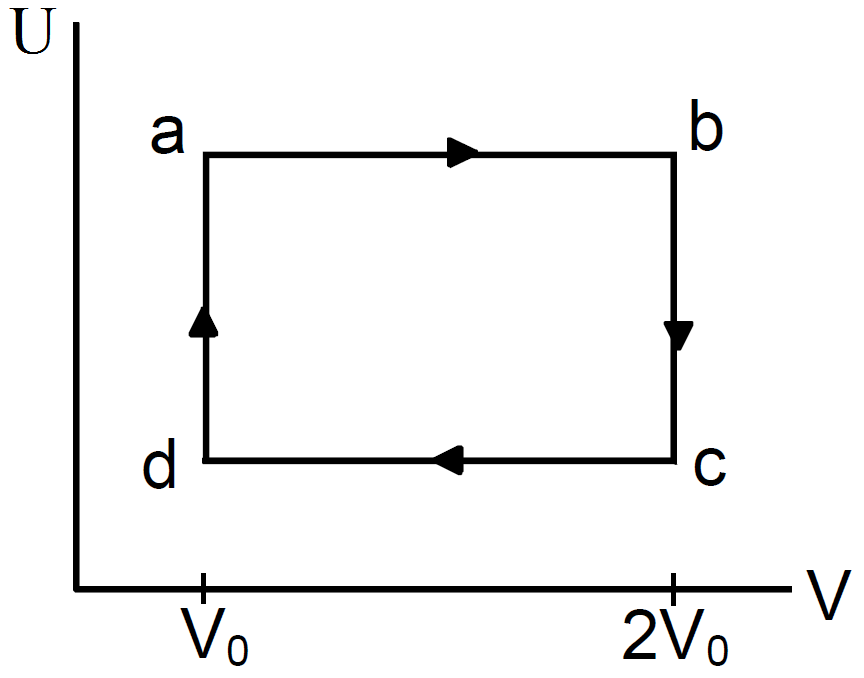
Figure. shows the variation in the internal energy $U$ with the volume $V$ of $2.0\ mol$ of an ideal gas in a cyclic process abcda. The temperatures of the gas at $b$ and $c$ are $500K$ and $300K$ respectively. Calculate the heat absorbed by the gas during the process.
View full solution
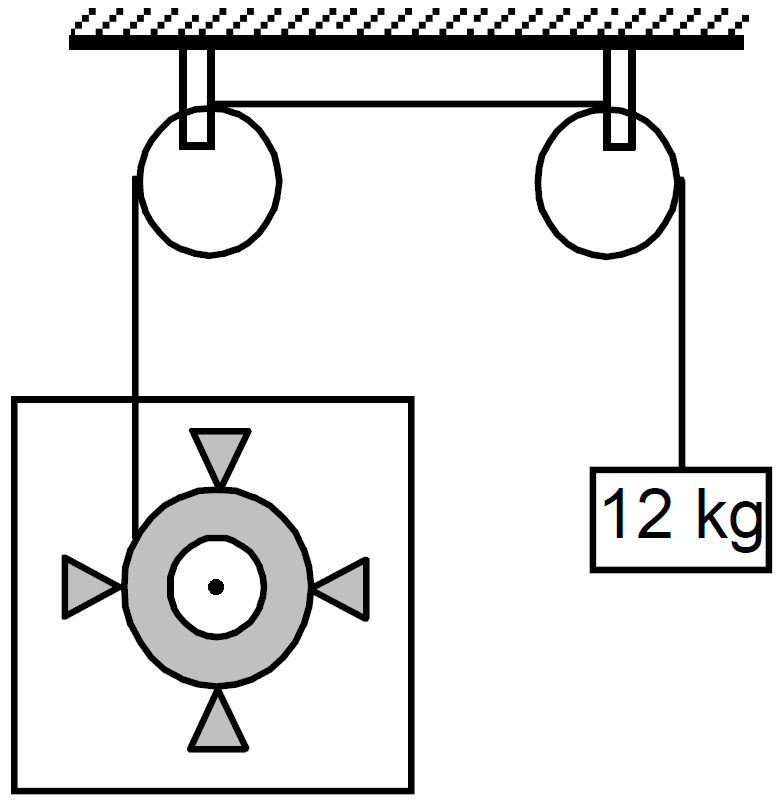
Figure. shows a paddle wheel coupled to a mass of $12\ kg$ through fixed frictionless pulleys. The paddle is immersed in a liquid of heat capacity $4200\ JK^{-1}$ kept in an adiabatic container. Consider a time interval in which the $12\ kg$ block falls slowly through $70\ cm$.
  1. How much heat is given to the liquid?
  2. How much work is done on the liquid?
  3. Calculate the rise in the temperature of the liquid neglecting the heat capacity of the container and the paddle.
View full solution
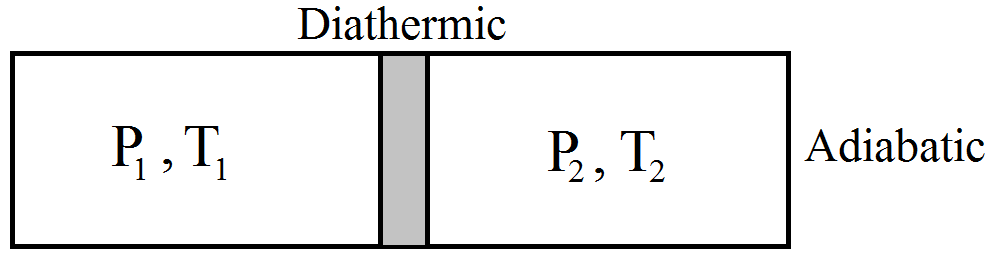
Figure. shows a cylindrical tube of volume $V$ with adiabatic walls containing an ideal gas. The internal energy of this ideal gas is given by $1. 5\ nRT$. The tube is divided into two equal parts by a fixed diathermic wall. Initially, the pressure and the temperature are $P_1, T_1$ on the left and $p_2, T_2$ on the right. The system is left for sufficient time so that the temperature becomes equal on the two sides.
  1. How much work has been done by the gas on the left part?
  2. Find the final pressures on the two sides.
  3. Find the final equilibrium temperature.
  4. How much heat has flown from the gas on the right to the gas on theleft?
View full solution
An adiabatic vessel of total volume $V$ is divided into two equal parts by a conducting separator. The separator is fixed in this position. The part on the left contains one mole of an ideal gas $(U = 1.5\ nRT)$ and the part on the right contains two moles of the same gas. Initially, the pressure on each side is $p$. The system is left for sufficient time so that a steady state is reached. Find,
  1. The work done by the gas in the left part during the process.
  2. The temperature on the two sides in the beginning.
  3. The final common temperature reached by the gases.
  4. The heat given to the gas in the right part.
  5. The increase in the internal energy of the gas in the left part.
View full solution

Generate a Laws of Thermodynamics paper free

Pick question groups from the list above, set marks and difficulty, and export a branded PDF with step-by-step answer keys. First 3 chapters free — no signup.

Download App