Question types

Magnetic Field due to a Current question types

92 questions across 5 question groups — pick any mix to generate a Physics paper with step-by-step answer keys.

92
Questions
5
Question groups
5
Question types
Sample Questions

Magnetic Field due to a Current questions

One sample from each question group in this chapter. Select any group above to see the full set with answer keys.

A particle is projected in a plane perpendicular to a uniform magnetic field. The area bounded by the path described by the particle is proportional to:
  1. The velocity.
  2. The momentum.
  3. The kinetic energy.
  4. None of these.
View full solution
Two parallel, long wires carry currents $i_1$ and $i_2$ with $i_1 > i_2$. When the currents are in the same direction, the magnetic field at a point midway between the wires is $10 \mu\text{T}.$ If the direction of $i_2$ is reversed, the field becomes $30 \mu\text{T}.$ The ratio $\frac{\text{i}_1}{\text{i}_2}$ is :
  • A
    $4$
  • B
    $3$
  • $2$
  • D
    $1$

Answer: C.

View full solution
A long, straight wire of radius $R$ carries a current distributed uniformly over its cross section. $T$ he magnitude of the magnetic field is:
  • A
    Maximum at the axis of the wire.
  • Minimum at the axis of the wire.
  • C
    Maximum at the surface of the wire.
  • D
    Minimum at the surface of the wire.

Answer: B.

View full solution
Consider three quantities $\text{x}=\frac{\text{E}}{\text{B}},\ \text{y}=\sqrt{\frac{1}{\mu_0\epsilon_0}}$ and $\text{z}=\frac{1}{\text{CR}}.$ Here, l is the length of a wire, C is a capacitance and R is a resistance. All other symbols have standard meanings.
  1. x, y have the same dimensions.
  2. y, z have the same dimensions.
  3. z, x have the same dimensions.
  4. None of the three pairs have the same dimensions.
View full solution
Two proton beams going in the same direction repel each other whereas two wires carrying currents in the same direction attract each other. Explain.
View full solution
A long solenoid is fabricated by closely winding a wire of radius $0.5\ mm$ over a cylindrical nonmagnetic frame so that the successive turns nearly touch each other. What would be the magnetic field $B$ at the centre of the solenoid if it carries a current of $5A$?
View full solution
A circular loop of radius 4.0cm is placed in a horizontal plane and carries an electric current of 5.0A in the clockwise direction as seen from above. Find the magnetic field:
  1. At a point 3.0cm above the centre of the loop.
  2. At a point 3.0cm below the centre of the loop.
View full solution
Consider the situation described in the previous problem. Suppose the current i enters the loop at the point A and leaves it at the point B. Find the magnetic field at the centre of the loop.
View full solution
You are facing a circular wire carrying an electric current. The current is clockwise as seen by you. Is the field at the centre coming towards you or going away from you?
View full solution
A current of 10A is established in a long wire along the positive z-axis. Find the magnetic field $\overrightarrow{\text{B}}$ at the point (1m, 0, 0).
View full solution
In Ampere's $\oint\overrightarrow{\text{B}}.\text{d}\overrightarrow{\text{l}}=\mu_0\text{i},$ the current outside the curve is not included on the right hand side. Does it mean that the magnetic field B calculated by using Ampere's law, gives the contribution of only the currents crossing the area bounded by the curve?
View full solution
A copper wire of diameter 1.6 mm carries 20A. Find the maximum magnitude of the magnetic field $\overrightarrow{\text{B}}$ due to this current.
View full solution
Q 153 Marks Question3 Marks
A long, vertical wire carrying a current of $10A$ in the upward direction is placed in a region where a horizontal magnetic field of magnitude $2·0 \times 10^{-3}T$ exists from south to north. Find the point where the resultant magnetic field is zero.
View full solution
Q 163 Marks Question3 Marks
A circular loop of radius r carries a current i. How should a long, straight wire carrying a current 4i be placed in the plane of the circle so that the magnetic field at the centre becomes zero?
View full solution
Q 173 Marks Question3 Marks
Consider the situation of the previous problem. A particle having charge q and mass m is projected from the point Q in a direction going into the plane of the diagram. It is found to describe a circle of radius r between the two plates. Find the speed of the charged particle.
View full solution
Q 183 Marks Question3 Marks
A long, cylindrical tube of inner and outer radii a and b carries a current i distributed uniformly over its cross section. Find the magnitude of the magnetic field at a point (a) just inside the tube (b) just outside the tube.
View full solution
Q 193 Marks Question3 Marks
A straight wire carrying an electric current is placed along the axis of a uniformly charged ring. Will there be a magnetic force on the wire if the ring starts rotating about the wire? If yes, in which direction?
View full solution
A copper wire having resistance $0.01$ ohm in each metre is used to wind a $400-$turn solenoid of radius $1.0\ cm$ and length $20\ cm$. Find the emf of a battery which when connected the solenoid will eauee a magnetic field of $1.0 \times 10^{-2}T$ near the centre of the solenoid.
View full solution
Consider a straight piece of length x of a wire carrying a current i. Let P be a point on the perpendicular bisector of the piece, situated at a distance d from its middle point. Show that for d >> x, the magnetic field at P varies as $\frac{1}{\text{d}^2}$ whereas ford d << x, it varies as $\frac{1}{\text{d}}.$
View full solution
Two long, straight wires, each carrying a current of $5A,$ are placed along the $X$ and $Y-$axes respectively. The currents point along the positive directions of the axes. Find the magnetic fields at the points $(a)\  (1m, 1m),\  (b) \ (-1m, 1m), \ (c) \ (-1m,-1m)$ and $(d) \ (1m, -1m),$
View full solution
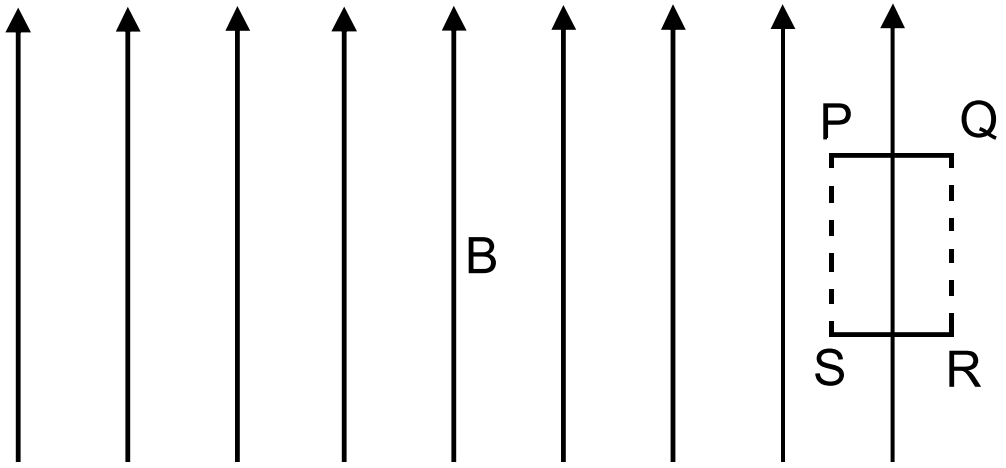
Sometimes we show an idealised magnetic field which is uniform in a given region and falls to zero abruptly. One such field is represented in figure. Using Ampere's law over the path PQRS, show that such a field is not possible.
View full solution
Two current-carrying wires may attract each other. In absence of other forces, the wires will move towards each other increasing the kinetic energy. Does it contradict the fact that the magnetic force cannot do any work and hence cannot increase the kinetic energy?
View full solution

Generate a Magnetic Field due to a Current paper free

Pick question groups from the list above, set marks and difficulty, and export a branded PDF with step-by-step answer keys. First 3 chapters free — no signup.

Download App