Questions

3 Marks Question

Take a timed test

26 questions · self-marked practice — reveal the answer and mark yourself.

Question 13 Marks
A straight, long wire carries a current of 20A. Another wire carrying equal current is placed parallel to it. If the. force acting on a length of 10cm of the second wire is $2 \times 10^{-5}N$, what is the separation between them?
Answer
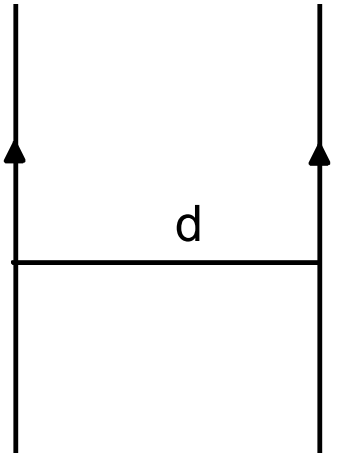

Force acting on 10cm of wire is $2 \times 10^{-5}N$
$\frac{\text{dF}}{\text{dl}}=\frac{\mu_0\text{i}_1\text{i}_2}{2\pi\text{d}}$
$\Rightarrow\frac{2\times10^{-5}}{10\times10^{-2}}=\frac{\mu_0\times20\times20}{2\pi\text{d}}$
$\Rightarrow\text{d}=\frac{4\pi\times10^{-7}\times20\times20\times10\times10^{-2}}{2\pi\times2\times10^{-5}}$
$=400\times10^{-3}=0.4\text{m}=40\text{cm}$
View full question & answer
Question 23 Marks
Consider the situation of the previous problem. A particle having charge q and mass m is projected from the point Q in a direction going into the plane of the diagram. It is found to describe a circle of radius r between the two plates. Find the speed of the charged particle.
Answer
Charge = q,
mass = m
We know radius described by a charged particle in a magnetic field B.
$\text{r}=\frac{\text{mv}}{\text{qB}}$
$\text{Bit}\ \text{B}=\mu_0\text{K}$ [according to Ampere’s circuital law, where K is a constant]
$\text{r}=\frac{\text{mv}}{\text{q}\mu_0\text{K}}\Rightarrow\text{v}=\frac{\text{rq}\mu_0\text{K}}{\text{m}}$
View full question & answer
Question 33 Marks
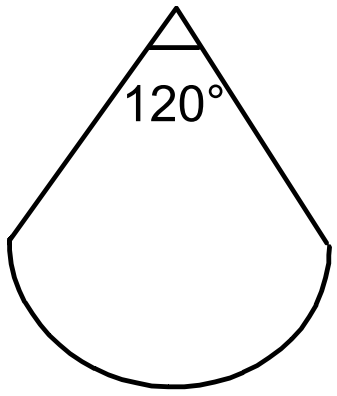
A piece of wire carrying a current of 6.00A is bent in the form of a circular arc of radius 10.0cm, and it subtends an angle of 120° at the centre. Find the magnetic field B due to this piece of wire at the centre.
Answer

$\text{B}=\frac{\mu_0\text{i}}{2\text{R}}\frac{\theta}{2\pi}=\frac{2\pi}{3\times2\pi}\times\frac{\mu_0\text{i}}{2\text{R}}$
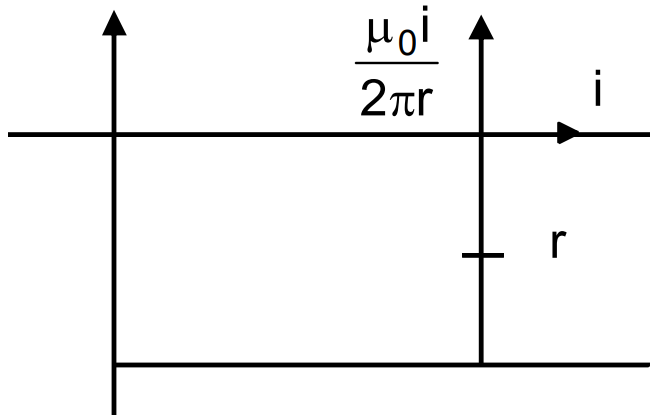
$=\frac{4\pi\times10^{-7}\times6}{6\times10^{-2}}=4\pi\times10^{-6}$
$=4\times3.14\times10^{-6}=12.56\times10^{-6}$
$=1.26\times10^{-5}\text{T}$
View full question & answer
Question 43 Marks
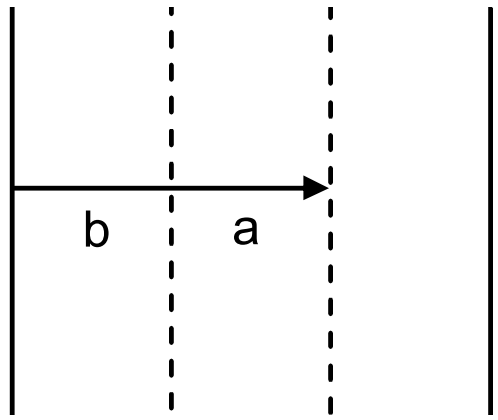
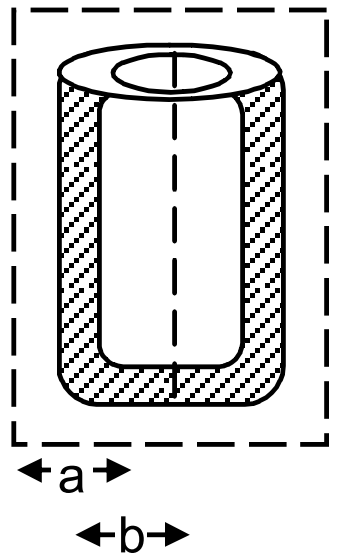
A long, cylindrical tube of inner and outer radii a and b carries a current i distributed uniformly over its cross section. Find the magnitude of the magnetic field at a point (a) just inside the tube (b) just outside the tube.
Answer
  1. At a point just inside the tube the current enclosed in the closed surface = 0.
Thus $\text{B}=\frac{\mu_0\text{o}}{\text{A}}=0$
  1. Taking a cylindrical surface just out side the tube, from ampere’s law
$\mu_0\text{i}=\text{B}\times2\pi\text{b}$

$\Rightarrow\text{B}=\frac{\mu_0\text{i}}{2\pi\text{b}}$
View full question & answer
Question 53 Marks
A straight wire carrying an electric current is placed along the axis of a uniformly charged ring. Will there be a magnetic force on the wire if the ring starts rotating about the wire? If yes, in which direction?
Answer
The magnetic force on a wire carrying an electric current i is $\overrightarrow{\text{F}}=\text{i}.\big(\overrightarrow{\text{l}}\times\overrightarrow{\text{B}}\big),$ where l is the length of the wire and B is the magnetic field acting on it. If a uniformly charged ring starts rotating around a straight wire, then according to the right-hand thumb rule, the magnetic field due to the ring on the current carrying straight wire placed at its axis will be parallel to it. So, the cross product will be:
$\big(\overrightarrow{\text{l}}\times\overrightarrow{\text{B}}\big)=0$
$\Rightarrow\overrightarrow{\text{F}}=0$
Therefore, no magnetic force will act on the wire.
View full question & answer
Question 63 Marks
A long, straight wire carries a current. Is Ampere's law valid for a loop that does not enclose the wire? That encloses the wire but is not circular?
Answer
Ampere's law is valid for a loop that is not circular. However, it should have some charge distribution in the area enclosed so as to have a constant electric field in the region and a non-zero magnetic field. Even if the loop defined does not have its own charge distribution but has electric influence of some other charge distribution, it can have some constant magnetic field $\big(\oint\overrightarrow{\text{B}}.\text{d}\overrightarrow{\text{l}}=\mu_0\text{i}\ \text{enclosed}\big).$
View full question & answer
Question 73 Marks
A long, straight wire of radius r carries a current i and is placed horizontally in a uniform magnetic field B pointing vertically upward. The current is uniformly distributed over its cross-section.
  1. At what points will the resultant magnetic field have maximum magnitude? What will be the maximum magnitude?
  2. What will be the minimum magnitude of the resultant magnetic field?
Answer

  1. The maximum magnetic field is $\text{B}+\frac{\mu_0\text{I}}{2\pi\text{r}}$ which are along the left keeping the sense along the direction of traveling current.
  1. The minimum $\text{B}-\frac{\mu_0\text{I}}{2\pi\text{r}}$
If $\text{r}=\frac{\mu_0\text{I}}{2\pi\text{B}}\ \text{B}\ \text{net}=0$

$\text{r}<\frac{\mu_0\text{I}}{2\pi\text{B}}\ \text{B}\ \text{net}=0$

$\text{r}>\frac{\mu_0\text{I}}{2\pi\text{B}}\ \text{B}\ \text{net}=\text{B}-\frac{\mu_0\text{I}}{2\pi\text{r}}$
View full question & answer
Question 83 Marks
A charge of $3.14 \times 10^{-6}C$ is distributed uniformly over a circular ring of radius 20.0cm. The ring rotates about its axis with an angular velocity of 60.0 rad/s. Find the ratio of the electric field to the magnetic field at a point on the axis at a distance of 5.00cm from the centre.
Answer


Given:
Magnitude of charges, $q = 3.14 \times 10^{−6}C$
Radius of the ring, $r = 20cm = 20 \times 10^{-2}mr = 20cm = 20 \times 10^{-2}m$
Angular velocity of the ring, $\omega=60\ \text{rad/s}$
Time for 1 revolution $=\frac{2\pi}{60}$
$\therefore\ \text{Current},\ \text{i}=\frac{\text{q}}{\text{t}}=\frac{3.14\times10^{-6}\times60}{2\pi}$
$=30\times10^{-6}\text{A}$
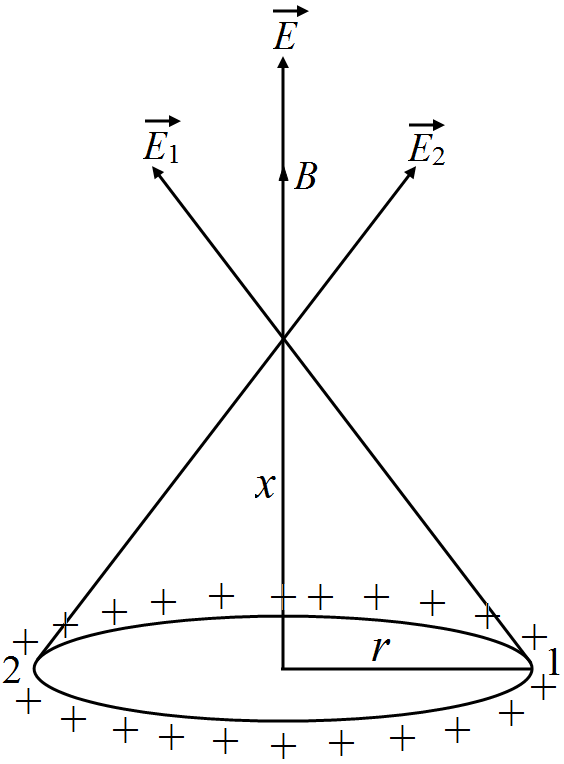
In the figure, $E_1$ and $E_2$ denotes the electric field at a point on the axis at a distance of 5.00 cm from the centre due to small element 1 and 2 of the ring respectively.
E is the resultant electric field due to the entire ring at a point on the axis at a distance of 5.00 cm from the centre.
The electric field at a point on the axis at a distance x from the centre is given by
$\text{E}=\frac{\text{xq}}{4\pi\in_0(\text{x}^2+\text{r}^2)^\frac{3}{2}}$
The magnetic field at a point on the axis at a distance x from the centre is given by
$\text{B}=\frac{\mu_0}{2}\frac{\text{ir}^2}{(\text{x}^2+\text{r}^2)^\frac{3}{2}}$
$\frac{\text{E}}{\text{B}}=\frac{\frac{\text{xq}}{4\pi\in_0(\text{x}^2+\text{r}^2)^\frac{3}{2}}}{\frac{\mu_0}{2}\frac{\text{ir}^2}{(\text{x}^2+\text{r}^2)^\frac{3}{2}}}$
$=\frac{9\times10^9\times3.14\times10^{-6}\times2\times(20.6)^3\times10^{-6}}{25\times10^{-4}\times4\pi\times12}$
$=\frac{9\times3.14\times2\times(20.6)^3}{25\times4\pi\times12}$
$=1.88\times10^{15}\text{m/s}$
View full question & answer
Question 93 Marks
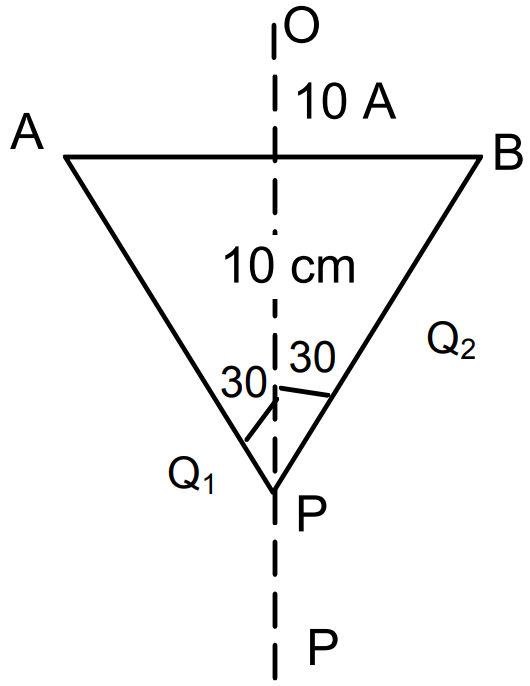
Consider a 10cm long piece of a wire which carries a current of 10A. Find the magnitude of the magnetic field due to the piece at a point which makes an equilateral triangle with the ends of the piece.
Answer

$\text{I} = 10 \text{A},\ \text{a} = 10\text{cm} = 0.1\text{m}$
$\text{r}=\text{OP}=\frac{\sqrt3}{2}\times0.1\text{m}$
$\text{B}=\frac{\mu_0\text{I}}{4\pi\text{r}}(\sin\phi_1+\sin\phi_2)$
$=\frac{10^{-7}\times10\times1}{\sqrt{\frac{\sqrt{3}}{2}}\times0.1}=\frac{2\times10^{-5}}{1.732}$
$= 1.154\times10^{-5}\text{T} = 11.54\mu\text{T}$
View full question & answer
Question 103 Marks
A long cylindrical wire of radius b carries a current i distributed uniformly over its cross-section. Find the magnitude of the magnetic field at a point inside the wire at a distance a from the axis.
Answer
i is uniformly distributed throughout So, ‘i’ for the part of radius $\text{a}=\frac{\text{i}}{\pi\text{b}^2}\times\pi\text{a}^2=\frac{\text{ia}^2}{\text{b}^2}=\text{I}$
Now according to Ampere’s circuital law, $\phi\text{B}\times\text{d}\ell=\text{B}\times2\times\pi\times\text{a}=\mu_0\text{I}$ $\Rightarrow\text{B}=\mu_0\frac{\text{ia}^2}{\text{b}^2}\times\frac{1}{2\pi\text{a}}=\frac{\mu_0\text{ia}}{2\pi\text{b}^2}$
View full question & answer
Question 113 Marks
A tightly-wound, long solenoid carries a current of 2.00A. An electron is found to execute a uniform circular motion inside the solenoid with a frequency of $1.00 \times 10^8$ rev/s. Find the number of turns per metre in the solenoid.
Answer
$\text{i} = 2\text{a}, \text{f} = 10^8\text{rev/sec,}$
$\text{n}= ?,$
$\text{m}_\text{e} = 9.1 × 10^{-31}\text{kg},$
$\text{q}_\text{e} = 1.6\times10^{-19}\text{c},$
$\text{B}=\mu_0\text{ni}\Rightarrow\text{n}=\frac{\text{B}}{\mu_0\text{i}}$
$\text{f}=\frac{\text{qB}}{2\pi\text{m}_\text{e}}\Rightarrow\text{B}=\frac{\text{f}2\pi\text{m}_\text{e}}{\text{q}_\text{e}}\Rightarrow\text{n}=\frac{\text{B}}{\mu_0\text{i}}=\frac{\text{f}2\pi\text{m}_\text{e}}{\text{q}_\text{e}\mu_0\text{i}}$
$=\frac{10^8\times9.1\times10^{31}}{1.6\times10^{-19}\times2\times10^{-7}\times2\text{A}}2=1421\ \text{turns/m}$
View full question & answer
Question 123 Marks
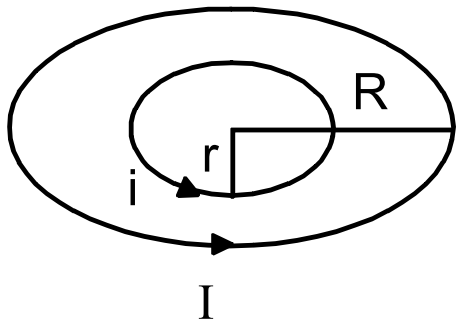
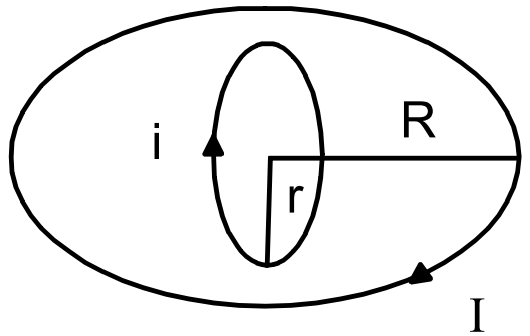
A circular loop of radius r carrying a current i is held at the centre of another circular loop of radius R(>> r) carrying a current I. The plane of the smaller loop makes an angle of 30° with that of the larger loop. If the smaller loop is held fixed in this position by applying a single force at a point on its periphery, what would be the minimum magnitude of this force?
Answer

The force acting on the smaller loop
$\text{F}=\text{ilB}\sin\theta$
$=\frac{\text{i}2\pi\text{r}\mu_0\text{I}1}{2\text{R}\times2}=\frac{\mu_0\text{iI}\pi\text{r}}{2\text{R}}$
View full question & answer
Question 133 Marks
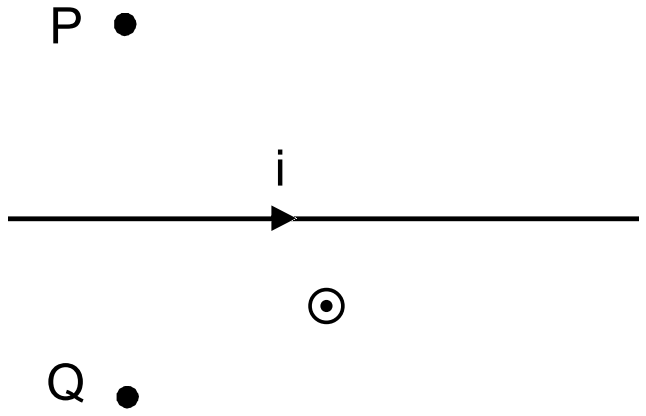
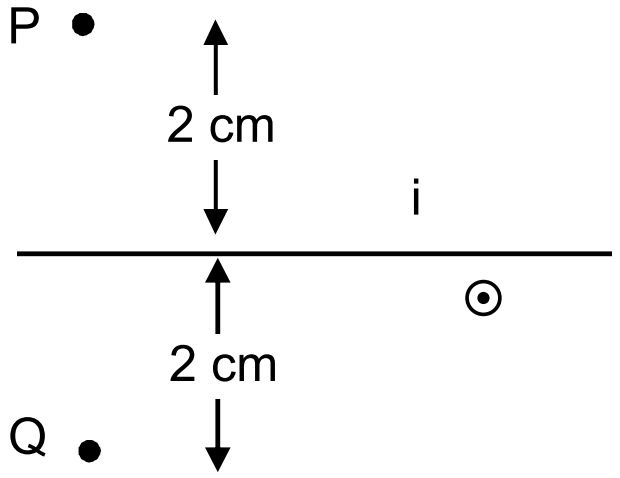
A long, straight wire carrying a current of 1.0A is placed horizontally in a uniform magnetic field $B = 1.0 \times 10^{-5}T$ pointing vertically upward figure. Find the magnitude of the resultant magnetic field at the points Pand Q, both situated at a distance of 2.0cm from the wire in the same horizontal plane.

Answer
$\mu_0=4\pi\times10^{-7}\text{T-m/A}$ $\text{r}2\text{cm}=0.02\text{m},$ $\text{I}=1\text{A}$ $\overrightarrow{\text{B}}=1\times10^{-5}\text{T}$

We know:
Magnetic field due to a long straight wire carrying current $=\frac{\mu_0\text{I}}{2\pi\text{r}}$ $\overrightarrow{\text{B}}\ \text{at}\ \text{P}=\frac{4\pi\times10^{-7}\times1}{2\pi\times0.02}=1\times10^{-5}{\text{T}}$
upward net $ \text{B} = 2\times1\times10^{–7}\text{T} = 20\mu\text{T}$
B at $Q = 1 \times 10^{-5}$ downwards
Hence net $\overrightarrow{\text{B}}=0$
View full question & answer
Question 143 Marks
A long, vertical wire carrying a current of 10A in the upward direction is placed in a region where a horizontal magnetic field of magnitude $2.0 \times 10^{-3}T$ exists from south to north. Find the point where the resultant magnetic field is zero.
Answer
$\text{i}=10\text{A}.(\hat{\text{K}})$
$\text{B}=2\times10^{-3}\text{T}$ South to North $(\hat{\text{J}})$
To cancel the magnetic field the point should be choosen so that the net magnetic field is along $-\hat{\text{J}}$ direction.
$\therefore$ The point is along $-\hat{\text{i}}$ direction or along west of the wire.
$\text{B}=\frac{\mu_0\text{I}}{2\pi\text{r}}$
$\Rightarrow2\times10^{-3}=\frac{4\pi\times10^{-7}\times10}{2\pi\times\text{r}}$
$\Rightarrow\text{r}=\frac{2\times10^{-7}}{2\times10^{-3}}=10^{-3}\text{m}=1\text{mm}.$
View full question & answer
Question 153 Marks
A capacitor of capacitance $100\mu\text{F}$ is connected to a battery of 20 volts for a long time and then disconnected from it. It is now connected across a long solenoid having 4000 turns per metre. It is found that the potential difference across the capacitor drops to 90% of its maximum value in 2.0 seconds. Estimate the average magnetic field produced at the centre of the solenofd during this period.
Answer
$\text{C}=100\mu\text{F},$
$\text{Q}=\text{CV}=2\times10^{-3}\text{C},$
$\text{t}=2\ \text{sec},$
$\text{V}=20\text{V},$
$ \text{V}' = 18\text{V},$
$\text{Q}'=\text{CV}=1.8\times10^{-3}\text{C},$
$\therefore\text{i}=\frac{\text{Q}-\text{Q}'}{\text{t}}=\frac{2\times10^{-4}}{2}=10^{-4}\text{A}$ $\text{n} = 4000\ \text{turns/m}$
$\therefore\text{B}=\mu_0\text{ni}=4\pi\times10^{-7}\times4000\times10^{-4}$
$=16\pi\times10^{-7}\text{T}$
View full question & answer
Question 163 Marks
A circular loop of radius R carries a current I. Another circular loop of radius r ( << R) carries a current i and is placed at the centre of the larger loop. The planes of the two circles are at right angle to each other. Find the torque acting on the smaller loop.
Answer

$\overrightarrow{\text{B}}$ Large loop $=\frac{\mu_0\text{I}}{2\text{R}}$
'i’ due to larger loop on the smaller loop
$=\text{i}(\text{A}\times\text{B})=\text{i}\text{AB}\ \sin90^\circ=\text{i}\times\pi\text{r}^2\times\frac{\mu_0\text{I}}{2\text{r}}$
View full question & answer
Question 173 Marks
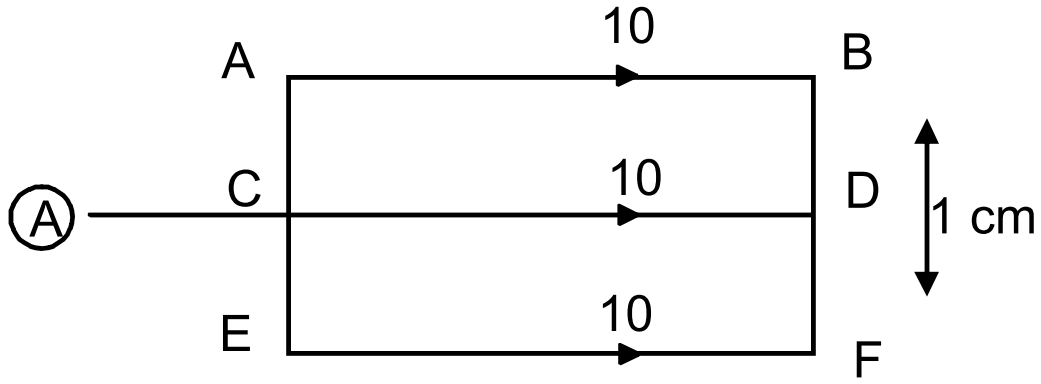
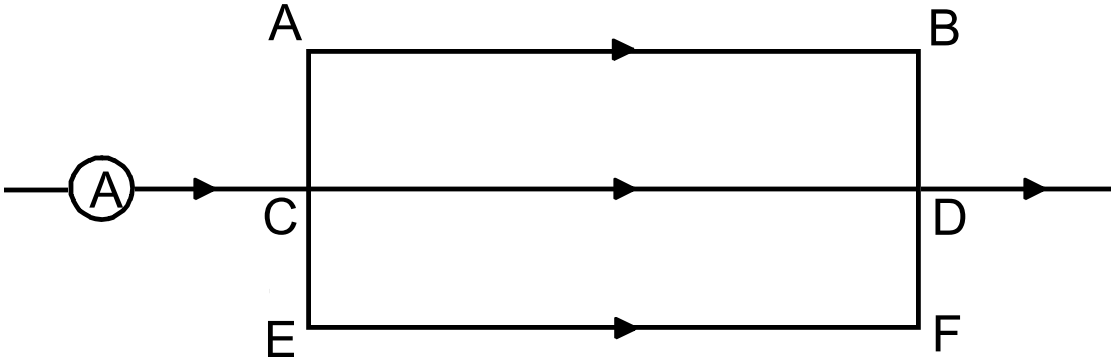
Figure shows a part of an electric circuit. The wires AB, CD and EF are long and have identical resistances. The separation between the neighbouring wires is 1.0cm. The wires AE and BF have negligible resistance and the ammeter reads 30A. Calculate the magnetic force per unit length of AB and CD.
Answer

$\text{F}_\text{AB} =\text{F}_\text{CD} +\text{F}_\text{EF}$
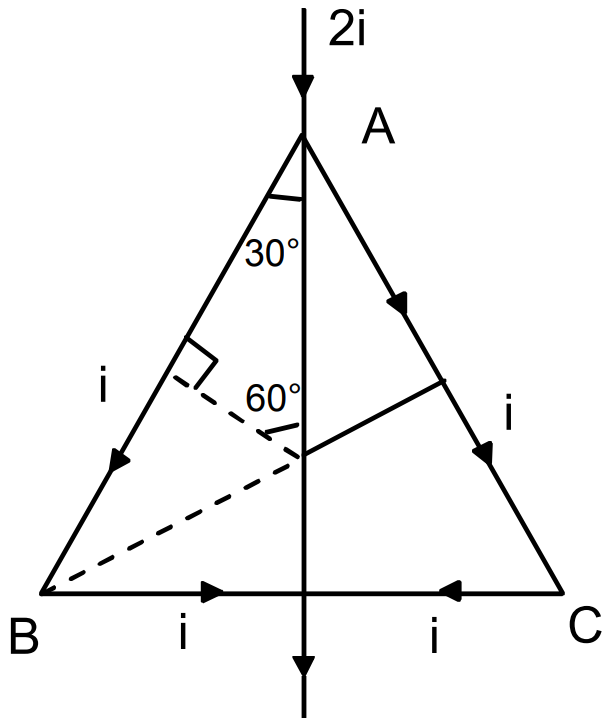
$=\frac{\mu_0\times10\times10}{2\pi\times10\times10}+\frac{\mu_0\times10\times10}{2\pi\times2\times10^{-2}}$
$=2\times10^{-3}+10^{-3}=3\times10^{-3}$ downward
$\text{F}_\text{CD} =\text{F}_\text{AB} +\text{F}_\text{EF}$
As $F_{AB} \& F_{EF}$ are equal and oppositely directed hence F = 0.
View full question & answer
Question 183 Marks
The magnetic field B inside a long solenoid, carrying a current of 5.00A, is $3.14 \times 10^{-2}T.$ Find the number of turns per unit length of the solenoid.
Answer
$\text{i} = 25\text{A},$
$\text{B} = 3.14\times10^{-2}\text{T},$
$\text{n} =?$
$\text{B}=\mu_0\text{ni}$
$\Rightarrow3.14\times10^{-2}=4\times\pi\times10^{-7}\text{n}\times5$
$\Rightarrow\text{n}=\frac{10^{-2}}{20\times10^{-7}}=\frac{1}{2}\times10^4$
$=0.5\times10^4=5000\ \text{turns/m}$
View full question & answer
Question 193 Marks
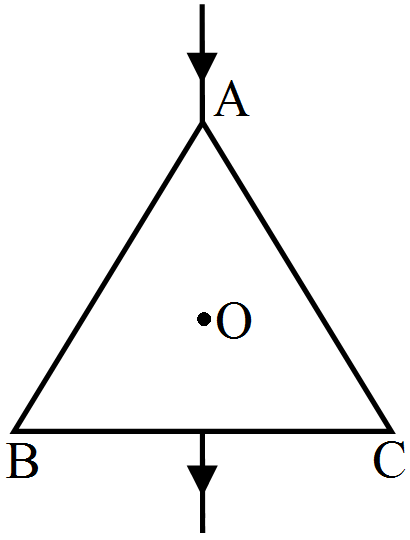
The. wire ABC shown in figure forms an equilateral triangle. Find the magnetic field B at the centre O of the triangle assuming the wire to be uniform.
Answer

For AB B is along $\odot\ \text{B}=\frac{\mu_0\text{i}}{4\pi\text{r}}(\sin60^\circ+\sin60^\circ)$
For AC B $\otimes\ \text{B}=\frac{\mu_0\text{i}}{4\pi\text{r}}(\sin60^\circ+\sin60^\circ)$
For BD B $\odot\ \text{B}=\frac{\mu_0\text{i}}{4\pi\text{r}}(\sin60^\circ)$
For DC $\otimes\ \text{B}=\frac{\mu_0\text{i}}{4\pi\text{r}}(\sin60^\circ)$
$\therefore\ \text{Net}\ \text{B}=0$
View full question & answer
Question 203 Marks
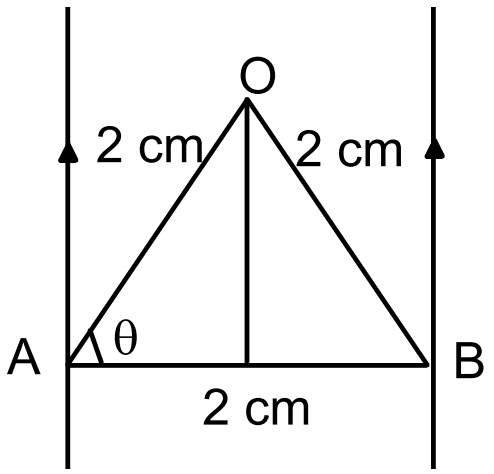
Two parallel wires carry equal currents of 10A along the same direction and are separated by a distance of 2.0cm. Find the magnetic field at a point which is 2.0cm away from each of these wires
Answer

$\cos\theta=\frac{1}{2},$
$\theta=60^\circ\ \&\ \angle\text{AOB}=60^\circ$
$\text{B}=\frac{\mu_0\text{I}}{2\pi\text{r}}=\frac{10^{-7}\times2\times10}{2\times10^{-2}}=10^{-4}\text{T}$
So net is $[(10^{-4})^2]+(10^{-4})^2+2(10^{-8})\cos60^\circ]^\frac{1}{2}$
$=10^{-4}\Big[1+1+2\times\frac{1}{2}\Big]^\frac{1}{2}$
$=10^{-4}\times\sqrt3\text{T}$
$=1.732\times10^{-4}\text{T}$
View full question & answer
Question 213 Marks
A current-carrying circular coil of 100 turns and radius 5.0cm produces a magnetic field of $6.0 \times 10^{-5}T$ at its centre. Find the value of the current.
Answer
$\text{B}=\frac{\mu_0\text{i}}{2\text{r}}$
$\text{n} = 100,\ \text{r} = 5\text{cm} = 0.05\text{m}$
$\overrightarrow{\text{B}}=6\times10^{-5}\text{T}$
$\text{i}=\frac{2\text{r}\text{B}}{\text{n}\mu_0}=\frac{2\times0.05\times6\times10^{-5}}{100\times4\pi\times10^{-7}}$
$=\frac{3}{6.28}\times10^{-1}=0.0477\approx48\text{mA}$
View full question & answer
Question 223 Marks
A circular loop of radius r carries a current i. How should a long, straight wire carrying a current 4i be placed in the plane of the circle so that the magnetic field at the centre becomes zero?
Answer

$\overrightarrow{\text{B}}$ due to loop $\frac{\mu_0\text{i}}{2\text{r}}$
Let the straight current carrying wire be kept at a distance R from centre. Given I = 4i
$\overrightarrow{\text{B}}$ due to wire $\frac{\mu_0\text{i}}{2\pi\text{R}}=\frac{\mu_0\times4\text{i}}{2\pi\text{R}}$
Now, the $\overrightarrow{\text{B}}$ due to both will balance each other
Hence $\frac{\mu_0\text{i}}{2\text{r}}=\frac{\mu_04\text{i}}{2\pi\text{R}}\Rightarrow\text{R}=\frac{4\text{r}}{\pi}$
Hence the straight wire should be kept at a distance $\frac{4\pi}{\text{r}}$ from centre in such a way that the direction of current in it is opposite to that in the nearest part of circular wire. As a result the direction will $\overrightarrow{\text{B}}$ will be oppose.
View full question & answer
Question 233 Marks
The magnetic field due to a long straight wire has been derived in terms of $\mu_0,$ i and d. Express this in terms of $\in_0,$ C, i and d.
Answer
The magnetic field due to a long, straight wire is given by
$\text{B}=\frac{\mu_0\text{i}}{2\pi\text{d}}$
$\because$ Speed of light, $\text{c}=\frac{1}{\sqrt{\mu_0\in_0}}$
$\Rightarrow\mu_0=\frac{1}{\text{c}^2\in_0}$
$\Rightarrow\text{B}=\frac{\text{i}}{2\pi\text{c}^2\in_0\text{d}}$
(In terms of $\in_0,$ c, i and d)
View full question & answer
Question 243 Marks
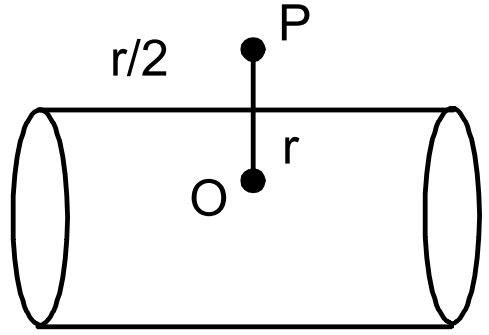
A thin but long, hollow, cylindrical tube of radius r carries a current i along its length. Find the magnitude of the magnetic field at a distance $\frac{\text{r}}{2}$ from the surface (a) inside the tube (b) outside the tube.
Answer

  1. For inside the tube $\overrightarrow{\text{B}}=0$
As, $\overrightarrow{\text{B}}$ inside the conducting tube = o
  1. For $\overrightarrow{\text{B}}$ outside the tube
$\text{d}=\frac{3\text{r}}{2}$

$\overrightarrow{\text{B}}=\frac{\mu_0\text{i}}{2\pi\text{d}}=\frac{\mu_0\text{i}\times2}{2\pi3\text{r}}=\frac{\mu_0\text{i}}{2\pi\text{r}}$
View full question & answer
Question 253 Marks
A circular loop of radius 20cm carries a current of 10A. An electron crosses the plane of the loop with a speed of $2.0 \times 10^6m/s.$ The direction of motion makes an angle of 30° with the axis of the circle and passes through its centre. Find the magnitude of the magnetic force on the electron at the instant it crosses the plane.
Answer
$\text{r}=20\text{cm},\ \text{i}=10\text{A},$
$\text{V}=2\times10^6\text{m/s}, \theta=30^\circ$
$\text{F}=\text{e}(\overrightarrow{\text{V}}\times\overrightarrow{\text{B}})=\text{eVB}\sin\theta$
$=1.6\times10^{-19}\times2\times10^6\times\frac{\mu_0\text{i}}{2\text{r}}\sin30^\circ$
$=\frac{1.6\times10^{-19}\times2\times10^6\times4\pi\times10^{-7}\times10}{2\times2\times20\times10^{-2}}=16\pi\times10^{-19}\text{N}$
View full question & answer
Question 263 Marks
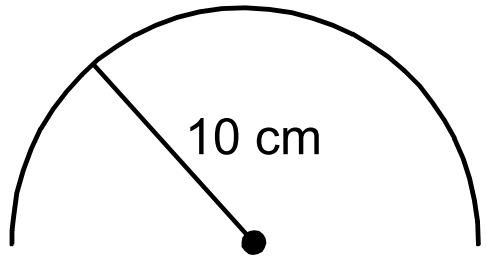
Find the magnetic field B due to a semicircular wire of radius 10.0cm carrying a current of 5.0A at its centre of curvature.
Answer
i = 5 Ampere,
r = 10cm = 0.1m

As the semicircular wire forms half of a circular wire,
So, $\overrightarrow{\text{B}}=\frac{1}{2}\frac{\mu_0\text{i}}{2\text{r}}=\frac{1}{2}\times\frac{4\pi\times10^{-7}\times5}{2\times0.1}$
$=15.7\times10^{-6}\text{T}\approx16\times10^{-6}\text{T}=1.6\times10^{-5}\text{T}$
View full question & answer