Question
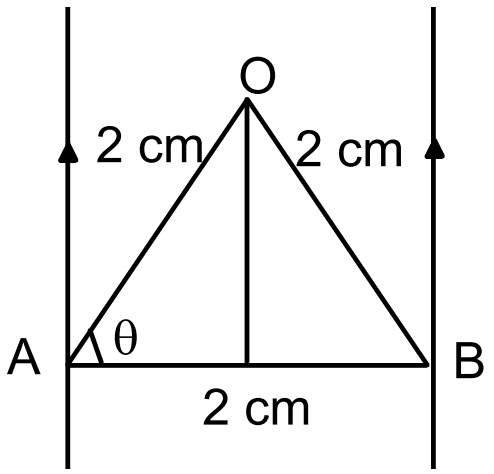
Two parallel wires carry equal currents of 10A along the same direction and are separated by a distance of 2.0cm. Find the magnetic field at a point which is 2.0cm away from each of these wires
Answer


$\cos\theta=\frac{1}{2},$
$\theta=60^\circ\ \&\ \angle\text{AOB}=60^\circ$
$\text{B}=\frac{\mu_0\text{I}}{2\pi\text{r}}=\frac{10^{-7}\times2\times10}{2\times10^{-2}}=10^{-4}\text{T}$
So net is $[(10^{-4})^2]+(10^{-4})^2+2(10^{-8})\cos60^\circ]^\frac{1}{2}$
$=10^{-4}\Big[1+1+2\times\frac{1}{2}\Big]^\frac{1}{2}$
$=10^{-4}\times\sqrt3\text{T}$
$=1.732\times10^{-4}\text{T}$

Need a full question paper?

Generate a complete, print-ready paper with questions like this in minutes — across 16+ boards, with answer keys.
Start Generating Free

Similar questions

Suppose the resistance of the coil in the preivous problem is $25\Omega.$ Assume that the coil moves with uniform velocity during its removal and restoration. Find the thermal energy developed in the coil during:
  1. Its removal.
  2. Its restoration.
  3. Its motion.
A cell of emf E and internal resistance r is connected across an external resistance R. Plot a graph showing the variation of P.D. across R, verses R.
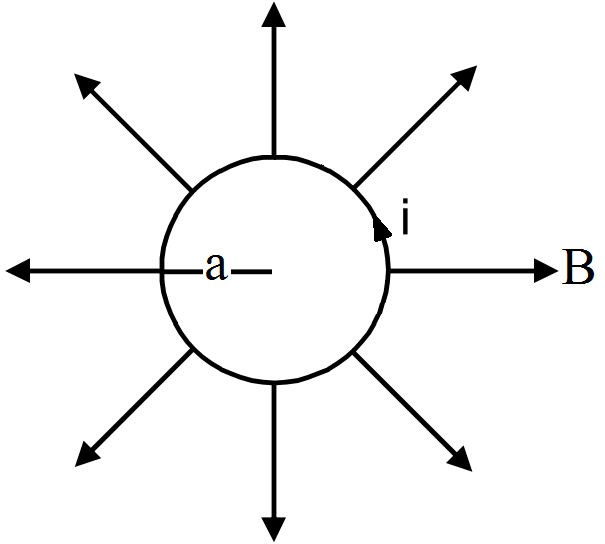
A circular loop of radius a, carrying a current i, is placed in a two-dimensional magnetic field. The centre of the loop coincides with the centre of the field The strength of the magnetic field at the periphery of the loop is B. Find the magnetic force on the wire.
In a series LCR circuit connected to an ac source of variable frequency and voltage v $v_m= \sin, $ draw a plot showing the variation of current (I) with angular frequency ($\omega$) for two different values of resistance R1 and R2(R1 > R2 ). Write the condition under which the phenomenon of resonance occurs. For which value of the resistance out of the two curves, a sharper resonance is produced? Define Q-factor of the circuit and give its significance.
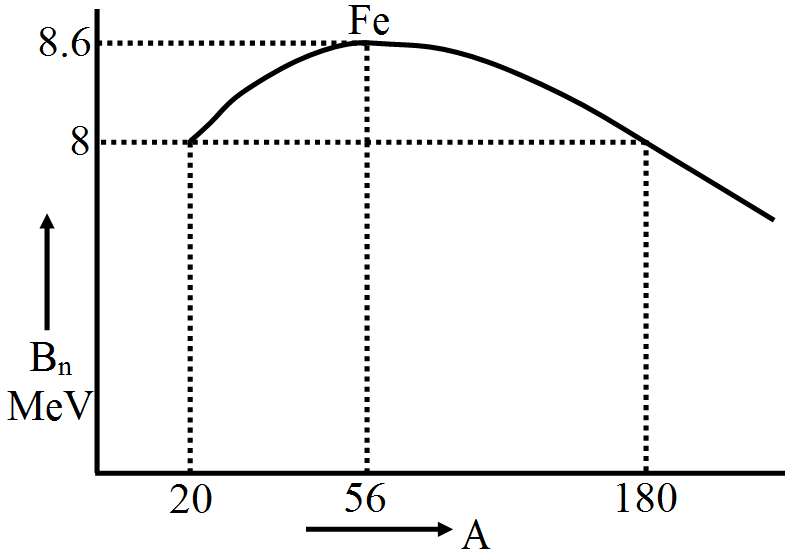
Draw the graph showing the variation of binding energy per nucleon with mass numbers. Give the reason for the decrease of binding energy per nucleon for nuclei with higher mass number.
The magnifying power of a converging lens used as a simple microscope is $\Big(1+\frac{\text{D}}{\text{f}}\Big).$ A compound microscope is a combination of two such converging lenses. Why don't we have magnifying power $\Big(1+\frac{\text{D}}{\text{f}_\text{o}}\Big) \Big(1+\frac{\text{D}}{\text{f}_\text{o}}\Big)?$ In other words, why can the objective not be treated as a simple microscope but the eyepiece can?
With what considerations in view, a photodiode is fabricated? State its working with the help of a suitable diagram. Eventhough the current in the forward bias is known to be more than in the reverse bias, yet the photodiode works in reverse bias. What is the reason?
A 10cm long rod carries a charge of $+50\mu\text{C}$ distributed uniformly along its length. Find the magnitude of the electric field at a point 10cm from both the ends of the rod.
The current in a solenoid of 240 turns, having a length of 12cm and a radius of 2cm, changes at a rate of 0.8A/s. Find the emf induced in it.
Two waves, travelling in the same direction through the same region, have equal frequencies, wavelengths and amplitudes. If the amplitude of each wave is 4mm and the phase difference between the waves is 90°, what is the resultant amplitude?