Questions

2 Marks Questions

Take a timed test

42 questions · self-marked practice — reveal the answer and mark yourself.

Question 12 Marks
A Rowland ring of mean radius 15 cm has 3500 turns of wire wound on a ferromagnetic core of relative permeability 800. What is the magnetic field B in the core for a magnetising current of 1.2 A?
Answer
Mean radius of a Rowland ring, r = 15 cm = 0.15 m
Number of turns on a ferromagnetic core, N = 3500
Relative permeability of the core material, $\mu_\text{r}=800$
Magnetising current, I = 1.2 A
The magnetic field is given by the relation:
$\text{B}=\frac{\mu_\text{r}\mu_0\text{ IN}}{2\pi\text{r}}$
Where,
$\mu_0$ = Permeability of free space $=4\pi\times10^{-7}\text{ Tm A}^{-1}$
$\text{B}=\frac{800\times4\pi\times10^{-7}\times1.2\times3500}{2\pi\times0.15}=4.48\text{ T}$
Therefore, the magnetic field in the core is 4.48 T.
View full question & answer
Question 22 Marks
Answer the following questions: Interstellar space has an extremely weak magnetic field of the order of $10^{–12} T.$ Can such a weak field be of any significant consequence? Explain.
Answer
From the relation, $\text{R}=\frac{\text{m v}}{\text{e B}},\ \Big[\because\frac{\text{mv}^2}{\text{R}}=\text{qvB}\Big]$
we find that an extremely minute field bends charged particles in a circle of very large radius.
Over a small distance, the deflection due to the circular orbit of such large radius may not be noticeable,
but over the gigantic interstellar distances, the deflection can significantly affect the passage of charged particles, e.g., cosmic rays.
View full question & answer
Question 32 Marks
A closely wound solenoid of $800$ turns and area of cross section $2.5 \times 10^{–4}m^2$ carries a current of $3.0 A.$ Explain the sense in which the solenoid acts like a bar magnet. What is its associated magnetic moment?
Answer
Given,
Number of turns, $N = 800$
Area of cross$-$section, $A = 2.5 \times 10^{-4}m^2$
Current, $I = 3.0 A$
Magnetic dipole moment, $M = NIA$
Putting values, we get
$M = 800 \times 3.0 \times 2.5 \times 10^{-4}$
$= 0.6 JT^{-1}$
Magnetic field is developed along the axis of the solenoid.
Therefore, solenoid acts like a bar magnet.
The direction is determined by the sense of flow of the current.
View full question & answer
Question 42 Marks
A magnetic needle free to rotate in a vertical plane parallel to the magnetic meridian has its north tip pointing down at $22^\circ$ with the horizontal. The horizontal component of the earth’s magnetic field at the place is known to be $0.35 G.$ Determine the magnitude of the earth’s magnetic field at the place.
Answer
Here,
$\delta=22^\circ$
Horizontal component of earth's magnetic field is, $B_H = 0.35 G$
Since, $\text{B}_\text{H}=\text{B}_\text{E }\cos\delta$
$\therefore\ \text{B}_\text{E}=\frac{\text{B}_\text{H}}{\cos\delta}$
$=\frac{0.35}{\cos22^\circ}$
$=\frac{0.35}{0.9272}$
$\Rightarrow\ \text{B}_\text{E}=0.38\text{ G}.$
which, is the required earth's magnetic field.
View full question & answer
Question 52 Marks
A magnetic dipole is under the influence of two magnetic fields. The angle between the field directions is $60^\circ ,$ and one of the fields has a magnitude of $1.2 \times 10^{–2} T$. If the dipole comes to stable equilibrium at an angle of $15^\circ$ with this field, what is the magnitude of the other field?
Answer
Magnitude of one of the magnetic fields $, B_1 = 1.2 \times 10^{−2} T$
Magnitude of the other magnetic field $= B_2$
Angle between the two fields, $\theta=60^\circ$
At stable equilibrium, the angle between the dipole and field $B_1, \theta_1=15^\circ$
Angle between the dipole and field $B_2, \theta_2=\theta-\theta_1=60^\circ-15^\circ=45^\circ$
At rotational equilibrium, the torques between both the fields must balance each other.
$\therefore\ $ Torque due to field $B_1 =$ Torque due to field $B_2$
$\text{MB}_1\sin\theta_1=\text{MB}_2\sin\theta_2$
Where,
$M =$ Magnetic moment of the dipole
$\therefore\ \text{B}_2=\frac{\text{B}_1\sin\theta_1}{\sin\theta_2}$
$=\frac{1.2\times10^{-2}\times\sin15^\circ}{\sin45^\circ}=4.39\times10^{-3}\text{ T}$
Hence, the magnitude of the other magnetic field is $4.39 \times 10^{-3} T.$
View full question & answer
Question 62 Marks
Answer the following questions regarding earth’s magnetism:
The earth’s field, it is claimed, roughly approximates the field due to a dipole of magnetic moment $8 \times 10^{22} J\ T^{–1}$ located at its centre. Check the order of magnitude of this number in some way.
Answer
Magnetic field $B$ at an equatorial point of the earth's magnetic dipole is given by.
$\text{B}=\frac{\mu0}{4\pi}\cdot\frac{\text{m}}{\text{r}^3}$
Now,
magnetic moment, $m = 8 \times 10^{22}\ JT^{-1}$
radius$, r = 6.4 \times 10^6 m$
Therefore,
$\text{B}=10^{-7}\times\frac{8\times10^{22}}{(6.4\times10^{6})^{3}}\text{T}$
$= 0.3 \times 10^{-4}\ T$
$= 0.3\ G$
Which is of the same order of magnitude as that of the observed field on the earth.
View full question & answer
Question 72 Marks
Answer the following questions regarding earth’s magnetism:
A vector needs three quantities for its specification. Name the three independent quantities conventionally used to specify the earth’s magnetic field.
Answer
The three independent quantities conventionally used to specify the earth's magnetic field are :
  1. Magnetic declination.
  2. Angle of dip and.
  3. Horizontal component of earth's magnetic field.
View full question & answer
Question 82 Marks
A short bar magnet placed with its axis at $30^\circ$ with a uniform external magnetic field of $0.25 T$ experiences a torque of magnitude equal to $4.5 \times 10^{–2}J.$ What is the magnitude of magnetic moment of the magnet?
Answer
Given,
Angle between magnetic moment and magnetic field, $\theta=30^\circ$
External magnetic field, $B = 0.25 T$
Torque, $\tau=4.5\times10^{-2}\text{J}$
Using formula
$\tau=\text{M.B }\sin\theta$
$\therefore\text{M}=\frac{\tau}{\text{B}\sin\theta}$
$=\frac{4.5\times10^{-2}}{0.25\times\sin30^\circ}$
$m = 0.36 JT^{-1}$
where, $m$ is the magnetic pole strength.
View full question & answer
Question 92 Marks
At a certain location in Africa, a compass points $12^\circ$ west of the geographic north. The north tip of the magnetic needle of a dip circle placed in the plane of magnetic meridian points $60^\circ$ above the horizontal. The horizontal component of the earth’s field is measured to be $0.16 G.$ Specify the direction and magnitude of the earth’s field at the location.
Answer
Angle of declination, $\theta=12^\circ$
Angle of dip, $\delta=60^\circ$
Horizontal component of earth's magnetic field, $B_H = 0.16 G$
Earth's magnetic field at the given location $= B$
We can relate $B$ and $B_{H }$ as:
$\text{B}_\text{H}=\text{B}\cos\delta$
$\therefore\ \text{B}=\frac{\text{B}_\text{H}}{\cos\delta}$
$=\frac{0.16}{\cos60^\circ}=0.32\text{ G}$
Earth's magnetic field lies in the vertical plane, $12^\circ$ West of the geographic meridian,
making an angle of $60^\circ ($upward$)$ with the horizontal direction. Its magnitude is $0.32 G.$
View full question & answer
Question 102 Marks
If the solenoid in Exercise $5.5$ is free to turn about the vertical direction and a uniform horizontal magnetic field of $0.25 T$ is applied, what is the magnitude of torque on the solenoid when its axis makes an angle of $30^\circ$ with the direction of applied field?
Answer
Given,
Number of turns, $N = 800$
Current passing through solenoid, $I = 3A$
Area of cross$-$section, $A = 2. 5 \times 10^{-4} m^2$
Magnetic field, $B = 0.25 T$
Angle between the axis and $B, \theta=30^\circ$
Magnetic moment, $\text{M = N. I .A.}$
$= 800 \times 3.0 \times 2.5 \times 10^{-4}$
$= 0.6JT^{-1}$
Torque acting on the solenoid, $\tau=\text{MB }\sin\theta$
$=0.6\times0.25\times\sin30^\circ$
$= 0.150 \times 0.5 = 7.5 \times 10^{-2} J.$
View full question & answer
Question 112 Marks
A short bar magnet of magnetic moment $m = 0.32 JT^{–1} $ is placed in a uniform magnetic field of $0.15 T$. If the bar is free to rotate in the plane of the field, which orientation would correspond to its $(a)$ stable, and $(b)$ unstable equilibrium? What is the potential energy of the magnet in each case?
Answer
  1. For stable eguilibrium: Magnetic moment is parallel to $\overrightarrow{\text{B}}.$
  2. Then,
    Potential energy, $\text{U}=-\text{MB}\cos\theta\ \ \big[\theta=0^\circ\big]$
  3. $= -0.32 \times 0.15 J$
  4. For unstable eguilibrium: Magnetic moment is antiparallel to $\overrightarrow{\text{B}}.$
  5. Then, $\theta=180^\circ$
    Potential energy $, \text{U}'=-\text{MB}\cos\theta$
    $=-0.32 \times 0.15 (-1)$$= 4.8 \times 10^{-2} J.$
View full question & answer
Question 122 Marks
Write two properties of a material suitable for making (a) a permanent magnet, and (b) an electromagnet.
Answer
  1. For making permanent magnet:
  1. High retentivity.
  2. High coercitivity.
  3. High permeability.
  1. For making electromagnet:
  1. High permeability.
  2. Low retentivity.
  3. Low coercivity.
View full question & answer
Question 132 Marks
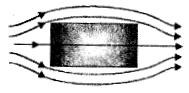
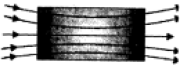
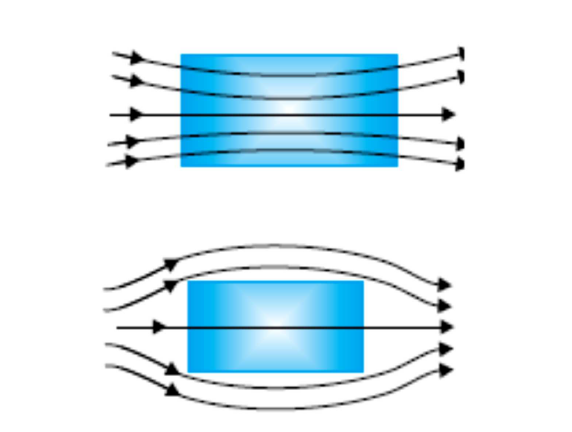
Show diagrammatically the behaviour of magnetic field lines in the presence of (i) paramagnetic and (ii) diamagnetic substances. How does one explain this distinguishing feature?
Answer


A paramagnetic material tends to move from weaker to stronger regions of the magnetic field and hence increases the number of lines of magnetic field passing through it.
Alternate Answer
A paramagnetic material, dipole moments are induced in the direction of the field. A diamagnetic material tends to move from stronger to weaker regions of the magnetic field and hence, decreases the number of lines of magnetic field passing through it.
Alternate Answer
A diamagnetic material, dipole moments are induced in the opposite direction of the field.
View full question & answer
Question 142 Marks
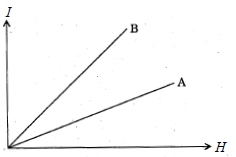
The following figure shows the variation of intensity of magnetisation versus the applied magnetic field intensity, H, for two magnetic materials A and B:
  1. Identify the materials A and B.
  2. Why does the material B, have a larger susceptibility than A, for a given field at constant temperature?
Answer
  1. A - Paramagnetic/ e.g., Al, Na etc.
B - Ferromagnetic/ e.g., Iron, Cobalt.
  1. Consists of domains which orient themselves along the magnetic field./ field lines are highly concentrated/ can be magnetized early.
View full question & answer
Question 152 Marks
The susceptibility of a magnetic material is $–2.6 \times 10^{–5}$. Identify the type of magnetic material and state its two properties.
Answer
Diamagnetic Material Properties.
  1. They have the tendency to move from stronger to weaker part of the external magnetic field.
  2. They expel magnetic field lines.
  3. Such substances are repelled by a magnet.
  4. When placed in an external magnetic field, a net magnetic dipole moment is developed inside it which is in a direction opposite to that of the applied magnetic field.
View full question & answer
Question 162 Marks
Draw magnetic field lines when a (i) diamagnetic, (ii) paramagnetic substance is placed in an external magnetic field. Which magnetic property distinguishes this behaviour of the field lines due to the two substances?
Answer
  1. Diamagnetic material
  1. Paramagnetic material

Paramagnetic substance: permeability slightly greater than one/susceptibility small but positive.
Diamagnetic substance: permeability very slightly less than one/susceptibility very small but negative.
 
View full question & answer
Question 172 Marks
  1. Write two characteristics of a material used for making permanent magnets.
  2. Why is core of an electromagnet made of ferromagnetic materials?
Answer
  1. (a) High Coercivity (b) High Retentivity (c) High Permeability.
  2. Because of high permeability and low retentivity.
View full question & answer
Question 182 Marks
Define magnetic susceptibility of a material. Name two elements, one having positive susceptibility and the other having negative susceptibility. What does negative susceptibility signify?
Answer
  1. Measure of how a magnetic material responds to an external magnetic field.
Alternate Answer
Property which determines how easily the material can be magnetised.
Alternate Answer
Ratio of the magnitude of magnetisation (M) produced in the material to the intensity of magnetising field (H) or M/H.
  1. .
    1. Positive susceptibility - Para-magnetic material/Al, Ca, Cr, Li, etc.
    2. Negative susceptibility - Diamagnetic material/Bi, Cu, diamond, Au, Hg, etc.
  2. Anyone characteristics/Property of diamagnetic materials.
Alternate Answer
The material is diamagnetic in nature.
Alternate Answer
The magnetic moment, developed in the material, is opposite in direction to that of the applied external magnetic field.
View full question & answer
Question 192 Marks
Horizontal component of earth’s magnetic field at a place is $\sqrt{3}$ times its vertical component. What is the value of angle of dip at that place?
Answer
Given H $=\sqrt{3}\text{V}$
$\Rightarrow\tan\theta=\frac{\text{V}}{\text{H}}=\frac{1}{\sqrt{3}}$
$\Rightarrow\text{Angle of dip,}\theta=\tan^{-1}\Big(\frac{1}{\sqrt{3}}\Big)=30$
View full question & answer
Question 202 Marks
Write any three characteristics, a ferromagnetic substance should possess if it is to be used to make a permanent magnet. Give one example of such a material.
Answer
Characteristics for permanent magnet.
  1. High permeability.
  2. High retentivity.
  3. High coercivity.
Example: steel.
View full question & answer
Question 212 Marks
Metallic (nonferromagnetic) and nonmetallic particles in a solid waste may be separated as follows. The waste is allowed to slide down an incline over permanent magnets. The metallic particles slow down as compared to the norunetallic ones and hence are separated. Discuss the role of eddy currents in the process.
Answer
As the metallic particle slide over permanent magnet they are attracted towards magnet due to formation of eddy current on the metallic body and thus they slow down and are separated from rest of material.
View full question & answer
Question 222 Marks
Define the term magnetic moment.
Answer
The magnetic moment of a magnet (or current loop) is defined as the maximum value of torque acting on a magnet when it is placed in a magnetic field of 1 T.
View full question & answer
Question 232 Marks
Assume that each iron atom has a permanent magnetic moment equal to $2$ Bohr magnetons $(1$ bohr magneton equals $9.27 \times 10^{-24}A-m^2).$ The density of atoms in iron is $8.52 \times 10^{28}$ atoms/$m^3.$
  1. Find the maximum magnetization $I$ in a long cylinder of iron.
  2. Find the maximum magnetic field $B$ on the axis inside the cylinder.
Answer
$f = 8.52 \times 10^{28}$ atoms$/m^3$ For maximum $‘T\ ’,$ Let us consider the no. of atoms present in $1m^3$ of volume. Given: $m$ per atom $= 2 \times 9.27 \times 10^{-24}A-m^2$
  1. $\text{I}=\frac{\text{net m}}{\text{V}}$
$=2\times9.27\times10^{-24}\times8.52\times10^{28}\approx1.58\times10^6\text{A/m}$
  1. $\text{B}=\mu_0(\text{H}+\text{I})=\mu_0\text{I} \big[\therefore\text{H}=0$ in this case$]$
$=4\pi\times10^{-7}\times1.58\times10^6$
$=1.98\times10^{-1}\approx2.0\text{T}$
View full question & answer
Question 242 Marks
The magnetic properties of the different materials A, B and C are shown in the following table:
Material Permeability Susceptibility Temperature dependence of susceptibility.
A Low positive Small but negative Independent of temperature
B High Very high 1 Susceptibility decreases with temperature
C Greater than 1  Small but positive Decreases with temperature
Which of the above three materials should be used for making an electromagnet and why?
Answer
The material to be used for making an electromagnet should have high permerability and low retentivity. Moreover, less energy should be utilised for magnetisation of the material.
Thus, material B should be used for making the core of an electromagnet.
View full question & answer
Question 252 Marks
A pivoted aluminium bar falls much more slowly through a small region containing a magnetic field than a similar bar of an insulating material. Explain.
Answer
Aluminum rod while falling will experience magnetic field and thus it will induce some eddy currents in it and thus it will feel some attraction towards magnetic field and thus it will fall slow as compared to insulating material.
View full question & answer
Question 262 Marks
The susceptibility of annealed iron at saturation is 5500. Find the permeability of annealed iron at saturation.
Answer
Permiability $(\mu)=\mu_0(1+\text{x})$
Given susceptibility $= 5500$
$\mu=4\times10^{-7}(1+5500)$
$=4\times3.14\times10^{-7}\times5501$
$= 6909.56\times10^{-7}\approx6.9\times10^{-3}$
View full question & answer
Question 272 Marks
What kind of ferromagnetic material is used for coating magnetic tapes in a cassette player or for building memory stores in a modern computer?
Answer
Ceramics are used for coating magnetic tapes in a cassette player or for building stores in a modern computer. Ceramics are specially treated barium-iron oxides and are also called ferrites.
View full question & answer
Question 282 Marks
In which direction would a compass needle align if taken to geographic (i) north pole and (ii) south pole?
Answer
The compass needle aligns along the horizontal component of earth’s field (H). At poles H = 0, so compass needle will become free and may rest in any direction.
View full question & answer
Question 292 Marks
The susceptibility of magnesium at $300K$ is $1.2 \times 10^{-5}.$ At what temperature will the susceptibility increase to $1.8 \times 10^{-5}?$
Answer
$\text{X}=\frac{\text{C}}{\text{T}}$
$\Rightarrow\frac{{\text{X}_1}}{{\text{X}_2}}=\frac{\text{T}_2}{\text{T}_1}$
$\Rightarrow\frac{1.2\times10^{-5}}{1.8\times10^{-5}}=\frac{\text{T}_2}{300}$
$\Rightarrow\text{T}_2=\frac{12}{18}\times300=200\text{K}.$
View full question & answer
Question 302 Marks
Depict the field-line pattern due to a bar magnet.
Answer
The field lines are shown in the figure alongside. The magnetic field lines of magnet form continuous closed loops and are directed from N to S pole outside the magnet and S to N pole inside the magnet and forms closed loops.
View full question & answer
Question 312 Marks
The angles of dip at two places located on the earth are 0° and 90° respectively. Where are the places located?
Answer
The angle of dip is 0° at magnetic equator and it is 90° at magnetic poles. That is, the required places are located at magnetic equator and at either pole respectively.
View full question & answer
Question 322 Marks
What is the value of magnetic field within a hollow sphere made of ferromagnetic substance? Hence explain magneto static shielding.
Answer
The magnetic field within, hollow sphere of ferromagnetic substance is zero. Magneto static shielding means to shield any specimen from magnetic effects by placing it within a hollow region of a ferromagnetic substance.
View full question & answer
Question 332 Marks
The magnetic field lines prefer to pass through iron than air. Explain why?
Answer
The magnetic field lines prefer to pass through iron than air because the permeability of iron is much larger than air.
View full question & answer
Question 342 Marks
What is Curie law in magnetism?
Answer
Curie law. It states that the magnetic susceptibility of a paramagnetic material is inversely proportional to absolute temperature.
$\therefore\text{X}\propto\frac{1}{\text{T}}=\frac{\text{C}}{\text{T}}$ where C is Curie constant.
View full question & answer
Question 352 Marks
An iron needle is attracted to the ends of a bar magnet but not to the middle region of the magnet. Is the material making up the ends of a bar magnet different from that of the middle region?
Answer
When a iron needle is attracted to towards a magnet. one pole of magnet induces other pole on the nearest side of needle thus making iron needle it self a magnet thus needle is attracted to one side of the magnet.
View full question & answer
Question 362 Marks
When is a magnet said to be in stable equilibrium in a magnetic field?
Answer
The magnet is said to be in stable equilibrium when the magnetic dipole moment of magnet is aligned along the direction of magnetic field.
View full question & answer
Question 372 Marks
The force on a north pole,$\overrightarrow{\text{F}}=\text{m}\overrightarrow{\text{B}},$ is parallel to the field $\overrightarrow{\text{B}}.$ Does it contradict our earlier knowledge that a magnetic field can exert forces only perpendicular to itself?
Answer
Yes it contradicts as force is always perpendicular to magnetic field. but in case other force is very far distant then the magnetic field can be parallel to force.
View full question & answer
Question 382 Marks
A tightly-wound, long solenoid has n turns per unit length, a radius r and carries a current i. A particle having charge q and mass m is projected from a point on the axis in a direction perpendicular to the axis. What can be the maximum speed for which the particle does not strike the solenoid ?
Answer


No. of turns per unit length = n,
radius of circle $= \frac{\text{r}}{2},$
current in the solenoid = i,
Charge of Particle = q,
mass of particle = m
$\therefore\text{B}=\mu_0\text{ni}$
Again $\frac{\text{mV}^2}{\text{r}}=\text{qVB}\Rightarrow\text{V}=\frac{\text{qBr}}{\text{m}}=\frac{\text{q}\mu_0\text{nir}}{2\text{m}}=\frac{\mu_0\text{ni}\ \text{qr}}{2\text{m}}$
View full question & answer
Question 392 Marks
Sketch the magnetic field lines for a current-carrying circular loop near its centre. Replace the loop by an equivalent magnetic dipole and sketch the magnetic field lines near the centre of the dipole. Identify the difference.
Answer
As in loop magnetic field lines pass thorough the center but in case of magnet dipole the magnetic field lines does not pass through center or even meet at center point.
View full question & answer
Question 402 Marks
Two bar magnets are placed close to each other with their opposite poles facing each other. In absence of other force the magnets are pulled towards each other and their kinetic energy increases. Does it contradict our earher knowledge that magnetic forces cannot do any work and hence cannot increase kinetic energy of a system?
Answer
As the magnet come closer to each other thus magnetic fields of lines are more dense and thus more is the force applying to each other. as force increases thus kinetic energy increases.
View full question & answer
Question 412 Marks
Compare the direction of the magnetic field inside a solenoid with that of the field there if the solenoid is replaced by its equivalent combination of north pole and south pole.
Answer
The direction of magnetic field is same in both cases as in solenoid magnetic field lines are directed from on end to other end internally and thus externally. so as in magnet.
View full question & answer
Question 422 Marks

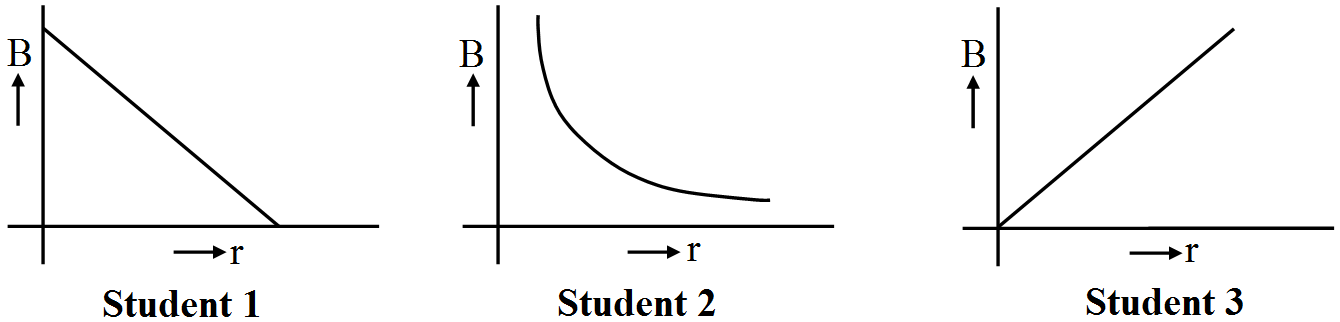
Three students represent the variation of magnetic field B with distance r for a straight infinity long current carrying conductor as:

Which of the three students has drawn the graph correctly and why?
Answer
For a straight infinitely long current carrying conductor, the magnetic field is given by the relation $\vec{\text{B}}=\frac{\mu_0\text{I}}{2\pi\text{r}}$
Thus, $\text{B}\propto\frac{1}{\text{r}}$ and the graph between B and r will be a rectangular hyperbola. Thus, student 2 has drawn the graph correctly.
View full question & answer