Questions

M.C.Q (1 Marks)

Take a timed test

12 questions · self-marked practice — reveal the answer and mark yourself.

Question 11 Mark
What happens to fringe width in the Young's double slit experiment, if it is performed in glycerine instead of air?
Answer
(a) The fringes shrink 
Explanation: The fringes shrink 
View full question & answer
Question 21 Mark
The value of $1$ Bohr magneton is: $[$Given $h =6.62 \times 10^{-34} Js , e =1.6 \times 10^{-19} C$ and $m _{ e }=9.1 \times 10^{-31} \ kg ]$
Answer
$(b) \ 9.27 \times 10^{-24} Am ^2$
Explanation : $1$ Bohr magneton
$=\frac{e h}{4 \pi m_e}$
$=\frac{1.6 \times 10^{-19} \times 6.62 \times 10^{-34}}{4 \pi \times 9.1 \times 10^{-31}}$
$=9.27 \times 10^{-24} Am ^2$
View full question & answer
Question 31 Mark
A Rowland ring of mean radius 15 cm has 3500 turns of wire wound on a ferromagnetic core of relative permeability 800. What is the magnetic field B in the core for a magnetising current of 1.2A?
Answer
(d) 4.48 T
Explanation: $B=\frac{\mu_{ o } \mu_r N i}{2 \pi r}=\frac{4 \pi \times 10^{-7} \times 800 \times 3500 \times 1.2}{2 \pi \times 15 \times 10^{-2}}=4.48 T$
View full question & answer
Question 41 Mark
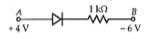
Consider the junction diode as ideal. The value of current flowing through $AB$ is
Image
Answer
$(a)\ 10^{-2} A$
Explanation : An ideal diode does not offer any resistance during forward biasing.
$\therefore I =\frac{V_A-V_B}{R}$
$=\frac{4-(-6)}{1000} A$
$=10^{-2} A$
View full question & answer
Question 51 Mark
In electrolytic capacitors positive terminal is
Answer
(b) one on which aluminium oxide film is formed
Explanation: Aluminium electrolytic capacitors have the Aluminium foil anode (positive terminal) which is etched and covered with a layer of Aluminium Oxide which acts as a dielectric. The whole assembly is covered using a paper separator soaked in electrolyte such as, Borax or Glycol and covered by Aluminium foil which acts as cathode (negative electrode)  
View full question & answer
Question 61 Mark
Magnifying power of a microscope depends on
Answer
(a) focal length of eyepiece and objective.
Explanation: Magnification $\frac{m \times 1}{f_o f_e}$
So, magnifying power of a microscope depends on focal length of eyepiece and objective only.
View full question & answer
Question 71 Mark
The attractive force between 2 charges is related to the distance between them as
Answer
(b) $\frac{1}{r^2}$
Explanation: According to Coulomb's law the force between two charges is inversely proportional to the square of distance between the two charges. So $F \alpha \frac{1}{ r ^2}$.
View full question & answer
Question 91 Mark
A wire of length L carrying current i is placed perpendicular to the magnetic induction B. The total force on the wire is
Answer
(c) iLB
Explanation: Magnitude of the Force experienced by a current carrying conductor placed in a magnetic field is $I L B \sin \theta$.
If the angle between the directions of the current and the magnetic field is $90^{\circ}, F = iLB$
View full question & answer
Question 101 Mark
If the temperature of cold junction of a thermocouple is lowered, then the neutral temperature:
Answer
(d) remains the same
Explanation: Neutral temperature is independent of temperature of cold junction.
View full question & answer
Question 111 Mark
If $\mu_c$ and $\mu_h$ are electron and hole mobility $,E$ be the applied electric field, the current density $j$ for intrinsic semiconductor is equal to
Answer
$(a)\ n_i e\left(\mu_e+\mu_h\right) E$
Explanation : $I = I _e+ I _{ h }$
$=e n_e A v_e+e n_h A v_h$
$=e A\left(n_e \mu_e+n_h \mu_h\right) E$
$j =\frac{I}{A}=e n_i\left(\mu_e+\mu_h\right) E$
View full question & answer
Question 121 Mark
The frequency of light in a material is $2 \times 10^{14} Hz$ and wavelength is $5,000 A$. The refractive index of the material will be
Answer
(b) $3 \cdot 00$
Explanation: Here, $\lambda=5,000 Å \times 10^{-7} m$ and $\nu=2 \times 10^{14} Hz$
Therefore, speed of light in the material, 
$v =\nu \lambda=2 \times 10^{14} \times 5 \times 10^{-7}=10^8 ms^{-1}$
Hence, the refractive index of the material, 
$\mu=\frac{c}{v}=\frac{3 \times 10^8}{10^8}=3$
View full question & answer