Question
Magnifying power of a microscope depends on

Answer

(a) focal length of eyepiece and objective.
Explanation: Magnification $\frac{m \times 1}{f_o f_e}$
So, magnifying power of a microscope depends on focal length of eyepiece and objective only.

Need a full question paper?

Generate a complete, print-ready paper with questions like this in minutes — across 16+ boards, with answer keys.
Start Generating Free

Similar questions

A circular loop is kept in that vertical plane which contains the north-south direction. It carries a current that is towards north at the topmost point. Let A be a point on the axis of the circle to the east of it and B a point on this axis to the west of it. The magnetic field due to the loop
  1. Is towards east at A and towards west at B.
  2. Is towards west at A and towards east at B.
  3. Is towards east at both A and B.
  4. Is towards west at both A and B.
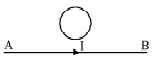
In the given figure, a current of constant magnitude is flowing in the wire AB. Direction of induced current flowing through the wire is:
Image
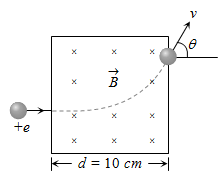
A proton accelerated by a potential difference $500 \ KV$ moves though a transverse magnetic field of $0.51T$ as shown in figure. The angle $0$ through which the proton deviates from the initial direction of its motion is
_________ Charge is produced by friction.
The length of a solenoid is $0.4m$ and the number turns in it is $500$. A current of $3\ amp$, is flowing in it. In a small coil of radius $0.01m$ and number of turns $10$, a current of $0.4\ amp$. is flowing. The torque necessary to keep the axis of this coil perpendicular to the axis of solenoid will be:
The magnifying power of an astronomical telescope in the position of normal adjustment is given by :
A bar magnet is held perpendicular to a uniform magnetic field. If the couple acting on the magnet is to be halved by rotating it, then the angle by which it is to be rotated is
Magnetic field intensity at the centre of coil of $50$ turns, radius $0.5 m$ and carrying a current of $2 A$ is
Let V and H be the vertical and horizontal components of earth's magnetic field at any point on earth. Near the north pole(a) V >> H(b) V << H (c) V = H  (d) V = H = 0
       
Light of frequency $4n_0$ is incident on the metal of the threshold frequency $n_0$. The maximum kinetic energy of the emitted photoelectrons is