Questions

2 Marks Questions

Take a timed test

6 questions · self-marked practice — reveal the answer and mark yourself.

Question 12 Marks
What information would you wish to know about the galvanometer before converting it into an ammeter or voltmeter?
Answer
For converting galvanometer into ammeter or voltmeter, we must know:
i. Resistance of the galvanometer $\left( R _{ g }\right)$
ii. Current $\left( I _{ g }\right)$ required to produce full scale deflection in the galvanometer.
View full question & answer
Question 22 Marks
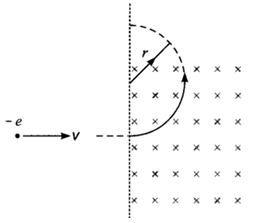
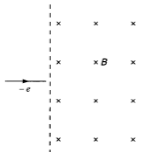
$a$. An electron moving horizontally with a velocity of $4 \times 10^4 m / s$ enters a region of uniform magnetic field of $10^{-5} T$ acting vertically upward as shown in the figure. Draw its trajectory and find out the time it takes to

Image

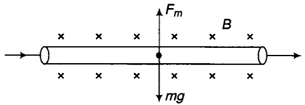
$b$. A straight wire of mass $200 g $and length $1.5\ m$ carries a current of $2 A$. It is suspended in mid air by a uniform magnetic field $B$. What is the magnitude of the magnetic field?
Answer
From Flemings left hand rule, the electron deflects in anticlockwise direction.
As the electron comes out the magnetic field region, it will describe a semi $-$ circular path.
Magnetic force provides a centripetal force. So,
$e v B=\frac{m v^2}{r} \text { or } e B=\frac{m v}{r}$
Time taken $, T=\frac{\pi r}{v}=\frac{\pi m}{e B}$
$T=\frac{3.14 \times 9.1 \times 10^{-31}}{1.6 \times 10^{-19} \times 10^{-5}}$
$=\frac{3.14 \times 9.1 \times 10^{-7}}{1.6}=1.97 \times 10^{-7} $ second

Image

$b$. If Ampere's force acts in upward direction and balances the weight, that is

Image
$ F _{ m }= mg$
$BIl = mg B=\frac{m g}{l}$
$=\frac{0.2 \times 10}{2 \times 1.5}=\frac{2}{3}$
$= 0 . 6 7 T $
View full question & answer
Question 32 Marks
Explain the formation of potential barrier and depletion region in a p-n junction diode. What is effect of applying forward bias on the width of depletion region?
Answer
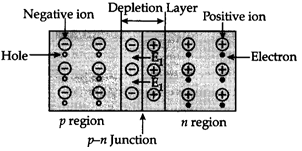
Formation of depletion region: In the p-type semiconductor, holes are the majority carrier and in the n-type semiconductor, electrons are the majority carrier.
When a p-n junction is formed, some of the electrons from the n-region which have reached the conduction band are free to diffuse across the junction and combine with holes.
Filling a hole, makes a negative ion in p-side and a positive ion in the n-side. Thus, free charges get depleted and a depletion region is formed, which inhibits any further electron transfer.

Image
Applying forward bias, the depletion region reduces and again electrons can diffuse.

View full question & answer
Question 42 Marks
A light beam travelling in the $x-$ direction is described by the electric field: $E _{ y }=270 \sin \omega\left(t-\frac{x}{c}\right)$. An electron is constrained to move along the $y-$ direction with a speed of $2.0 \times 10^7 ms^{-1}$. Find the maximum electric force and maximum magnetic force on the electron.
Answer
Maximum electric field,
$E _0=270 Vm ^{-1}$
Maximum magnetic field,
$B_0=\frac{E_0}{c}=\frac{270}{3 \times 10^8}$
$=9 \times 10^{-7} T$,
directed along $z-$ direction
Maximum electric force on the electron,
$F _{ e }= qE _0=1.6 \times 10^{-19} \times 270$
$=4.32 \times 10^{-17} N$
Maximum electric force on the electron
$ F _{ m }= qvB _0=1.6 \times 10^{-19} \times 2.0 \times 10^7 \times 9 \times 10^{-7}$
$=2.88 \times 10^{-18} N.$
View full question & answer
Question 52 Marks
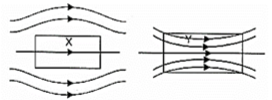
A uniform magnetic field gets modified as shown below, when two specimens X and Y are placed in it.

Image

i. Identify the two specimens X and Y.
ii. State the reason for the behaviour of the field lines in X and Y.
Answer
(i) X is a diamagnetic substance.
Y is a paramagnetic substance.
(ii). X - The field lines are repelled or expelled and the field inside the material is reduced when a diamagnetic bar is placed in an external field.
Y - The field lines get concentrated inside the material and the field is increased when a paramagnetic bar is placed in an external field.
View full question & answer
Question 62 Marks
If the short series limit of the Balmer series for hydrogen is $3646 \stackrel{o}{A}$ calculate the atomic number of the element which gives $X-$ ray wavelengths down to $1.0 \stackrel{o}{A}$. Identify the element.
Answer
The short limit of the Balmer series is given by
$\bar{\nu}=\frac{1}{\lambda}=R\left(\frac{1}{2^2}-\frac{1}{\infty^2}\right)=\frac{R}{4}$
$\therefore R=\frac{4}{\lambda}=\frac{4}{3646} \times 10^{10} m^{-1}$
Further the wavelengths of the $K_\alpha$ series are given by the relation,
$\bar{\nu}=\frac{1}{\lambda}=R(Z-1)^2\left(\frac{1}{1^2}-\frac{1}{n^2}\right)$
The maximum wave number corresponds to $n=\infty$ and, therefore, we have
$\bar{\nu}=\frac{1}{\lambda}=R(Z-1)^2$
Or $(Z-1)^2=\frac{1}{R \lambda}$
$=\frac{3646 \times 10^{-10}}{4 \times 1 \times 10^{-10}}=911.5$
$\therefore(Z-1)=\sqrt{911.5}$
or $ \cong 30.2$
or $Z=31.2 \cong 31$
Thus, the atomic number of the element concerned is $31$.
The element having atomic number $Z = 31$ is Gallium.
View full question & answer
2 Marks Questions - Physics STD 12 Science Questions - Vidyadip