Green light of wavelength 5460 $\stackrel{\circ}{A}$ is incident on an air-glass interface. If the refractive index of glass is 1⋅ 5, the wavelength of light in glass would be (Given that the velocity of light in air, $c =3 \times 10^8 m s ^{-1}$ )
View full solution →Question types
MODEL PAPER 1 question types
38 questions across 6 question groups — pick any mix to generate a Physics paper with step-by-step answer keys.
38
Questions
6
Question groups
5
Question types
01
M.C.Q (1 Marks)
12 Q→02Assertion (A) & Reason (B) MCQ
4 Q→032 Marks Questions
6 Q→043 Marks Question
8 Q→054 Marks Questions
2 Q→065 Marks Questions
6 Q→Sample Questions
MODEL PAPER 1 questions
One sample from each question group in this chapter. Select any group above to see the full set with answer keys.
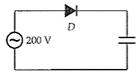
In the circuit given in the figure, an a.c. source of 200 V is connected through a diode D to a capacitor. The potential difference across the capacitor will be
An electron is travelling along the X-direction. It encounters a magnetic field in the Y-direction. Its subsequent motion will be:
The cations and anions are arranged in alternate form in
If an electron is accelerated by $8.8 \times 10^{14} m / s ^2$ , then electric field required for acceleration is $($given specific charge of the electron $=1.76 \times 10^{11} Ckg ^{-1} )Z$
View full solution →Assertion (A) :A step-up transformer cannot be used as a step-down transformer.
Reason (R): A transformer works only in one direction.
Reason (R): A transformer works only in one direction.
Assertion (A) : Light added to light can produce darkness.
Reason (B) : When two coherent light waves interfere, there is darkness at position of destructive interference.
Reason (B) : When two coherent light waves interfere, there is darkness at position of destructive interference.
Assertion : For a charged particle moving from point P to point Q, the net work done by an electrostatic field on the particle is independent of the path connecting point P to point Q.
Reason : The net work done by a conservative force on an object moving along a closed loop is zero.
Reason : The net work done by a conservative force on an object moving along a closed loop is zero.
Assertion (A): The photoelectrons produced by a monochromatic light beam incident on a metal surface, have a spread in their kinetic energies.
Reason (R): The work function of the metal varies as a function of depth from the surface
Reason (R): The work function of the metal varies as a function of depth from the surface
What information would you wish to know about the galvanometer before converting it into an ammeter or voltmeter?
$a$. An electron moving horizontally with a velocity of $4 \times 10^4 m / s$ enters a region of uniform magnetic field of $10^{-5} T$ acting vertically upward as shown in the figure. Draw its trajectory and find out the time it takes to
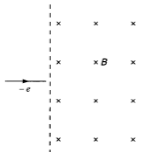
$b$. A straight wire of mass $200 g $and length $1.5\ m$ carries a current of $2 A$. It is suspended in mid air by a uniform magnetic field $B$. What is the magnitude of the magnetic field?
View full solution →$b$. A straight wire of mass $200 g $and length $1.5\ m$ carries a current of $2 A$. It is suspended in mid air by a uniform magnetic field $B$. What is the magnitude of the magnetic field?
Explain the formation of potential barrier and depletion region in a p-n junction diode. What is effect of applying forward bias on the width of depletion region?
A light beam travelling in the $x-$ direction is described by the electric field: $E _{ y }=270 \sin \omega\left(t-\frac{x}{c}\right)$. An electron is constrained to move along the $y-$ direction with a speed of $2.0 \times 10^7 ms^{-1}$. Find the maximum electric force and maximum magnetic force on the electron.
View full solution →A uniform magnetic field gets modified as shown below, when two specimens X and Y are placed in it.
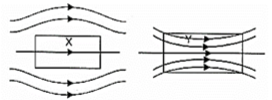
i. Identify the two specimens X and Y.
ii. State the reason for the behaviour of the field lines in X and Y.
i. Identify the two specimens X and Y.
ii. State the reason for the behaviour of the field lines in X and Y.
Show that the radius of the orbit in hydrogen atom varies as $n^2,$ where n is the principal quantum number of the atom.
View full solution →i. Differentiate between three segments of a transistor on the basis of their size and level of doping.
ii. When is a transistor said to be in active state?
iii. Draw a plot of transfer characteristic ($V _0$ vs. $V _{ i }$ ) and show which portion of the characteristic is used in amplification and why?
iv. Draw the circuit diagram of the base bias transistor amplifier in CE configuration and briefly explain its working.
View full solution →ii. When is a transistor said to be in active state?
iii. Draw a plot of transfer characteristic ($V _0$ vs. $V _{ i }$ ) and show which portion of the characteristic is used in amplification and why?
iv. Draw the circuit diagram of the base bias transistor amplifier in CE configuration and briefly explain its working.
Two cells of $\text {EMFs} \ 1 V, 2 V$ and internal resistance $2 \Omega$ and $1 \Omega$ respectively are connected in
$i$. series,
$ii.$ parallel. What should be the external resistance in the circuit so that the current through the resistance be the same in the two cases? In which case, more heat is generated in the cells?
View full solution →$i$. series,
$ii.$ parallel. What should be the external resistance in the circuit so that the current through the resistance be the same in the two cases? In which case, more heat is generated in the cells?
Define mutual inductance between a pair of coils. Derive an expression for the mutual inductance of two long coaxial solenoids of the same length wound one over the other.
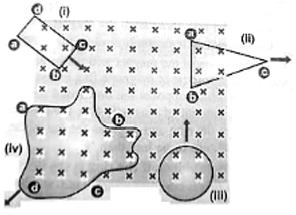
The figure below shows planer loops of different shapes moving out of or into a region of the magnetic field which is directed normal to the plane of the loops away from the reader. Determine the direction of induced current in each loop using Lenz's law. Check if you would obtain the same answers by considering the magnetic force on the charge inside the moving loops.
Microwave oven: The spectrum of electromagnetic radiation contains a part known as microwaves. These waves have frequency and energy smaller than visible light and wavelength larger than it. What is the principle of a microwave oven and how does it work? Our objective is to cook food or warm it up. All food items such as fruit, vegetables, meat, cereals, etc., contain water as a constituent. Now, what does it mean when we say that a certain object has become warmer? When the temperature of a body rises, the energy of the random motion of atoms and molecules increases and the molecules travel or vibrate or rotate with higher energies. The frequency of rotation of water molecules is about 2.45 gigahertz (GHz). If water receives microwaves of this frequency, its molecules absorb this radiation, which is equivalent to heating up water. These molecules share this energy with neighbouring food molecules, heating up the food. One should use porcelain vessels and non-metal containers in a microwave oven because of the danger of getting a shock from accumulated electric charges. Metals may also melt from heating. The porcelain container remains unaffected and cool, because its large molecules vibrate and rotate with much smaller frequencies, and thus cannot absorb microwaves. Hence, they do not get eaten up. Thus, the basic principle of a microwave oven is to generate microwave radiation of appropriate frequency in the working space of the oven where we keep food. This way energy is not wasted in heating up the vessel. In the conventional heating method, the vessel on the burner gets heated first and then the food inside gets heated because of transfer of energy from the vessel. In the microwave oven, on the other hand, energy is directly delivered to water molecules which is shared by the entire food.
(i) As compared to visible light microwave has frequency and energy
(a) Frequency is less but energy is more
(b) less than visible light
(c) more than visible light
(d) equal to visible light
(ii) When the temperature of a body rises
(a) the energy of the random motion of atoms and molecules decreases.
(b) the energy of the random motion of atoms and molecules remains same.
(c) the energy of the random motion of atoms and molecules increases
(d) the random motion of atoms and molecules becomes streamlined.
(iii) he frequency of rotation of water molecules is about
(a) 2.45 THz
(b) 2.45 kHz
(c) 2.45 MHz
(d) 2.45 GHz
OR
In the microwave oven
(a) Energy is directly delivered to the food grains.
(b) The vessel gets heated first and then the water molecules collect heat from the body of the vessel
(c) Energy is directly delivered to water molecules which is shared by the entire food
(d) The vessel gets heated first, and then the food grains inside
(iv) Why should one use porcelain vessels and non-metal containers in a microwave oven?
(a) Because it will prevent the food items to become hot
(b) Because it will get too much hot
(c) Because of the danger of getting a shock from accumulated electric charges
(d) Because it may crack due to high frequency
(i) As compared to visible light microwave has frequency and energy
(a) Frequency is less but energy is more
(b) less than visible light
(c) more than visible light
(d) equal to visible light
(ii) When the temperature of a body rises
(a) the energy of the random motion of atoms and molecules decreases.
(b) the energy of the random motion of atoms and molecules remains same.
(c) the energy of the random motion of atoms and molecules increases
(d) the random motion of atoms and molecules becomes streamlined.
(iii) he frequency of rotation of water molecules is about
(a) 2.45 THz
(b) 2.45 kHz
(c) 2.45 MHz
(d) 2.45 GHz
OR
In the microwave oven
(a) Energy is directly delivered to the food grains.
(b) The vessel gets heated first and then the water molecules collect heat from the body of the vessel
(c) Energy is directly delivered to water molecules which is shared by the entire food
(d) The vessel gets heated first, and then the food grains inside
(iv) Why should one use porcelain vessels and non-metal containers in a microwave oven?
(a) Because it will prevent the food items to become hot
(b) Because it will get too much hot
(c) Because of the danger of getting a shock from accumulated electric charges
(d) Because it may crack due to high frequency
The triboelectric series is a list that ranks materials according to their tendency to gain or lose electrons. The process of electron transfer as a result of two objects coming into contact with one another and then separating is called triboelectric charging. During such an interaction, one of the two objects will always gain electrons (becoming negatively charged) and the other object will lose electrons (becoming positively charged). The relative position of the two objects on the triboelectric series will define which object gains electrons and which object loses electrons.
In triboelectric series, materials are ranked from high to low in terms of the tendency for the material to lose electron. If an object high up on this list (Glass, for example) is rubbed with an object low down on the list (Teflon, for example), the glass will lose electrons to the teflon. The glass will, in this case, become positively charged and the teflon will become negatively charged. Materials in the middle of the list (steel and wood, for example) are items those do not have a strong tendency to give up or accept electrons.
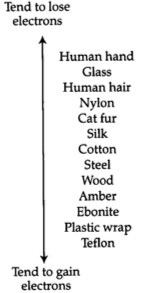
(i) Materials in the upper position have ________ tendency to become positively charged
(a) no (b) medium (c) high (d) low
(ii) Name two materials which do not have a strong tendency to give up or accept electrons.
(a) Steel, wood (b) Plastic wrap, Teflon (c) Ebonite, Nylon (d) Nylon, cat fur
(iii) if human hair is rubbed with amber, how those will be charged?
(a) Hair will be negatively charged, Amber will be positively charged.
(b) Both positive
(c) Hair will be positively charged, Amber will be negatively charged.
(d) Both negative
(iv) Triboelectric charging is the process of electron transfer between two objects
(a) By contact (b) Without contact (c) By anyone of these (d) By none of these
OR
The object which loses electron becomes ________ charged and the object gains electron becomes ________ charged.
(a) positively, positively
(b) negatively, positively
(c) negatively, negatively
(d) positively, negatively
In triboelectric series, materials are ranked from high to low in terms of the tendency for the material to lose electron. If an object high up on this list (Glass, for example) is rubbed with an object low down on the list (Teflon, for example), the glass will lose electrons to the teflon. The glass will, in this case, become positively charged and the teflon will become negatively charged. Materials in the middle of the list (steel and wood, for example) are items those do not have a strong tendency to give up or accept electrons.
(i) Materials in the upper position have ________ tendency to become positively charged
(a) no (b) medium (c) high (d) low
(ii) Name two materials which do not have a strong tendency to give up or accept electrons.
(a) Steel, wood (b) Plastic wrap, Teflon (c) Ebonite, Nylon (d) Nylon, cat fur
(iii) if human hair is rubbed with amber, how those will be charged?
(a) Hair will be negatively charged, Amber will be positively charged.
(b) Both positive
(c) Hair will be positively charged, Amber will be negatively charged.
(d) Both negative
(iv) Triboelectric charging is the process of electron transfer between two objects
(a) By contact (b) Without contact (c) By anyone of these (d) By none of these
OR
The object which loses electron becomes ________ charged and the object gains electron becomes ________ charged.
(a) positively, positively
(b) negatively, positively
(c) negatively, negatively
(d) positively, negatively
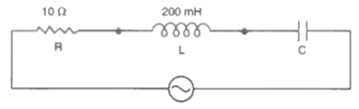
In the following circuit, calculate:
$i$. the capacitance of the capacitor, if the power factor of the circuit is unity,
$ii$. the $Q-$ factor of this circuit. What is the significance of the $Q-$ factor in ac circuit? Given the angular frequency of the ac source to be $100 \text{ rad/s}.$ Calculate the average power dissipated in the circuit.
View full solution →$i$. the capacitance of the capacitor, if the power factor of the circuit is unity,
$ii$. the $Q-$ factor of this circuit. What is the significance of the $Q-$ factor in ac circuit? Given the angular frequency of the ac source to be $100 \text{ rad/s}.$ Calculate the average power dissipated in the circuit.
$i$. Prove that an ideal capacitor in an ac circuit does not dissipate power.
$ii$. An inductor of $200 mH,$ a capacitor of $400 \mu f$, and a resistor of $10 \Omega$ are connected in series to ac source of $50 V$ of variable frequency. Calculate the
$a$. the angular frequency at which maximum power dissipation occurs in the circuit and the corresponding value of the effective current and
$b$. value of $Q-$ factor in the circuit.
View full solution →$ii$. An inductor of $200 mH,$ a capacitor of $400 \mu f$, and a resistor of $10 \Omega$ are connected in series to ac source of $50 V$ of variable frequency. Calculate the
$a$. the angular frequency at which maximum power dissipation occurs in the circuit and the corresponding value of the effective current and
$b$. value of $Q-$ factor in the circuit.
Derive an expression for the electric potential at a point due to an electric dipole. Mention the contrasting features of electric potential of a dipole at a point as compared to that due to a single charge.
A parallel plate capacitor is charged by a battery. After some time the battery is disconnected and a dielectric slab with its thickness equal to the plate separation is inserted between the plates. What change, in any will take place in
i. charge on the plates
ii. electric field intensity between the plates
iii. the capacitance of the capacitor,
iv. a potential difference between the plates and
v. the energy stored in the capacitor? Justify your answer in each case. OR
i. charge on the plates
ii. electric field intensity between the plates
iii. the capacitance of the capacitor,
iv. a potential difference between the plates and
v. the energy stored in the capacitor? Justify your answer in each case. OR
When a parallel beam of a monochromatic source of light of wavelength $\lambda$ is incident on a single slit of width a, show how the diffraction pattern is formed at the screen by the interference of the wavelets from the slit. Show that, besides the central maxima $\theta=0$, secondary maxima are observed at $\theta=\left(n+\frac{1}{2}\right) \frac{\lambda}{a}$ and the minima at $\theta=\frac{n \lambda}{a}$. Why do secondary maxima get weaker in intensity with increasing n?
View full solution →Generate a MODEL PAPER 1 paper free
Pick question groups from the list above, set marks and difficulty, and export a branded PDF with step-by-step answer keys. First 3 chapters free — no signup.