Questions

4 Marks Questions

Take a timed test

2 questions · self-marked practice — reveal the answer and mark yourself.

Question 14 Marks
Photoelectric effect
It is the phenomenon of emission of electrons from a metallic surface when light of a suitable frequency is incident on it. The emitted electrons are called photoelectrons.
Nearly all metals exhibit this effect with ultraviolet light but alkali metals like lithium, sodium, potassium, cesium etc. show this effect even with visible light. It is an instantaneous process i.e. photoelectrons are emitted as soon as the light is incident on the metal surface. The number of photoelectrons emitted per second is directly proportional to the intensity of the incident radiation.
The maximum kinetic energy of the photoelectrons emitted from a given metal surface is independent of the intensity of the incident light and depends only on the frequency of the incident light. For a given metal surface there is a certain minimum value of the frequency of the incident light below which emission of photoelectrons does not occur. 
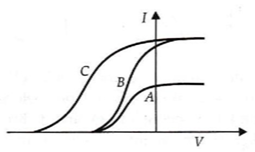
(I) In a photoelectric experiment plate current is plotted against anode potential.


Image

(A) A and B will have same intensities while B and C will have different frequencies.
(B) B and C will have different intensities while A and B will have different frequencies.
(C) A and B will have different intensities while B and C will have equal frequencies.
(D) B and C will have equal intensities while A and B will have same frequencies

(II) Photoelectrons are emitted when a zinc plate is
(A) Heated (B) hammered (C) Irradiated by ultraviolet light (D) subjected to a high pressure

(III) The threshold frequency for photoelectric effect on sodium corresponds to a wavelength of 500 nm. Its work function is about
(A) $4 \times 10^{-19} J$ (B) $2 \times 10^{-19} J$ (D) $3 \times 10^{-19} J$

(IV) The maximum kinetic energy of photoelectrons emitted from a surface when photons of energy 6 eV fall on it is 4 eV. The stopping potential is
(A) 2 V (B) 4 V (C) 6 V (D) 10 V

OR

The minimum energy required to remove an electron from a substance is called its
(A) work function (B) kinetic energy (C) stopping potential (D) potential energy
Answer
I (D) II (C) III (A) IV (B)

OR

IV (A)
View full question & answer
Question 24 Marks
Motion of Charge in Magnetic Field
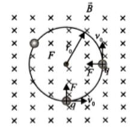
An electron with speed $V_0$ << c moves in a circle of radius $r _{\circ}$ in a uniform magnetic field. This electron is able to traverse a circular path as the magnetic force acting on the electron is perpendicular to both $V_0$ and B ,as shown in the figure. This force continuously deflects the particle sideways without changing its speed and the particle will move along a circle perpendicular to the field. The time required for one revolution of the electron is $T _{ o }$.

Image

(i) If the speed of the electron is now doubled to 2vo. The radius of the circle will change to
(A) $4 r_0$ (B) $2 r_0$ (C) $r _{ o }$ (D) $r _0 / 2$

(ii) If v = 2vo, then the time required for one revolution of the electron (To ) will change to
(A) $4 T_0$ (B) $2 T_{ O }$ (C) $T _{ o }$ (D) $T _{ d } / 2$
(iii) A charged particles is projected in a magnetic field . The acceleration of the particle is found to be. Find the value of x.
(A) $4 ms^{-2}$ (B) $-4 ms^{-2}$ (C) $-2 ms^{-2}$ (D) $2 ms^{-2}$

(iv) If the given electron has a velocity not perpendicular to B, then trajectory of the electron is
(A) straight line (B) circular (C) helical (D) zig-zag

OR

If this electron of charge (e) is moving parallel to uniform magnetic field with constant velocity v, the force acting on the electron is
(A) Bev (B) Be/v (C) B/ev (D) Zero
Answer
I (A) II (C) III (D) IV (C)

OR

IV (B)
View full question & answer