Question types

MODEL PAPER 2025 question types

38 questions across 6 question groups — pick any mix to generate a Physics paper with step-by-step answer keys.

38
Questions
6
Question groups
5
Question types
Sample Questions

MODEL PAPER 2025 questions

One sample from each question group in this chapter. Select any group above to see the full set with answer keys.

A long straight wire of circular cross section of radius'a carries a steady current $1.$ The current is uniformly distributed across its cross section. The ratio of magnitudes of the magnetic field at a point $a/2$ above the surface of wire to that of a point a $2$ below its surface is
View full solution
A conducting wire connects two charged conducting spheres such that they attain equilibrium with respect to each other. The distance of separation between the two spheres is very large as compared to either of their radii.
The ratio of the magnitudes of the electric fields at the surfaces of the two spheres is
View full solution
A uniform electric field pointing in positive X-direction exists in a region. Let A be the origin, B be the point on the X-axis at x = +1 cm and C be the point on the Y-axis at y 1 cm. Then the potential at points A, B and C satisfy
View full solution
Assertion (A): On increasing the current sensitivity of a galvanometer by increasing the number of turns may not necessarily increase its voltage sensitivity.
Reason(R): The resistance of the coil of the galvanometer increases on increasing the number of turns.
View full solution
Assertion (A): In a hydrogen atom there is only one electron but its emission spectrum shows many lines.
Reason(R): In a given sample of hydrogen there are many atoms each containing one electron; hence many electrons in different atoms may be in different orbits so many transitions from higher to lower orbits are possible.
View full solution
A beam of light consisting of two wavelengths $, 4000 \mathring A$ and $6000 \mathring A ,$ is used to obtain interference fringes in a Young’s double $-$ slit experiment. What is the least distance from the central maximum where the dark fringe is obtained?
View full solution
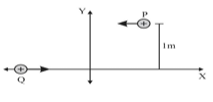
$P$ and $Q$ are two identical charged particles each of mass $4 \times 10^{-26} \ kg$ and charge $4.8 \times 10^{-19} C$, each moving with the same speed of $2.4 \times 10^5 m / s$ as shown in the figure. The two particles are equidistant $(0.5 m)$ from the vertical $Y -$ axis. At some instant, a magnetic field $B$ is switched on so that the two particles undergo head $-$ on collision.

Image
Find $–$
$(I)$ the direction of the magnetic field and
$(II)$ the magnitude of the magnetic field applied in the region.
View full solution
In Young’s double $-$ slit experiment using monochromatic light of wavelength $\lambda, $ the intensities of two sources is $I.$  What is the intensity of light at a point where path difference between wave front is $\lambda / 4$ ?
View full solution
What should be the radius ‘r’ of nearest possible orbits of satellite of mass ‘m’ revolving around the planet of mass ‘M’ as per Bohr Postulates in terms of m, M, G, h where G is Gravitational constant and h is plank’s constant.
View full solution
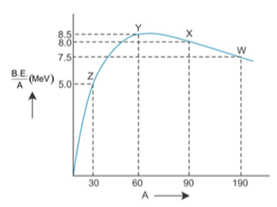
Binding energy per nucleon vs mass number curve for nuclei is shown in the figure. W, X, Y and Z are four nuclei indicated on the curve. Identify which of the following nuclei is most likely to undergo
(i) Nuclear Fission
(ii) Nuclear Fusion.
Justify your answer.

Image
View full solution
Q 153 Marks Question3 Marks
(I) Draw the energy band diagram for P-type semiconductor at (i) T=0K and (ii) room temperature.
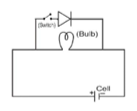
(II) In the given diagram considering an ideal diode, in which condition will the bulb glow
(a) when the switch is open
(b) when the switch is closed
Justify your answer.

Image
View full solution
Q 163 Marks Question3 Marks
Find the expression for the capacitance of a parallel plate capacitor of plate area $A$ and plate separation $d$ when $(I)$ a dielectric slab of thickness $t$ and $(II)$ a metallic slab of thickness $t,$ where $(t < d)$ are introduced one by one between the plates of the capacitor. In which case would the capacitance be more and why?
View full solution
Q 173 Marks Question3 Marks
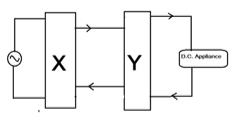
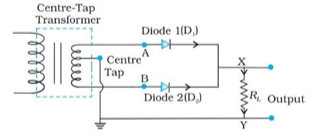
(I) Identify the circuit elements X and Y as shown in the given block diagram and draw the output waveforms of X and Y.

Image

(II) If the centre tapping is shifted towards Diode D1 as shown in the diagram, draw the output waveform of the given circuit.

Image
View full solution
Q 183 Marks Question3 Marks
$(II) (a)$ Define electric flux and write its $SI$ unit.
$(b)$ Use Gauss᾿s law to obtain the expression for the electric field due to a uniformly charged infinite plane sheet of charge.
View full solution
Q 193 Marks Question3 Marks
State Gauss᾿s theorem in electrostatics. Using this theorem, derive an expression for the electric field due to an infinitely long straight wire of linear charge density $\lambda$.
View full solution
Photoelectric effect
It is the phenomenon of emission of electrons from a metallic surface when light of a suitable frequency is incident on it. The emitted electrons are called photoelectrons.
Nearly all metals exhibit this effect with ultraviolet light but alkali metals like lithium, sodium, potassium, cesium etc. show this effect even with visible light. It is an instantaneous process i.e. photoelectrons are emitted as soon as the light is incident on the metal surface. The number of photoelectrons emitted per second is directly proportional to the intensity of the incident radiation.
The maximum kinetic energy of the photoelectrons emitted from a given metal surface is independent of the intensity of the incident light and depends only on the frequency of the incident light. For a given metal surface there is a certain minimum value of the frequency of the incident light below which emission of photoelectrons does not occur. 
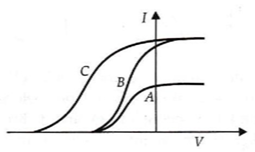
(I) In a photoelectric experiment plate current is plotted against anode potential.


Image

(A) A and B will have same intensities while B and C will have different frequencies.
(B) B and C will have different intensities while A and B will have different frequencies.
(C) A and B will have different intensities while B and C will have equal frequencies.
(D) B and C will have equal intensities while A and B will have same frequencies

(II) Photoelectrons are emitted when a zinc plate is
(A) Heated (B) hammered (C) Irradiated by ultraviolet light (D) subjected to a high pressure

(III) The threshold frequency for photoelectric effect on sodium corresponds to a wavelength of 500 nm. Its work function is about
(A) $4 \times 10^{-19} J$ (B) $2 \times 10^{-19} J$ (D) $3 \times 10^{-19} J$

(IV) The maximum kinetic energy of photoelectrons emitted from a surface when photons of energy 6 eV fall on it is 4 eV. The stopping potential is
(A) 2 V (B) 4 V (C) 6 V (D) 10 V

OR

The minimum energy required to remove an electron from a substance is called its
(A) work function (B) kinetic energy (C) stopping potential (D) potential energy
View full solution
Motion of Charge in Magnetic Field
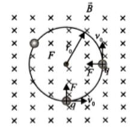
An electron with speed $V_0$ << c moves in a circle of radius $r _{\circ}$ in a uniform magnetic field. This electron is able to traverse a circular path as the magnetic force acting on the electron is perpendicular to both $V_0$ and B ,as shown in the figure. This force continuously deflects the particle sideways without changing its speed and the particle will move along a circle perpendicular to the field. The time required for one revolution of the electron is $T _{ o }$.

Image

(i) If the speed of the electron is now doubled to 2vo. The radius of the circle will change to
(A) $4 r_0$ (B) $2 r_0$ (C) $r _{ o }$ (D) $r _0 / 2$

(ii) If v = 2vo, then the time required for one revolution of the electron (To ) will change to
(A) $4 T_0$ (B) $2 T_{ O }$ (C) $T _{ o }$ (D) $T _{ d } / 2$
(iii) A charged particles is projected in a magnetic field . The acceleration of the particle is found to be. Find the value of x.
(A) $4 ms^{-2}$ (B) $-4 ms^{-2}$ (C) $-2 ms^{-2}$ (D) $2 ms^{-2}$

(iv) If the given electron has a velocity not perpendicular to B, then trajectory of the electron is
(A) straight line (B) circular (C) helical (D) zig-zag

OR

If this electron of charge (e) is moving parallel to uniform magnetic field with constant velocity v, the force acting on the electron is
(A) Bev (B) Be/v (C) B/ev (D) Zero
View full solution
(I) (a) Write two limitations of ohm’s law. Plot their I-V characteristics.
(b) A heating element connected across a battery of 100 V having an internal resistance of $1 \Omega$ draws an initial current of 10 A at room temperature 20.0 °C which settles after a few seconds to a steady value. What is the power consumed by battery itself after the steady temperature of 320.0 °C is attained? Temperature coefficient of resistance averaged over the temperature range involved is $3.70 \times 10^{-4}{ }^{\circ} C ^{-1}$.
View full solution
$(II) $ A compound microscope consists of an objective lens of focal length $2.0 \ cm$ and an eyepiece of focal length $6.25 \ cm$ separated by a distance of $15 \ cm$. How far from the objective should an object be placed in order to obtain the final image at
$(a)$ the least distance of distinct vision $(25 \ cm)$ and
$(b)$ infinity? What is the magnifying power of the microscope in each case?
View full solution
$(I) (a)$ A giant refracting telescope at an observatory has an objective lens of focal length $15 m$. If an eyepiece of focal length $1.0 \ cm$ is used, what is angular magnification of the telescope in normal adjustment?
$(b)$ If this telescope is used to view the moon, what is the diameter of the image of the moon formed by the objective lens? The diameter of the moon is $3.48 \times 10^6 m$ and the radius of lunar orbit is $3.8 \times 10^8 m$.
View full solution
(II) (a) With the help of a diagram, explain the principle of a device which changes a low ac voltage into a high voltage . Deduce the expression for the ratio of secondary voltage to the primary voltage in terms of the ratio of the number of turns of primary and secondary winding. For an ideal transformer, obtain the ratio of primary and secondary currents in terms of the ratio of the voltages in the secondary and primary coils.
(b) Write any two sources of the energy losses which occur in actual transformers.
(c) A step-up transformer converts a low input voltage into a high output voltage. Does it violate law of conservation of energy? Explain.
View full solution
$(I)$ Explain briefly, with the help of a labelled diagram, the basic principle of the working of an $a.c.$ generator. In an a.c. generator, coil of $N$ turns and area $A$ is rotated at an angular velocity $ω$ in a uniform magnetic field $B$. Derive an expression for the instantaneous value of the emf induced in coil. What is the source of energy generation in this device?
View full solution

Generate a MODEL PAPER 2025 paper free

Pick question groups from the list above, set marks and difficulty, and export a branded PDF with step-by-step answer keys. First 3 chapters free — no signup.

Download App