Question 14 Marks
In $1909,$ Robert Millikan was the first to find the charge of an electron in his now $-$ famous oil-drop experiment. In that experiment, tiny oil drops were sprayed into a uniform electric field between a horizontal pair of oppositely charged plates. The drops were observed with a magnifying eyepiece, and the electric field was adjusted so that the upward force on some negatively charged oil drops was just sufficient to balance the downward force of gravity. That is, when suspended, upward force $qE$ just equaled $Mg$. Millikan accurately measured the charges on many oil drops and found the values to be whole number multiples of $1.6 \times 10^{-19} C$ the charge of the electron. For this, he won the Nobel prize.
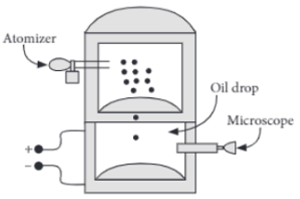
$(i) $If a drop of mass $1.08 \times 10^{-14} kg$ remains stationary in an electric field of $1.68 \times 10^5 NC ^{-1}$, then the charge of this drop is
$(i) $If a drop of mass $1.08 \times 10^{-14} kg$ remains stationary in an electric field of $1.68 \times 10^5 NC ^{-1}$, then the charge of this drop is
- $(a)\ 6.40 \times 10^{-19} C$
- $(b)\ 4.8 \times 10^{-19} C$
- $(c)\ 3.2 \times 10^{-19} C$
- $(d)\ 1.6 \times 10^{-19} C$
- $(a)\ 4 $
- $(b)\ 5$
- $(c)\ 8$
- $(d) \ 3$
$(iii)$ A negatively charged oil drop is prevented from falling under gravity by applying a vertical electric field $100 V m ^{-1}$. If the mass of the drop is $1.6 \times 10^{-3} g$, the number of electrons carried by the drop is $( g =10$ $\left.ms ^{-2}\right)$
- $(a)\ 10^9$
- $(b)\ 10^{18}$
- $(c)\ 10^{12}$
- $(d)\ 10^{15}$
$(iv)$ The important conclusion given by Millikan's experiment about the charge is
- $(a)$ charge has no definite value
- $(b)$ charge is quantized
- $(c)$ charge is never quantized
- $(d)$ charge on oil drop always increases
OR
If in Millikan's oil drop experiment, charges on drops are found to be $8 \mu C , 12 \mu C , 20 \mu C$, then quanta charge is
$(a)\ 20 \mu C$
$(b)\ 12 \mu C$
$(c)\ 8 \mu C$
$(d)\ 4 \mu C$
If in Millikan's oil drop experiment, charges on drops are found to be $8 \mu C , 12 \mu C , 20 \mu C$, then quanta charge is
$(a)\ 20 \mu C$
$(b)\ 12 \mu C$
$(c)\ 8 \mu C$
$(d)\ 4 \mu C$
Answer
View full question & answer→In $1909,$ Robert Millikan was the first to find the charge of an electron in his now $-$ famous oil-drop experiment. In that experiment, tiny oil drops were sprayed into a uniform electric field between a horizontal pair of oppositely charged plates.
The drops were observed with a magnifying eyepiece, and the electric field was adjusted so that the upward force on some negatively charged oil drops was just sufficient to balance the downward force of gravity.
That is, when suspended, upward force $qE$ just equaled $Mg$.
Millikan accurately measured the charges on many oil drops and found the values to be whole number multiples of $1.6 \times 10^{-19} C$ the charge of the electron.
For this, he won the Nobel prize.
$(i) (a) \ 6.40 \times 10^{-19} C$
Explanation: As, $qE = mg \Rightarrow q =\frac{1.08 \times 10^{-14} \times 2.8}{1.68 \times 10^5}=6.4 \times 10^{-19} C$
$(ii) (a) 4$
Explanation: $q = ne$ or $\Rightarrow n =\frac{6.4 \times 10^{-19}}{1.5 \times 10^{-19}}=4$
$(iii) (c) \ 10^{12}$
Explanation: For the drop to be stationary,
Force on the drop due to electric field $=$ Weight of the drop
$ qE = mg$
$q =\frac{ mg }{E}=\frac{1.5 \times 10^{-6} \times 10}{100}=1.6 \times 10^{-7} C $
Number of electrons carried by the drop is
$n =\frac{q}{e}=\frac{1.6 \times 10^{-7} C }{1.6 \times 10^{-19} C }=10^{12}$
$(iv) (b)$ charge is quantized
Explanation: charge is quantized
OR
$(d) \ 4 \mu C$
Explanation: Millikan's experiment confirmed that the charges are quantized,
i.e., charges are small integer multiples of the base value which is charge on electron.
The charges on the drops are found to be multiple of $4$.
Hence, the quanta of charge is $4 \mu C$.
The drops were observed with a magnifying eyepiece, and the electric field was adjusted so that the upward force on some negatively charged oil drops was just sufficient to balance the downward force of gravity.
That is, when suspended, upward force $qE$ just equaled $Mg$.
Millikan accurately measured the charges on many oil drops and found the values to be whole number multiples of $1.6 \times 10^{-19} C$ the charge of the electron.
For this, he won the Nobel prize.
$(i) (a) \ 6.40 \times 10^{-19} C$
Explanation: As, $qE = mg \Rightarrow q =\frac{1.08 \times 10^{-14} \times 2.8}{1.68 \times 10^5}=6.4 \times 10^{-19} C$
$(ii) (a) 4$
Explanation: $q = ne$ or $\Rightarrow n =\frac{6.4 \times 10^{-19}}{1.5 \times 10^{-19}}=4$
$(iii) (c) \ 10^{12}$
Explanation: For the drop to be stationary,
Force on the drop due to electric field $=$ Weight of the drop
$ qE = mg$
$q =\frac{ mg }{E}=\frac{1.5 \times 10^{-6} \times 10}{100}=1.6 \times 10^{-7} C $
Number of electrons carried by the drop is
$n =\frac{q}{e}=\frac{1.6 \times 10^{-7} C }{1.6 \times 10^{-19} C }=10^{12}$
$(iv) (b)$ charge is quantized
Explanation: charge is quantized
OR
$(d) \ 4 \mu C$
Explanation: Millikan's experiment confirmed that the charges are quantized,
i.e., charges are small integer multiples of the base value which is charge on electron.
The charges on the drops are found to be multiple of $4$.
Hence, the quanta of charge is $4 \mu C$.