An astronomical telescope of ten fold angular magnification has a length of 44 cm. The focal length of the objective is
Question types
MODEL PAPER 2 question types
38 questions across 6 question groups — pick any mix to generate a Physics paper with step-by-step answer keys.
38
Questions
6
Question groups
5
Question types
01
M.C.Q (1 Marks)
12 Q→02Assertion (A) & Reason (B) MCQ
4 Q→032 Marks Questions
6 Q→043 Marks Question
8 Q→054 Marks Questions
2 Q→065 Marks Questions
6 Q→Sample Questions
MODEL PAPER 2 questions
One sample from each question group in this chapter. Select any group above to see the full set with answer keys.
View full solution →
According to Joule's law, if potential difference across a conductor of material of resistivity remains constant, then heat produced in the conductor is directly proportional to
Which of the following principle is used in optical fibre?
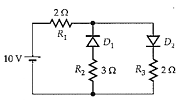
The given circuit has two ideal diodes connected as shown in the figure below. The current flowing through the resistance $R _1$ will be
View full solution →Point charges $+4 q,-q$ and $+4 q$ are kept on the $X$-axis at points $x=0, x=a$ and $x=2$ a respectively:
View full solution →Assertion (A): If a proton and electron are moving with same velocity, then wavelength of de-Broglie wave associated with electron is longer than that associated with proton.
Reason (R): The wavelength of de-Broglie wave associated with a moving particle is inversely proportional to its mass.
Reason (R): The wavelength of de-Broglie wave associated with a moving particle is inversely proportional to its mass.
Assertion: A parallel plate capacitor is connected across battery through a key. A dielectric slab of dielectric constant K is introduced between the plates. The energy which is stored becomes K times.
Reason(R): The surface density of charge on the plate remains constant or unchanged.
Reason(R): The surface density of charge on the plate remains constant or unchanged.
Assertion (A): A bulb connected in series with a solenoid is connected to ac source. If a soft iron core is introduced in the solenoid, the bulb will glow brighter.
Reason (R): On introducing soft iron core in the solenoid, the inductance increases.
Reason (R): On introducing soft iron core in the solenoid, the inductance increases.
Assertion (A): In Young's double slit experiment the fringes become indistinct if one of the slits is covered with cellophane paper.
Reason (R): The cellophane paper decreases the wavelength of light.
Reason (R): The cellophane paper decreases the wavelength of light.
$a$. State Ampere's circuital law connecting the line integral of $B$ over a closed path to the net current crossing the area bounded by the path.
$b$. Use Ampere's law to derive the formula for the magnetic field due to an infinitely long straight current carrying wire.
$c$. Explain carefully why the derivation as in $(b)$ is not valid for magnetic field in a plane normal to a currentcarrying straight wire of finite length and passing through the midpoint of the axis.
View full solution →$b$. Use Ampere's law to derive the formula for the magnetic field due to an infinitely long straight current carrying wire.
$c$. Explain carefully why the derivation as in $(b)$ is not valid for magnetic field in a plane normal to a currentcarrying straight wire of finite length and passing through the midpoint of the axis.
Write the shortcomings of Rutherford atomic model. Explain how these were overcome by the postulates of Bohr's atomic model.
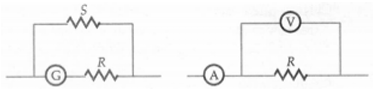
A galvanometer has a resistance of $8 \Omega$ . It gives a full scale deflection for a current of $10 mA$. It is to be converted into an ammeter of range $5 A$. The only shunt resistance available is of $0.02 \Omega$ , which is not suitable for this conversion. Find the value of resistance $R$ that must be connected in series with the galvanometer $($Fig.$)$ to get ammeter of desired range.
View full solution →Explain the formation of the barrier potential in a p-n junction.
The coercivity of a certain permanent magnet is $4.0 \times 10^4 Am ^{-1}$. This magnet is placed inside a solenoid 15 cm long and having 600 turns and a current is passed in the solenoid to demangnetise it completely. Find the current.
View full solution →$i.$ Define the term self-inductance and write its $S.I$. unit.
$ii$. Obtain the expression for the mutual inductance of two long co $-$ axial solenoids $S_1$ and $S_2$ wound one over the other, each of length $L$ and radii $r_1$ and $r_2$ and $n_1$ and $n_2$ number of turns per unit length, when a current $I$ is set up in the outer solenoid $S _2$.
View full solution →$ii$. Obtain the expression for the mutual inductance of two long co $-$ axial solenoids $S_1$ and $S_2$ wound one over the other, each of length $L$ and radii $r_1$ and $r_2$ and $n_1$ and $n_2$ number of turns per unit length, when a current $I$ is set up in the outer solenoid $S _2$.
i. Will the earth's magnetic field induce current in an artificial satellite with a metal surface that is in orbit around the equator? Around the poles?
ii. If so how would these currents affect the motion of the satellite?
ii. If so how would these currents affect the motion of the satellite?
In a diffraction pattern due to a single slit, how will the angular width of central maximum change, if
a. Orange light is used in place of green light,
b. the screen is moved closer to the slit,
c. the slit width is decreased?
Justify your answer in each case.
a. Orange light is used in place of green light,
b. the screen is moved closer to the slit,
c. the slit width is decreased?
Justify your answer in each case.
$i$. Using Bohr's second postulate of quantisation of orbital angular momentum show that the circumference of the electron in the nth orbital state in hydrogen atom is $n-$ times the de $-$ Broglie wavelength associated with it.
$ii.$ The electron in hydrogen atom is initially in the third excited state. What is the maximum number of spectral lines which can be emitted when it finally moves to the ground state?
View full solution →$ii.$ The electron in hydrogen atom is initially in the third excited state. What is the maximum number of spectral lines which can be emitted when it finally moves to the ground state?
Draw a graph showing the variation of binding energy per nucleon with mass number of different nuclei. Write any two salient features of the curve. How does this curve explain the release of energy both in the processes of nuclear fission and fusion?
In $1909,$ Robert Millikan was the first to find the charge of an electron in his now $-$ famous oil-drop experiment. In that experiment, tiny oil drops were sprayed into a uniform electric field between a horizontal pair of oppositely charged plates. The drops were observed with a magnifying eyepiece, and the electric field was adjusted so that the upward force on some negatively charged oil drops was just sufficient to balance the downward force of gravity. That is, when suspended, upward force $qE$ just equaled $Mg$. Millikan accurately measured the charges on many oil drops and found the values to be whole number multiples of $1.6 \times 10^{-19} C$ the charge of the electron. For this, he won the Nobel prize.
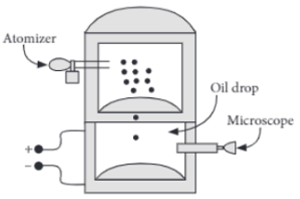
$(i) $If a drop of mass $1.08 \times 10^{-14} kg$ remains stationary in an electric field of $1.68 \times 10^5 NC ^{-1}$, then the charge of this drop is
View full solution →$(i) $If a drop of mass $1.08 \times 10^{-14} kg$ remains stationary in an electric field of $1.68 \times 10^5 NC ^{-1}$, then the charge of this drop is
- $(a)\ 6.40 \times 10^{-19} C$
- $(b)\ 4.8 \times 10^{-19} C$
- $(c)\ 3.2 \times 10^{-19} C$
- $(d)\ 1.6 \times 10^{-19} C$
- $(a)\ 4 $
- $(b)\ 5$
- $(c)\ 8$
- $(d) \ 3$
$(iii)$ A negatively charged oil drop is prevented from falling under gravity by applying a vertical electric field $100 V m ^{-1}$. If the mass of the drop is $1.6 \times 10^{-3} g$, the number of electrons carried by the drop is $( g =10$ $\left.ms ^{-2}\right)$
- $(a)\ 10^9$
- $(b)\ 10^{18}$
- $(c)\ 10^{12}$
- $(d)\ 10^{15}$
$(iv)$ The important conclusion given by Millikan's experiment about the charge is
- $(a)$ charge has no definite value
- $(b)$ charge is quantized
- $(c)$ charge is never quantized
- $(d)$ charge on oil drop always increases
OR
If in Millikan's oil drop experiment, charges on drops are found to be $8 \mu C , 12 \mu C , 20 \mu C$, then quanta charge is
$(a)\ 20 \mu C$
$(b)\ 12 \mu C$
$(c)\ 8 \mu C$
$(d)\ 4 \mu C$
If in Millikan's oil drop experiment, charges on drops are found to be $8 \mu C , 12 \mu C , 20 \mu C$, then quanta charge is
$(a)\ 20 \mu C$
$(b)\ 12 \mu C$
$(c)\ 8 \mu C$
$(d)\ 4 \mu C$
LASER: Electromagnetic radiation is a natural phenomenon found in almost all areas of daily life, from radio waves to sunlight to x-rays. Laser radiation - like all light - is also a form of electromagnetic radiation. Electromagnetic radiation that has a wavelength between 380 nm and 780 nm is visible to the human eye and is commonly referred to as light. At wavelengths longer than 780 nm, optical radiation is termed infrared (IR) and is invisible to the eye. At wavelengths shorter than 380 nm, optical radiation is termed ultraviolet (UV) and is also invisible to the eye. The term laser light refers to a much broader range of the electromagnetic spectrum that just the visible spectrum, anything between 150 nm up to 11000 nm (i.e., from the UV up to the far IR). The term laser is an acronym which stands for light amplification by stimulated emission of radiation. Einstein explained the stimulated emission. In an atom, electron may move to higher energy level by absorbing a photon. When the electron comes back to the lower energy level it releases the same photon. This is called spontaneous emission. This may also so happen that the excited electron absorbs another photon, releases two photons and returns to the lower energy state. This is known as stimulated emission.
Laser emission is therefore a light emission whose energy is used, in lithotripsy, for targeting and ablating the tone inside human body organ.
Apart from medical usage, laser is used for optical disk drive, printer, barcode reader etc.
(i) What is the full form of LASER?
(a) light amplification by simultaneous emission of radiation
(b) light amplified by synchronous emission of radiation
(c) light amplified by stimulated emission of radiation
(d) light amplification by stimulated emission of radiation
(ii) The stimulated emission is the process of
(a) absorption of two photon when electron moves from lower to higher energy level
(b) release of two photons by absorbing one photon when electron comes back from higher to lower energy level
(c) release of a photon when electron comes back from higher to lower energy level
(d) absorption of a photon when electron moves from lower to higher energy level
(iii) What is the range of amplitude of LASER?
(a) 150 nm - 400 nm
(b) 700 nm - 11000 nm
(c) Both 150 nm - 400 nm and 700 nm 11000 nm
(d) 800 nm - 12000 nm
OR
LASER is used in
(a) Ionization
(b) Transmitting Satellite signal
(c) Optical disk drive
(d) Radio communication
(iv) Lithotripsy is
(a) Laboratory application
(b) An industrial application
(c) A medical application
(d) Process control application
Laser emission is therefore a light emission whose energy is used, in lithotripsy, for targeting and ablating the tone inside human body organ.
Apart from medical usage, laser is used for optical disk drive, printer, barcode reader etc.
(i) What is the full form of LASER?
(a) light amplification by simultaneous emission of radiation
(b) light amplified by synchronous emission of radiation
(c) light amplified by stimulated emission of radiation
(d) light amplification by stimulated emission of radiation
(ii) The stimulated emission is the process of
(a) absorption of two photon when electron moves from lower to higher energy level
(b) release of two photons by absorbing one photon when electron comes back from higher to lower energy level
(c) release of a photon when electron comes back from higher to lower energy level
(d) absorption of a photon when electron moves from lower to higher energy level
(iii) What is the range of amplitude of LASER?
(a) 150 nm - 400 nm
(b) 700 nm - 11000 nm
(c) Both 150 nm - 400 nm and 700 nm 11000 nm
(d) 800 nm - 12000 nm
OR
LASER is used in
(a) Ionization
(b) Transmitting Satellite signal
(c) Optical disk drive
(d) Radio communication
(iv) Lithotripsy is
(a) Laboratory application
(b) An industrial application
(c) A medical application
(d) Process control application
$a$. Derive an expression for the energy stored in a parallel plate capacitor of capacitance $C$ when charged up to voltage $V$. How is this energy stored in the capacitor?
$b.$ A capacitor of capacitance $1 \mu F$ is charged by connecting a battery of negligible internal resistance and emf $10 V$ across it. Calculate the amount of charge supplied by the battery in charging the capacitor fully.
View full solution →$b.$ A capacitor of capacitance $1 \mu F$ is charged by connecting a battery of negligible internal resistance and emf $10 V$ across it. Calculate the amount of charge supplied by the battery in charging the capacitor fully.
A circuit containing a $80\ mH$ inductor and a $60 \mu\ F$ capacitor in series is connected to a $230\ V, 50 \ Hz$ supply. The resistance of the circuit is negligible.
$a.$ Obtain the current amplitude and rms values.
$b.$ Obtain the rms values of potential drops across each element.
$c.$ What is the average power transferred to the inductor?
$d.$ What is the average power transferred to the capacitor?
$e.$ What is the total average power absorbed by the circuit? $[$‘Average’ implies ‘averaged over one cycle’.$]$
View full solution →$a.$ Obtain the current amplitude and rms values.
$b.$ Obtain the rms values of potential drops across each element.
$c.$ What is the average power transferred to the inductor?
$d.$ What is the average power transferred to the capacitor?
$e.$ What is the total average power absorbed by the circuit? $[$‘Average’ implies ‘averaged over one cycle’.$]$
An emf $\varepsilon=100 \sin 314 t$ is applied across a pure capacitor of $637\ \mu F$. Find
$i.$ the instantaneous current $I$
$ii.$ instantaneous power $P$
$ii.$ the frequency of power and
$iii.$ the frequency of power and
$iv.$ the maximum energy stored in the capacitor.
View full solution →$i.$ the instantaneous current $I$
$ii.$ instantaneous power $P$
$ii.$ the frequency of power and
$iii.$ the frequency of power and
$iv.$ the maximum energy stored in the capacitor.
Derive an expression for equivalent capacitance of three capacitors when connected
i. in series and
ii. in parallel.
i. in series and
ii. in parallel.
Give the shape of interference fringes observed
a. in a Young's double-slit experiment
b. in the air wedge experiment
c. in the Lloyd's mirror experiment
d. when a small lamp is placed before a thin mica sheet and light waves reflected from the front and back surfaces of the sheet combine to produce interference pattern on a screen behind the lamp. (Pohl's experiment)
e. from a thin air film formed by placing a convex lens on top of a flat glass plate (Newton's arrangement).
a. in a Young's double-slit experiment
b. in the air wedge experiment
c. in the Lloyd's mirror experiment
d. when a small lamp is placed before a thin mica sheet and light waves reflected from the front and back surfaces of the sheet combine to produce interference pattern on a screen behind the lamp. (Pohl's experiment)
e. from a thin air film formed by placing a convex lens on top of a flat glass plate (Newton's arrangement).
Generate a MODEL PAPER 2 paper free
Pick question groups from the list above, set marks and difficulty, and export a branded PDF with step-by-step answer keys. First 3 chapters free — no signup.