Questions

M.C.Q (1 Marks)

Take a timed test

12 questions · self-marked practice — reveal the answer and mark yourself.

Question 11 Mark
An astronomical telescope of ten fold angular magnification has a length of 44 cm. The focal length of the objective is
Answer
(d) 40cm
Explanation:
$
L=f_o+f_e=44 \text { and }|m|=\frac{f_o}{f_e}=10
$ This gives $f_o=40 cm$
View full question & answer
Question 21 Mark
According to Joule's law, if potential difference across a conductor of material of resistivity remains constant, then heat produced in the conductor is directly proportional to
Answer
(c) $\rho^{-1}$
Explanation: $\rho^{-1}$
View full question & answer
Question 31 Mark
Which of the following principle is used in optical fibre?
Answer
(a) Total internal reflection
Explanation: Total internal reflection principle is used in optical fibre.
View full question & answer
Question 41 Mark
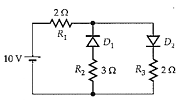
The given circuit has two ideal diodes connected as shown in the figure below. The current flowing through the resistance $R _1$ will be
Image
Answer
$(a) 2.5 A$
Explanation: $D_1$ is reverse biased and $D_2$ is forward biased. $D_1$ blocks current.
Hence, Current will flow through $10 V$ cell, $R _1, D _2$ and $R _3$.
$\therefore I =\frac{\varepsilon}{R_1+R_3}$
$=\frac{10 V}{(2+2) \Omega}$
$=2.5 A$
View full question & answer
Question 51 Mark
Point charges $+4 q,-q$ and $+4 q$ are kept on the $X$-axis at points $x=0, x=a$ and $x=2$ a respectively:
Answer
(a) all the charges are in unstable equilibrium
Explanation: The net force on each charge is zero. Therefore, all the charges are in equilibrium. If we slightly displace the charge -q to the right, the net force of attraction will further displace it to the right i.e., away from its mean positive. The equilibrium is, therefore, unstable.
View full question & answer
Question 61 Mark
Consider sunlight incident on a slit of width $10^4$ A. The image seen through the slit shall
Answer
(d) be a fine sharp slit white in colour at the center
Explanation: Width of slit $10^4 \stackrel{o}{A}=10,000 \stackrel{o}{A}$
Wavelength of visible light varies from 4000 to 8000$\stackrel{o}{A}$ . As the width of slit 10000 $\stackrel{o}{A}$ is comparable to that of wavelength of visible light i.e. 8000 $\stackrel{o}{A}$ . Hence the diffraction occurs with maxima at the centre. So at the centre all colours appear ,mixing of colors forms white colour at the centre.
View full question & answer
Question 71 Mark
The susceptibility of a paramagnetic material is $\chi$ at $27^{\circ} C$. At what temperature will its susceptibility be $\frac{\chi}{2}$ ?
Answer
(b) $327^{\circ} C$
Explanation: $\frac{\chi_2}{\chi_1}=\frac{T_2}{T_1}$
$T _2=\frac{\chi_1}{\chi_2} \cdot T_1=\frac{\chi}{\chi / 2}(273+27) K =600 K=327^{\circ} C$
View full question & answer
Question 81 Mark
Two coils have a mutual inductance $0.005 H$. The current changes in the first coil according to equation $I = I _0 \sin$
$\Omega t$, where $I _0=10 A$ and $\omega=100 \pi rad s ^{-1}$. The maximum value of emf in the second coil is
Answer
$(c)\ 5 \pi$
Explanation :
$\varepsilon=M \frac{d I}{d t}$
$=M \frac{d}{d t}\left[I_0 \sin \omega t\right]=M I_0 \omega \cos \omega t $
$ E _{\max }=M I_0 \omega[\text { Max. value of } \cos \omega t=1] $
$ =0.005 \times 10 \times 100 \pi=5 \pi V$
View full question & answer
Question 91 Mark
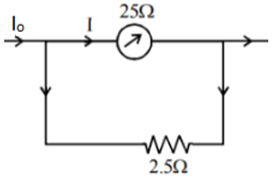
A galvanometer of resistance $25\Omega$ galvanometer is given by a $2.5\Omega$ wire. The part of total current $I _0$ that flows through the galvanometer is given by
Answer
$(c) \frac{I}{I_0}=\frac{1}{11}$
Explanation:
Image

$I=\frac{I_o \times 2.5}{(25+2.5)}$
$=I_o \times \frac{25}{275}$
$=\frac{1}{11} \times I_o$
$\Rightarrow \frac{ I }{ I _0}=\frac{1}{11}$
View full question & answer
Question 101 Mark
Time period of oscillation of a magnetic needle is
Answer
(d) $T=2 \pi \sqrt{\frac{I}{M B}}$
Explanation: Time period of oscillation of a magnetic needle is $T=2 \pi \sqrt{\frac{I}{M B}}$
View full question & answer
Question 111 Mark
C and Si both have the same lattice structure, having 4 bonding electrons in each. However, C is an insulator whereas Si is an intrinsic semiconductor. This is because
A. In case of C the valence band is not completely filled at absolute zero temperature.
B. In case of C the conduction band is partly filled even at absolute zero temperature.
C. The four bonding electrons in the case of C lie in the second orbit, whereas in the case of Si they lie in the third.
D. The four bonding electrons in the case of C lie in the third orbit, whereas for Si they lie in the fourth orbit.
Answer
(d) Option C
Explanation: ${ }^6 C : 1 s^2 2 s^2 2 p^2$
${ }^{14} Si : 1 s^2 2 s^2 2 p^6 3 s^2 3 p^2$
The energy required to take out an electron from the 3rd orbit of Si is much smaller than to take out an electron from the 2nd orbit of C. So, Si has a significant number of free electrons while C has a negligibly small number of free electrons.

View full question & answer
Question 121 Mark
The electrostatic force between the metal plates of an isolated parallel capacitor C having a charge Q and area A is:
Answer
(a) independent of the distance between the plates
Explanation: $F=Q E=Q \frac{\sigma}{2 \varepsilon_0}=Q \frac{Q}{2 A \varepsilon_0}=\frac{Q^2}{2 A \varepsilon_0}$
F is independent of the distance between the plates.
View full question & answer